
Category: Blog

Your blog category

  • What Size Water Tank Does A Family Of 4 Need?

    What Size Water Tank Does A Family Of 4 Need?

    A family of four needs a water tank sized between 2,000 and 5,000 litres (530–1,320 US gallons), depending on how reliable your supply is, how many days of backup you want, and your household’s actual consumption. The WHO baseline is 50 litres per person per day for basic needs; real household use in developed countries runs 100–200 litres per person per day. This article walks through the calculation, the variables that shift it, and the most common sizing mistakes so you can commit to a number with confidence.

    The quick answer

    At 50 L/person/day (WHO minimum), four people need 200 L/day. At 150 L/person/day (typical urban household), they need 600 L/day. The tank size you need depends on how many days of backup storage you require — a single-day buffer is useless if your supply cuts out for three days.

    Usage levelL/person/day1-day buffer3-day buffer
    Minimum (WHO)50200 L600 L
    Moderate100400 L1,200 L
    Typical urban150600 L1,800 L
    High-use household200800 L2,400 L

    Skip the math: Use the water tank size for home calculator to get a figure tailored to your household’s actual consumption and supply conditions.

    How the calculation works

    The formula is straightforward:

    Tank size (L) = persons × daily use (L/person/day) × backup days + safety buffer (10–15%)

    For a family of four at 150 L/person/day wanting three days of storage:

    4 × 150 × 3 = 1,800 L. Add a 10% safety buffer: 1,800 × 1.10 = 1,980 L. Round up to a standard 2,000 L tank.

    That 10% buffer matters. Tanks are measured at full capacity but operated below it — sediment accumulates at the bottom, and most tank gauges lose accuracy in the bottom 5–10% of the tank. You’ll also never get a delivery that tops it up to exactly zero headroom.

    Key variables that change the answer

    Supply reliability. If your mains supply fails daily for 4–6 hours (common in parts of South Asia and Sub-Saharan Africa), you need at minimum 1 day’s buffer. In areas with weekly or irregular supply, plan for 5–7 days of storage — that moves a family-of-four tank into the 4,000–7,000 L range.

    Climate and seasonal demand. Household water use rises 20–40% in hot months due to increased bathing, garden watering, and evaporative cooling. In hot climates, size the tank against peak-season demand, not the annual average.

    Household composition. A family of four with two teenagers uses significantly more than one with two young children. Teenagers average 20–30% higher water use than children under 10 (IWA household benchmarks).

    Appliance efficiency. Low-flow showerheads cut shower consumption from ~15 L/min to ~7 L/min. A household with water-efficient appliances throughout can drop daily per-person use from 150 L to 90–100 L — a meaningful difference when sizing for 5+ days of backup.

    Tank placement. Rooftop tanks are limited by structural load capacity. A 2,000 L tank full of water weighs roughly 2,100 kg including the tank shell. If your roof wasn’t engineered for that load, you’re constrained regardless of what the calculation says.

    Family of 4 sizing scenarios

    ScenarioDaily useBackup daysRecommended tank size
    Urban, reliable supply150 L/person1 day660 L (round to 1,000 L)
    Urban, intermittent supply150 L/person3 days2,000 L
    Rural, borehole or irregular tanker100 L/person7 days3,000–3,500 L
    Off-grid or emergency prep50–80 L/person14 days3,000–4,500 L

    Common mistakes

    Sizing for minimum rather than typical use. Many households size for the WHO’s 50 L/person/day because it looks conservative. That’s the survival minimum — drinking, cooking, basic sanitation. It excludes laundry, dishwashing, showers, and garden use. A family of four sized to 50 L/person will drain a 1,000 L tank in five days during normal operation, which is 2–3 days less than they expected.

    Ignoring the no-supply scenario duration. Buyers in areas with intermittent supply ask ‘how much for a family of four?’ without specifying backup days. A 1,000 L tank and a 5,000 L tank are both ‘for a family of four’ — the difference is whether you’re sizing for 1-day inconvenience or week-long outages. Know your worst-case supply gap before committing to a size.

    Forgetting structural limits before buying. A 3,000 L rooftop tank weighs over 3 tonnes when full. Residential rooftop slabs in many regions are designed for 150–200 kg/m². Placing an oversized tank on an inadequately reinforced roof causes structural damage over time — cracking, deflection, and in extreme cases, collapse. Check the load rating first.

    Not accounting for dead volume. The bottom 5–10% of a tank is typically unusable due to sediment accumulation. A nominally 2,000 L tank delivers closer to 1,800 L of usable water. Size up by at least 10% to account for this, which the safety buffer in the formula above captures — but only if you actually apply it.

    Related calculators you might need

    Once you have a tank size in mind, the next question is usually whether your roof can support it. Use the rooftop load bearing calculator to check your slab’s capacity before purchasing. If you’re on intermittent supply, the how long will my tank last calculator lets you enter your tank size and daily consumption to find out exactly how many days it covers. For daily use estimates you haven’t nailed down yet, the daily water requirement calculator walks through each household activity and totals it up. And if you’re also considering water treatment after storage, the chlorine dosage calculator gives you the correct disinfection amount based on your tank’s volume.

    Frequently asked questions

    What size water tank do I need for a family of 4?

    For a typical family of four using 150 L/person/day with three days of backup, you need approximately 2,000 litres (530 US gallons). If your supply is reliable and you only need one day’s buffer, 600–1,000 litres is sufficient. In areas with weekly supply interruptions, size up to 3,500–4,000 litres. Use the water tank size for home calculator to model your specific scenario.

    How many litres of water does a family of 4 use per day?

    In developed countries, the average is 100–200 litres per person per day, putting a family of four at 400–800 litres daily. In regions with limited infrastructure, usage drops to 50–80 litres per person. The WHO emergency minimum is 15 litres per person per day for survival. Actual household use varies significantly with appliance efficiency and lifestyle — teenagers and frequent bathers push that number toward the higher end.

    Is a 1,000-litre tank enough for a family of 4?

    Only if your mains supply is reliable and interruptions are rare. At 150 L/person/day, a family of four drains 600 litres daily — a 1,000 L tank gives you fewer than two days of backup. For areas with regular outages, 1,000 litres is undersized. If supply is consistent and the tank is just a pressure buffer, 1,000 litres can work.

    How do I calculate my family’s daily water use?

    Add up each activity: toilet flushing (6–9 L per flush, average 5 flushes/person/day), showers (8–15 L/min for 5–10 minutes), laundry (50–80 L per load), dishwashing (15–35 L per cycle), drinking and cooking (5–10 L/person/day). Total it per person, then multiply by four. Most households land between 100 and 180 litres per person per day through this method.

    Does tank size affect water pressure?

    For gravity-fed systems, yes. Pressure is determined by the height of the water above the outlet, not the tank’s volume. A 2,000 L rooftop tank at 5 metres height generates approximately 0.5 bar of pressure — adequate for showers but marginal for high-pressure appliances. A larger tank at the same height gives no additional pressure. If pressure is a concern, focus on elevation rather than volume.

    How often does a 2,000-litre tank need to be refilled at normal use?

    A family of four at 150 L/person/day consumes 600 litres daily, meaning a 2,000 L tank lasts roughly three days at full capacity. Accounting for dead volume (10%), usable capacity is closer to 1,800 L — just under three days. If supply refills the tank partially each day, that gap extends indefinitely; if supply is batch-delivered, plan refills every 2–3 days.

  • How to Size A Water Tank For Daily Household Use

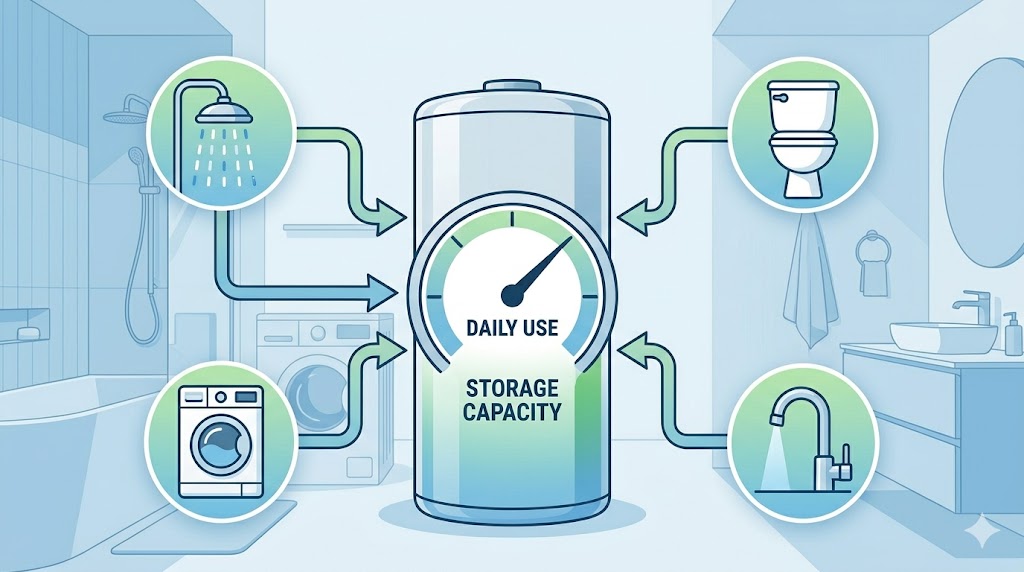
    How to Size A Water Tank For Daily Household Use

    Sizing a household water tank correctly comes down to two numbers: daily consumption and backup days required. Multiply them, add a 10% buffer, and you have your minimum tank size. The difficulty is pinning down accurate consumption figures — most households underestimate by 30–50% compared to actual metered use. This article gives you the formula, the per-activity benchmarks to estimate consumption accurately, and the supply-scenario adjustments that change the answer significantly.

    The quick answer

    Use this formula:

    Tank size (L) = persons × L/person/day × backup days × 1.10

    The 1.10 factor adds a 10% safety buffer to account for dead volume, sediment, and gauge inaccuracy.

    Household sizeL/person/day1-day buffer3-day buffer
    1 person100–150110–165 L330–495 L
    2 persons100–150220–330 L660–990 L
    4 persons100–150440–660 L1,320–1,980 L
    6 persons100–150660–990 L1,980–2,970 L

    Skip the math: use the water tank size for home calculator to enter your household details and get a tailored recommendation immediately.

    How the calculation works

    Daily consumption per person is the key variable. The benchmark figures used in the table above come from IWA (International Water Association) household use studies across urban residential properties. Here is where that 100–150 L/person/day goes:

    ActivityLitres per useDaily total (per person)
    Toilet flushing6–9 L per flush30–45 L
    Shower (5 min, standard head)60–75 L60–75 L
    Shower (5 min, low-flow head)35–40 L35–40 L
    Drinking & cooking5–10 L
    Laundry (shared, 1 load/day)50–80 L per load12–20 L
    Dishwashing (machine)15–20 L per cycle4–7 L
    Hand washing, misc.5–10 L

    A household with standard-efficiency appliances and typical shower habits lands at 120–150 L/person/day. Fitting low-flow showerheads and a water-efficient washing machine drops this to 90–110 L/person/day — a reduction that allows sizing down by 20–25% on the same backup target.

    Worked example: 4 people, 3-day backup, standard appliances

    Daily use: 4 × 140 L = 560 L/day. Target: 3 days. Raw figure: 560 × 3 = 1,680 L. Add 10% buffer: 1,680 × 1.10 = 1,848 L. Round up to the nearest standard size: 2,000 L tank

    Key variables that change the answer

    Supply reliability. This is the single biggest factor. In cities with reliable 24-hour mains supply, a tank sized for 1 day’s buffer is a pressure-head buffer, not emergency storage — 500–800 L is adequate for most households. In areas where supply runs for 4–6 hours per day, you need enough to cover the off-supply window plus a margin — typically 2–3 days. Where tanker deliveries are the only source and arrive weekly or fortnightly, size for the full delivery interval: 7–14 days of storage

    Rooftop vs underground placement. Rooftop tanks are governed by structural load limits. A full 2,000 L tank weighs roughly 2,100 kg — most residential slabs rated for rooftop loads in developing markets are engineered for 200–300 kg/m². On a 2 m × 1.5 m footprint, that’s 400–600 kg maximum — a 500 L tank ceiling without structural assessment. Underground tanks have no such constraint and are the right choice for larger household storage volumes.

    Seasonal demand variation. Hot climates see water use spike 25–40% in summer — more frequent showers, garden irrigation, evaporative coolers. If you’re sizing for a region with hot dry seasons, apply your peak-season consumption figure, not the annual average. A tank sized for average demand runs dry during the months you need it most.

    Household type. Young children (under 10) use 30–40% less water than adults. Elderly residents use less shower water but more frequent toilet flushes. Teenagers and young adults are consistently the highest per-person users. Weighting your household composition against these patterns gives a more accurate daily total than simply multiplying people by a fixed per-person average.

    Common mistakes

    Using the WHO 15 L/person/day survival figure for tank sizing. The WHO’s 15 L/person/day is the humanitarian emergency threshold — drinking and basic sanitation only. It does not include showers, laundry, or dishwashing. Using it to size a residential household tank produces a tank that runs out in days under normal operation. The correct baseline for residential sizing is 100 L minimum; 140–160 L for a typical household.

    Ignoring the supply pattern and sizing by household size alone. A 1,000 L tank serves a family of two with reliable mains and a family of two in a water-scarce region very differently. Without factoring in supply frequency, tank size recommendations are meaningless. Define your worst-case supply gap first, then size.

    Underestimating garden and outdoor use. Garden irrigation, car washing, and outdoor cleaning add 50–150 L/day to a household’s consumption during active months. This frequently pushes per-person consumption above 200 L/day for households with moderate-sized gardens. Exclude it only if your outdoor area is fully paved or you source outdoor water separately.

    Not accounting for tank accessibility for maintenance. Tanks that are never fully drained and cleaned accumulate biofilm and sediment — reducing usable capacity and degrading water quality over 2–5 years. An undersized tank that’s topped up continuously without ever being emptied causes more problems than one correctly sized and periodically cleaned. Factor in a cleaning interval (every 6–12 months) when planning tank size.

    Related calculators you might need

    If you don’t yet know your daily consumption, the daily water requirement calculator walks through each household activity to build a total. Once you’ve settled on a tank size, the how long will my tank last calculator confirms how many days it covers at your consumption rate. For underground or larger tanks, check the total filled weight with the water tank weight calculator before finalising placement. And if your area has treated water supply, the safe water storage duration calculator tells you how long stored water remains safe before requiring retreatment.

    Frequently asked questions

    How do I size a water tank for daily household use?

    Multiply the number of people in your household by litres per person per day (use 140–160 L for a standard household), then multiply by your backup days, and add 10%. For a family of four needing 3 days’ backup: 4 × 150 × 3 × 1.10 = 1,980 L — round to a 2,000 L tank. Use the water tank size for home calculator to refine this for your specific usage pattern.

    What is the minimum water tank size for a household?

    The minimum that makes practical sense is 500–1,000 L for a single person or couple with reliable mains supply — enough to buffer daily supply interruptions. Below 500 L, a tank provides almost no meaningful backup. For a family of four with any supply variability, 2,000 L should be considered the floor, not the target.

    How much water does a household use per day?

    In OECD countries, average residential water use is 100–200 litres per person per day (WHO/OECD data). In urban South Asia and Sub-Saharan Africa, actual delivered supply is often 40–80 L/person/day due to infrastructure limits. Your actual number depends on appliance efficiency, climate, and lifestyle — the per-activity breakdown in the table above will give you a household-specific total.

    How many days should a household tank last?

    Size for your realistic worst-case supply gap, not the average. If your area loses supply for one day twice a week, size for 2–3 days. If tanker deliveries are the only source and arrive every 7–10 days, size for the full interval. A tank that runs dry before the next refill provides no safety margin — add at least 1.5–2 days beyond your expected gap.

    Does a larger tank mean better water pressure?

    Not from volume — pressure in a gravity-fed system depends on the height of the water surface above the outlet, not the tank’s capacity. A 500 L tank at 5 m elevation produces the same pressure as a 5,000 L tank at 5 m elevation. To improve gravity-feed pressure, raise the tank or install a pump booster. Volume and pressure are independent variables.

  • How To Calculate The Volume of a Rectangular Water Tank

    How To Calculate The Volume of a Rectangular Water Tank

    The volume of a rectangular water tank equals length × width × height, measured in the same unit throughout. The result is in cubic units — multiply by 1,000 to convert cubic metres to litres, or multiply cubic feet by 7.48 to get US gallons. This article covers the formula, unit conversions, partial-fill calculations, and the adjustments needed for tanks with wall thickness or irregular proportions.

    The quick answer

    For a rectangular tank, the calculation has one step:

    Volume = Length × Width × Height

    All three dimensions must be in the same unit before you multiply. Use metres for litres, feet for cubic feet, or inches for cubic inches (then convert). Here are the most common unit conversions:

    Measurement unitVolume resultConvert to litres by
    Metres (m)Cubic metres (m³)× 1,000
    Centimetres (cm)Cubic centimetres (cm³)÷ 1,000
    Feet (ft)Cubic feet (ft³)× 28.317
    Inches (in)Cubic inches (in³)÷ 61.024

    Skip the conversion math: the rectangular water tank volume calculator handles all unit conversions and outputs results in litres, gallons, and cubic metres simultaneously.

    How the calculation works

    The formula treats the interior of the tank as a cuboid. Each dimension — length (L), width (W), height (H) — contributes directly and proportionally to the result. Double the height, you double the volume.

    Worked example: residential rooftop tank

    A concrete rooftop tank is 2.5 m long, 1.5 m wide, and 1.2 m high.

    Volume = 2.5 × 1.5 × 1.2 = 4.5 m³ = 4,500 litres

    At 150 litres per person per day, this serves a household of four for 7.5 days without refill.

    Worked example: US gallon conversion

    A tank measuring 8 ft × 4 ft × 3 ft:

    Volume = 8 × 4 × 3 = 96 ft³ × 7.48 = 718 US gallons (2,718 litres)

    Key variables that change the answer

    Wall thickness. Many concrete and brick tanks have walls 100–200 mm thick. If you measure the external dimensions, you need to subtract wall thickness from each side to get the internal dimensions. For a tank with 150 mm walls: a 2.5 m external length becomes 2.5 − 0.30 = 2.2 m internally. Ignoring this on a brick tank overstates volume by 10–20%.

    Fill level. Tanks are almost never filled to capacity. If you’re calculating usable volume or checking how much water is currently stored, use the actual fill height rather than the tank height. Volume at partial fill = L × W × fill depth.

    Freeboard. Rooftop and open-top tanks are typically filled to 50–100 mm below the rim to prevent overflow and splashing. This effective height reduction of 5–8% on a standard 1.2 m tank reduces usable volume by 40–60 litres — not trivial if you’re sizing tightly.

    Internal fittings. Tanks with inlet baffles, sediment chambers, or structural pillars have obstructions that displace water. Commercial and agricultural tanks sometimes have internal dividers — measure the usable chambers separately and sum them.

    Rectangular vs other tank shapes

    Tank shapeFormulaBest useVolume efficiency
    RectangularL × W × HRooftop, underground, concrete100% space used
    Cylindricalπ × r² × HPolyethylene tanks, silos~79% of bounding box
    Horizontal cylinderπ × r² × LUnderground, transport~79% of bounding box
    Cone-bottomCylinder + 1/3 coneAgriculture, mixingVaries

    Rectangular tanks are the most space-efficient shape — they fill every cubic centimetre of the space they occupy. A cylindrical tank of the same external dimensions holds only 78.5% as much water.

    Common mistakes

    Measuring external instead of internal dimensions. For plastic tanks this barely matters — walls are thin. For concrete, brick, or fibreglass tanks with walls 100–200 mm thick, external measurement overstates volume by 15–25%. Always measure from inside face to inside face.

    Mixing units mid-calculation. Multiplying 2 metres × 150 centimetres × 1,200 millimetres is a common error — the dimensions aren’t in the same unit. Convert everything to one unit first. The most reliable approach: use metres throughout for litres, or centimetres throughout and divide the cm³ result by 1,000.

    Using nominal tank capacity instead of calculating it. Tank manufacturers list nominal capacities that sometimes reflect design intent rather than actual internal volume. A ‘5,000 L’ tank measured physically may hold 4,750 L due to wall thickness, baffles, or manufacturing tolerances. For critical sizing — hospital storage, agricultural irrigation — always calculate from measured dimensions rather than the label.

    Ignoring the dead zone at the bottom. Sediment accumulates at the base of rectangular tanks over time, particularly in concrete tanks supplied by surface water. The bottom 50–100 mm is effectively dead volume. A 2.5 × 1.5 m tank loses 188–375 litres to sediment accumulation — deduct this from usable capacity in your planning.

    Related calculators you might need

    If your tank isn’t a simple rectangle — it has a sloped bottom, a cone section, or it’s cylindrical — the cylindrical tank volume calculator or the cone bottom tank volume calculator will handle the correct geometry. If you’ve calculated litres and need US gallons or imperial gallons for purchasing or regulatory purposes, use the litres to gallons converter. And if you’re installing a rectangular concrete tank on a rooftop, cross-check the filled weight against your slab rating using the water tank weight calculator before pouring or placing.

    Frequently asked questions

    How do I calculate the volume of a rectangular water tank?

    Multiply length × width × height, with all three dimensions in the same unit. If using metres, the result is cubic metres — multiply by 1,000 for litres. Example: a tank 2 m × 1 m × 1.5 m holds 3 m³ or 3,000 litres. Use the rectangular water tank volume calculator for instant results across multiple units simultaneously.

    What is the formula for tank volume in litres?

    Volume (litres) = Length (m) × Width (m) × Height (m) × 1,000. Alternatively, measure in centimetres: Volume (litres) = L (cm) × W (cm) × H (cm) ÷ 1,000. Both produce the same result. For feet and gallons: L (ft) × W (ft) × H (ft) × 7.48 = US gallons.

    How do I calculate how much water is in my rectangular tank?

    Measure the current depth of water in the tank (the fill level, not the tank height). Then: Volume = Length × Width × Fill depth. All measurements in the same unit. If your 2.5 × 1.5 m tank currently has water 0.8 m deep: 2.5 × 1.5 × 0.8 = 3 m³ = 3,000 litres currently stored.

    Does wall thickness affect the calculation?

    Yes, for any tank with walls thicker than 20 mm — concrete, brick, fibreglass, or thick HDPE. Subtract twice the wall thickness from each external dimension to get internal dimensions. A tank with 150 mm walls has 300 mm (0.3 m) deducted from both length and width. Ignoring this on a large concrete tank can overstate volume by hundreds of litres.

    How accurate is the rectangular tank volume formula?

    Mathematically exact for a perfect cuboid with uniform walls. Real-world accuracy depends on how carefully you measure. A 10 mm error in a 1,000 mm dimension is 1% — acceptable. For a 2,500 mm length, a 25 mm measurement error creates a 1% volume error. Measure each dimension at multiple points and use the smallest reading if walls are uneven.

  • How to Calculate the Right Water Tank Size for Your Home

    How to Calculate the Right Water Tank Size for Your Home

    A household of 4 people in an area with daily municipal supply needs a minimum 1,000-litre (264-gallon) overhead tank — but that number can double or triple depending on your supply reliability, climate, and usage habits. This article walks you through the formula, the variables that shift the answer, and the sizing benchmarks used by water engineers globally. By the end, you will know exactly what size tank your home needs and why.

    The Quick Answer

    The standard formula is: Tank Size = Daily Water Consumption × Backup Days × Safety Margin. The WHO recommends a baseline of 50 litres per person per day for basic domestic use (WHO, 2017 Guidelines for Drinking Water Quality). FEMA recommends a minimum of 1 gallon (3.8 litres) per person per day for emergency survival — but that is the floor, not a sizing standard for a home. For normal household use, engineer-recommended minimums sit between 50–200 litres per person per day depending on climate and appliance load.

    Household SizeDaily Use (50L/person)1-Day Tank3-Day Tank
    1–2 people50–100 L100–200 L300–600 L
    3–4 people150–200 L200–400 L600–1,200 L
    5–6 people250–300 L300–600 L900–1,800 L
    7–8 people350–400 L400–800 L1,200–2,400 L
    10+ people500+ L1,000+ L3,000+ L

    Note: These figures use WHO baseline (50L/person/day). Actual use in South Asia, the Middle East, and sub-Saharan Africa often ranges 80–150L/person/day. Australia and the US average 150–300L/person/day (World Bank, 2020).

    ▶  Skip the math: Use the Water Tank Size for Home Calculator to get a number tailored to your situation.

    How the Calculation Works

    The formula:  Tank Capacity (litres) = P × D × B × SF

    Where:

    P = number of people in the household

    D = daily consumption per person (litres)

    B = backup days required (how long supply may be interrupted)

    SF = safety factor (typically 1.2 to 1.3 to account for leakage, sediment, and irregular supply)

    Worked example: Family of 4, warm climate, 2-day backup

    P = 4, D = 120 litres (warm climate, includes toilet flushing, cooking, bathing), B = 2 days, SF = 1.25

    Calculation:  4 × 120 × 2 × 1.25 = 1,200 litres

    This household needs a minimum 1,200-litre tank — a standard size widely available as a polyethylene overhead tank. If supply interruptions in your area extend to 3 days, the same household would need 1,800 litres.

    To calculate your daily water requirement precisely before running this formula, use the Daily Water Requirement Calculator.

    Key Variables That Change the Answer

    1. Supply reliability

    This is the biggest driver. A home with 24-hour mains supply needs only a 1-day buffer — roughly 200–400 litres for a family of 4. A home in Karachi, Lagos, or Chennai where supply arrives for 2–4 hours every 2–3 days needs a 3–5 day buffer, pushing the requirement to 1,500–3,000 litres. If you are on a borehole or tanker delivery, calculate for 7–14 days

    2. Climate and appliance load.

    Hot climates increase personal water consumption by 20–40% through additional bathing and drinking. If your household has a washing machine, dishwasher, or garden irrigation, add 40–60 litres per day per appliance. Air conditioning condensate recovery can offset 5–10 litres/day in humid climates — marginal, but worth noting if you are optimising.

    3. Household type.

    A family of 4 adults uses more than a family with 2 adults and 2 young children. Adults consume 15–30% more water than children under 12 (WHO, 2017). Cooking habits matter — households that prepare meals from scratch use 10–20 litres more per day than those relying on pre-prepared food.

    4. Tank placement — overhead vs underground.

    An underground tank can typically be 2–4x larger than a rooftop tank because it is not constrained by structural load limits. Rooftop tanks are capped by slab capacity — most residential slabs in South Asia support 200–500 kg/m², which limits practical tank size to 1,000–2,000 litres without reinforcement. Underground tanks can go to 10,000 litres or more.

    5. Tank shape and fill efficiency.

    Cylindrical tanks have no dead corners, giving 95–98% usable volume. Rectangular tanks lose 3–8% to sediment accumulation in corners over time. Factor this into sizing — a 1,000-litre rectangular tank realistically delivers 920–970 litres of usable water.

    Sizing by Scenario: What Engineers Recommend

    The table below applies the formula across real-world conditions. All figures use the WHO 50L baseline adjusted for climate and supply reliability, with a 1.25 safety factor.

    ScenarioDaily UseBackup DaysRecommended Tank
    Urban apartment, reliable supply200 L (4 people)1 day300–500 L
    Urban house, intermittent supply (2–3 days)240 L (4 people)3 days900–1,200 L
    Suburban home, daily 4-hr window300 L (4 people)2 days750–1,000 L
    Rural household, tanker delivery weekly280 L (4 people)7 days2,450–3,000 L
    Off-grid property320 L (4 people)14 days5,600–7,000 L
    Small guesthouse (10 guests)1,500 L2 days3,750–4,500 L

    Common Mistakes When Sizing a Home Water Tank

    Sizing for minimum supply, not worst-case supply. Most homeowners calculate for how often supply interruptions normally occur, not for the longest gap they have ever experienced. A Lahore household that typically gets water every 2 days should size for 5 days — not 2 — because summer shortages regularly push that gap past 4 days. Under-sized tanks run dry exactly when water stress is highest.

    Ignoring roof load capacity before buying. A 2,000-litre tank full of water weighs over 2,000 kg. Residential rooftop slabs in older construction often have a load limit of 150–200 kg/m². Installing a tank without checking this is a structural risk. Always check slab capacity before committing to a tank size, especially if the building is more than 20 years old.

    Buying the tank, then buying the wrong pump. A larger tank at height requires more pump head pressure to fill. Homeowners who size up their tank without recalculating pump requirements end up with tanks that take 4–6 hours to fill from a pump rated for the old smaller tank — or that never fill to capacity during short supply windows.

    Treating nominal capacity as usable capacity. A tank labelled 1,000 litres stores 1,000 litres — but 5–10% is typically dead volume below the outlet fitting. For a gravity-fed system, the effective pressure head also drops as the tank empties. Size for 110–120% of your calculated need to ensure you always have usable water even when the tank is at 20% full.

    Related Calculators You Will Need

    Once you have your tank size calculated, structural capacity is the next check. Use the Rooftop Load Bearing Calculator to confirm your slab can hold a full tank before you purchase — a 2,000-litre poly tank weighs roughly 2,050 kg when full, and that load concentrates on the tank’s footprint, not the entire roof.

    If your supply window is short, your tank size is only part of the equation — you also need to confirm the tank fills completely within that window. The Tank Refill Time Calculator tells you exactly how long filling takes given your inlet pipe size and mains pressure.

    For homes that want to cut dependence on mains supply, the Rainwater Harvesting Calculator calculates how much rainwater your roof can realistically collect per year based on your catchment area and local rainfall — useful for sizing a supplementary storage tank.

    If you are deciding between overhead and underground storage, the Underground vs Rooftop Tank Cost Calculator compares the lifetime cost of both options including installation, pump running costs, and maintenance.

    Apartment residents have a different sizing problem — shared risers, limited roof space, and body corporate rules. The Apartment Water Tank Size Calculator handles the specific constraints of multi-storey residential buildings.

    Frequently Asked Questions

    What size water tank do I need for a family of 4?

    A family of 4 using 120 litres per person per day (realistic for warm climates with normal appliance use) needs a 600-litre tank for 1-day backup and a 1,200-litre tank for 2-day backup — applying a 1.25 safety factor. In areas with unreliable supply, size for 3 days minimum, which gives 1,800 litres. Use the Water Tank Size for Home Calculator to enter your specific daily use and backup requirements for a precise figure.

    How long will a 1,000-litre tank last a family of 4?

    At 120 litres per person per day (480 litres/day for 4 people), a 1,000-litre tank lasts approximately 2 days — just over 48 hours. In a heatwave or if guests are present, consumption can spike 20–30%, cutting that to 36–40 hours. The How Long Will My Tank Last Calculator lets you enter your actual daily usage and current tank level for a precise depletion estimate.

    Is 500 litres enough for a house?

    500 litres is adequate only for a 1–2 person household with reliable daily mains supply. For a family of 3 or more, or any location where supply interruptions exceed 12 hours, 500 litres is undersized. It provides roughly 1 day of water for 4 people at minimum usage — no margin for a shower, laundry, or cooking beyond the basics.

    Should the tank be overhead or underground?

    Overhead tanks deliver water by gravity — no pump required for distribution, lower electricity costs, simpler maintenance. Underground tanks allow larger volumes (5,000–20,000 litres) without roof load issues but require a transfer pump to push water upward, adding electricity cost and a failure point. In areas with long supply gaps, the most reliable setup is a combination: underground sump + overhead overhead tank, where a pump fills the overhead tank automatically when the underground sump has water.

    How do I calculate water tank size in litres?

    Multiply people × daily litres per person × backup days × 1.25 safety factor. Example: 5 people × 100 litres × 3 days × 1.25 = 1,875 litres. Round up to the nearest standard tank size — in most markets, standard sizes are 500L, 750L, 1,000L, 1,500L, 2,000L, 2,500L, 3,000L, and 5,000L.

    What is the minimum tank size for a home with no mains supply?

    Off-grid homes should size for a minimum 14-day supply — longer if delivery logistics are difficult. For a family of 4 using 150 litres/person/day, that is 4 × 150 × 14 × 1.25 = 10,500 litres minimum. This typically means one or more underground tanks in the 5,000–10,000 litre range. The Off-Grid Water Storage Calculator accounts for seasonal rainfall variation and consumption fluctuations for a more accurate off-grid sizing.

  • How to Choose the Right Water Tank Size for Your Home (Complete Guide)

    How to Choose the Right Water Tank Size for Your Home (Complete Guide)

    Choosing the wrong water tank size is one of the most common — and costly — mistakes homeowners make. Too small, and you run dry. Too large, and you’re wasting money on unused storage capacity.

    This guide walks you through everything you need to know: how to calculate your daily water needs, pick the right tank shape, check your rooftop load capacity, and even factor in water pressure. By the end, you’ll know exactly what size tank your home needs — and we’ve linked every free calculator you need along the way.


    Step 1: Calculate How Much Water Your Family Uses Daily

    Before picking a tank, you need to know your household’s daily water consumption. This depends on the number of people, your usage habits, and local climate.

    A general rule of thumb: the average person uses 80–150 liters per day for drinking, cooking, bathing, and cleaning. But this varies widely.

    👉 Use our free Daily Water Requirement Calculator to get an accurate estimate based on your household size and usage patterns.

    Once you know your daily usage, you can determine how many days of storage you need — typically 3 to 7 days as a buffer in case of supply interruptions.


    Step 2: Determine the Right Tank Size for Your Home

    After calculating your daily requirement, the next step is to size your tank properly. For a family of 5 using 100 liters/person/day and wanting 5 days of storage, you’d need a 2,500-liter tank at minimum.

    But it’s not always that simple — apartment buildings, commercial buildings, and schools all have different requirements.


    Step 3: Choose the Right Tank Shape & Calculate Its Volume

    Water tanks come in many shapes — rectangular, cylindrical, oval, and more. The shape affects both how much water fits in a given space and how the tank is installed. Use the right volume calculator for your tank type:

    Not sure about unit conversions? Use our Liters to Gallons Converter to switch between metric and imperial units instantly.


    Step 4: Check If Your Roof Can Handle the Weight

    This is a step most homeowners skip — and it can be dangerous. A 1,000-liter tank holds 1,000 kg of water. That’s a full metric ton sitting on your roof.

    Before installing any rooftop tank, you must verify your roof’s load-bearing capacity.


    Step 5: Ensure Adequate Water Pressure

    Tank height directly affects water pressure. If your tank is too low, you’ll have weak water flow — especially for showers. The general rule is that every 1 meter of tank height produces approximately 0.1 bar (1.5 PSI) of pressure.

    A shower typically requires at least 0.5 bar, meaning your tank needs to be at least 5 meters above the shower head.


    Bonus: How Long Will Your Tank Last?

    Already have a tank and want to know how long it will last before running out? This is especially useful during water outages or when managing supply during dry seasons.

    👉 Try our How Long Will My Tank Last Calculator — just enter your tank size and daily usage, and it gives you a precise estimate.


    Bonus: Rooftop vs Underground Tank — Which Is Better?

    Both have pros and cons:

    FactorRooftop TankUnderground Tank
    Pressure✅ Natural gravity pressure❌ Needs a pump
    Space❌ Visible on roof✅ Hidden underground
    Temperature❌ Heats up in sun✅ Stays cool naturally
    Cost✅ Cheaper to install❌ Higher installation cost
    Maintenance🔧 Easier to access🔧 Harder to access

    Want to compare costs? Use our Underground vs Rooftop Tank Cost Calculator to see which makes more financial sense for your situation.


    Quick Summary: Your Tank Sizing Checklist

    1. ✅ Calculate daily water usage → Daily Water Requirement Calculator
    2. ✅ Determine required tank size → Home Tank Size Calculator
    3. ✅ Pick your tank shape and verify volume → Volume Calculators
    4. ✅ Check roof load capacity → Load Bearing Calculator
    5. ✅ Confirm water pressure is sufficient → Pressure Calculator
    6. ✅ Estimate how long your tank will last → Tank Duration Calculator

    Final Thoughts

    Selecting the right water tank doesn’t have to be complicated. By following these steps and using the free calculators above, you’ll avoid undersizing or oversizing your tank — saving money, ensuring reliable supply, and protecting your home’s structure.

    Explore more tools in our complete calculator library covering everything from rainwater harvesting to emergency water storage.