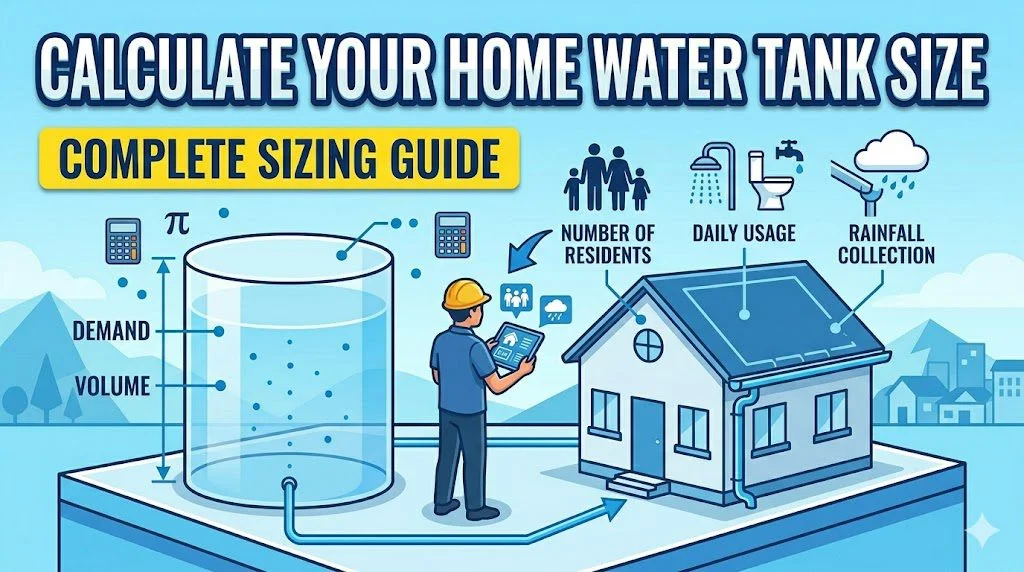
To size a water tank for your home, multiply the number of people by the litres each person uses per day, then by the number of days the tank must last without a refill, and add 20% as a buffer. A family of four using 135 litres each and covering a 2-day gap needs 4 × 135 × 2 × 1.2 = 1,296 litres, so the tank to buy is 1,500 litres (about 400 US gallons).
The formula is the easy part. The answer swings most on two inputs that people tend to guess: how much water the household really uses, and how long the supply really stays off. This guide shows how to pin down both, then how to check that the tank you picked will work on your roof, with your pump, inside your supply window.
Quick answer
- Formula: Tank size (L) = People × Litres per person per day × Backup days × 1.2
- Per-person use: 130–150 L a day suits most piped homes with flush toilets. Your water meter gives the real figure.
- Backup days: the longest gap you normally see between refills. 1 day on reliable mains, 2–3 days where water comes on alternate days, a week or more on tanker delivery.
- Then: round up to the next tank size on sale, and check the roof and the refill time before you pay for it.
The water tank size formula
Tank size (litres) = People × Litres per person per day × Backup days × 1.2
Each input has one job, and each has a right place to get it from:
| Input | What it means | Where to get it |
|---|---|---|
| People | Everyone who lives in the home, plus live-in staff and regular guests | Count the household you expect in a few years, not only today |
| Litres per person per day | Average daily use for drinking, cooking, bathing, toilets and laundry | Your water meter or bill (Step 1) |
| Backup days | How long the tank must supply the house with nothing coming in | Your longest normal gap in supply (Step 2) |
| × 1.2 | A 20% buffer on top of the base volume | Covers busy days and the water a tank cannot deliver (Step 3) |
Working in gallons? Divide litres by 3.785 for US gallons or by 4.546 for UK gallons, or use the tank litres to gallons converter.
Step 1: Work out how much water your household uses
This is the input that makes or breaks the result. A guess of 80 litres per person when the real figure is 160 gives you a tank half the size you need.
The accurate way: take it from your meter
Take one month of consumption from your bill or from two meter readings, divide by the number of days, then divide by the number of people. If the bill is in cubic metres (or kilolitres), multiply by 1,000 to get litres.
Example: the meter shows 16.2 m³ used in 30 days by a household of four. 16,200 L ÷ 30 days ÷ 4 people = 135 litres per person per day.
Use a hot-season month if you can, because that is when the tank is under the most strain. If the dials confuse you, our guide on how to read a water meter walks through each type, and the Water Meter Reading Calculator turns two readings into daily use.
No meter? Start from a published benchmark
Per-person figures vary a great deal between sources because they measure different things. These are the ones worth knowing, and what each is meant for:
| Litres per person per day | What the figure covers | Source |
|---|---|---|
| 3.8 L (1 US gallon) | Emergency drinking and basic sanitation only | Ready.gov (FEMA) |
| 15 L | Humanitarian minimum for drinking, cooking and hygiene in a crisis | Sphere Handbook |
| 50 L | “Intermediate access”: basic household needs met, low health concern | WHO (2020) |
| 100 L+ | “Optimal access”: water piped to several taps in the home | WHO (2020) |
| 135 L (150–200 L in large cities) | Indian design norm for homes with flush toilets; about 45 L of it is flushing | IS 1172:1993 |
| About 140 L | Measured household average, England, 2023/24 | Defra |
| About 310 L (82 US gallons) | Measured US home average, including garden watering | US EPA WaterSense |
For a piped home with flush toilets, showers and a washing machine, 130–150 litres per person per day is a sound planning figure when you have nothing better. The Daily Water Requirement Calculator adjusts it for children, climate and how much comfort you want.
Do not size a house tank on 50 litres or on 1 gallon a day. The WHO 50-litre level describes the point where health risk becomes low, not what a piped household draws. The FEMA gallon is drinking water for a disaster. A tank sized on either runs dry in normal use. For disaster stock specifically, see our FEMA emergency water storage guide.
What pushes your number up or down
Three fixtures account for most indoor use, and the gap between efficient and older models is large:
| Fixture | Efficient model | Standard or older model |
|---|---|---|
| Shower | 7.6 L/min, about 60 L for 8 minutes | 9.5 L/min, about 76 L for 8 minutes |
| Toilet | 4.8 L per flush | 6 L per flush; old cisterns can use up to about 23 L |
| Washing machine | About 53 L per load | About 76 L per load |
Heat raises drinking and bathing, and Ready.gov notes that drinking needs alone can double in very hot weather. Garden watering is often the largest single use in a dry month, so if the garden runs off the same tank, add it on top instead of assuming the benchmark covers it.
Step 2: Decide how many backup days you need
Backup days are set by your supply, not by your household. Two identical families need very different tanks if one has water around the clock and the other gets two hours every third day. The values below are planning guides, not code requirements:
| Your supply | Backup days to plan for | Why |
|---|---|---|
| Continuous mains, rare outages | 1 day | Covers a burst main or a day of repair work |
| Mains every day, a few hours only | 1–2 days | One missed window should not empty the tank |
| Mains on alternate days | 2–3 days | The normal gap, plus one skipped turn |
| Every third day or irregular | Longest usual gap + 1 day | Often works out at 4–5 days |
| Tanker delivery | Days between deliveries + 2–3 | Deliveries run late exactly when demand is highest |
| Own borehole or well with a pump | 1–3 days | Power cuts and pump repairs |
| Rainwater only, off-grid | Your longest dry spell | Commonly 30–90 days or more |
Size for the longest gap you normally see, not the average. If water usually comes every second day but stretches to four days each summer, four is your number. The tank earns its keep in that week.
For region-specific supply patterns, see our sizing guides for homes in Pakistan and homes in India. If three days is your target, how much water storage you need for 3 days of backup works through that case on its own.
Step 3: Add the buffer and round up
The × 1.2 at the end of the formula is a 20% buffer, and 15–25% is the usual range for homes. It pays for three things at once:
- Busy days. Guests, a heatwave, a big laundry day.
- Water the tank cannot deliver. The outlet sits a little above the floor so sediment stays behind, and the float valve shuts off below the brim. A tank labelled 1,000 litres gives you somewhat less than that at the tap.
- Error in your estimate. Both the usage figure and the backup days are approximations.
One buffer is enough. Adding a separate 10% for dead volume on top of the 20% counts the same water twice.
Then round up to the next size you can buy. Common sizes are 500, 750, 1,000, 1,500, 2,000, 3,000 and 5,000 litres, though the range differs by maker and country. Our comparison of 1,000 L vs 2,000 L vs 5,000 L tanks shows what each size suits.
Round up one size, not three. Every extra 1,000 litres is another tonne on the structure, and water that sits for many days loses the chlorine it arrived with. If stored water already smells or tastes off, read why water tastes or smells bad after storage before buying bigger.
Worked example: family of four, water on alternate days
Two adults and two teenagers. Mains water arrives every second day for about two hours, and now and then a turn is skipped.
- Daily use. Last month’s bill shows 16.2 m³. 16,200 ÷ 30 ÷ 4 = 135 L per person, or 540 L a day for the household.
- Backup days. The normal gap is 2 days. One skipped turn makes it 3, so they plan for 3.
- Base volume. 4 × 135 × 3 = 1,620 L.
- Buffer. 1,620 × 1.2 = 1,944 L.
- Round up. The next size on sale is 2,000 L (about 530 US gallons).
Result: a 2,000-litre tank. Full, it holds about 3.7 days of water at 540 L a day. It also weighs just over 2 tonnes, and it has to refill inside a two-hour window, which means the supply or pump must deliver about 17 L/min. Those two facts decide whether 2,000 litres on the roof is realistic, and they are the checks further down.
To run the same steps with your own numbers, use the Water Tank Size for Home Calculator. Its default buffer is the same 20%, so the result will match this method.
Tank size chart by household size
Minimum tank size in litres at 135 L per person per day with the 20% buffer included. Round each figure up to the next size on sale.
| People | 1 day | 2 days | 3 days | 7 days |
|---|---|---|---|---|
| 2 | 324 L | 648 L | 972 L | 2,268 L |
| 3 | 486 L | 972 L | 1,458 L | 3,402 L |
| 4 | 648 L | 1,296 L | 1,944 L | 4,536 L |
| 5 | 810 L | 1,620 L | 2,430 L | 5,670 L |
| 6 | 972 L | 1,944 L | 2,916 L | 6,804 L |
| 8 | 1,296 L | 2,592 L | 3,888 L | 9,072 L |
For the four-person row in more depth, including low-use and high-use households, see what size water tank a family of 4 needs.
Three checks before you buy
The formula tells you how much water you need. It does not tell you whether that much water can sit where you plan to put it, or whether it will fill in time.
1. Can the roof carry it?
Water weighs 1 kg per litre, so a full 1,000 L tank is about 1,030 kg with its shell. On a 1.2 m × 1.0 m base that is roughly 860 kg/m².
Now compare that with what roofs are designed for. India’s IS 875 (Part 2) sets 1.5 kN/m², about 150 kg/m², for a flat roof with access. The US standard ASCE 7 uses 20 psf, about 98 kg/m², for ordinary roofs. Both codes state that these figures exclude special concentrated loads, and a water tank is one. A full tank presses down at several times the roof’s general design load.
That is why rooftop tanks belong over beams, columns or load-bearing walls, on a stand that carries the weight to them, and why a structural engineer should confirm the position. No rule of thumb says a slab “takes up to 2,000 litres”.
Run your tank through the Rooftop Load Bearing Calculator first, and read will my roof hold a full water tank for the warning signs in older buildings. If the load is too high, two smaller tanks in different spots or a ground-level tank solve it.
2. Will it refill inside your supply window?
A bigger tank only helps if it gets full. The fill rate you need is simple division:
Required fill rate (L/min) = Tank volume (L) ÷ Supply window (minutes)
2,000 L in a 2-hour window: 2,000 ÷ 120 = about 17 L/min.
Use the flow that actually reaches the tank, not the figure on the pump’s nameplate. Lift height and pipe friction take a real share of it, and the honest test is to time how long a bucket of known size takes to fill at the tank inlet. Enter that in the Tank Refill Time Calculator.
If the pump falls short, the usual cause is head. How pump head works explains it, and why a tank takes so long to refill covers the other suspects.
3. Will the pressure be enough?
Tank size has nothing to do with pressure. In a gravity-fed system, pressure comes only from the height of the water surface above the tap: about 0.1 bar (1.42 psi) for every metre. A 500 L tank and a 5,000 L tank at the same height give the same shower.
So if weak pressure is the real complaint, a bigger tank will not fix it. Check the Minimum Tank Height for Shower Pressure Calculator, or see why shower pressure is low even with a full rooftop tank.
Should the tank be overhead or underground?
Often the answer is both. An overhead tank feeds the house by gravity and keeps working in a power cut, but the structure limits its size. An underground or ground-level tank can be far larger and puts no load on the roof, but every litre has to be pumped.
Where mains pressure is too weak to reach the roof, the standard arrangement is a ground-level sump that fills from the mains and a pump that lifts water to a smaller overhead tank. Size the total storage with the formula above, then split it. A common split is about one day’s use overhead and the rest in the sump.
Overhead vs underground water tanks compares the two in full. The Underground vs Rooftop Tank Cost Calculator totals upfront and running costs for each from your own quotes.
Sizing mistakes to avoid
- Using a survival figure for a household tank. 15 L and 50 L per person are humanitarian and health thresholds. A piped home draws two to three times the 50 L level.
- Sizing for the average gap. The tank is tested by the longest gap, and that usually arrives in the hottest weeks, when use is also at its highest.
- Buying first and checking the roof later. The structure sets the ceiling on a rooftop tank. Check it before you choose a size.
- Upsizing the tank and keeping the old pump. Twice the volume takes twice as long to fill. If the window is short, the new tank never fills.
- Reading the label as usable water. Plan on the buffer covering the layer below the outlet. If you know your tank’s dead volume, the How Long Will My Tank Last Calculator has a field for it.
- Sizing for today’s household only. A tank lasts 15 years or more. Children grow up and families grow.
Already own a tank and suspect it is the wrong one? How to tell if your water tank is the wrong size lists the signs, and my water runs out in 2 days covers the most common one.
More calculators for this job
- Apartment Water Tank Size Calculator: shared storage for a whole building, from flats and residents per flat.
- Water Tank Weight Calculator: full weight of any tank, shell included.
- Rainwater Harvesting Calculator: how much your roof can collect in a year, to see what rain can take off the mains.
- Emergency Water Storage Calculator: a separate drinking-water reserve for disasters.
Frequently asked questions
What size water tank do I need for a family of 4?
At 135 litres per person per day with a 20% buffer, a family of 4 needs 648 L for 1 day of backup, 1,296 L for 2 days and 1,944 L for 3 days. In tank sizes that is 750 L, 1,500 L and 2,000 L. Pick the row that matches your longest normal gap in supply.
How long will a 1,000-litre tank last a family of 4?
At 135 litres each, a family of 4 uses 540 L a day, so a full 1,000 L tank lasts about 1.85 days, or roughly 44 hours. At 100 L each it lasts 2.5 days, and at 200 L each only 1.25 days. Allow a little less in practice for the water below the outlet. Our guide on how to calculate how long a water tank will last has the full method.
Is a 500-litre tank enough for a house?
For one or two people with water every day, yes: two people at 135 L use 270 L a day, so 500 L covers a full day with room to spare. For a family of four it is not enough. They use about 540 L a day, which is more than the tank holds.
How do I calculate water tank size in litres?
Multiply people × litres per person per day × backup days × 1.2. For example, 5 people × 100 L × 3 days × 1.2 = 1,800 L, which rounds up to a 2,000 L tank. Divide litres by 3.785 for US gallons: 2,000 L is about 528 US gallons.
How many days of water should a home tank hold?
Enough to cover the longest gap you normally see between refills. That is about 1 day on reliable mains, 2–3 days where water comes on alternate days, and the delivery interval plus 2–3 days if you rely on tankers. This is separate from emergency drinking water: Ready.gov advises at least 1 gallon per person per day for several days, which is a far smaller volume.
Does a bigger tank give better water pressure?
No. Gravity pressure depends on how high the water surface is above the tap, about 0.1 bar per metre, not on how much water the tank holds. To improve pressure, raise the tank or add a booster pump.
What size tank does a home with no mains supply need?
Size it for the longest stretch between refills, whether that is a tanker interval or a dry season. A family of 4 using a careful 80 L each through a 30-day gap needs 4 × 80 × 30 × 1.2 = 11,520 L, usually three 5,000 L tanks. The Off-Grid Water Storage Calculator works out the volume and the number of tanks for any gap.
Sources
- World Health Organization, Domestic water quantity, service level and health, 2nd edition (2020). Service levels: about 50 L per person per day as intermediate access, 100 L or more as optimal.
- Sphere Association, The Sphere Handbook (2018). Minimum 15 L per person per day in humanitarian response.
- Bureau of Indian Standards, IS 1172:1993, Code of Basic Requirements for Water Supply, Drainage and Sanitation. 135 to 200 L per head per day for homes with full flushing systems, of which 45 L may be taken for flushing.
- Defra, Outcome Indicator Framework, E8: Efficient use of water. Per capita household consumption in England, 139.47 L per person per day in 2023/24.
- US EPA WaterSense, Statistics and Facts. 82 gallons per person per day at home. Fixture limits from WaterSense showerheads and residential toilets.
- ENERGY STAR, Clothes Washers. 14 gallons per load for certified full-size washers against 20 gallons for a standard machine.
- Ready.gov (FEMA), Water. At least 1 gallon per person per day for several days; needs can double in very hot temperatures.
- Bureau of Indian Standards, IS 875 (Part 2):1987, Imposed Loads, Table 2. 1.5 kN/m² for flat roofs with access, 0.75 kN/m² without.
- American Society of Civil Engineers, ASCE/SEI 7, Minimum Design Loads and Associated Criteria for Buildings and Other Structures. 20 psf minimum roof live load for ordinary roofs.
- US Geological Survey, Water Density. About 1 kg per litre (8.34 lb per US gallon).

Licensed Professional Engineer (Texas, PE) with 13+ years in residential and light-commercial water storage systems. Reviews and writes the technical guides on this site — sizing, pressure, roof loading, and treatment — based on 180+ completed field projects.