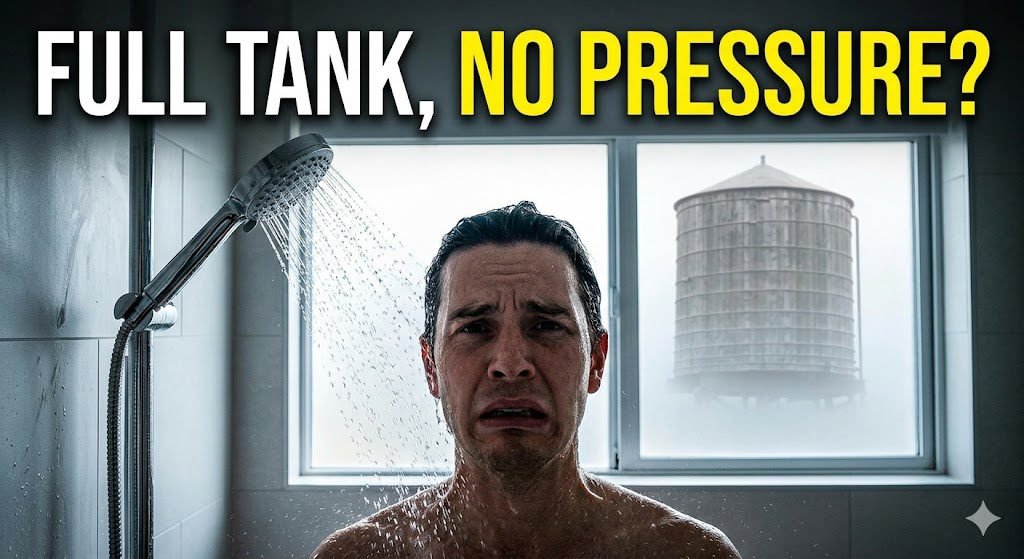
Low shower pressure from a full rooftop tank almost always comes down to one of three causes: insufficient tank elevation, undersized pipes, or a blocked aerator or inlet. The tank being full rules out water shortage — the problem is in delivery. If your issue isn’t specifically a full-but-weak tank, low water tank pressure covers the broader troubleshooting picture. Use the minimum tank height for shower pressure calculator to immediately check whether your setup meets the minimum 2.5 PSI threshold (0.17 bar) required for most standard showerheads. This article walks through each cause, how to test for it, and how to fix it.
The Quick Answer
Adequate gravity-fed shower pressure requires the base of your tank to sit at least 3 metres (10 feet) above the shower head — this produces approximately 0.3 bar (4.3 PSI), which is the practical lower limit for a comfortable shower. At 2 metres elevation, pressure drops to around 0.2 bar — functional but weak. At 1 metre, it is 0.1 bar — barely a trickle.
| Tank Height Above Shower | Approx. Pressure (bar) | Approx. Pressure (PSI) | Result |
| 1 m (3.3 ft) | 0.10 | 1.45 | Poor — trickle flow |
| 2 m (6.6 ft) | 0.20 | 2.90 | Marginal — weak shower |
| 3 m (9.8 ft) | 0.29 | 4.20 | Acceptable for basic heads |
| 5 m (16.4 ft) | 0.49 | 7.10 | Comfortable — most showerheads |
| 8 m (26.2 ft) | 0.78 | 11.3 | Good — high-flow showerheads |
Skip the math: Use the minimum tank height for shower pressure calculator to find the exact height your setup needs based on your showerhead’s flow rating and pipe run.
How Water Pressure from a Rooftop Tank Actually Works
Gravity-fed water systems — the basic principle behind how gravity feed water systems work — rely entirely on the vertical distance between the water surface in the tank and the point of use, known as the static head. Every metre of elevation generates 0.098 bar (1.42 PSI) of pressure (based on the hydrostatic pressure formula: P = ρgh, where ρ is water density at 1000 kg/m³ and g is 9.81 m/s²).
Worked example: If your rooftop tank sits on a 1-metre stand on a flat roof 4 metres above ground level, the tank base is 5 metres up. Your shower is at ground floor level, 1 metre above grade — so the effective head is approximately 4 metres. That produces 0.39 bar (5.7 PSI) before friction losses. If your pipes are narrow or long, losses can cut this to 0.2 bar or less at the shower head.
The water pressure calculator can model this including pipe friction for any pipe material and diameter.
Diagnosing the Real Cause: Three Tests You Can Do Now
Test 1 — Measure actual head height. Measure the vertical distance from the bottom of your water tank to the shower head outlet. If it is under 3 metres, insufficient elevation is the primary problem. No amount of pipe work will fix this without also raising the tank or adding a pump.
Test 2 — Check flow at different points. Turn on a tap near the base of the building and compare its flow to the shower. If the tap flows well but the shower is weak, the problem is specific to the shower branch — likely a long pipe run, narrow pipe diameter, or a blocked showerhead aerator.
Test 3 — Inspect the outlet pipe diameter. A standard rooftop tank outlet pipe is 25 mm (1 inch) or 32 mm (1.25 inch). If a previous plumber reduced this to 15 mm (0.5 inch) at any point in the run, that restriction alone can halve available flow rate. The pipe size and flow rate calculator shows exactly what flow rate each pipe diameter can deliver at a given pressure.
Key Variables That Change the Answer
Tank elevation
This is the dominant factor. Each additional metre of height adds 0.098 bar. If you can raise the tank by 1.5 metres — even on a taller stand — you gain roughly 0.15 bar, which can make the difference between an unusable and a functional shower.
Pipe diameter
Gravity-fed systems are particularly sensitive to pipe bore. A 15 mm pipe at 3 metres head can deliver around 6–8 litres per minute. A 25 mm pipe at the same head delivers 18–22 L/min. The difference is determined by the Hazen-Williams equation. Most showerheads require a minimum of 8 L/min for satisfactory use.
Pipe length and bends
Each metre of horizontal pipe introduces friction equivalent to losing about 0.01 bar. Each 90-degree bend adds the equivalent of 0.5–1.5 metres of pipe resistance. A 20-metre pipe run with 6 bends might consume 0.25–0.35 bar before the water even reaches the shower.
Showerhead type
Low-flow showerheads are rated at 6–8 L/min and work acceptably at 0.2 bar. High-pressure rain-head showerheads may require 0.4–0.6 bar and 12+ L/min to function correctly. If you’ve recently changed to a larger showerhead, that alone can explain a sudden pressure drop.
Tank outlet fitting
A partially closed valve, corroded ball valve, or an incorrectly sized tank outlet bushing creates a restriction upstream of everything else. This is easy to overlook and check first before undertaking larger plumbing work.
Common Mistakes
| Mistake | Why it fails | Fix |
| Installing a booster pump without fixing the pipe | A pump can only boost what it receives — a 15 mm inlet pipe feeding the pump will still limit flow to 6–8 L/min regardless of pump rating | Upsize the pipe feeding the pump before, or instead of, upgrading the pump itself |
| Measuring tank height from the roof surface, not the shower head | The relevant measurement is tank base to shower outlet, not roof to ground — a first-floor shower has far less effective head than a ground-floor one in the same building | Measure from the tank base directly to the specific outlet you’re troubleshooting |
| Assuming a full tank means adequate pressure | Volume and pressure are independent — a 5,000-litre tank sitting 1.5 metres above a shower head has plenty of water but only 0.15 bar of pressure | Check elevation separately from volume; use the rooftop tank size calculator if you’re also unsure the tank is sized correctly |
| Ignoring aerator blockage | Hard water deposits build up inside showerhead aerators and can reduce flow by 40–60% over 12–18 months | Unscrew the showerhead, soak it in white vinegar for 30 minutes, and retest — 5 minutes, no cost, and often the actual fix |
Related Calculators You Might Need
The gravity feed flow rate calculator lets you model the exact flow rate your system will produce at a given head height and pipe diameter — essential before deciding whether to raise the tank or upsize the pipe. If you determine a pump is necessary, the pump head pressure calculator will help you size it correctly against your actual pipe run. For systems with long distribution runs, the water flow rate calculator helps identify where friction losses are occurring. And if your tank height is genuinely the limiting factor, use the water tank weight calculator before raising it on a taller stand — tank stands impose significantly higher point loads on roofs, so it’s worth confirming whether your roof can hold a full water tank at the new height before committing to the work.
Frequently Asked Questions
Why does my shower pressure drop when someone uses another tap?
This is a classic sign of an undersized outlet pipe or a gravity system at the edge of its pressure capacity. When two fixtures draw simultaneously, the available head is split across both. The fix is either to upsize the main distribution pipe or stagger usage. At low gravity pressures (under 0.3 bar), simultaneous use is almost always problematic.
Can I improve shower pressure without raising my tank?
Yes, in some cases. Replacing 15 mm pipe runs with 25 mm pipe, eliminating unnecessary bends, and clearing aerators can reclaim 0.1–0.15 bar. Adding an inline shower pump (gravity-assisted pump) is the most reliable fix if head height cannot be changed — pumps rated at 1.5–2.0 bar are available specifically for low-pressure tank systems. If you go this route, how pump head works explains what to check before buying one, so you don’t just swap a gravity bottleneck for a pump that’s undersized for the same pipe run.
What is the minimum tank height for a decent shower?
3 metres of vertical clearance between the tank base and the shower outlet is the practical minimum for a standard showerhead. Below 2 metres, most showerheads produce unsatisfactory flow. Use the minimum tank height for shower pressure calculator to get a figure matched to your specific showerhead and pipe setup.
Does water pressure change when the tank is nearly empty?
Yes. As the water level drops, the head decreases. A tank that is 75% full has slightly lower effective pressure than when it is 100% full, depending on tank height. For a 1-metre-deep tank, the difference between full and a quarter full is approximately 0.07 bar — noticeable in a marginal gravity system.
How do I calculate water pressure from my rooftop tank?
Multiply the height difference in metres (from tank base to outlet) by 0.098 to get pressure in bar, or by 1.42 to get PSI. This is the static pressure. Subtract friction losses (roughly 0.01 bar per metre of pipe, plus 0.02–0.05 bar per 90-degree elbow) to get working pressure at the showerhead.

Licensed Professional Engineer (Texas, PE) with 13+ years in residential and light-commercial water storage systems. Reviews and writes the technical guides on this site — sizing, pressure, roof loading, and treatment — based on 180+ completed field projects.