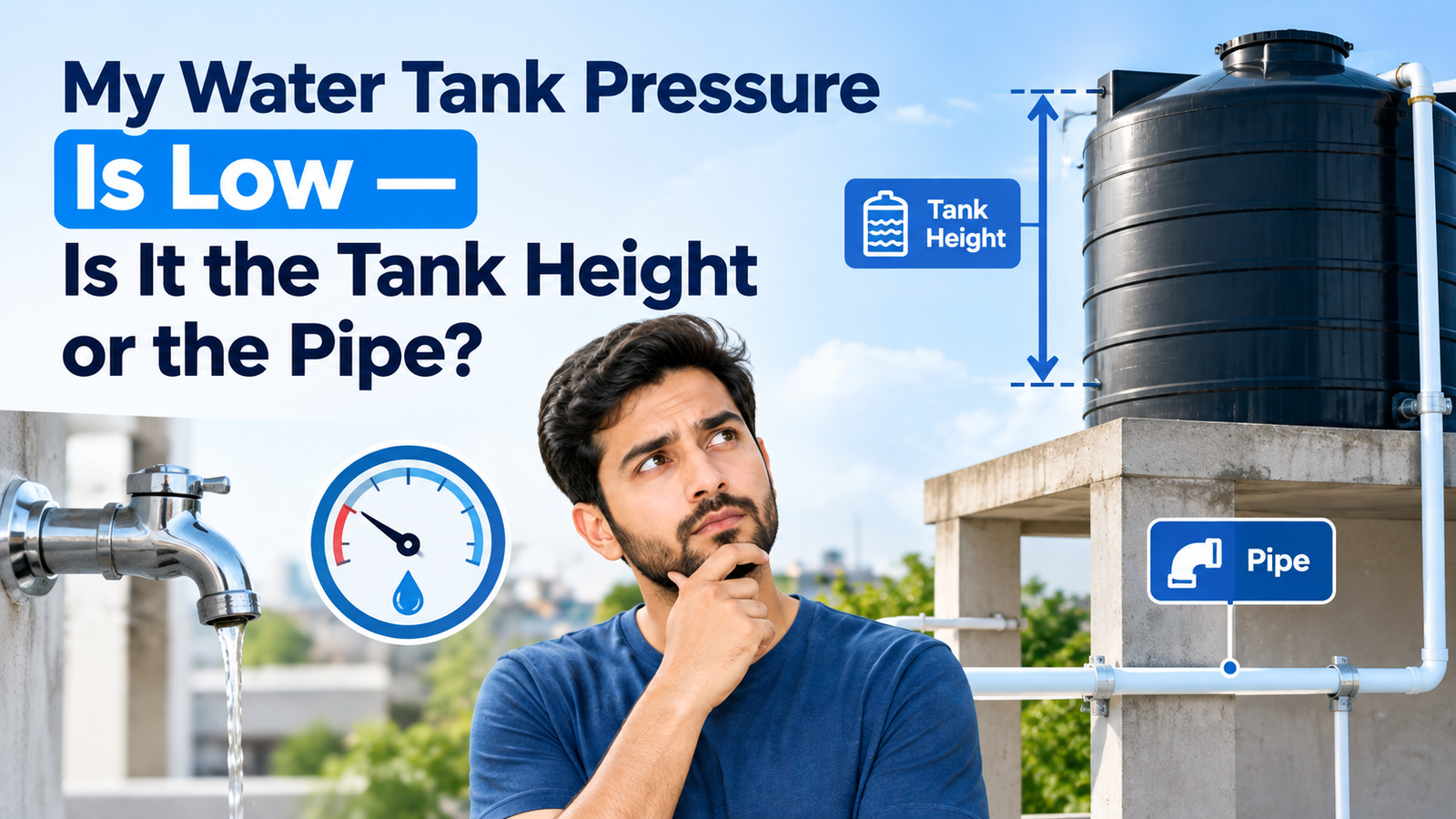
Low water pressure from a gravity-fed rooftop tank is caused by either insufficient tank elevation, undersized or blocked pipes, or a combination of both. If your tank is full and the problem only shows up at the shower specifically, low shower pressure with a full rooftop tank covers that narrower case in more detail. The fastest way to isolate the general cause: open the outlet valve directly at the tank base. If flow is strong there but weak at the tap, the pipe is the problem. If flow is weak at the tank outlet itself, the tank height is insufficient. Use the water pressure calculator to model your system and identify the limiting factor before spending money on fixes.
The Quick Answer
Every metre of height between your tank base and the outlet point generates 0.098 bar (1.42 PSI) of static pressure — the same principle behind how gravity feed water systems work more broadly. Pipe friction then reduces this. The formula is:
Working pressure = (Head in metres × 0.098) − Friction losses (bar)
| Head Height | Static Pressure | After 15m of 20mm pipe | After 15m of 25mm pipe |
| 2 m | 0.20 bar (2.9 PSI) | ~0.08 bar | ~0.14 bar |
| 3 m | 0.29 bar (4.2 PSI) | ~0.17 bar | ~0.23 bar |
| 5 m | 0.49 bar (7.1 PSI) | ~0.37 bar | ~0.43 bar |
| 8 m | 0.78 bar (11.3 PSI) | ~0.66 bar | ~0.72 bar |
Skip the math: Use the gravity feed flow rate calculator to model your specific pipe run and head height.
How to Isolate the Cause in 10 Minutes
Step 1: Test at the tank outlet. Close all taps in the house. Open the outlet valve or union joint directly at the tank’s exit point. Time how long it takes to fill a 10-litre bucket. If it fills in under 60 seconds (>10 L/min), the tank elevation is adequate and the problem is downstream. If it takes more than 90 seconds, the head height itself is insufficient.
Step 2: Test at intermediate points. If you can access the pipe at a midpoint — for example, where it enters the house at roof level — repeat the bucket test. A significant drop between tank outlet and mid-run confirms pipe friction or a restriction (a partially closed valve, a corroded joint, or a diameter reduction) within that section.
Step 3: Check for diameter reductions. Trace your pipe run from tank to outlets. Look for any point where 25 mm pipe connects to 15 mm pipe. Even a short 1-metre run of 15 mm pipe acts as a bottleneck for the entire system. The pipe size and flow rate calculator quantifies exactly how much a given pipe diameter restricts flow at your available pressure.
Is It the Tank Height?
If your outlet flow is weak (under 8 L/min at the tank exit), the tank elevation is the primary constraint — the underlying reason is the same hydrostatic pressure relationship that governs any water column. The minimum practical head for household use is 3 metres above the highest outlet point — typically the showerhead or a first-floor tap. For a single-storey home with the tank on a roof stand, 3–5 metres of effective head is achievable. For a two-storey home, a ground-floor tank is not viable for gravity feed — the tank must be elevated above the roof.
Solutions for insufficient head: raise the tank on a taller stand — check whether your roof can hold a full water tank at the new stand height, and confirm roof loading with the rooftop load bearing calculator first — install a gravity-assisted booster pump (typically 1.0–2.0 bar boost), or fit a pressurisation unit that draws from the tank and pressurises the household supply to 2.0–3.0 bar.
Use the minimum tank height for shower pressure calculator to determine the exact height needed for your specific fixtures. If a PSI-vs-bar-vs-kPa reading is confusing your comparison across sources, water pressure explained covers the unit conversions directly.
Is It the Pipe?
If tank outlet flow is adequate but pressure at taps is low, the pipe network is the problem. Three sub-causes are most common:
Undersized pipe diameter
The Hazen-Williams equation governs gravity flow: Q = 0.2785 × C × D^2.63 × S^0.54, where Q is flow rate (m³/s), C is pipe roughness (typically 130–150 for PVC), D is internal diameter (m), and S is hydraulic gradient (head loss per unit length). In practice: a 15 mm pipe at 3 metres head delivers around 6 L/min. A 25 mm pipe at the same head delivers approximately 20 L/min. Upgrading from 15 mm to 25 mm throughout your distribution run typically triples available flow.
Pipe corrosion or scale
Galvanised steel pipes narrow progressively as scale builds inside them. A 25 mm pipe with 4 mm of scale has an effective internal diameter of 17 mm — nearly a 50% reduction in cross-section. Old steel systems in hard-water areas (above 200 mg/L calcium carbonate) can lose significant capacity within 10 years.
Excessive bends and fittings
Each 90-degree elbow adds the equivalent of 0.5–1.5 metres of straight pipe to the friction calculation. A pipe run with 8 elbows effectively becomes 4–12 metres longer for pressure calculation purposes. Minimise bends and use 45-degree elbows instead of 90-degree where layout allows.
Common Mistakes
| Mistake | Why it fails | Fix |
| Installing a pump before diagnosing the actual bottleneck | A pump added before a pipe restriction is bypassed by the restriction — a 15 mm pipe from pump to house caps output regardless of pump rating | Fix any pipe restrictions first, then size the pump against the corrected system |
| Measuring tank height from the ground, not the highest outlet | Effective head is tank base to point of use, not tank to ground — a tank 6 m above ground serving a shower 3.5 m up has only 2.5 m of effective head | Always measure from the tank base to the specific fixture being troubleshot |
| Assuming new pipes are always the right size | Fresh copper or CPVC in a renovated bathroom still bottlenecks if it connects to an old 15 mm galvanised branch upstream | Trace the full run back to the tank, not just the newest section |
| Ignoring partially closed valves | A ball valve at 70% open is equivalent to a 15–20% reduction in pipe diameter | Check all inline valves are fully open before investigating pipe size or tank height |
Related Calculators You Might Need
Start with the water pressure calculator to get a complete model of your system based on head height, pipe diameter, and run length. If you’ve determined the tank needs to be higher, the pump head pressure calculator will help size a booster pump if raising the tank is not feasible. The tank refill time calculator is useful if low incoming flow rate — rather than distribution pressure — is the underlying issue. And for situations where multiple outlets are competing for pressure simultaneously, the water flow rate calculator shows how flow splits under simultaneous demand.
Frequently Asked Questions
How do I increase water pressure from a gravity tank without a pump?
Raise the tank height (every additional metre adds 0.098 bar), replace undersized pipe sections with larger bore pipe, eliminate unnecessary bends, and ensure all valves are fully open. Together, these changes can reclaim 0.15–0.25 bar in a typical gravity system — meaningful if you’re starting from a marginal position of 0.2–0.3 bar.
What is normal water pressure from a rooftop tank?
In practice, gravity-fed rooftop systems in South Asia and Africa typically deliver 0.2–0.5 bar at fixtures — well below the 1.0–3.5 bar common in mains-pressurised systems. Most basic showerheads need at least 0.2 bar to function. Thermostatic shower valves and rain-head showerheads typically require 0.4–0.8 bar.
How much does pipe size affect gravity water pressure?
Pipe diameter does not change static pressure — only head height does that. But pipe diameter dramatically affects flow rate at a given pressure. A 15 mm pipe limits flow so severely that even adequate static pressure (0.3 bar) produces only a trickle. Pressure at the fixture drops because flow-limiting creates friction. Upgrading pipe diameter is the single most cost-effective improvement for low-flow gravity systems.
My water pressure is fine downstairs but weak upstairs — what does that mean?
Each floor of height (approximately 3 metres) reduces gravity pressure by 0.3 bar. If ground-floor pressure is 0.4 bar, first-floor pressure will be approximately 0.1 bar — barely functional for most fixtures. This is a head height problem, not a pipe problem. The only solutions are raising the tank, fitting an upper-floor booster pump, or installing a pressurisation unit.
Can I add a pressure booster pump to a gravity-fed tank system?
Yes — gravity-assisted booster pumps are specifically designed for low-pressure tank systems. They activate on demand and boost pressure to 1.5–3.0 bar. Size the pump based on your peak flow demand (typically 15–20 L/min for a family home) and the suction head available from the tank. Use the pump head pressure calculator to match pump specifications to your system.

Licensed Professional Engineer (Texas, PE) with 13+ years in residential and light-commercial water storage systems. Reviews and writes the technical guides on this site — sizing, pressure, roof loading, and treatment — based on 180+ completed field projects.