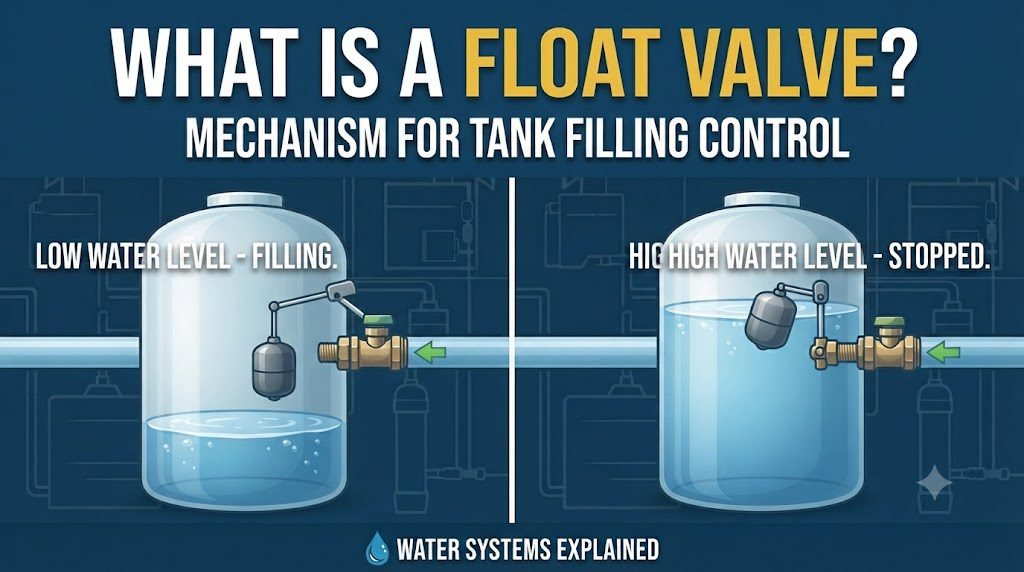
A float valve — also called a ball valve, ballcock, or float-operated valve — automatically shuts off water flow into a tank once it reaches a set level, using a floating ball or cup connected by an arm to a valve mechanism. As the water rises, the float rises with it, and at a set height the arm closes the valve, stopping the fill. It’s the same basic mechanism used in a household toilet tank, scaled up for storage and rooftop tanks. This article covers how the mechanism works, sizing considerations, and the most common failure modes.
The quick answer
Float valves are sized by the flow rate they need to shut off, not just the tank size — a valve rated for 10 GPM will struggle or fail to seal on a high-pressure supply line delivering 25 GPM, causing it to chatter, leak, or wear out prematurely. Most residential float valves handle 6–20 GPM at supply pressures up to 125 psi, while larger agricultural and rooftop tank float valves scale up to 40+ GPM. Two main types exist: direct-acting float valves, where the float arm directly operates the valve seat, and pilot-operated (diaphragm) float valves, where a small pilot float controls a larger diaphragm valve — used for high-flow or high-pressure applications where a direct-acting arm isn’t strong enough to hold back the water.
| Valve type | Typical flow range | Best for |
| Direct-acting (ball & arm) | 6–15 GPM | Small to mid-size household tanks |
| Pilot-operated diaphragm | 15–100+ GPM | Large storage, rooftop, and agricultural tanks |
| Servo/solenoid-assisted | Any, electronically controlled | Automated or remote-monitored systems |
Skip the math: Use the Tank Refill Time Calculator to see how long your tank actually takes to refill once the float valve reopens.
How the sizing calculation works
A float valve has to hold back the full static pressure of the supply line while sized correctly to pass the required fill rate without excessive turbulence or chatter at the valve seat. The key relationship is that valve seat size and incoming pressure together determine maximum controllable flow — an undersized valve seat on a high-pressure line creates a jetting effect that erodes the seat and shortens the float valve’s life.
Worked example: A 2,000-gallon rooftop tank is fed from a supply line at 60 psi, and the owner wants it to refill within 45 minutes when the level drops. Required flow rate = 2,000 gallons ÷ 45 minutes ≈ 44.4 GPM. At 60 psi, that flow rate is beyond what a typical direct-acting float valve (rated to roughly 15 GPM) can reliably shut off without excessive wear, so a pilot-operated diaphragm float valve rated for 50+ GPM at that pressure is the correct choice — a smaller direct-acting valve would either restrict the fill rate well below the 44.4 GPM target or fail early from constant high-pressure strain.
Key variables that change the answer
Supply pressure. Higher incoming pressure pushes harder against the valve seat, meaning a valve that seals reliably at 40 psi may leak or chatter at 100 psi even at the identical flow rate — always size against your actual measured supply pressure, not an assumed average.
Float arm length and buoyancy. A longer float arm provides more mechanical leverage to close the valve fully, which matters more as supply pressure increases; some very high-pressure applications need a pilot-operated design specifically because a direct arm can’t generate enough closing force on its own.
Water hammer risk. A float valve that closes very quickly against a full-pressure line can create a pressure spike (water hammer) that stresses pipe joints over time — high-flow installations often need a slower-closing or dashpot-damped valve design to avoid this.
Debris and sediment in the supply. Grit or scale particles in the water can lodge in the valve seat and prevent full closure, which is a common cause of a float valve that appears correctly sized on paper but still drips or overflows in practice.
The mechanism, in plain language
In a direct-acting float valve, a hollow ball or cup floats on the water surface, connected by a rigid arm to a lever inside the valve body. As the tank fills, the float rises, and the arm’s rotation gradually closes a small disc or plunger against the valve seat, restricting and finally stopping flow. This is a purely mechanical, self-regulating system — no electricity, no sensor, no controller — which is exactly why it’s been the standard tank-filling mechanism for over a century.
A pilot-operated float valve works differently: a small, low-flow pilot valve is operated by the float arm exactly like the direct-acting design, but instead of controlling the main flow directly, it controls water pressure on one side of a diaphragm inside a larger main valve. When the pilot closes, pressure builds behind the diaphragm and forces the main valve shut — this lets a small, easily-moved float mechanism control a much larger flow than it could physically hold back on its own, which is why pilot-operated designs scale up to serve large storage and rooftop tanks that a simple arm-and-ball setup couldn’t manage.
Either design can be set to close at a specific fill level by adjusting the arm length or the float’s position on it, and most designs include an adjustable stop so the shutoff level can be raised or lowered without replacing the whole valve.
Common mistakes
Ignoring supply pressure when replacing a valve. Swapping in a like-for-like float valve without checking whether supply pressure changed (a new booster pump, a municipal main upgrade) is the most common cause of a “new” valve chattering or leaking within weeks.
Setting the float arm too loosely. A float arm that isn’t tight enough on its pivot lets the valve creep open under vibration, causing slow overflows that go unnoticed until the tank’s overflow pipe starts running constantly.
Skipping periodic seat inspection. Rubber or synthetic valve seats wear and harden over years of contact with mineral-laden water, especially in hard-water areas — a valve that used to seal perfectly can start dripping purely from seat wear, unrelated to the float or arm mechanism.
Undersizing for peak refill speed after emergency drawdown. A float valve sized only for gradual daily top-up may take far longer than expected to refill a tank drained heavily during a fire event or peak demand — size against your worst-case refill scenario, not just routine daily use.
Related calculators you might need
Once you know the float valve’s flow rating, the Tank Refill Time Calculator tells you exactly how long a full refill will take at that rate, which matters if you’re relying on the tank to recover quickly between uses. If you’re specifying a tank for the first time, the Rooftop Tank Size Calculator helps confirm the right capacity before matching a float valve to it. And if refill speed still feels slow after replacing the valve, check the How Long Will My Tank Last Calculator to see whether the real issue is consumption outpacing refill rather than the valve itself.
Frequently asked questions
What is a float valve used for on a water tank? It automatically stops water flowing into a tank once it reaches a set level, preventing overflow without any electrical control. It’s the same working principle as a toilet tank fill valve, scaled up for storage or rooftop tank use.
Why does my float valve keep dripping after it closes? A drip after closure usually means the valve seat has worn or has debris lodged in it, or the float arm has lost its adjustment and isn’t rising high enough to fully seat the valve. Check for sediment first, since it’s the easiest fix.
What size float valve do I need for my tank? Size against your required refill flow rate at your actual supply pressure, not tank volume alone. Use the Tank Refill Time Calculator to work out what flow rate meets your refill-time target, then match that to a direct-acting or pilot-operated valve rated for it.
What’s the difference between a float valve and a solenoid valve? A float valve is purely mechanical, operated by water level alone, with no power needed. A solenoid valve is electrically controlled, usually paired with a separate level sensor, and can be integrated into a remote monitoring or automated system — at the cost of needing power and more components that can fail.

Licensed Professional Engineer (Texas, PE) with 13+ years in residential and light-commercial water storage systems. Reviews and writes the technical guides on this site — sizing, pressure, roof loading, and treatment — based on 180+ completed field projects.