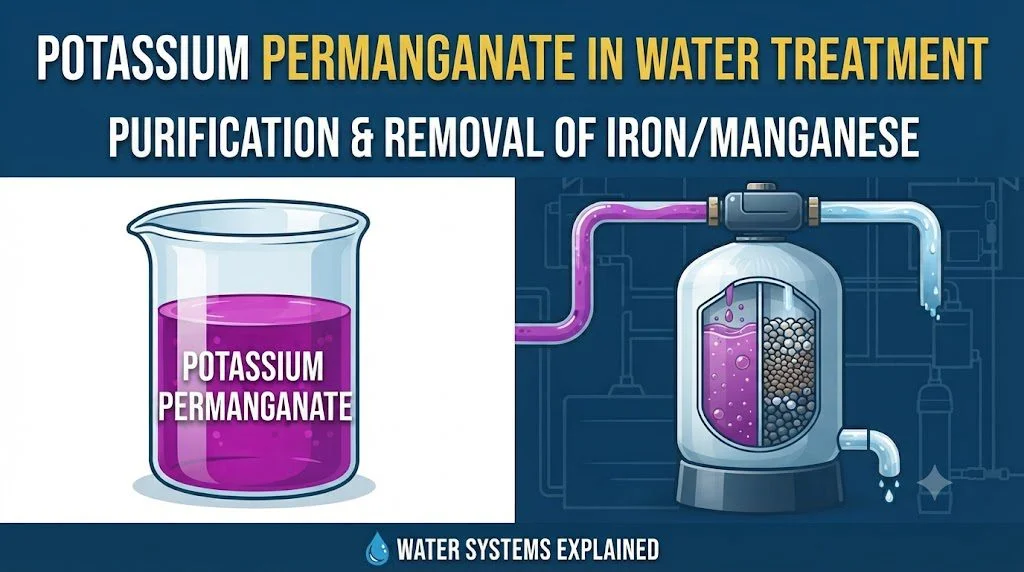
Potassium permanganate (KMnO4) is a purple, crystalline oxidizing chemical used mainly to remove dissolved iron, manganese, and hydrogen sulfide from well and borehole water before filtration. It doesn’t disinfect water on its own — it’s an oxidant, not a biocide — but it converts dissolved contaminants into solid particles that a sand or greensand filter can then strip out. This article explains the chemistry in plain terms, how much to dose, and the safety margin you need to stay inside.
The quick answer
Typical treatment dosing for iron and manganese oxidation runs 2–5 mg/L (ppm); algae and taste/odor control in reservoirs runs 5–10 mg/L; shock disinfection of a contaminated storage tank runs considerably higher, 10–20 mg/L, followed by a full flush before the tank returns to service. The theoretical stoichiometric requirement is close to 1 mg of KMnO4 per mg of dissolved iron and roughly 2 mg of KMnO4 per mg of dissolved manganese oxidized (Knocke et al., cited in EPA-referenced manganese removal literature). Water treated with KMnO4 must never be consumed while it still shows a visible pink or purple tint — that color means unreacted oxidant is still present.
| Purpose | Typical dose | Contact time |
| Iron/manganese oxidation | 2–5 mg/L | 10–15 minutes before filtration |
| Odor & taste (H2S) control | 1–3 mg/L | 10–15 minutes |
| Algae/biofilm control | 5–10 mg/L | Varies with organic load |
| Shock disinfection of a tank | 10–20 mg/L | Several hours, then full flush |
Skip the math: Use the Potassium Permanganate Dosage Calculator to get the exact gram dose for your tank volume and target concentration.
How the dosing calculation works
Dose is calculated from tank or flow volume multiplied by the target concentration, expressed in mg/L, which is numerically equivalent to ppm for dilute water solutions. The formula is: dose (grams) = volume (litres) × target concentration (mg/L) ÷ 1,000.
Worked example: A 2,000-litre well storage tank tests at 0.8 mg/L of dissolved iron. Using the roughly 1:1 stoichiometric ratio for iron oxidation, the target KMnO4 dose is about 1 mg/L, with a small excess commonly added for reliability, say 1.5 mg/L. Dose = 2,000 L × 1.5 mg/L ÷ 1,000 = 3 grams of KMnO4, dissolved in a bucket of water first, then mixed thoroughly into the tank and allowed 10–15 minutes contact time before the water is run through a sand or greensand filter.
Key variables that change the dose
Iron vs. manganese concentration. Manganese requires roughly double the KMnO4 per milligram compared to iron, because manganese oxidation is chemically slower and less complete at neutral pH — a water source with both contaminants needs the dose calculated against whichever is dominant, then verified with a residual test.
Raw water pH. Oxidation runs cleanly between pH 6.5 and 8.5. Below pH 6.5, manganese oxidation slows significantly and dosing needs to increase; a pH adjustment upstream is often more efficient than simply adding more KMnO4.
Organic load. Water with dissolved organic matter, tannins, or algae consumes KMnO4 before it can fully oxidize iron and manganese, meaning naturally colored or swamp-fed water sources need a higher dose than the base stoichiometric calculation suggests.
Purity of the KMnO4 product. Technical-grade potassium permanganate is typically 97–99% pure. Using the stated purity in the dose calculation, rather than assuming 100%, avoids a small but consistent under-dosing error.
Water temperature. Oxidation reactions run measurably slower in cold water, particularly below about 10°C (50°F), which is why winter dosing on a cold well source sometimes needs either a higher dose or a longer contact time to reach the same result a warm-season dose achieves in 10–15 minutes.
The chemistry, in plain language
Dissolved iron and manganese in well water exist in a soluble, reduced form (Fe2+ and Mn2+) that passes straight through a normal filter — it’s invisible until it hits oxygen, at which point it turns into the reddish-brown or black staining familiar to anyone with a well. Potassium permanganate speeds that same oxidation reaction up on purpose, in a controlled dose, before the water reaches your fixtures rather than inside your toilet tank or laundry.
When KMnO4 is added, the permanganate ion strips electrons from the dissolved Fe2+ and Mn2+, converting them into insoluble Fe3+ and Mn4+ compounds — solid particles rather than dissolved ions. Those particles are then physically filtered out, commonly through a manganese greensand or multimedia filter bed, which itself gets periodically regenerated with a stronger KMnO4 solution to keep its oxidizing coating active. The permanganate itself is consumed in this reaction; a properly dosed system leaves little to no residual KMnO4 in the finished water, evidenced by the water running clear rather than tinted pink.
This is also why KMnO4 is not classified as a disinfectant in the way chlorine is — it’s effective at oxidizing metals, sulfides, and some organics, but it does not reliably inactivate pathogens at the doses used for iron and manganese removal. Systems needing both metal removal and microbial disinfection typically pair KMnO4 pretreatment with a separate chlorine or UV disinfection stage afterward.
Common mistakes
Dosing without a filter downstream. KMnO4 only converts contaminants into a solid form — it doesn’t remove them. Dosing a tank without a sand or greensand filter afterward just replaces dissolved staining with suspended black particulate, which is worse in practice, not better.
Skipping the pH check. Dosing at the standard 2–5 mg/L rate on water below pH 6.5 leaves manganese only partially oxidized, so staining continues even though the chemical was added correctly. Test and correct pH before troubleshooting dose amounts.
Confusing shock-treatment dose with routine treatment dose. The 10–20 mg/L range used for tank shock disinfection is roughly 4–10 times the routine iron/manganese dose — using it for ongoing treatment leaves persistent pink-tinted water and wastes chemical.
Storing KMnO4 near organic materials. As a strong oxidizer, KMnO4 crystals can react with oils, solvents, and some fabrics, creating a fire risk in storage. Keep it in its original sealed container, away from heat and organic contamination, and always mix solutions in plastic or glass, never metal scoops.
Related calculators you might need
If you’re treating the same tank for microbial safety as well as metals, the Water Tank Disinfection Calculator gives the correct chlorine-based shock dose to run afterward. Where chlorine is the primary disinfectant rather than a metals oxidant, check the Chlorine Dosage Calculator for the right concentration. It’s also worth testing overall dissolved solids with the TDS Water Calculator before and after treatment to confirm the filter stage is actually pulling contaminants out, and the Safe Water Storage Duration Calculator to check how long treated water stays safe in a closed tank.
Frequently asked questions
Is potassium permanganate safe in drinking water? Yes, at correctly controlled doses followed by adequate filtration and no visible residual color. Water still showing a pink or purple tint contains unreacted KMnO4 and should not be consumed until the color clears naturally or is neutralized with a reducing agent.
Does potassium permanganate kill bacteria in water? Not reliably. It’s an effective oxidant for iron, manganese, and hydrogen sulfide, but it isn’t classified as a primary disinfectant. Systems needing microbial disinfection should pair it with chlorine or UV treatment using the Water Tank Disinfection Calculator.
How much potassium permanganate do I need for well water? Routine iron and manganese oxidation runs 2–5 mg/L, roughly 1 mg per mg of dissolved iron and 2 mg per mg of dissolved manganese present. Test your raw water first — dosing without a baseline reading is the most common cause of under- or over-treatment.
Why did my water turn pink after adding potassium permanganate? A persistent pink or purple color means the dose exceeded what the iron, manganese, and organic content in the water could consume. Let it sit longer for the color to fade naturally, add a reducing agent like sodium thiosulfate, or reduce the dose next time.
Can I use potassium permanganate and chlorine together? They’re typically used in sequence, not mixed simultaneously — KMnO4 handles metals oxidation first, followed by filtration, then chlorine handles disinfection afterward. Mixing them directly in a dosing tank can interfere with both reactions.
How long does potassium permanganate last once mixed into a tank? Once dosed, the oxidation reaction with dissolved iron, manganese, and sulfides typically completes within 10–20 minutes under normal pH and temperature conditions. Any color remaining beyond that window signals excess dose or unusually high organic load rather than a slow-acting chemical, and the water should not be used until it clears.

Licensed Professional Engineer (Texas, PE) with 13+ years in residential and light-commercial water storage systems. Reviews and writes the technical guides on this site — sizing, pressure, roof loading, and treatment — based on 180+ completed field projects.