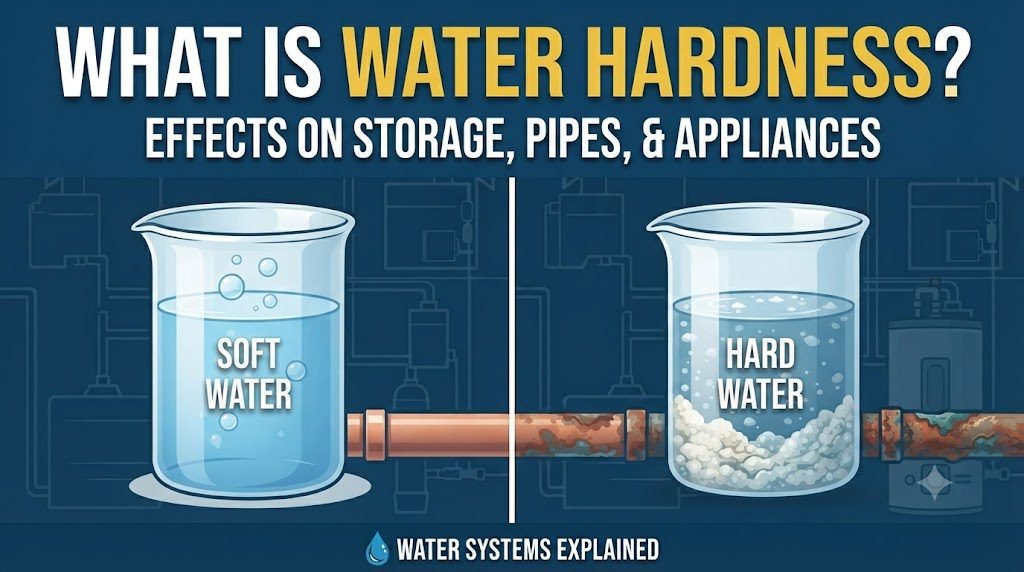
Water hardness measures the dissolved calcium and magnesium in your water, reported as mg/L (or ppm) of calcium carbonate equivalent. The U.S. Geological Survey (USGS) classifies water as soft (0–60 mg/L), moderately hard (61–120), hard (121–180), or very hard (over 180 mg/L). Hardness itself isn’t a health risk — the EPA doesn’t regulate it — but it drives limescale buildup that clogs pipes, coats tank walls, and measurably cuts water heater efficiency over time. This article covers the scale, what causes it, and how much it actually costs you.
The quick answer
Test your water’s hardness in mg/L or grains per gallon (1 gpg = 17.1 mg/L) and compare it against the USGS scale below. A landmark 2009 study by the Battelle Memorial Institute, commissioned by the Water Quality Research Foundation, found that every 5 gpg of hardness causes roughly a 4% loss in gas water heater efficiency at moderate usage, rising to as much as 48% efficiency loss at very high hardness (30 gpg).
| Classification | mg/L (CaCO3) | Grains per gallon | Practical impact |
| Soft | 0–60 | 0–3.5 | Minimal scale risk |
| Moderately hard | 61–120 | 3.5–7 | Light scale over years |
| Hard | 121–180 | 7–10.5 | Noticeable scale, reduced heater efficiency |
| Very hard | 180+ | 10.5+ | Rapid scale buildup, appliance strain |
Skip the math: Use the Water Hardness Calculator to convert your test results between mg/L, ppm, and grains per gallon and get your classification instantly.
How the calculation works
Hardness is calculated from lab or test-strip readings of calcium (Ca) and magnesium (Mg) concentration, converted to an equivalent calcium carbonate value using each mineral’s atomic weight ratio to CaCO3: Hardness (mg/L as CaCO3) = 2.5 × Ca(mg/L) + 4.1 × Mg(mg/L).
Worked example: A well water test shows 40 mg/L calcium and 12 mg/L magnesium. Hardness = (2.5 × 40) + (4.1 × 12) = 100 + 49.2 = 149.2 mg/L as CaCO3, which places the water in the hard classification (121–180 mg/L). Converted to grains per gallon: 149.2 ÷ 17.1 ≈ 8.7 gpg — high enough that scale buildup on a storage tank’s interior walls and on any electric water heater element becomes a realistic maintenance concern within a few years, not decades.
Key variables that change the answer
Water temperature. Scale forms fastest in hot water — solubility of calcium carbonate drops sharply above roughly 60°C (140°F), which is exactly why water heaters, not cold storage tanks, take the worst of the buildup even when both are fed by the same hard-water source.
Source geology. Groundwater moving through limestone, chalk, or dolomite formations picks up far more calcium and magnesium than surface water from a reservoir or rainwater catchment. Well and borehole users in limestone regions routinely see hardness in the hard-to-very-hard range even without any obvious warning signs at the tap.
Usage volume through the system. A household running 100 gallons of hot water a day sees roughly double the efficiency loss, according to Battelle’s findings, compared to one running 50 gallons a day at the same hardness level — heavier hot-water use accelerates the practical cost of untreated hard water.
Pipe material. Scale accumulates fastest on rough or corroded interior pipe surfaces, which is why older galvanized steel plumbing scales up faster than smooth-bore copper or PEX carrying the identical water. Over a decade or more, that difference in scaling rate is often the real reason two houses on the same street report very different pressure complaints despite drawing from the same municipal supply.
Storage tank turnover. A tank that sits mostly full and rarely cycles gives dissolved minerals more time to lose carbon dioxide and settle out on interior surfaces, compared to a tank with regular daily turnover that carries hardness minerals out before they have much chance to crystallize in place.
The mechanism: how hard water becomes scale
Calcium and magnesium stay dissolved in cold water under normal pressure, invisible and harmless in solution. Two things push them out of solution and into solid limescale: heat and pressure loss. As water heats up, particularly above 140°F, calcium carbonate’s solubility drops and it precipitates out as a hard, chalky solid — this is why the inside of a kettle or the lower element of an electric water heater scales up long before a cold storage tank ever does.
The same thing happens more slowly at ambient temperature wherever water sits still or moves slowly enough for dissolved gases to escape — carbon dioxide loss shifts the chemical equilibrium and encourages calcium carbonate to crystallize on tank walls, valve seats, and pipe interiors. Once a thin scale layer forms, it acts as a rough nucleation surface that accelerates further buildup, which is why scale problems tend to get worse at an increasing rate rather than a steady one once they start.
Inside a storage tank, scale settles preferentially at the bottom (sediment) and on any heating element or hot surface. Inside pipes, it narrows the effective diameter over years, which is the mechanism behind a home’s water pressure quietly dropping over a decade even though nothing was ever visibly “broken.”
Common mistakes
Ignoring hardness because water “tastes fine.” Hardness has no meaningful taste or safety signature at the levels that still cause serious scale damage — a water source can be perfectly safe to drink and still be hard enough to cut water heater life significantly. Test, don’t taste.
Softening only the hot water line. Because scale accelerates dramatically with heat, softening only the water heater feed still leaves cold-water storage tanks, ice makers, and cold fixtures exposed to full hardness — whole-house treatment is usually more cost-effective long-term than a partial fix.
Descaling on a schedule instead of by test result. Blanket “descale every 6 months” advice ignores that a soft-water household may never need it, while a very-hard-water household may need it twice as often. Base descaling frequency on your actual measured hardness, not a generic interval.
Mistaking hardness for a safety issue. Hardness is a plumbing and appliance-efficiency problem, not a health regulation — the EPA doesn’t set an enforceable limit because calcium and magnesium aren’t harmful to drink. Don’t confuse hardness testing with a full contaminant test for lead, bacteria, or nitrates, which require separate testing.
Related calculators you might need
Hardness is one input into overall water quality — pair it with the TDS Water Calculator to see total dissolved solids, since hardness minerals are usually only part of the TDS figure. If scale has already reduced flow through your system, the Water Filter Flow Rate Calculator shows how much a clogged filter or scaled pipe is actually costing you in delivered flow. And if you’re treating a tank for both hardness and microbial safety, the Water Tank Disinfection Calculator covers the separate chlorine-based step that hardness treatment doesn’t.
Frequently asked questions
What is considered hard water? On the USGS scale, water above 121 mg/L (as calcium carbonate) is classified hard, and above 180 mg/L is very hard. In grains per gallon, that’s roughly 7 gpg and up for hard, 10.5 gpg and up for very hard.
Does hard water damage my water tank? Yes, over time. Hard water precipitates calcium carbonate scale inside storage and pressure tanks, particularly around heating elements and at the sediment layer on the bottom, which reduces effective volume and can shorten tank life. The effect is worse in hot-water storage than cold.
How do I know if my water is hard without a test kit? Common signs include white crusty deposits around faucets and showerheads, reduced lather from soap, spotty dishes after washing, and a water heater that seems to be losing efficiency faster than its rated lifespan suggests — but a real hardness test with the Water Hardness Calculator gives a specific number rather than a guess.
Is hard water safe to drink? Yes. The EPA does not regulate hardness as a health contaminant, and the World Health Organization notes calcium and magnesium in drinking water can even contribute modestly to dietary intake. Hardness is a plumbing and appliance-life issue, not a safety one.
Will a water softener lower my water pressure? A correctly sized softener has minimal impact on pressure during normal flow, though very high-flow moments (multiple fixtures at once) can see a small, usually unnoticeable pressure drop across the resin bed. An undersized softener for your household’s peak demand is the more common cause of any pressure complaint after installation, not the softening process itself.

Licensed Professional Engineer (Texas, PE) with 13+ years in residential and light-commercial water storage systems. Reviews and writes the technical guides on this site — sizing, pressure, roof loading, and treatment — based on 180+ completed field projects.