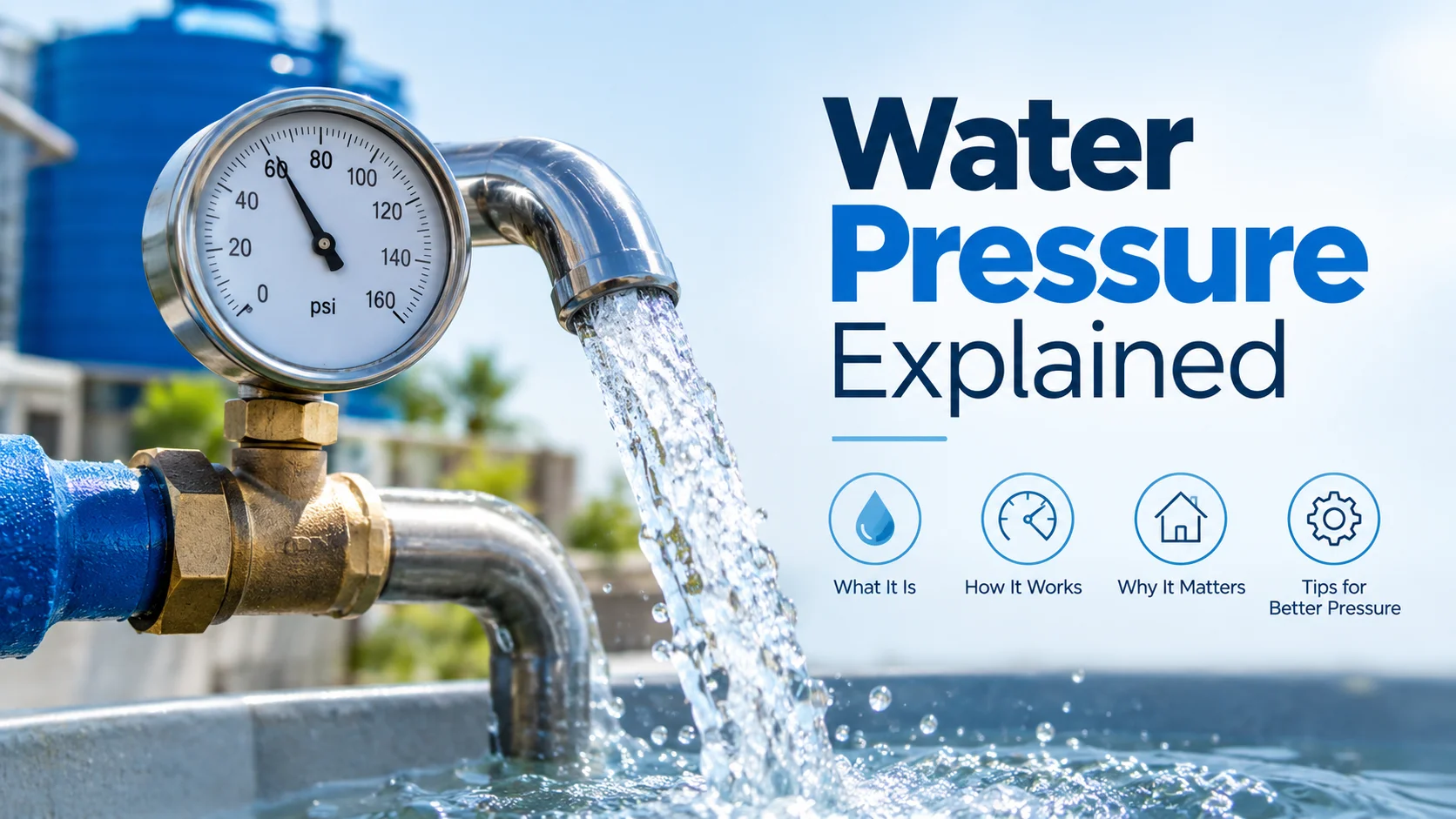
PSI, bar and kPa are three scales for the same thing: how hard water pushes on each unit of area. 1 bar = 100 kPa = 14.5 psi, and each is roughly the pressure at the bottom of a 10-metre (33-foot) column of water. Which unit you meet depends on where you are and what you are reading: psi on American gauges and pumps, bar on European ones, kPa in Australian plumbing rules, and often kg/cm² on gauges in South Asia.
For anyone with a water tank, one more unit matters more than all of these: metres of head. Every metre of height between the water surface and the tap gives about 0.1 bar (1.42 psi). That single figure tells you what a rooftop tank can deliver, how far mains pressure will lift water, and what a pump has to overcome.
Quick answer
- psi to bar: divide by 14.5. So 60 psi is 4.1 bar.
- bar to kPa: multiply by 100. So 3 bar is 300 kPa.
- psi to kPa: multiply by 6.9. So 40 psi is 276 kPa.
- Metres of head to bar: divide by 10. So a tank 5 m up gives about 0.5 bar.
- Feet of head to psi: multiply by 0.433. So 30 ft gives 13 psi.
The pressure units you will see, and where
| Unit | What it is | Where you meet it | Equal to 1 bar |
|---|---|---|---|
| psi | Pounds-force per square inch | United States; pump and tyre gauges worldwide | 14.5 psi |
| bar | 100,000 pascals | UK and Europe; most pump data sheets | 1 bar |
| kPa | Kilopascal, the SI unit | Australia, New Zealand, engineering standards | 100 kPa |
| MPa | Megapascal, 1,000 kPa | Pipe and fitting ratings | 0.1 MPa |
| m head | Height of a water column in metres (also mH₂O, mWC) | Pump curves, tank heights, water company standards | 10.2 m |
| ft head | Height of a water column in feet | US pump curves and well data | 33.5 ft |
| kg/cm² | Kilogram-force per square centimetre | Gauges in India, Pakistan and much of Asia | 1.02 kg/cm² |
Two shortcuts are worth remembering. A gauge marked in kg/cm² reads almost the same number as one in bar, and 1 kg/cm² is exactly 10 metres of head. And the “PN” number stamped on plastic pipe and fittings is the rated pressure in bar, so PN10 means 10 bar.
Conversion table: psi, bar, kPa and head
| 1 of these | psi | bar | kPa | m head | ft head |
|---|---|---|---|---|---|
| psi | 1 | 0.0689 | 6.895 | 0.703 | 2.31 |
| bar | 14.50 | 1 | 100 | 10.20 | 33.46 |
| kPa | 0.145 | 0.01 | 1 | 0.102 | 0.335 |
| m head | 1.422 | 0.0981 | 9.807 | 1 | 3.281 |
| ft head | 0.4335 | 0.0299 | 2.989 | 0.3048 | 1 |
| kg/cm² | 14.22 | 0.981 | 98.07 | 10.00 | 32.81 |
The Water Column Pressure Calculator turns any height into psi, bar, kPa and head in one step.
How height becomes pressure
The pressure under a column of still water depends on one thing only, which is how tall the column is:
P = ρ × g × h
P is pressure in pascals, ρ is the density of water (about 998 kg/m³ at 20°C), g is gravity (9.81 m/s²) and h is the height of water in metres.
Example: a tap sits 5 m below the water surface in a rooftop tank. P = 998 × 9.81 × 5 = 48,952 Pa, which is 49 kPa, 0.49 bar or 7.1 psi.
Water is densest at 4°C, at 1,000 kg/m³, and slightly lighter when warm (USGS). The difference is a fifth of one percent, so for plumbing the working figure is simply 9.8 kPa per metre, or 0.1 bar.
| Height of water | kPa | bar | psi |
|---|---|---|---|
| 1 m (3.3 ft) | 9.8 | 0.10 | 1.4 |
| 2 m (6.6 ft) | 19.6 | 0.20 | 2.8 |
| 3 m (9.8 ft) | 29.4 | 0.29 | 4.3 |
| 5 m (16.4 ft) | 49.0 | 0.49 | 7.1 |
| 8 m (26.2 ft) | 78.5 | 0.78 | 11.4 |
| 10 m (32.8 ft) | 98.1 | 0.98 | 14.2 |
| 15 m (49.2 ft) | 147 | 1.47 | 21.3 |
| 20 m (65.6 ft) | 196 | 1.96 | 28.4 |
| 30 m (98.4 ft) | 294 | 2.94 | 42.7 |
Three things follow from the formula, and each one settles a common argument:
- Tank size does not affect pressure. A 500-litre tank and a 5,000-litre tank at the same height give the same pressure at the tap.
- Pipe width does not affect pressure when nothing is flowing. It matters a great deal once a tap opens, which is covered below.
- Height is measured to the water surface. As the tank empties the surface drops and so does the pressure. Design from the tank outlet level, which is the worst case, not from the full level.
The same formula sets the load on the tank itself: water 2 m deep presses on the base and lower walls at about 0.2 bar. What hydrostatic pressure is and how it affects tank design covers that side, and the Hydrostatic Pressure Calculator gives the pressure at any depth for water or other liquids.
What pressure is normal? It depends where you live
There is no worldwide “normal”. Each country sets its own floor and ceiling, in its own unit. Put on one scale, they look like this:
| Where | The rule or target | In bar | In psi |
|---|---|---|---|
| United States | Pressure-reducing valve required when static pressure exceeds 80 psi (International Plumbing Code) | 5.5 | 80 |
| Texas, US (example) | Utilities must keep at least 35 psi in the network in normal operation | 2.4 | 35 |
| United Kingdom | Companies aim for at least 10 m head at the boundary; guaranteed minimum 7 m | 1.0 and 0.7 | 14 and 10 |
| Australia | Static pressure at any outlet in a building must not exceed 500 kPa | 5.0 | 72.5 |
| India | Design minimum at the house connection: 7 m, 12 m or 17 m head for one, two or three storeys | 0.7, 1.2, 1.7 | 10, 17, 24 |
The spread explains a lot about how homes are plumbed. An American house on 50 psi has around 35 metres of head to spend, so water reaches every floor directly and nobody needs a roof tank. A house designed around 7 to 10 metres of head has barely enough to reach the first floor, and where supply is intermittent the real figure is often lower still. That is why overhead tanks are standard in Indian homes and across South Asia, and why a rooftop tank can take hours to refill from a weak main.
How much pressure do you need?
Less than most people think, provided the fittings suit the pressure you have. These are the planning values used in our calculators for showers, which are usually the most demanding outlet in a house:
| Shower type | bar | psi | Head needed |
|---|---|---|---|
| Gravity shower, bare minimum | 0.1 | 1.5 | 1 m |
| Low-pressure shower head, workable | 0.3 | 4.4 | 3 m |
| Comfortable everyday shower | 0.5–0.7 | 7–10 | 5–7 m |
| Rain or power-spray head | 1.0–1.5 | 15–22 | 10–15 m |
Match the shower head to the system. Shower heads sold for mains-pressure homes are built for far more than a roof tank gives. The US EPA WaterSense specification tests them at 20, 45 and 80 psi (1.4, 3.1 and 5.5 bar), and 20 psi is the lowest pressure it checks (WaterSense). A tank 5 m up delivers a third of that. Fit a head made for low-pressure or gravity systems, and the same 0.5 bar feels entirely different.
In a building fed from a roof tank, pressure is lowest on the top floor and rises by about 0.3 bar with each 3-metre storey you go down. So the top-floor bathroom is the one to check. The Minimum Tank Height for Shower Pressure Calculator works out the height you need for a chosen pressure, with an allowance for pipe losses. For a weak shower you already have, see why shower pressure is low even with a full rooftop tank, and for taller buildings how to size a rooftop water tank for a multi-storey building.
If the height is not there, raising the tank is rarely the practical answer: every extra 0.1 bar needs another metre of stand, and the full weight of the tank goes up with it. A small booster pump does the same job at floor level. Pump system vs gravity feed compares the two approaches, and what a pressure tank is explains the vessel that usually comes with a pump.
Static pressure and flowing pressure
Everything above is static pressure: the pressure with every tap closed. Open a tap and the pressure at that tap falls, because moving water loses pressure to friction against the pipe wall. What is left is the flowing pressure, also called residual pressure, and loosely called dynamic pressure. It is the figure that decides how a shower feels.
Here is a tank 8 m above a tap, feeding it through 20 m of pipe. The static pressure is 0.78 bar in every row:
| Pipe bore | Flow | Head lost to friction | Pressure left at the tap |
|---|---|---|---|
| 15 mm | 9 L/min | 1.3 m | 0.66 bar (9.6 psi) |
| 15 mm | 15 L/min | 3.3 m | 0.47 bar (6.8 psi) |
| 20 mm | 15 L/min | 0.8 m | 0.71 bar (10.2 psi) |
| 25 mm | 15 L/min | 0.3 m | 0.76 bar (11.0 psi) |
At a modest flow the narrow pipe costs little. At shower-plus-tap flow it throws away 40% of the pressure the tank height provided, and one size up gets nearly all of it back. This is also why pressure sags when several taps run at once: more flow through the same pipe means more friction.
To put numbers on your own pipework, the Gravity Feed Flow Rate Calculator gives the flow a tank height and pipe will deliver, and the Pipe Size and Flow Rate Calculator does the same for a pressurised supply. How gravity feed water systems work explains the principles.
How to measure your own water pressure
- Static pressure. Screw a pressure gauge onto an outside tap or a washing machine valve, close every other outlet in the house and open that tap fully. The reading is your static pressure.
- Flowing pressure. Leave the gauge on and open another tap nearby. The lower reading is what you have while water is in use.
- No gauge? Time a bucket. On a UK main at 10 m head, the first tap in the house should fill a 4.5-litre bucket in 30 seconds, which is 9 L/min (WaterSafe). The Water Flow Rate Calculator converts a volume and a time into litres per minute.
- Repeat at another time of day. Mains pressure is highest at night when demand is low and lowest in the morning and evening. One reading tells you little.
- Tank-fed? You do not need a gauge. Measure the height from the tank outlet down to the tap and divide by 10 for bar.
When pressure is too high
Low pressure is the usual complaint with tanks, but mains pressure can also be too high. Above 500 kPa, Victoria’s plumbing regulator warns, pressure “can result in water hammer”, and it shortens the life of appliances, taps and fittings (Practice Note CW-03). The cure is a pressure-reducing valve, also called a pressure-limiting valve, on the supply line. The International Plumbing Code requires one above 80 psi, and Australian rules require one where any outlet would exceed 500 kPa.
If your pipes bang when a tap or float valve shuts, high pressure is one of the causes to check. See water tank making noise.
Mistakes people make with pressure units
| Mistake | What goes wrong | What to do |
|---|---|---|
| Reading psi as bar, or bar as psi | A pump labelled “60 psi” is a 4.1 bar pump, not a 60 bar one. A fitting rated 6 bar is good for 87 psi, not 6. | Find the unit on every label before comparing numbers, especially on imported equipment. |
| Treating tank height as delivered pressure | Height gives static pressure. Friction in a long or narrow pipe can take a third or more of it away under flow. | Work out the flowing pressure, and go up a pipe size on long runs. |
| Measuring to the wrong point | Head runs from the water surface to the outlet, not from the roof to the floor. A shower head 2 m above the floor has 2 m less head than the floor does. | Measure from the tank outlet to the shower head itself. |
| Mixing up gauge and absolute pressure | Gauges and fitting ratings use gauge pressure, which reads zero in open air. Absolute pressure adds the atmosphere, about 101 kPa or 14.7 psi at sea level. The two get confused when reading pump suction data. | Assume gauge pressure unless a figure is marked “abs”, “psia” or “bar(a)”. |
| Trusting a single reading | Mains pressure changes through the day and can fall to nothing where supply is intermittent. | Measure at night and at peak time before choosing a pump or tank height. |
| Expecting a bigger tank to raise pressure | Volume has no effect on pressure. Only height does. | Raise the outlet level, cut pipe losses or add a booster pump. |
More calculators for pressure work
- Pump Head Pressure Calculator: adds up lift, pipe friction and outlet pressure to give the total head a pump must meet. How pump head works explains the idea.
- Rooftop Load Bearing Calculator: check the roof before putting a tank on a taller stand to gain pressure.
If the whole system feels weak and not only the shower, my water tank pressure is low walks through the diagnosis.
Frequently asked questions
How do I convert psi to bar?
Divide psi by 14.5, or multiply by 0.0689. So 30 psi is 2.07 bar, 60 psi is 4.14 bar and 100 psi is 6.89 bar. To go the other way, multiply bar by 14.5: 2 bar is 29 psi.
How many kPa is 1 bar?
Exactly 100 kPa. One bar is also 0.1 MPa, 14.5 psi and about 10.2 metres of water head.
How much pressure does a rooftop tank produce?
About 0.1 bar (9.8 kPa, 1.42 psi) for every metre between the water surface and the outlet. A tank 3 m above a tap gives 0.29 bar, 5 m gives 0.49 bar and 10 m gives 0.98 bar. The size of the tank makes no difference.
What is a good water pressure for a house?
It depends on the system. In a mains-pressure home in the US, anything from the mid-30s psi up to the code ceiling of 80 psi (about 2.4 to 5.5 bar) is normal. A gravity-fed home works well at far less, around 0.5 to 0.7 bar at the shower, as long as the shower heads and taps are made for low pressure.
Is 40 psi enough water pressure?
Yes. 40 psi is 2.76 bar, or 28 metres of head. That is above the 35 psi Texas utilities must maintain, half the 80 psi code limit, and twice the lowest pressure at which WaterSense shower heads are tested. If it falls well below 40 psi when several taps are open, the pipework is the likely restriction, not the supply.
What does kg/cm² mean on a pressure gauge?
Kilogram-force per square centimetre, common on gauges in India, Pakistan and much of Asia and often just called “kg”. One kg/cm² is 0.981 bar, 98.07 kPa, 14.22 psi and exactly 10 metres of water head. For everyday plumbing you can read it as bar.
Why does my water pressure drop when several taps are open?
More flow through the same pipe means more friction, and friction is paid for in pressure. Doubling the flow through a pipe takes about 3.6 times the friction loss. A larger supply pipe is the lasting fix. Where the supply itself is weak, a booster pump drawing from a storage tank is the alternative.
What is the difference between static and dynamic pressure?
Static pressure is the reading with no water flowing. In plumbing, “dynamic” pressure usually means the flowing or residual pressure: what is left at the outlet once friction has taken its share. A tank 8 m up gives 0.78 bar static, but through 20 m of 15 mm pipe at 15 L/min only about 0.47 bar reaches the tap. Design for the flowing figure.
Sources
- NIST, Guide to the SI (Special Publication 811), Appendix B.8. Conversion factors: 1 psi = 6.894757 kPa; 1 bar = 100 kPa; 1 kgf/cm² = 98.0665 kPa; 1 ft of water = 2.989067 kPa; 1 atm = 101.325 kPa.
- US Geological Survey, Water Density. Density of water by temperature.
- US EPA, WaterSense Specification for Showerheads, version 1.1 (2018). Flow tested at flowing pressures of 20, 45 and 80 psi.
- City of College Station, Texas, Water Pressure. Quotes the International Plumbing Code requirement for a pressure-reducing valve above 80 psi (Section 604.8) and the Texas minimum operating pressure of 35 psi.
- WaterSafe (UK), What is the minimum water pressure that a water supplier must supply? 10 m head target, 7 m guaranteed minimum.
- Building and Plumbing Commission, Victoria, Practice Note CW-03: Maximum static water pressure within a building (2026). 500 kPa limit at any outlet.
- CPHEEO, Manual on Water Supply and Treatment, paragraph 10.3, as reproduced in an NCR Planning Board design clause. Minimum residual pressure of 7 m, 12 m and 17 m at the ferrule for one, two and three storeys.

Licensed Professional Engineer (Texas, PE) with 13+ years in residential and light-commercial water storage systems. Reviews and writes the technical guides on this site — sizing, pressure, roof loading, and treatment — based on 180+ completed field projects.