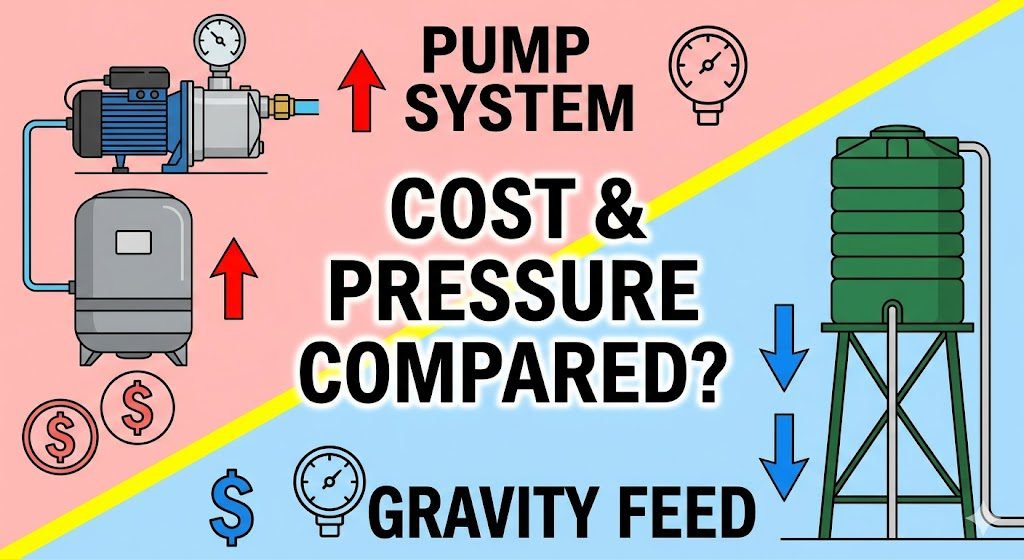
A gravity-feed system uses tank elevation to create pressure — free, silent, and immune to power cuts. A pump system draws water from a low-level or underground tank and pressurises it on demand — flexible, high-pressure, but dependent on electricity and maintenance. The correct choice depends on your available head height, pressure requirements, and power reliability. For a closer look at how each system works mechanically, see our guides on how gravity feed water systems work and how pump head works and why it matters for water tanks.
Before comparing systems, confirm the pressure your gravity setup would actually deliver using the gravity feed flow rate calculator. This tells you whether gravity alone can meet your fixture requirements without any pump investment.
How Each System Generates Pressure
Gravity feed relies entirely on static head — the vertical distance between the water surface in the tank and the outlet point. The formula is simple: 1 metre of head = 0.098 bar (approximately 1.42 psi) — see our guide on water pressure explained in psi, bar, and kPa if you want the full unit breakdown. A tank mounted 7 metres above the shower head delivers about 0.68 bar — adequate for standard showerheads (which typically require 0.1–0.3 bar) but insufficient for thermostatic mixer showers or high-pressure appliances that need 1–3 bar.
A pump system pressurises water independently of tank position. A typical residential pressure-boosting pump delivers 2–5 bar consistently. This means a ground-level or underground tank can supply high-pressure water to the top floor of a multi-storey building — something impossible with gravity from a rooftop tank on the same building.
Cost Comparison: Upfront and Ongoing
| Cost Factor | Gravity Feed | Pump System |
| Initial setup | Tank stand/rooftop structure: $200–2,000 | Pump unit: $150–1,500; plumbing: $200–800 |
| Energy cost | $0 (no electricity) | $30–180/year (residential use) |
| Maintenance | Minimal — inspect tank, clean annually | Annual service, impeller/seal replacement every 3–7 years |
| Failure cost | Low — no moving parts | Pump replacement: $150–800+ |
| 10-year total cost (estimate) | $300–2,500 (structure + maintenance) | $800–4,500 (pump + energy + servicing) |
These figures assume a residential installation. The pump energy cost is based on a 0.5 kW pump running 2 hours/day at $0.15/kWh. Larger commercial or agricultural systems have proportionally higher energy costs. Use the pump horsepower and flow rate calculator to size a pump correctly before estimating running costs.
Pressure Performance by System Type
| Fixture / Application | Gravity Feed Viable? | Minimum Head Required | Pump Pressure Needed |
| Standard tap | Yes | 1 m | N/A |
| Garden hose | Yes | 3 m | N/A |
| Basic showerhead | Yes | 3–5 m | N/A |
| Thermostatic mixer shower | Marginal | 10 m+ | 1–2 bar |
| Power shower | No | Not feasible | 2–3 bar |
| Washing machine | Yes (most models) | 3 m | N/A |
| Dishwasher | Yes | 3 m | N/A |
| Drip irrigation | Yes | 1–3 m | N/A |
| Sprinkler system (large area) | Marginal | 8 m+ | 2–4 bar |
When Gravity Feed Is Sufficient
Gravity feed is the better choice when: the tank can be mounted at least 5 metres above the highest outlet, the site has frequent power outages, and fixtures do not require high pressure. This describes the standard residential setup across South Asia, much of Africa, and rural areas globally where overhead tanks on 3–5 metre stands are the default.
The water pressure calculator can convert your available head height directly into bar and psi values, letting you check against every fixture’s stated minimum pressure requirement before deciding whether to invest in a pump.
When a Pump System Is Necessary
A pump is necessary when: the tank cannot be elevated to the required head, pressure-sensitive fixtures (thermostatic showers, high-pressure appliances) are installed, the water source is below the distribution point, or you need consistent pressure regardless of tank water level. In gravity systems, pressure drops as the tank empties, because the water surface inside the tank sits lower relative to the outlet — the size of that drop depends on how much of your total head comes from the tank’s own water depth versus the height of the stand or structure it sits on.
Common Mistakes
Underestimating head drop with a gravity system. A rooftop tank might be 6 metres above ground level, but the outlet in the master bathroom might only be 4 metres below the tank base — not 6. Calculate the actual head from the tank’s water surface (not the tank base) to the specific outlet, accounting for pipe friction losses. Friction loss in a 20-metre pipe run at typical residential flow can reduce effective pressure by 0.1–0.3 bar.
Oversizing a pump. A pump delivering 5 bar when the system only needs 2 bar wastes energy, causes water hammer in pipes, and strains tap washers and valve seats. Match pump output to system requirements — not to the maximum available on the shelf.
Assuming a pump solves all low-pressure problems. If your main supply pressure from the mains or borehole is already low, a booster pump only increases pressure from the supply point downstream. Low flow rate at the source — a borehole yielding only 0.5 L/s — cannot be overcome by increasing pump pressure. Flow rate and pressure are separate issues.
Neglecting the gravity falloff as the tank empties. In a gravity system, pressure at the outlet is not constant. A 2,000-litre tank at full level delivers a certain pressure; at 25% full, the water surface is lower and pressure drops accordingly. If fixtures require a minimum pressure, design for the minimum tank level that will ever be in use, not the full-tank level. If you’re troubleshooting pressure that’s already lower than expected even with a full tank, our guide on why is my shower pressure low even with a full rooftop tank covers the likely causes.
Related Calculators You Might Need
To verify that gravity feed will deliver adequate pressure for your specific setup, start with the minimum tank height for shower pressure calculator. If you are sizing a pump, the pump head pressure calculator determines the total dynamic head the pump must overcome including friction losses. For systems sourcing from a borehole or mains with variable pressure, the hydrostatic pressure calculator helps model static water column behaviour. If you want to know how long your tank will last on gravity supply alone before running dry, use the how long will my tank last calculator. And if your pressure is already low and you’re not sure why, our guide on what to check when your water tank pressure is low is a good starting point.
Frequently Asked Questions
Is gravity feed enough for a shower? For a basic showerhead, yes — if the tank is at least 3–5 metres above the showerhead. For thermostatic mixer showers, most manufacturers specify a minimum dynamic pressure of 0.5–1.0 bar, which requires at least 5–10 metres of head. For power showers (which have a built-in pump) or rain-head installations, gravity alone is inadequate and a booster pump is required. Use the gravity feed flow rate calculator to check your specific head height.
How much does it cost to run a water pump? A typical 0.5 kW residential pressure pump running 2 hours per day costs approximately $54/year at $0.15/kWh. A larger 1.5 kW pump on the same schedule costs around $165/year. Actual cost depends on run time and local electricity tariffs. Pumps triggered by every tap opening (pressure-switch systems) often run more frequently than expected — a faulty pressure vessel or loose fitting can cause the pump to cycle on and off continuously, multiplying energy consumption.
What is the minimum height for a gravity-fed water tank? The minimum height depends on the pressure requirement of your lowest-pressure fixture. Most household taps and showerheads require 0.1–0.3 bar minimum, which corresponds to 1–3 metres of head. However, designing for the minimum means no margin for pipe friction losses. A practical minimum for a usable gravity system is 4–5 metres above the highest outlet point.
Can I switch from gravity to pump without replacing the tank? Yes. Adding a booster pump downstream of an existing overhead or ground-level tank is straightforward. You plumb the pump into the main outlet pipe from the tank and install a pressure vessel and switch to maintain system pressure. The tank itself needs no modification. This is common when household pressure needs increase — new appliances, added bathrooms — after the original gravity system was installed.

Licensed Professional Engineer (Texas, PE) with 13+ years in residential and light-commercial water storage systems. Reviews and writes the technical guides on this site — sizing, pressure, roof loading, and treatment — based on 180+ completed field projects.