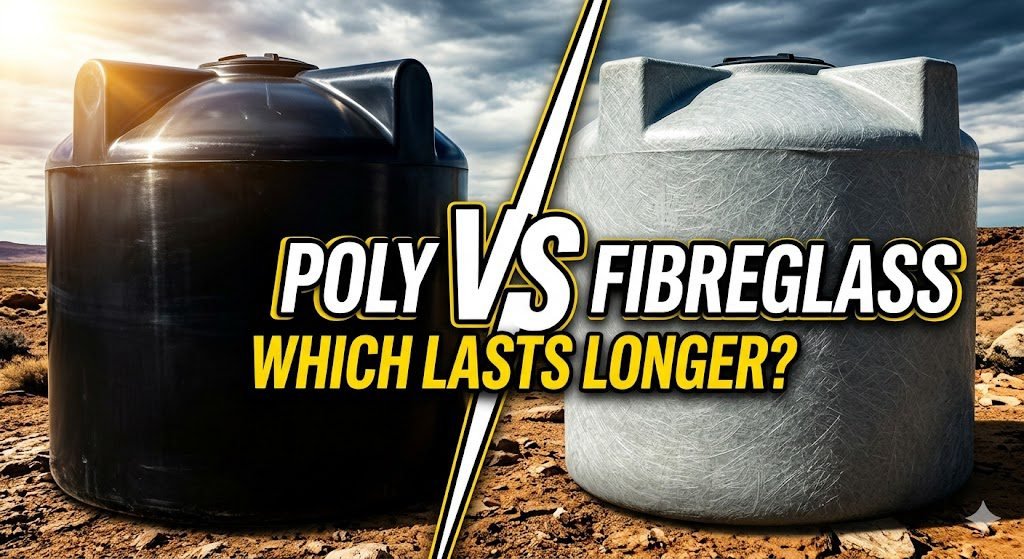
Fibreglass tanks generally last longer. As planning figures, allow 25–40 years for a fibreglass (GRP) tank and 15–25 years for a polyethylene tank, and the warranties point the same way: up to 30 years on fibreglass against 3 to 10 years on polyethylene. But lasting longer is not the same as costing less. Fibreglass usually costs about three times as much to buy, so for an ordinary above-ground home tank, polyethylene is still the cheaper choice per year of service.
Fibreglass earns its price in four situations: when the tank is buried, when it is very large, when the water is hot, and when vehicles will drive over it. This guide compares the two materials on lifespan, heat, burial, drinking-water safety, cost and repair, and ends with a checklist of what to look for on the label of either one.
Quick answer
- Lasts longer: fibreglass, by roughly 10 to 15 years in typical use.
- Costs less to buy and per year: polyethylene, in most above-ground home installations.
- Above ground, up to about 10,000 litres: choose polyethylene, kept shaded and on a flat, fully supported base.
- Buried, very large, hot water or under traffic: choose fibreglass.
- For drinking water: the material matters less than the certificate. Buy a tank certified for potable water, in either material.
Polyethylene vs fibreglass at a glance
| Property | Polyethylene | Fibreglass (GRP) |
|---|---|---|
| Planning lifespan | 15–25 years | 25–40 years |
| Example warranties | 3 to 10 years | Up to 30 years |
| Sunlight | Degrades in UV unless stabilised or made with carbon black | Surface weathers slowly; a pigmented gel coat or paint protects it |
| Knocks and impact | Tough; flexes and dents | Rigid; cracks instead of denting |
| Maximum water temperature | About 49°C to 66°C, depending on the maker | Up to 82°C above ground, 66°C buried |
| Burial | Only models built for it; shallow cover, no traffic | Routine; deep cover and traffic loads possible |
| Largest one-piece sizes | Roughly 50,000 L | Over 200,000 L |
| Fittings | Added through the wall; a possible leak point | Moulded in as part of the tank |
| Repair | Plastic welding, on linear polyethylene only | Laminated patch; must be fully cured |
| Price for 5,000 L | $500–1,500 | $1,750–4,000 |
| Empty weight | A few percent of the full weight | A few percent of the full weight |
Fibreglass is also written fiberglass, and sold as GRP (glass-reinforced plastic) or FRP. Polyethylene tanks are often just called poly or plastic tanks. If steel or concrete is also on your list, see plastic vs steel vs concrete water tanks, and the Plastic vs Steel Tank Cost Calculator for a side-by-side of those two from your own quotes.
How long does each one last?
No standard promises a lifespan for either material, so the most honest evidence is what manufacturers are willing to guarantee:
| Maker and product | Material | Warranty |
|---|---|---|
| Norwesco (US) tanks | Polyethylene | 3 years |
| Bushmans (Australia), above ground | Polyethylene | 10 years |
| Bushmans (Australia), underground | Polyethylene | 5 years |
| Xerxes (North America) potable water tanks | Fibreglass | 30 years, limited |
Tanks of both kinds normally outlive their warranties. What ends their life is different for each material, and most of it is in your control.
What wears out a polyethylene tank
- Sunlight. Polyethylene is UV-degradable (Texas Manual on Rainwater Harvesting). The plastic slowly turns brittle and chalky on the sunny side. Makers counter this with UV stabilisers or carbon black: India’s standard for moulded polyethylene tanks requires 2 to 3% carbon black in any tank meant for outdoor use (IS 12701). Even so, Norwesco notes that sheltering a tank extends its life.
- A poor base. Polyethylene is flexible, so it relies on the ground beneath it. IS 12701 says the flat base “should be fully supported over its whole bottom area”, and Bushmans voids its guarantee where the base was unsound. A tank that overhangs its slab or sits on stones is being bent every time it fills.
- Heat. Warm plastic is softer plastic. Keep the tank away from heaters and flues, and do not store hot water in it.
- Rigid pipework at the outlet. The wall moves slightly as the tank fills and empties. A rigid pipe bolted straight to the outlet turns that movement into stress at the fitting, which is why Bushmans requires a flexible hose there.
What wears out a fibreglass tank
- Impact. Fibreglass is stiff and strong but does not give. A blow that would dent polyethylene can crack it, most often during delivery and installation.
- Uneven support. A rigid shell on an uneven base carries its load on a few high points. The Texas manual’s one caution for fibreglass is that it “must be sited on smooth, solid, level footing”.
- Surface ageing. The inner surface of a GRP vessel deteriorates over decades and eventually needs repair, according to a 2010 study of GRP food and water vats. That is a slow process and a repairable one, which is a large part of why fibreglass lasts.
The cheapest way to add years to a polyethylene tank is shade and a proper base. A tank under a roof or on the shaded side of a building, on a flat slab wider than the tank, avoids the two things that age it fastest.
Heat and hot water
This is where the two materials differ most clearly on paper. Norwesco states that its polyethylene tanks “have a maximum storage temperature of 120 degrees F” (49°C). An engineering guide to rotationally moulded tanks puts the general limit for polyethylene at 150°F (66°C). The American standard for fibreglass water tanks, AWWA D120, covers service up to 180°F (82°C) above ground and 150°F (66°C) underground.
For cold mains water or rainwater this makes no difference. It matters if you store warm bore water, water returning from a solar heater, or process water. Bushmans excludes elevated-temperature water, and bore water that has not been cooled first, from its polyethylene guarantee. For those uses, fibreglass is the safer material.
Underground: the biggest difference
An ordinary polyethylene tank must not be buried. IS 12701 says so in its scope: “These tanks are not meant for underground applications.” The Texas manual agrees that standard plastic tanks “must be installed above ground” and that burial needs “specially reinforced tanks”. Soil pushes inward on an empty tank, and a thin flexible wall designed to hold water in is not designed to hold soil out.
Polyethylene tanks made for burial do exist, but compare their limits with fibreglass:
| Condition | Polyethylene burial tank (Norwesco) | Fibreglass burial tank (Xerxes) |
|---|---|---|
| Soil cover | 15 to 76 cm (6 to 30 in) | At least 0.9 m (36 in); standard design to 2.1 m (7 ft), deeper with a thicker wall |
| Vehicles overhead | Not permitted | Rated for truck loads with the specified cover |
| High water table | Not permitted | Anchored to concrete deadmen with straps |
| Keeping water in it | Filled as the backfill rises; cisterns left one-quarter full | Backfilled in layers to the maker’s procedure |
So fibreglass is the usual material for anything buried deep, buried large or buried under a driveway. A small polyethylene cistern is fine in a well-drained garden with shallow cover and no traffic.
An empty buried tank can float. Where groundwater rises above the base of the tank, the upward force is roughly 1 kg for every litre of tank below the water line. Both materials are light, so both need the anchoring the maker specifies. Ask about your water table before you dig.
For the wider question of where the tank should go, see overhead vs underground water tanks. The Underground vs Rooftop Tank Cost Calculator compares the two from your own quotes, and the Underground Water Tank Volume Calculator works out capacity from the dimensions of a pit or an existing tank.
Are they safe for drinking water?
Both are, when the finished tank is certified for it. Australian health guidance lists plastic and fibreglass among suitable tank materials, “providing the materials used are at least of food-grade standard” (enHealth). The certificate to look for depends on where you live:
| Region | Standard to look for | What it covers |
|---|---|---|
| US and Canada | NSF/ANSI/CAN 61 | Chemicals a product can release into drinking water |
| Australia and New Zealand | AS/NZS 4020 | Products in contact with drinking water |
| India | IS 12701 (polyethylene), IS 14399 (GRP panel tanks) | Tank construction, including a migration test for polyethylene |
“Food-grade resin” is not the same as a certified tank. A statement that the plastic meets FDA food-contact rules describes the raw material. NSF/ANSI/CAN 61 is tested on the product, and makers certify it plant by plant: Norwesco, for example, lists NSF 61 certification at five of its manufacturing facilities. Ask for the certificate for the model you are buying.
Fibreglass: check that it is fully cured
Polyester resin is hardened with styrene, and a tank that has not cured completely can give stored water a chemical taste and smell. The 2010 study found that cure temperature was the main factor: a 3-hour cure at 80°C cut both the leftover styrene and the amount that moved into water by about 100 times. A new fibreglass tank that smells strongly of resin inside is not ready. Ask the supplier whether the tank was post-cured, and the same applies to any repair made later.
Polyethylene: a new-tank taste that fades
New plastic tanks can also give water a taste at first. enHealth notes that this “will diminish with time” and is not a health hazard when the tank is potable-water grade. One caution on resin type: cross-linked polyethylene, used for some chemical tanks, was traditionally not approved for potable water, so check the certificate if a tank is described as cross-linked or XLPE. If stored water tastes or smells wrong in a tank that is not new, see why water tastes or smells bad after storage.
Both: keep the light out
“Exposure of stored rainwater to light will lead to algal growth”, in enHealth’s words, and tanks should be impervious to light. That is a question of opacity, not of material. A thin white or pale tank of either kind lets light through. This is why outdoor polyethylene tanks are often built in layers, with a black outer layer and a white inner one, and why the Texas manual says a fibreglass tank for drinking water should be opaque. A black tank blocks light best. Its drawback is heat: it warms the water more in full sun, which is one more reason to shade it.
Routine cleaning and disinfection are the same for both. How chlorination of water tanks works explains the process, and the Water Tank Disinfection Calculator gives the dose for your volume.
Cost: purchase price and cost per year
As planning figures, a 5,000-litre polyethylene tank costs $500–1,500 and a fibreglass one $1,750–4,000. Prices vary a great deal by country, so treat the ratio as the useful part: fibreglass costs roughly three times as much.
The fair comparison is cost per year of service:
| Polyethylene | Fibreglass | |
|---|---|---|
| Price, 5,000 L | $1,000 | $3,000 |
| Service life | 20 years | 30 years |
| Cost per year | $50 | $100 |
| Over 60 years | 3 tanks, $3,000 | 2 tanks, $6,000 |
The rule: fibreglass is cheaper per year only if its price is a smaller multiple than its lifespan. A tank that costs 3 times as much has to last more than 3 times as long. At 1.5 times the life, it costs twice as much per year.
Burial changes the sum. Underground, the excavation often costs more than the tank, and replacing a failed tank means paying for the dig again. There the longer life of fibreglass is worth far more than the table suggests.
To run your own quotes, the Water Storage Cost per Litre Calculator spreads price, installation and maintenance over the lifespan you enter and gives a cost per year. The Water Tank Installation Cost Estimator covers the installation side.
Repair and end of life
Polyethylene. Glue does not hold on polyethylene, so repairs are made by plastic welding. That works only on linear polyethylene, which is what most water tanks are made of. Cross-linked polyethylene “cannot be recycled or welded”, so a cracked cross-linked tank is scrap. Linear polyethylene can be recycled at the end of its life.
Fibreglass. The Texas manual describes fibreglass tanks as easily repaired: a crack is ground back and covered with new layers of glass and resin. The patch has to cure fully before the tank holds drinking water again, for the styrene reason above. Fibreglass cannot be melted down, so recycling options at the end of its life are limited.
Fittings. On fibreglass tanks the fittings are “an integral part of the tank”. On plastic tanks they are added through the wall, and the Texas manual warns that such bulkhead fittings “might be subject to leakage”. Check them once a year. A weeping fitting is a small job when caught early.
Which should you choose?
| Your situation | Better choice | Why |
|---|---|---|
| Home tank above ground, up to about 10,000 L | Polyethylene | Lowest cost per year; light and quick to install |
| Rooftop tank | Polyethylene | Easy to lift; the water is the load either way |
| Farm or yard where it may get knocked | Polyethylene | Dents instead of cracking |
| Tank you may move later | Polyethylene | Tolerates handling |
| Buried, in a well-drained garden, small | Either | Use a burial-rated model and follow its limits |
| Buried deep, large or under a driveway | Fibreglass | Built for soil and traffic loads |
| Warm bore water or solar return water | Fibreglass | Higher temperature rating |
| Very large single tank | Fibreglass | Available far beyond polyethylene sizes |
| You want to fit it once and forget it | Fibreglass | Longest warranties |
Material comes after size. If you have not settled the volume yet, start with how to calculate the right water tank size for your home or the Water Tank Size for Home Calculator. For a roof installation, the full weight is what your structure has to carry, so get it from the Water Tank Weight Calculator, run the Rooftop Load Bearing Calculator and read will my roof hold a full water tank. Shape and number of tanks are separate choices, covered in round vs rectangular water tanks and single large tank vs multiple small tanks.
What to check before you buy
Polyethylene tank
- Made to a tank standard: ASTM D1998 (US), AS/NZS 4766 (Australia and New Zealand) or IS 12701 (India)
- Certified for drinking water, for the model you are buying
- UV-stabilised or carbon black, and opaque: no daylight visible through the wall from inside
- Wall thickness stated. As a reference point, IS 12701 sets a 4.5 mm minimum for a 1,000 L tank
- Rated for burial, if it is going in the ground
- Warranty length, and what the base and plumbing conditions are
Fibreglass tank
- Made to a tank standard: AWWA D120 (US) or IS 14399 (India, panel tanks)
- Certified for drinking water as a finished tank, with a food-grade resin lining
- Post-cured, with no strong resin smell inside
- Opaque wall or pigmented gel coat
- For burial: the maker’s cover depth, traffic rating and anchoring details
- Delivery inspection: look for cracks and crazing before you sign for it
Wall thickness matters because water pressure at the bottom of a tank rises with depth, by about 0.1 bar for every metre. That is why taller tanks need thicker walls low down. What hydrostatic pressure is and how it affects tank design explains the principle.
Mistakes to avoid
- Burying an above-ground tank. It was not built for soil pressure. Only bury a tank its maker rates for burial.
- Comparing sticker prices. Compare cost per year, and remember that a longer life only pays if it is longer by more than the price difference.
- Buying a pale, thin-walled tank for a sunny spot. Light through the wall grows algae, whatever the material.
- Setting a tank on an uneven or undersized base. It shortens the life of polyethylene and can crack fibreglass.
- Accepting “food grade” in place of a certificate. Ask which drinking-water standard the finished tank is certified to.
- Filling a new fibreglass tank that still smells of resin. Have the supplier confirm the cure first.
Frequently asked questions
Which lasts longer, a polyethylene or a fibreglass water tank?
Fibreglass. A reasonable planning range is 25–40 years for fibreglass and 15–25 years for polyethylene. Warranties show the same gap: up to 30 years on fibreglass potable water tanks, against 3 to 10 years on polyethylene. Shade and a good base narrow the gap for polyethylene.
How long does a polyethylene water tank last?
Plan on 15–25 years for a UV-stabilised tank on a proper base. Sunlight is the main thing that shortens it, followed by a base that does not support the whole floor and by stored water that is too warm. The polyethylene warranties cited in this guide run from 3 to 10 years.
Is fibreglass safe for drinking water storage?
Yes, when the tank is certified for potable water and fully cured. Look for NSF/ANSI/CAN 61 in North America or AS/NZS 4020 in Australia and New Zealand. An under-cured tank can give water a styrene taste and smell, so a strong resin smell inside a new tank is a reason to send it back.
Which is cheaper, a polyethylene or a fibreglass water tank?
Polyethylene, both to buy and per year of use in most above-ground installations. As a planning figure, fibreglass costs about three times as much for the same volume and lasts about one and a half times as long. Fibreglass comes out ahead mainly underground, where replacing a tank means digging again.
Can a polyethylene tank be buried?
Only if it was made for burial. Standard above-ground tanks are not designed for soil pressure, and India’s IS 12701 excludes underground use outright. Burial-rated polyethylene cisterns have limits: Norwesco’s, for example, allow 15 to 76 cm of cover, no vehicles overhead and no high water table.
Can polyethylene tanks be repaired?
Linear polyethylene tanks can be repaired by plastic welding, which is a specialist job because adhesives do not bond to the material. Cross-linked polyethylene tanks cannot be welded. A long crack in the wall of a large tank is usually a reason to replace it.
Does the colour of the tank matter?
Opacity matters more than colour. A wall that lets light through allows algae to grow in the water. Dark and black tanks block light well but run warmer in full sun, and pale tanks stay cooler but must be thick or layered enough to be opaque. Whatever the colour, shade helps.
What causes a fibreglass tank to crack?
Impact is the usual cause, most often a knock during transport or installation. The second is uneven support, where a rigid shell carries its load on a few high points instead of the whole base. Inspect a new tank on delivery and set it on smooth, solid, level footing.
Sources
- Bureau of Indian Standards, IS 12701:1996, Rotational Moulded Polyethylene Water Storage Tanks. Not for underground use; 2 to 3% carbon black for outdoor tanks; 4.5 mm minimum wall for 1,000 L; base fully supported.
- American Water Works Association, AWWA D120, Thermosetting Fiberglass-Reinforced Plastic Tanks (2019). Service temperature to 180°F above ground and 150°F underground.
- Texas Water Development Board, The Texas Manual on Rainwater Harvesting, 3rd edition. Fibreglass and plastic tank features, cautions, fittings and burial.
- enHealth (Australia), Guidance on the use of rainwater tanks. Food-grade materials, AS/NZS 4020, light and algal growth, new-tank taste.
- NSF, NSF/ANSI 61: Drinking Water System Components, Health Effects.
- Bradley EL, Castle L, Damant AP, Jickells SM, Philo MR, Laboratory studies into how glass-reinforced plastic (GRP) vat surfaces can be repaired without causing migration of styrene into foodstuffs, Journal of Coatings Technology and Research, 2010.
- Oltman D and Auber M, Specifying rotationally molded PE storage tanks, Environmental Science and Engineering Magazine, 2004. Linear and cross-linked polyethylene; welding and recycling; temperature limit.
- Norwesco, frequently asked questions and underground tank installation guide. Three-year warranty, 120°F maximum storage temperature, burial limits.
- Bushmans, warranty terms. Ten years above ground and five years underground for polyethylene tanks.
- Xerxes, potable water tanks and fiberglass underground tank storage (ARCSA presentation). 30-year limited warranty; burial depth, anchoring and capacities.

Licensed Professional Engineer (Texas, PE) with 13+ years in residential and light-commercial water storage systems. Reviews and writes the technical guides on this site — sizing, pressure, roof loading, and treatment — based on 180+ completed field projects.