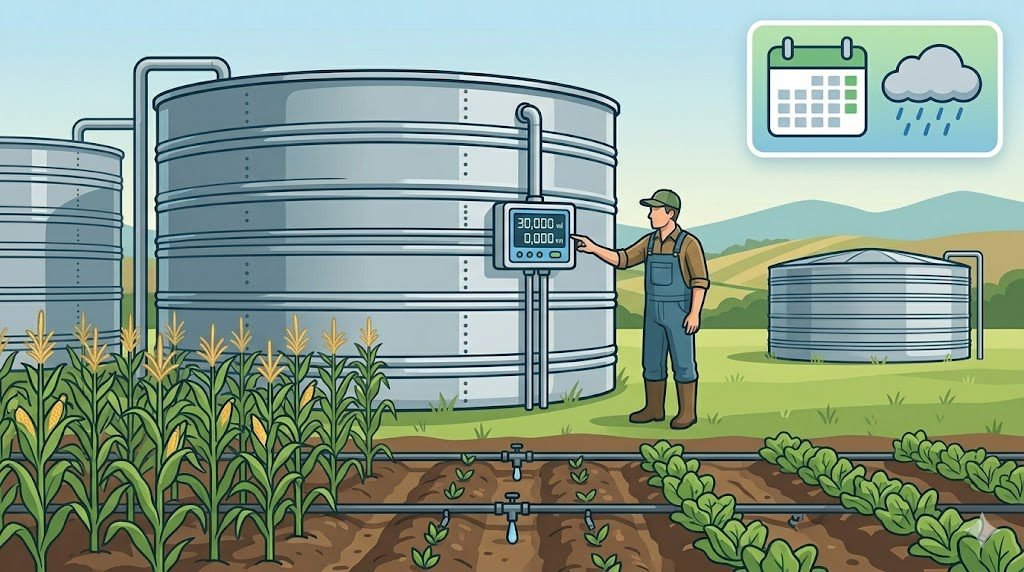
A farm irrigation tank needs to hold enough water to bridge the gap between your source (bore, river, rain, mains) and your peak daily crop demand — typically across the hottest, driest stretch of the season when source flow drops and crop stress peaks simultaneously. The minimum tank size equals peak daily demand × buffer days, where buffer days is determined by your source reliability, not personal preference. This article covers the FAO-based calculation method, crop-specific benchmarks, and the sizing errors that cause tanks to run dry during critical growth windows. If your farm also carries livestock, see our guide on agricultural water storage sizing for irrigation for how the two demands combine in practice.
The Quick Answer
The core formula is:
Tank size (L or m³) = irrigated area (ha) × crop water need (mm/day) × 10,000 × buffer days × 1.15
Where 10,000 converts mm/ha to litres/ha (1 mm of water over 1 hectare = 10,000 L), and 1.15 adds a 15% safety margin for distribution losses and pump inefficiency.
Crop type
Peak water need (mm/day)
1 ha, 3-day buffer (L)
5 ha, 3-day buffer
Maize (corn)
6–8
207,000–276,000 L
~1.0–1.4 ML
Wheat
4–6
138,000–207,000 L
~0.7–1.0 ML
Tomato (field)
5–7
172,500–241,500 L
~0.9–1.2 ML
Pasture / fodder grass
5–9
172,500–310,500 L
~0.9–1.5 ML
Tree fruits (orchard)
3–5
103,500–172,500 L
~0.5–0.9 ML
Use the farm water storage calculator to enter your crop type, irrigated area, and source reliability for a precise tank size recommendation.
How the calculation works
Crop water need (also called ETc — crop evapotranspiration) is derived from the FAO Penman-Monteith method (FAO Irrigation and Drainage Paper No. 56). It accounts for reference evapotranspiration (ETo) — a climate-driven baseline — multiplied by a crop coefficient (Kc) that varies by growth stage.
ETc (mm/day) = ETo × Kc
During peak growing season in a semi-arid climate, ETo runs 6–10 mm/day. Kc for maize at mid-season is 1.20 (FAO), giving a peak ETc of 7.2–12 mm/day. For wheat at mid-season, Kc is 1.15.
Worked example: 3 ha of tomatoes, 3-day buffer, semi-arid region
Peak ETc for tomatoes: 6 mm/day (conservative estimate).
Daily demand: 3 ha × 6 mm × 10,000 = 180,000 L/day
3-day buffer: 180,000 × 3 = 540,000 L
15% safety margin: 540,000 × 1.15 = 621,000 L (621 m³). This requires either one large above-ground bladder tank or a concrete/earthen storage pond of that capacity.
Key variables that change the answer
Source refill rate vs demand rate. If your bore pumps 5 L/second and your peak demand is 4 L/second, you may not need buffer storage at all — the bore keeps pace. If your bore pumps 2 L/second but demand peaks at 5 L/second, you need buffer storage equal to the deficit × peak hours. A bore pumping 10 hours per day at 2 L/s delivers 72,000 L/day — if your crop demands 120,000 L/day, you need to buffer 48,000 L minimum, plus supply gap coverage.
Irrigation method efficiency. Drip irrigation delivers water directly to the root zone with 85–95% application efficiency. Sprinklers run 70–80%. Surface flooding runs 40–60%. A switch from flood to drip on the same crop area reduces water demand — and therefore tank size — by 35–55%. The buffer days required also drop because less water is lost to evaporation between the tank and the root zone.
Soil water holding capacity. Clay-heavy soils hold 150–200 mm of plant-available water per metre of depth. Sandy soils hold 50–80 mm/m. A deep clay soil acts as a natural buffer — crops can draw from stored soil moisture for 3–5 days without irrigation before stress onset. Sandy soils have almost no buffer — daily irrigation is required. Soil type directly affects how many buffer days your tank must cover.
Seasonal rainfall during irrigation season. If your irrigation season overlaps with partial rainfall — common in Mediterranean or monsoon-adjacent climates — effective rainfall reduces net irrigation requirement. FAO’s CROPWAT method accounts for effective rainfall (typically 70–80% of actual rainfall is plant-available). A 20 mm rainfall event on 3 ha = 600,000 L, replacing approximately 3 days of irrigation demand in a moderate-use crop.
Irrigation system and tank sizing scenarios
Farm type
Area
Method
Buffer days
Min tank
Market garden
0.5 ha
Drip
3 days
90–130 KL
Arable crop farm
10 ha
Sprinkler
3 days
1.5–2.5 ML
Orchard (tree fruit)
5 ha
Drip
5 days
750 KL–1.2 ML
Dairy farm (pasture)
20 ha
Flood/spray
3 days
3–6 ML
Common mistakes
Sizing to average ETc rather than peak ETc. Average crop water need across a full growing season is 20–40% lower than peak mid-season demand. A tank sized for average demand runs dry during the 4–6 weeks of peak demand when crop stress causes the most economic damage. Always size to peak ETc — typically mid-season for most crops — not the season average.
Not accounting for pump flow rate vs tank draw rate. A common error: the farmer calculates daily crop demand correctly but chooses a pump sized for average flow rather than peak demand. If the irrigation system draws 8 L/s for 6 hours per day but the bore pump delivers 3 L/s continuously, the tank must absorb the deficit (5 L/s × 6 hours = 108,000 L buffer minimum). Undersizing here means the tank empties before the irrigation run completes. The irrigation pump size calculator helps confirm your pump is matched to peak demand before this becomes a problem.
Treating the tank as a season-long reserve rather than a daily buffer. Farm irrigation tanks are not intended to store an entire season’s water requirement — that volume is impractical to store. The tank’s job is to smooth out the mismatch between source availability (often time-of-use restricted or flow-rate limited) and daily crop demand peaks. Size for 3–7 days of peak daily demand, not the full irrigation season.
Ignoring evaporation losses from open storage. Open concrete ponds and earthen dams lose 5–15 mm/day to evaporation in hot, dry conditions (equivalent to 50–150 m³/ha/day). A 500,000 L earth tank in a hot semi-arid climate can lose 30,000–60,000 L per day to evaporation alone. Covered poly tanks or sealed concrete eliminates this loss. When comparing tank types, factor evaporation into the effective storage capacity.
Related calculators you might need
The irrigation water requirement calculator takes your crop type, climate zone, and irrigated area to output daily and seasonal water needs without manual ETc calculations. If you’re using drip irrigation, the drip irrigation tank size calculator accounts for the application efficiency of drip systems specifically. For farms also running livestock, the livestock water requirement calculator produces the daily drinking and management water needed per animal type — combine this with your irrigation figure for total farm storage. And if you’re choosing between a bore pump and a gravity-fed tank system, the irrigation pump size calculator tells you the pump specification needed to meet your peak demand.
Frequently asked questions
How do I size a farm water tank for irrigation?
Multiply your irrigated area in hectares by your crop’s peak water need in mm/day by 10,000 to get litres per day. Multiply that by your buffer days (3–7 for most farms) and add 15% for losses. Example: 2 ha of tomatoes at 6 mm/day peak = 120,000 L/day × 3 days × 1.15 = 414,000 L minimum. Use the farm water storage calculator to model your specific crop and source conditions.
What size water tank do I need for 1 hectare of irrigation?
At a mid-range crop water need of 6 mm/day, 1 hectare requires 60,000 litres per day. For a 3-day buffer with 15% losses, that is 60,000 × 3 × 1.15 = 207,000 L (207 m³). High-demand crops like maize in peak summer can push this to 300,000+ L for the same area and buffer period. Low-demand crops like orchards may require only 120,000–150,000 L.
How many days of irrigation water should I store?
Size for your realistic source gap — the longest period your source cannot deliver at full rate. For bore-fed farms with reliable bores: 2–3 days. For surface water systems subject to seasonal low flow: 5–7 days. For farms relying on water deliveries or seasonal rainfall collection: size to span the full expected dry interval. Never size for less than 2 days regardless of source type — equipment failures always occur at peak demand.
What is the difference between crop water need and irrigation water requirement?
Crop water need (ETc) is the water a crop demands from all sources — rain, soil moisture, and irrigation combined. Irrigation water requirement (IWR) is ETc minus effective rainfall and soil moisture contribution. IWR is always less than or equal to ETc. In dry seasons with no rainfall, IWR = ETc. In wet seasons, IWR can be near zero. Tank sizing should use IWR during the irrigation season, not ETc, to avoid oversizing.
Can I use a rainwater harvesting system to fill a farm irrigation tank?
Yes, where catchment area and rainfall are adequate. A farm shed roof of 500 m² with 600 mm annual rainfall captures approximately 270,000 L per year (at 90% efficiency). Whether that meets irrigation demand depends entirely on when rain falls vs when crops need water. In most agricultural regions, peak irrigation demand coincides with the dry season — meaning rainwater harvesting supplements rather than replaces irrigation storage. Size the tank to the irrigation need, not the catchment capacity.
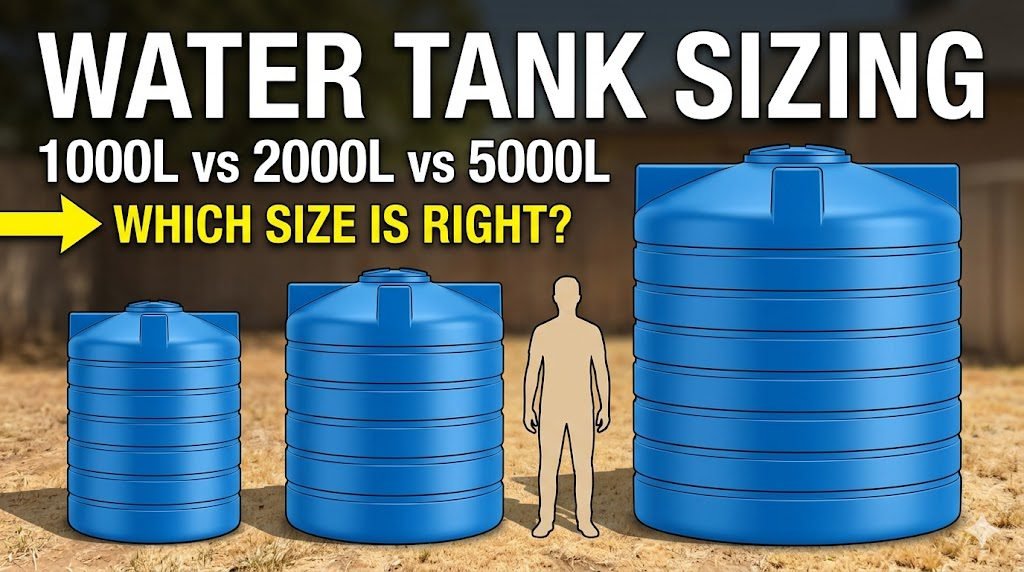
A 2,000-litre tank is the right starting point for a household of 3–4 people with a reasonably reliable municipal supply. A 1,000-litre tank only works for 1–2 people or as a secondary top-up tank. A 5,000-litre tank is correct when supply is intermittent, the household is large, or irrigation is involved. This article gives you the formula to confirm the right size for your actual usage, supply pattern, and site constraints. If you specifically need a number for a four-person household, see our dedicated guide on what size water tank does a family of 4 need.
The quick answer
Tank sizing comes down to three numbers: daily consumption, how many backup days you need, and what you can physically fit on the site. Use the Water Tank Size for Home Calculator to get a number tailored to your household size, climate, and supply reliability.
Household / Use Case
Daily use (L)
Backup days
Recommended size
1–2 people, city supply
100–150 L
7 days
1,000 L
3–4 people, city supply
200–300 L
7 days
2,000 L
3–4 people, intermittent supply
200–300 L
14 days
5,000 L
5–6 people, city supply
300–450 L
7 days
3,000–5,000 L
5–6 people, rural/borehole
300–450 L
21 days
5,000–10,000 L
Small farm or livestock (<20 head)
500–1,000 L
7 days
5,000 L
Daily use figures are based on WHO guidelines (50–100 L/person/day for basic use, up to 150 L in high-income households). Backup days assume one supply interruption per week at the stated duration.
How the calculation works
The formula is straightforward: Tank size = Daily household consumption (L) × Backup days required.
Every variable matters. Here is a worked example:
Household: 4 people. Average daily use: 250 L (62.5 L/person, within the WHO range for basic needs). Supply reliability: city mains, 10-day worst-case outage. Tank size = 250 × 10 = 2,500 L. Round up to 3,000 L for a safety margin, or 2,000 L if you are confident outages rarely exceed 7 days.
If you are adding irrigation or livestock, calculate those demands separately and add to the household figure before sizing. A vegetable garden of 50 m² uses 3–5 L/m²/day in hot climates — that adds 150–250 L/day to the calculation. Use the Daily Water Requirement Calculator to model combined household and garden demand.
Key variables that change the answer
Supply reliability. This is the single biggest variable. In cities with 24/7 mains pressure, a 7-day backup (the most common outage scenario in South Asian urban centres) drives the tank size. In rural areas or regions with scheduled outages — parts of sub-Saharan Africa, Pakistan, India — 14–21 day buffers are standard. Doubling the backup period doubles the required tank size.
Household size. Per-person water use does not scale linearly. A single person in a large house uses more water than a per-head average suggests — shared facilities change the maths. Per-capita use typically drops from 120–150 L/person for 1–2 person households to 80–100 L/person for households of 5+.
Climate and season. In arid climates, a household of 4 uses 20–30% more water during summer months due to increased showering, garden watering, and evaporative cooling. Size for peak-season demand, not annual average. A tank sized on annual averages will run dry for 3 months of every year.
Rooftop vs ground installation. A filled 5,000-litre tank weighs 5,025 kg. Most residential reinforced concrete roof slabs in South Asia are rated for 150–200 kg/m². A 5,000-litre tank requires a 25–33 m² load distribution or a purpose-built concrete plinth — it cannot sit on a typical residential roof. The 2,000-litre tank at 2,020 kg filled requires careful load distribution. The 1,000-litre tank at 1,015 kg filled is the only one that routinely clears standard residential roof loading without engineering input. Before assuming any of these will work on your specific roof, see will my roof hold a full water tank; for multi-storey buildings where the maths differ further, see how to size a rooftop water tank for a multi-storey building.
Spec
1,000 L
2,000 L
5,000 L
Typical footprint (HDPE)
1.0 m dia.
1.3–1.4 m dia.
1.8–2.0 m dia.
Height (vertical HDPE)
1.4 m
1.7 m
2.5 m
Filled weight
1,015 kg
2,020 kg
5,025 kg
Typical rooftop fit?
Yes (most slabs)
Verify load
No — ground only
Price range (HDPE)
$50–$150
$120–$280
$280–$600
Price range (steel)
$180–$350
$300–$550
$700–$1,400
Common mistakes
Sizing for average demand instead of peak demand. Average daily use across the year is not the number to use. A family of 4 that uses 250 L/day in winter can hit 380 L/day in summer when children are home, gardens need watering, and temperatures push daily showering up. Tank sized at 250 × 7 = 1,750 L will run out in 4–5 days at peak summer demand. Size for peak-season use or you will constantly supplement with deliveries.
Ignoring the refill rate. A tank only works if it refills before the next demand cycle. If your mains pressure delivers 200 L/hour and your household uses 300 L/day, your 2,000-litre tank refills in 10 hours — fine. If your supply is gravity-fed at 50 L/hour, refill takes 40 hours and you will drain the tank faster than it fills. Check refill time with the Tank Refill Time Calculator. If refill is slower than consumption rate, size up.
Buying the cheapest tank without checking wall thickness. 1,000-litre HDPE tanks range from 3.5 mm wall thickness (entry-level) to 8+ mm (heavy-duty). A thin-walled tank stored at ground level under direct sun in a hot climate will deform and develop stress cracks within 5 years. Wall thickness is not always advertised — ask the manufacturer for the specification sheet or check for a 10-year warranty as a minimum proxy.
Not accounting for dead volume. The outlet fitting on most tanks is positioned 5–15 cm above the base — this is dead volume you cannot use. On a 1,000-litre tank, 50–100 litres (5–10%) may be inaccessible without a pump. Factor this into your usable capacity calculation, especially for tanks near the bottom of your backup requirement. If you’re weighing one large tank against splitting the same capacity across several smaller units, our guide on single large tank vs multiple small tanks covers the trade-offs.
Related calculators you might need
Once you know the tank size you need, the next check is whether your roof structure can support it. Run the Rooftop Load Bearing Calculator before ordering anything above 1,000 litres for an elevated position. If your situation is an apartment with limited space, the Apartment Water Tank Size Calculator accounts for the space and load constraints typical of multi-storey buildings. To verify your current tank is lasting as expected, use the How Long Will My Tank Last Calculator to model drawdown against your daily usage. And if you already have a tank but suspect it’s the wrong size for your household, our guide on how to tell if your water tank is the wrong size for your home walks through the warning signs.
Frequently asked questions
Is a 1000-litre tank enough for a family of 4? Only if your mains supply is continuous and reliable. At 200–300 L/day for 4 people, a 1,000-litre tank provides 3–5 days of backup — not enough for extended outages. If your city experiences outages longer than 3 days, move to 2,000 L minimum. Use the Water Tank Size for Home Calculator with your specific outage data to confirm.
What is the standard water tank size for a house? There is no universal standard, but 2,000–3,000 litres is the most common residential tank size across South Asia, Australia, and sub-Saharan Africa for households of 3–5 people. This covers 7–14 days of typical household use and fits within standard residential roof load limits when properly distributed.
Can a 5000-litre tank go on a rooftop? Rarely. At 5,025 kg filled, a 5,000-litre tank exceeds the load capacity of most residential rooftops. It typically requires a purpose-built ground-level pad or a reinforced concrete structure. Even purpose-built elevated plinths need structural engineering signoff for this weight. A 5,000-litre tank is a ground-level or below-ground installation in most residential contexts.
How do I calculate the right tank size for my home? The basic formula is: daily household water use (litres) × maximum backup days required. If you use 250 L/day and need 10 days of backup, you need 2,500 L minimum. Add 20% margin for peak-season demand variation. If you have irrigation or livestock, add those daily volumes before multiplying by backup days.
Does a bigger tank mean better pressure? No. Water pressure from a gravity-fed tank depends on the height of the water surface above the outlet, not the tank volume. A 1,000-litre tank mounted 5 metres high gives the same pressure as a 5,000-litre tank at the same height. To calculate the pressure you will get from your tank elevation, use the Water Pressure Calculator.
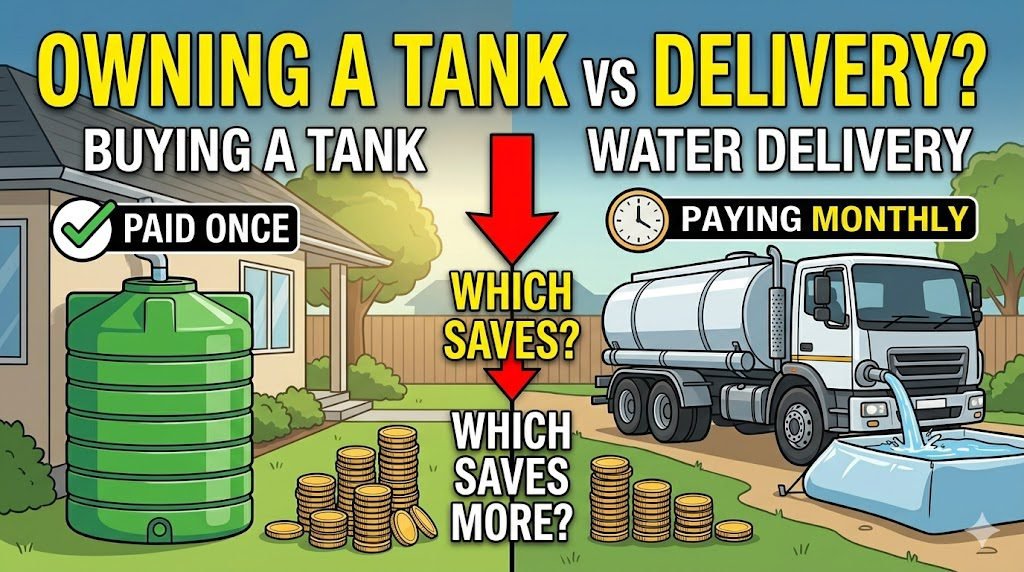
If you are spending more than $80–$120/month on water delivery, buying a tank almost always saves money within 24 months. Below that threshold, the calculation depends on your delivery frequency, local tank prices, and how reliably you can refill the tank from mains or rainwater. This article gives you the break-even formula and the numbers for common real-world scenarios so you can decide which is cheaper for your situation. If mains water isn’t your only alternative to delivery, our guide on rainwater harvesting vs municipal supply: real cost comparison covers a third option worth weighing.
The quick answer
Water delivery costs $5–$50 per 1,000 litres in most markets — 10 to 100 times more expensive per litre than stored mains water. A household spending $100/month on deliveries will typically recover the cost of a $1,500 tank system in 15 months. Use the Water Delivery vs Tank Cost Calculator to enter your actual delivery spend and get a personalised break-even date.
Water Tank (owned)
Water Delivery (recurring)
Upfront cost
$200–$2,500+ (tank + install)
Near zero
Cost per 1,000 L
$0.05–$0.50 (amortised)
$5–$50 (delivered)
Supply control
Full — fill on your schedule
Dependent on supplier
Quality consistency
Depends on storage hygiene
Variable by supplier
Long-term cost trend
Fixed (depreciating asset)
Rising (market-linked)
Break-even vs delivery
12–36 months typical
N/A
Space required
Yes (footprint + height)
None
Right for intermittent needs?
No — tank sits idle
Yes — pay only when needed
How the calculation works
The break-even formula: Break-even (months) = Total tank system cost ÷ Monthly delivery savings.
Monthly delivery savings = Current monthly delivery spend − Monthly tank operating cost (maintenance + refill if paid for).
Worked example — rural Kenya: A household buys 4,000 litres/month from a water vendor at KES 80/20L jerrycan = KES 16,000/month ($120 USD). A 5,000-litre HDPE tank installed costs KES 35,000 ($262). Mains connection unavailable, so they refill with tanker delivery at bulk rate KES 25/20L = KES 5,000/month ($37.50). Monthly saving = $120 − $37.50 = $82.50. Break-even = $262 ÷ $82.50 = 3.2 months. After break-even, the tank saves $990/year ongoing.
Worked example — suburban Australia: Household spends A$180/quarter on delivered spring water for drinking. Tank system with pump and filter: A$1,200. Quarterly saving: A$180 − A$15 maintenance = A$165. Break-even = A$1,200 ÷ A$165/quarter = 7.3 quarters (22 months). After break-even: A$660/year saved.
Monthly delivery spend
Tank cost ($1,500 total)
Break-even point
$50/month
$1,500
30 months (2.5 years)
$100/month
$1,500
15 months
$200/month
$1,500
7.5 months
$500/month
$1,500
3 months
Key variables that change the answer
Delivery cost per litre. This drives the entire calculation. Urban water delivery in developed markets runs $1–$5 per 20-litre container ($50–$250/m³). Rural delivery via tanker in developing markets runs $5–$30/m³. Municipal mains water averages $0.30–$2.50/m³. The gap between what you pay for delivery and what you could pay for refilling a tank is the core economic engine of the decision.
Delivery frequency and minimum orders. Delivery services charge per trip, not per litre. A household taking one 5,000-litre delivery per month pays a trip fee once. A household taking eight 500-litre deliveries pays the trip fee eight times. If you are currently ordering in small quantities due to lack of storage, a tank dramatically reduces your effective cost per litre even before the volume discount on bulk delivery is factored in.
Access to low-cost refill. A tank only saves money if you can refill it cheaply. If mains water is available at $0.50/m³, a 5,000-litre tank costs $2.50 to refill — replacing $25–$250 of delivery cost. If your only option is another (slightly cheaper) tanker service, the savings are real but smaller. The Water Storage Cost Per Litre Calculator shows the all-in cost per litre of owning and filling your own tank at various refill tariffs.
Permanence of need. Water delivery makes economic sense for temporary or irregular needs: construction sites, seasonal properties, emergency backup. If you are in a location for 3+ years and water is a recurring cost, a tank almost always wins on 5-year economics. If you are renting short-term, the upfront capital cannot be recovered. In that case, delivery remains the pragmatic choice regardless of unit cost.
Common mistakes
Comparing tank cost to a single delivery rather than cumulative spend. A $1,200 tank sounds expensive compared to a $40 delivery. Compared to 30 months of $40 deliveries ($1,200 total), it looks different. Always calculate cumulative delivery cost over 2–3 years before concluding that a tank is too expensive.
Under-sizing the tank for delivery economics. If you buy a 1,000-litre tank but need 3,000 litres/month, you still need 2–3 deliveries per month and lose most of the benefit of tank ownership. The tank needs to be large enough to reduce your delivery frequency to once per month or less — otherwise trip fees dominate the cost. Our guide on how to size a water tank for daily household use walks through getting this number right, and the How Long Will My Tank Last Calculator confirms your tank lasts the intended interval between refills.
Not factoring in installation and access costs. Tank prices quoted online are often ex-works. Add delivery of the tank itself ($50–$300 depending on distance), installation labour ($100–$500), and site preparation if needed (concrete pad, plumbing connections). The all-in cost is routinely 40–80% higher than the sticker price for the tank alone. Always use the installed cost in your break-even calculation, not the purchase price.
Ignoring water quality differences between delivery and stored water. Delivered water is often tested and certified at point of sale. Stored water quality depends entirely on tank hygiene, UV exposure (algae risk), and whether the tank is properly sealed against contamination. A poorly maintained tank can deliver water that is worse quality than the delivery service it replaced. Clean and inspect tanks every 12–24 months and use the Water Tank Disinfection Calculator to calculate chlorination doses correctly.
How much does water delivery cost? Water delivery costs vary widely: $1–$5 per 20-litre container in urban developed markets ($50–$250/m³), $5–$30/m³ for tanker delivery in rural or developing-country settings, and $0.10–$0.50/m³ for municipal mains supply. The gap between mains and delivery is the economic case for tank ownership.
How do I calculate if buying a tank is worth it? Divide the all-in cost of the tank system (tank + installation + filtration) by your current monthly delivery spend minus the projected monthly tank operating cost (maintenance + cheap refill). The result is your break-even in months. If break-even is under 24 months and you plan to stay in the location 3+ years, buying a tank almost always makes sense.
Is water delivery safe compared to a tank? Reputable delivery services test water at point of filling. Stored tank water is safe if the tank is food-grade HDPE or stainless steel, sealed against insects and contamination, cleaned annually, and treated if stored for more than 6 months. Neither is inherently safer — maintenance practices determine quality in both cases.
What size tank do I need to reduce water delivery costs? Size the tank to last at least 30 days between refills at your current usage rate. If your household uses 300 L/day, you need a 9,000-litre minimum for a 30-day interval. In practice, most households buying 3,000–5,000-litre tanks reduce delivery frequency from weekly to monthly — cutting the trip-fee component by 75%.
Does buying a tank make sense for a rental property? Rarely. The upfront cost cannot typically be recovered in 1–2 year rental periods, and the tank is a fixed asset that may not transfer with you. Water delivery remains the rational choice for tenancies under 3 years unless the landlord is willing to invest in and retain the tank as part of the property.
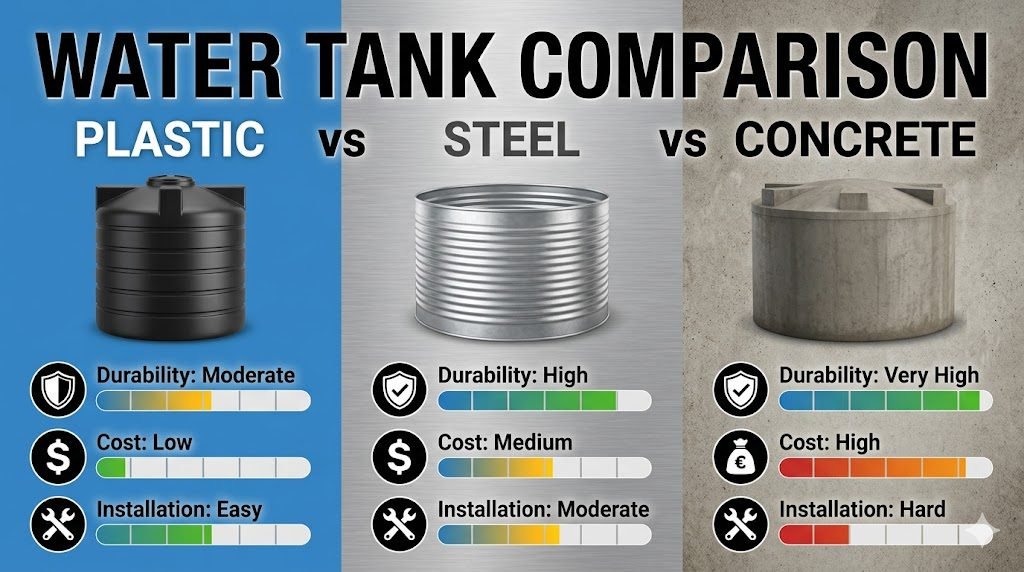
For most households and small commercial sites, HDPE plastic tanks deliver the best value: lowest upfront cost, easiest installation, and adequate lifespan for most use cases. Steel wins on fire resistance and aesthetics in commercial settings. Concrete is the right call only when permanence and very high capacity are the primary requirements. This article breaks down all three across cost, durability, maintenance, safety, and climate suitability so you can make a call that holds up over decades. If you’re specifically deciding between plastic sub-types, our guide on polyethylene vs fibreglass water tanks goes deeper on that comparison.
The quick answer
Plastic tanks dominate residential markets globally because they are cheap, light, and food-safe. Galvanised steel tanks serve farms and light industry where structural durability matters. Reinforced concrete tanks are built when nothing else will survive the environment — underground cisterns, bushfire zones, high-load commercial sites. Use the Plastic vs Steel Tank Cost Calculator to run a side-by-side cost comparison for your specific capacity and region.
Factor
Plastic (HDPE/PP)
Steel (GI/SS)
Concrete (RCC)
Cost (1,000L)
$50–$150
$120–$400
$180–$600+
Lifespan
10–25 years
15–30 years
30–50+ years
Weight (empty, 1,000L)
8–25 kg
60–120 kg
500–1,000 kg
Installation
DIY-possible
Skilled labour needed
Civil work required
Maintenance
Low
Moderate (rust risk)
Low (seal/crack checks)
Algae risk
High (translucent)
Low
Low
Taste/odour risk
Low (food-grade)
Moderate (galvanised)
Low (lined)
BPA risk
None (HDPE/PP)
None
None
Seismic risk
Low (flexible)
Moderate
High (brittle)
Recyclable
Yes (partially)
Yes (fully)
No
All cost ranges are indicative for a 1,000-litre tank installed in a residential setting. Regional prices vary by up to 40%.
How the calculation works
Tank material selection is not purely a cost decision — it is a total cost of ownership calculation. The variables are: upfront purchase price, installation labour, maintenance over the expected lifespan, likelihood of early failure, and replacement cost.
A simple total cost of ownership (TCO) formula: TCO = Purchase price + Installation cost + (Annual maintenance cost × lifespan in years) + (Replacement cost if lifespan exceeded).
Worked example for a 5,000-litre tank, 20-year horizon, warm-climate residential site:
Plastic (HDPE): $400 purchase + $100 installation + ($20/year × 20 years) = $900 total. Expected lifespan: 15–20 years. One replacement likely over 40 years.
Steel (galvanised): $900 purchase + $350 installation + ($80/year × 20 years) = $2,850 total. Includes annual rust inspection and repainting every 7–10 years.
Concrete: $2,000 construction + $1,000 civil labour + ($30/year × 20 years) = $3,600 total. Lifespan 40–50 years means no replacement on that horizon — TCO per year is competitive over longer timescales.
Key variables that change the answer
Climate and UV exposure. UV radiation degrades standard polyethylene over 10–15 years. UV-stabilised HDPE tanks extend this to 20–25 years. In tropical zones above 25°C mean annual temperature, plastic tank walls can soften and deform if water is stored above ground without shade. Steel and concrete are immune to UV degradation but concrete cracks under thermal cycling — a 30°C daily temperature swing increases crack propagation compared to stable-temperature environments (ACI 350 guidance).
Seismic zone. In high seismic zones (IS 1893 / ASCE 7), unreinforced concrete tanks above ground fail catastrophically under lateral loading. HDPE flexes and survives. Steel tanks anchored to a pad survive if the anchor bolts are rated correctly. If you are in a high-seismic zone, plastic or properly anchored steel is the default recommendation.
Firefighting requirements. Australian bushfire-prone areas (BAL-40 and above) typically require steel or concrete tanks. AS 3959 fire exposure testing shows standard HDPE tanks can deform and fail under sustained radiant heat exposure well below the temperatures a bushfire front can generate. Steel tanks survive direct flame impingement for extended periods without structural failure.
Water quality — hardness and pH. Hard water (above 200 mg/L CaCO3) accelerates scale buildup in galvanised steel tanks and can corrode the zinc coating, releasing zinc at levels above WHO’s aesthetic guideline of 3 mg/L. Concrete tanks leach lime into stored water initially, raising pH to 10–12 for the first 2–3 filling cycles. Plastic is pH-neutral and scale-resistant across the full potable water range. See our guide on how water hardness affects storage for more on how this interacts with tank material.
Roof loading. A 1,000-litre concrete tank fully loaded weighs approximately 2,500 kg including structure. A comparable HDPE tank weighs approximately 1,020 kg. Most residential roof slabs in South Asia are designed for 150–200 kg/m² live load. No 1,000-litre concrete tank should be placed on a residential rooftop without a structural engineer’s sign-off — see will my roof hold a full water tank for what to check first. Use the Rooftop Load Bearing Calculator before specifying any overhead storage tank.
Common mistakes
Buying a translucent plastic tank. Light penetration drives algae growth. Blue or black HDPE tanks block the great majority of light; translucent white or yellow tanks let significantly more light through. Algae blooms are not just aesthetic — they consume dissolved oxygen and can produce toxins. Always specify opaque tanks. If you already have a translucent tank, paint the exterior with food-safe reflective paint.
Installing a galvanised tank without pH testing the water. Galvanised steel corrodes rapidly below pH 6.5. Water in granite-geology catchments frequently sits at pH 5.5–6.0. At that level, a galvanised tank can shed zinc at several times the WHO aesthetic guideline within 12 months. Check water pH with the Water pH Adjustment Calculator and treat if needed, or switch to stainless steel or HDPE.
Skipping curing on new concrete tanks. Uncured concrete leaches calcium hydroxide, pushing stored water above pH 11. At that pH, chlorine disinfection is significantly less effective and water tastes strongly alkaline. Cure new concrete tanks by filling and draining three times, or applying a food-grade epoxy liner before commissioning — our guide on how chlorination of water tanks actually works explains why pH matters so much for disinfection.
Using tank volume as the only sizing criterion. Material choice affects how you should size the tank. Concrete tanks are typically oversized at construction because adding capacity later is nearly impossible. HDPE tanks can be added in series cheaply. If your requirements might grow — more occupants, irrigation expansion — size for future demand now if choosing concrete, or buy modular plastic and expand later. Our guide on single large tank vs multiple small tanks covers this trade-off in more detail.
Related calculators you might need
Before purchasing, confirm the numbers hold up. The Water Tank Cost Calculator gives a full purchase and installation estimate by material type and capacity. If the tank is going on a roof, the Safe Rooftop Tank Load Calculator will tell you whether your slab can handle the filled weight before you commit. For treatment planning — particularly relevant for steel and new concrete tanks — the Water Hardness Calculator and TDS Water Calculator will flag whether your source water is corrosive or scaling.
Frequently asked questions
How long does a plastic water tank last? Food-grade HDPE tanks last 10–25 years depending on UV exposure, water chemistry, and whether the tank was manufactured with UV stabilisers. Cheap tanks without UV inhibitors in tropical climates can fail in 7–10 years. Premium brands with UV-stabilised HDPE and 10-year warranties are widely available and worth the 20–30% price premium.
Are plastic water tanks safe for drinking water? Yes, provided the tank is manufactured from food-grade polyethylene (HDPE or PP) and marked as such. The material itself does not leach harmful chemicals into water under normal storage conditions. BPA is not present in HDPE or PP — it is associated with polycarbonate (PC), which is not used in water storage tanks.
Which is better for a rooftop water tank — plastic or steel? Plastic (HDPE) is the correct default for rooftop installation. A 2,000-litre HDPE tank weighs approximately 30–40 kg empty vs 150–200 kg for a comparable steel tank. Lighter structure means lower structural load on the slab, lower installation cost, and no risk of rust staining. Confirm the filled weight is within your roof’s rated capacity using the Water Tank Weight Calculator.
Do concrete tanks need to be lined? Not always, but lining is recommended for potable water storage. Bare concrete leaches lime during the first several months of use. A food-grade epoxy or polyurea coating applied to the interior eliminates this and adds 10–15 years to the effective life of the tank. Cost is typically $8–$25 per square metre of internal surface, depending on tank size and coating type.
What is the most durable water tank material? For structural longevity: reinforced concrete tanks correctly built and lined last 50+ years with minimal maintenance. For practical durability in residential settings accounting for cost, repairability, and ease of installation: UV-stabilised HDPE with a 20+ year warranty from a reputable manufacturer is the most pragmatic choice for the vast majority of homeowners.
In most urban settings, municipal supply remains cheaper on a per-litre basis than rainwater harvesting — but that comparison ignores reliability, price trajectories, and the value of supply independence. Rainwater harvesting becomes cost-competitive when municipal tariffs exceed $1.50/m³, when supply is unreliable, or when the system is sized to supplement rather than replace mains water. This article sets out the real numbers so you can make the calculation for your location. For the mechanics behind how a system actually collects and stores water, see how rainwater harvesting works.
The quick answer
Municipal water costs $0.30–$2.50/m³ in most countries (WHO/IWA data). Rainwater harvesting amortised over a 20-year system life costs $0.50–$3.00/m³ depending on system size, rainfall, and local construction costs. Use the Rainwater Harvesting ROI Calculator to enter your roof area, local rainfall, and current water bill for a site-specific comparison.
Factor
Rainwater Harvesting
Municipal Supply
Setup cost
$500–$5,000 (residential)
$0 (connection included)
Ongoing cost (annual)
$30–$80 maintenance
$200–$800 (bills)
Water quality
Variable — needs treatment
Regulated (safe by default)
Reliability
Climate-dependent
High (in most cities)
Volume available
Limited by catchment + rainfall
Essentially unlimited
Carbon footprint
Low (pumping only)
Higher (treatment + distribution)
Regulatory status
Permitted with conditions in most regions
No restrictions
Typical payback period
5–15 years
N/A
How the calculation works
Step 1 — Quantify what you can collect. Annual collection (litres) = Roof catchment area (m²) × Annual rainfall (mm) × Runoff coefficient × 0.85 first-flush loss factor. A typical runoff coefficient is 0.80–0.90 for metal roofs, 0.70–0.80 for tiles, 0.60–0.70 for concrete (FAO Irrigation and Drainage Paper No. 25) — see what is water tank runoff coefficient and how is it calculated for a fuller explanation of this factor.
Worked example — Sydney, Australia: 100 m² metal roof. Annual rainfall: 1,200 mm. Runoff coefficient: 0.85. First-flush factor: 0.90. Annual collection = 100 × 1,200 × 0.85 × 0.90 = 91,800 litres (91.8 m³) per year. For more on how Australian rainfall patterns and local rules affect system sizing, see rainwater harvesting in Australia.
Step 2 — Value the collected water. Sydney water tariff: approximately A$2.35/kL (Sydney Water). Value of 91.8 m³ = 91.8 × $2.35 = A$215.7/year
Step 3 — Calculate system cost. Basic residential system (100 m² catchment, 2,000-litre tank, first-flush diverter, pump): A$1,500–$2,500 installed. Annual maintenance: A$50–$80.
Step 4 — Payback: At A$216/year savings and A$2,000 system cost, payback = 9.3 years. After payback, net saving of A$135–$165/year (after maintenance). Over 20-year system life: net saving of A$650–$1,350 after accounting for setup cost.
In higher-tariff cities (Copenhagen at $6.70/m³, Berlin at $5.30/m³, or private water delivery in low-income urban areas at $10–$20/m³), payback compresses to 3–5 years. If you’re weighing a tank against a water delivery service rather than mains supply specifically, our guide on buying a water tank vs water delivery: which saves more money runs that comparison directly.
Key variables that change the answer
Local water tariff. This is the most important variable. A $0.30/m³ tariff (common in subsidised city systems across South Asia and parts of Africa) makes rainwater harvesting economically marginal — the free municipal supply is simply too cheap to beat on cost alone. At $2.00/m³ and above, rainwater harvesting is clearly economical. At tariffs above $4.00/m³ (typical in Northern Europe, parts of Australia, and commercial metered supplies globally), it is financially compelling without any reliability argument.
Annual rainfall and distribution. A city with 800 mm annual rainfall concentrated in 4 months captures and uses water differently from one with 1,200 mm spread across 9 months. The critical metric is not annual rainfall but the length of the dry gap — if you have 5+ months of zero or near-zero rainfall, your tank needs to be large enough to bridge that gap, which drives up system cost significantly. Use the Annual Rainwater Collection Calculator to model your specific climate.
Supply reliability and quality. Where municipal supply is intermittent, contaminated, or subject to boil-water orders, the value of rainwater harvesting goes beyond cost — supply independence has real dollar value. In cities where households already pay for bottled water or water delivery because mains quality is poor, harvested rainwater (properly filtered and treated) eliminates that supplementary spend. This can add $300–$1,000/year in effective savings that a pure cost-per-litre comparison misses.
System sizing. Over-sizing a rainwater system is the most common economic error. A tank that collects more than your catchment can supply during dry months costs money to build but delivers no additional water. The optimal tank size for most residential systems is 2–6 weeks of average demand — enough to bridge dry spells without building excess storage capacity that never fills. The Rainwater Savings Calculator models this against your actual usage pattern.
Common mistakes
Comparing rainwater cost to municipal cost without including treatment. Rainwater requires filtration and disinfection for potable use — minimum a sediment filter plus UV or chlorination. Add $200–$600 upfront and $50–$100/year running costs. Many cost comparisons omit these and make rainwater look cheaper than it is. For non-potable uses (irrigation, toilet flushing, laundry) treatment costs are lower, which is why these end-uses give better economics.
Assuming rainfall translates directly to collection. First-flush contamination (bird droppings, dust, organic matter on the roof surface) means the first 1–2 mm of each rain event should be diverted to waste. On a 100 m² roof, the first 100–200 litres of every rain event are typically discarded. Without a properly sized first-flush diverter, this contaminated water enters your tank — see what is a first flush diverter and do you need one for the full explanation. Size the diverter correctly using the First Flush Diverter Size Calculator.
Ignoring local regulations. Rainwater harvesting is restricted or regulated in some jurisdictions. In parts of the US (historically Colorado, now relaxed; still regulated in Utah and Oregon), collection was legally restricted for water rights reasons. In Australia, South Australia and Queensland have mandatory requirements for new dwellings. In most of South Asia and Africa, harvesting is encouraged or required in new construction. Check local planning rules before investing in any system.
Not accounting for roof material contamination. Asbestos cement, copper, lead-painted, and pressure-treated timber roofs contaminate runoff with material-specific toxins. HDPE, Colorbond/Zincalume, and uncoated concrete tile roofs are the safest catchment surfaces for potable water collection (ANZECC guidelines). If your roof material is incompatible with potable collection, restrict harvested water to non-potable uses only.
Related calculators you might need
Before committing to a system, run the Roof Catchment Area Calculator to establish your maximum possible collection volume — this sets the upper limit on system value. If you are evaluating whether the investment is worthwhile, the Rainwater Harvesting Payback Calculator models your specific tariff, rainfall, and system cost to give you a payback period in years. For sites with existing mains supply where cost reduction is the primary goal, the Water Bill Savings Calculator quantifies the annual bill reduction from partial or full rainwater substitution.
Frequently asked questions
Is rainwater harvesting worth it financially? It depends on your local water tariff and rainfall. At tariffs above $1.50/m³ and with 700+ mm annual rainfall, a correctly sized system typically pays back in 7–12 years and generates positive returns over its 20-year life. At tariffs below $0.80/m³ or with less than 500 mm annual rainfall, the economics are marginal and the case rests on supply reliability rather than cost.
How much does a rainwater harvesting system cost? A basic residential system with 2,000-litre tank, guttering, first-flush diverter, and sediment filter runs $800–$2,500 installed depending on the region and labour rates. Larger systems with pumps, UV treatment, and 5,000+ litre tanks cost $3,000–$8,000. Add 15–25% for below-ground installation.
Can harvested rainwater replace municipal supply entirely? In high-rainfall regions (above 1,200 mm/year, well-distributed), large systems (10,000+ litres) can supply 80–100% of household demand for toilet, laundry, and irrigation. Full potable supply replacement is technically feasible but requires multi-stage treatment (sediment + activated carbon + UV minimum) and is subject to regulatory approval in many regions. Most systems are sized to supplement, not replace.
Does rainwater harvesting make sense in dry climates? It can, but tank sizing becomes critical. A dry climate with seasonal rainfall requires enough storage to bridge the dry months. In Phoenix, AZ (200 mm/year), a 100 m² roof collects only 14,000 litres annually — enough for garden irrigation but not meaningful household supply. In Brisbane (1,000 mm/year), the same roof collects 75,000+ litres — a significant household contribution.
What is the environmental benefit of harvesting rainwater? Reduced demand on municipal systems lowers energy use for water treatment and pumping — typically 0.3–0.8 kWh/m³ for conventional treatment and distribution. At a household scale, a system delivering 80 m³/year substitutes approximately 40–64 kWh of embedded energy annually. Carbon benefit is real but small compared to the supply resilience and cost arguments in most residential cases.
A single large tank costs less per litre of storage capacity and is simpler to install and maintain. Multiple smaller tanks in parallel cost more upfront but offer redundancy, easier installation in constrained sites, and the ability to expand capacity incrementally. The right answer depends on whether your site can accommodate a large tank, whether supply continuity under failure matters, and what your budget phasing looks like. This article covers both options across cost, reliability, installation, and site constraints.
The quick answer
For most residential applications with straightforward site access and a ground-level or purpose-built elevated pad, a single large tank is cheaper and simpler. Multiple tanks are the right call when the site physically constrains tank size, when continuity of supply is critical, or when you need to expand gradually. Use the Water Tank Cost Calculator to compare total installed cost for both configurations at your target capacity.
Factor
Single Large Tank
Multiple Small Tanks
Unit cost per litre of capacity
Lower (economies of scale)
Higher (more units, more fittings)
Installation complexity
One connection point
Manifold plumbing required
Redundancy if one fails
None — total loss
Partial — others remain online
Site footprint
Larger single footprint
Distributed — flexible placement
Access to tight spaces
Poor (large tanks don’t fit)
Good (small tanks manoeuvrable)
Phased capacity expansion
Replace entire tank
Add another unit
Maintenance per litre
Lower
Higher (multiple entry points, fittings)
Pressure/flow uniformity
Higher (single head height)
Varies if tanks at different heights
Rooftop suitability
Limited (weight)
Better distributed load
Tank failure impact
Catastrophic loss
Isolated to one unit
How the calculation works
Cost comparison at 10,000 litres total capacity: A single 10,000-litre HDPE tank: approximately $600–$900 purchase + $200 installation = $800–$1,100 total. Two 5,000-litre tanks with manifold plumbing: approximately $560–$1,200 purchase + $350–$500 installation = $910–$1,700 total. Four 2,500-litre tanks with manifold: $640–$1,200 purchase + $600–$900 installation = $1,240–$2,100 total.
Per litre of capacity, a single tank typically costs 15–40% less than an equivalent multi-tank arrangement at the same total volume. The premium for multiple tanks comes from: higher per-unit tank prices (smaller tanks have higher cost-per-litre than larger ones), additional fittings and plumbing for the manifold, and more installation time.
However, cost-per-litre is not the only metric. The economic case for multiple tanks includes: avoided loss on failure (if one of four tanks fails, you retain 75% of capacity; if the single large tank fails, you have zero), and phased capital outlay (buy two tanks now, add two more in 18 months when budget allows, without re-engineering the system if you plumbed for it upfront).
Key variables that change the answer
Site access and installation constraints. A 10,000-litre HDPE tank is typically 2.8–3.0 metres in diameter and 3.2–3.5 metres tall. It requires crane or telehandler delivery and a clear path to the installation site. Narrow access (less than 2.5 m gate width), trees, overhead lines, or basement locations make large tanks impractical. Four 2,500-litre tanks, each under 1.8 m diameter, can be manoeuvred by two people and installed almost anywhere. If your site is constrained, multiple small tanks may be the only option, and cost becomes secondary.
Rooftop load distribution. A single 5,000-litre HDPE tank fully loaded weighs 5,100 kg. Concentrated on one roof beam, this exceeds the safe capacity of most residential slabs. Four 1,250-litre tanks distributed across four beam positions, weighing 1,275 kg each, fall within the range of load-rated residential slabs if positioned correctly over structural supports. If rooftop installation is required and your total demand is above 2,000 litres, distributed tanks may be the only structurally sound approach, particularly on multi-storey buildings — see our guide on how to size a rooftop water tank for a multi-storey building. Verify with the Rooftop Load Bearing Calculator before specifying either option.
Supply continuity requirements. For residential use, a tank failure means an inconvenience — you call for a delivery or use mains supply. For a rural hospital, livestock operation, or off-grid property with no alternative source, a tank failure during a dry season is a crisis. Where continuity matters, redundancy in the tank system is not a luxury — it is part of the supply reliability specification. Two tanks with isolation valves means one can be taken offline for cleaning or repair without interrupting supply. For commercial or institutional sites with this kind of continuity requirement, our guide on sizing a water tank for a commercial building covers the additional considerations.
Cleaning and maintenance logistics. Tanks should be cleaned every 2–5 years (or annually in tropical climates with high biological activity). Cleaning a 10,000-litre tank requires full drainage — losing the entire stored volume. Cleaning one of four 2,500-litre tanks requires draining only 25% of total capacity. For operations where storage continuity during maintenance is important, the multiple-tank model wins on operational grounds, not just cost.
Future expansion plans. A properly designed multiple-tank system uses a manifold with isolation valves and enough port capacity to add further tanks. If your water demand may increase — more occupants, a garden, livestock, a new irrigation zone — the multiple-tank approach with expansion plumbing costs slightly more upfront but avoids a complete system replacement later. Plan the manifold for double the current tank count if future expansion is likely.
Scenario
Recommended approach
Reason
Urban residential, reliable supply, 3,000–5,000 L needed
Single large tank
Lower cost, simple plumbing, site usually allows it
Rooftop installation with load constraints
2–3 smaller tanks distributed
Spreads weight across beam lines
Remote farm, no access for large equipment
Multiple small tanks
Delivery and installation of large tanks may be impossible
Phased budget — buy now, expand later
Start with one, plumb for expansion
Manifold plumbing cost offset by flexibility
Mission-critical supply (hospital, commercial)
Multiple tanks in parallel
Redundancy prevents total supply failure
Rural off-grid — rainwater primary source
Single large tank if site allows
Maximises storage from infrequent rain events
Common mistakes
Connecting multiple tanks without isolation valves. A manifold system without isolation valves cannot isolate a failing tank. If one tank develops a crack or leak in a no-isolation-valve manifold, the entire system drains to the level of the breach. Every tank in a parallel array should have its own inlet and outlet isolation valve. This is a $20–$50 addition per tank that makes the redundancy argument real.
Installing tanks at different heights in a gravity-fed system. Multiple tanks only deliver uniform pressure if the water surface is at the same height in all tanks. A manifold connecting tanks at different elevations will drain the lower tanks preferentially and leave the higher tanks unused until the lower ones are nearly empty. If your site requires different heights, use a pump system with a float controller that equalises fill levels, or arrange tanks in separate circuits for separate uses — not as a single gravity-fed array.
Using a single inlet without a flow splitter. A manifold with one mains inlet and no flow balancing will fill the tank nearest the inlet first, creating unequal levels across the array. Install a T-piece or distribution manifold at the inlet point so incoming water flows equally to all tanks. Unequal fill creates dead volume in under-used tanks and shortens lifespan in over-filled ones.
Assuming larger is always more economical long-term. Large tanks have higher failure risk per event — a 10,000-litre tank failing loses 10,000 litres of stored water and typically requires replacement of the full unit. Single-use tank warranties often exclude damage from incorrect installation, UV exposure, or overfilling. A multi-tank arrangement where each unit is well within its pressure and UV exposure specification may outlast a single large tank pushed to its limits. The Water Tank Weight Calculator can help verify load is within specification for both single and multi-tank configurations. If you’re also still deciding on tank material, our guide on plastic vs steel vs concrete water tanks is a useful companion read.
Is it cheaper to buy one big water tank or multiple smaller ones? One large tank is cheaper per litre of capacity in most cases. At 10,000 litres, a single tank costs 15–40% less all-in than an equivalent multi-tank manifold arrangement. The premium for multiple tanks reflects higher per-unit prices on smaller tanks, additional fittings, and more installation time. The cost advantage of a single tank is real but narrows as site constraints or redundancy requirements drive the specification toward multiple units.
Can I connect two water tanks together? Yes. Tanks in parallel connected at the base with a manifold equalise their water levels automatically via hydrostatic pressure — provided the tanks sit at the same elevation and the connecting pipe diameter is adequate (typically 50 mm minimum for a two-tank array). Each tank should have its own isolation valve. A properly designed two-tank manifold costs $150–$400 in fittings and takes 2–4 hours to install.
What is the advantage of multiple small water tanks? Redundancy (one tank failure does not lose all supply), easier installation in constrained sites, distributed rooftop load, the ability to phase capacity investment over time, and easier maintenance without full supply interruption. The cost premium over a single equivalent tank is real — justify it only when these operational advantages matter for your situation.
How do I connect water tanks in series vs parallel? Parallel connection (tanks connected at the base) is standard for residential and commercial storage — it equalises water levels and provides combined capacity automatically. Series connection (outlet of one tank feeds inlet of the next) is rare and generally used only in gravity-cascade rainwater systems where tanks are at different elevations. For combined storage capacity, always use parallel manifold configuration.
How many tanks can I connect together? There is no fixed limit, but practical constraints emerge above 4–6 tanks in a single manifold array. Beyond that, pressure drop through the manifold affects fill and drain uniformity, and the installation complexity increases non-linearly. Large commercial installations use multiple manifold groups, each serving 2–4 tanks, rather than a single large manifold serving many tanks.
The answer depends on your priority. Overhead tanks cost less upfront and deliver water by gravity with zero pump energy. Underground tanks hold more water, last longer structurally, and protect stored water from heat and contamination — but cost more to install and require a pump for distribution. This guide breaks down the real differences so you can make the right choice for your site.
Before committing to either option, calculate exactly how much storage your household needs. The water tank size for home calculator factors in family size, daily usage, and supply frequency to give you a precise volume target.
How Do Overhead and Underground Tanks Actually Work?
An overhead tank sits on a raised platform — rooftop, tower, or stand — and uses gravity to push water to taps and fixtures (see how gravity feed water systems work for the full mechanics). The higher the tank, the more pressure it generates: every 1 metre of head produces approximately 0.1 bar (1.42 psi) — for the full breakdown of pressure units, see water pressure explained: psi, bar, and kPa. A tank mounted 5 m above the highest outlet produces around 0.5 bar, which is adequate for most residential fixtures but marginal for high-pressure showers or appliances.
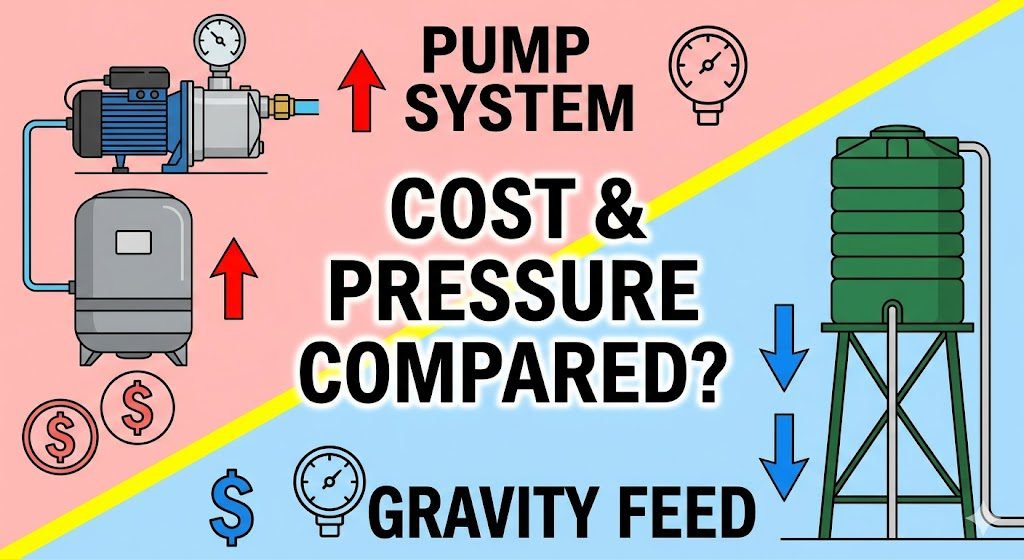
An underground tank is buried in the ground, insulated from temperature swings, and fed by gravity or pump from the mains, borehole, or tanker. Water is retrieved by a submersible or surface pump. Because the tank is below the distribution point, a pump is always required — there is no gravity-feed option. Our guide on pump system vs gravity feed covers this trade-off in more depth if you’re deciding between the two distribution methods.
Overhead vs Underground: Side-by-Side Comparison
Factor
Overhead Tank
Underground Tank
Installation cost
Low–Medium
High
Water pressure
Gravity-fed, low–moderate
Pump-dependent, adjustable
Capacity range (residential)
500 L – 5,000 L
2,000 L – 50,000+ L
Temperature protection
Poor (heats in sun)
Excellent (stable ground temp)
Structural load on building
Significant (1 kg per litre)
None
Contamination risk
Higher (bird droppings, UV degradation)
Lower (sealed underground)
Power dependency
None for distribution
Pump required always
Lifespan (typical)
10–25 years
25–50+ years (concrete/GRP)
Maintenance access
Easy
Requires manhole entry
Flood risk
None
Risk of groundwater ingress if unsealed
When an Overhead Tank Is the Better Choice
An overhead tank wins when power cuts are frequent and you cannot rely on a pump. In South Asia and sub-Saharan Africa, where outages can last 8–16 hours daily, gravity feed from an overhead tank is the most reliable distribution method available. It is also the cheaper default for residential projects: a 1,000-litre HDPE overhead tank in India or Pakistan costs roughly $30–80, while a comparable underground tank costs $150–400 plus excavation.
Overhead tanks are also the default for urban apartments that already have a concrete rooftop slab rated for the load. Check the slab’s capacity with the rooftop load bearing calculator before purchasing — a full 2,000-litre tank weighs over 2 tonnes, which exceeds the safe limit of many older slabs. If you’re unsure whether your existing roof can take a full tank, our guide on will my roof hold a full water tank walks through what to check first.
When an Underground Tank Is the Better Choice
Underground tanks suit high-volume storage needs — agricultural holdings, large properties, or sites where above-ground aesthetics matter. Their biggest practical advantage is water quality preservation: buried tanks maintain a stable temperature of 10–15°C in most climates, which dramatically slows bacterial growth compared to overhead tanks that can reach 40°C+ in direct sun. If you’ve noticed off-tasting or smelly water from an overhead tank, our guide on why does my water taste or smell bad after storage explains the mechanism.
Underground tanks also carry no structural load on buildings, making them the only viable option for sites without a suitable load-bearing surface. Where supply is seasonal — farm rainwater capture, for example — underground tanks can store 20,000–100,000 litres that would require a forest of overhead towers to match.
Common Mistakes
Ignoring structural load for overhead tanks. A 2,000-litre tank full of water weighs approximately 2,050 kg. Many homeowners install large overhead tanks on rooftop slabs designed for foot traffic only (typically 150–200 kg/m²). The result is slab cracking or, in worst cases, collapse. Calculate the distributed load across the support area before installation — the rooftop load bearing calculator does this for you.
Choosing overhead for large-volume storage. Overhead tanks above 5,000 litres require heavy structural support that adds significant cost. At that volume, an underground tank is almost always cheaper per litre of storage capacity and causes no structural concerns.
Neglecting pump sizing for underground tanks. Buyers often purchase the tank and find afterwards that their existing pump cannot deliver adequate flow at the required head. A pump sized for a 10-metre head will underperform badly on a 25-metre rise. Size the pump alongside the tank, not after — see how pump head works and why it matters for water tanks for the underlying calculation.
Assuming underground tanks are maintenance-free. Buried tanks still need annual inspection through the manhole for sediment accumulation, seal integrity, and inlet screen condition. Concrete underground tanks require crack inspection every 3–5 years.
Related Calculators You Might Need
If you are choosing between tank types and have not yet sized your storage volume, start with the daily water requirement calculator to establish your baseline consumption. For overhead installations, verify structural safety with the safe rooftop tank load calculator before purchasing. If you are going underground and need a pump, the pump head pressure calculator will confirm whether your pump can deliver the required pressure at the distribution point. For gravity-feed overhead setups, check minimum mounting height with the minimum tank height for shower pressure calculator.
Frequently Asked Questions
Is an overhead tank or underground tank better for a family of 4? For a family of four in an area with daily supply interruptions, a 1,000–2,000 litre overhead tank is usually the practical choice. It delivers water without electricity. If supply is intermittent and you want 5+ days of backup, an underground tank of 5,000–10,000 litres combined with a pump is more suitable. Use the water tank size for home calculator to confirm the right size for your specific daily consumption.
How much does an underground water tank cost compared to overhead? Underground tank costs vary widely by material and size. A 5,000-litre fibreglass underground tank typically costs $800–2,000 in the US, plus $500–2,000 for excavation and backfill. An equivalent overhead HDPE tank costs $200–500, with a support structure adding $300–1,500. Underground tanks are consistently more expensive installed, but last significantly longer.
Can an underground tank be contaminated? Yes, if improperly sealed. Groundwater infiltration during high water-table periods is the main risk — particularly for older concrete tanks with cracked walls. Modern fibreglass and polyethylene underground tanks with sealed lids and watertight inlets carry very low contamination risk. Annual inspection and periodic chlorination mitigate this effectively.
What is the maximum size for a rooftop overhead tank? There is no universal maximum — it depends on the slab’s load rating and support structure. Most domestic rooftop slabs support 200–250 kg/m². A 2,000-litre tank on a 2 m² base puts roughly 1,025 kg/m² on the contact points — well beyond the slab limit. The load must be distributed via a properly engineered platform. Anything above 3,000 litres on a residential rooftop requires a structural engineer’s sign-off in most countries.
Does an underground tank need electricity? For filling, no — a tank can be filled by gravity from mains supply or tanker. For distribution, yes, always. Water stored below the outlet level requires a pump for every use. This makes underground tanks unsuitable as the sole storage solution in areas with prolonged power outages unless a generator or solar pump is available.
Fibreglass tanks generally last longer. As planning figures, allow 25–40 years for a fibreglass (GRP) tank and 15–25 years for a polyethylene tank, and the warranties point the same way: up to 30 years on fibreglass against 3 to 10 years on polyethylene. But lasting longer is not the same as costing less. Fibreglass usually costs about three times as much to buy, so for an ordinary above-ground home tank, polyethylene is still the cheaper choice per year of service.
Fibreglass earns its price in four situations: when the tank is buried, when it is very large, when the water is hot, and when vehicles will drive over it. This guide compares the two materials on lifespan, heat, burial, drinking-water safety, cost and repair, and ends with a checklist of what to look for on the label of either one.
Quick answer
Lasts longer: fibreglass, by roughly 10 to 15 years in typical use.
Costs less to buy and per year: polyethylene, in most above-ground home installations.
Above ground, up to about 10,000 litres: choose polyethylene, kept shaded and on a flat, fully supported base.
Buried, very large, hot water or under traffic: choose fibreglass.
For drinking water: the material matters less than the certificate. Buy a tank certified for potable water, in either material.
Degrades in UV unless stabilised or made with carbon black
Surface weathers slowly; a pigmented gel coat or paint protects it
Knocks and impact
Tough; flexes and dents
Rigid; cracks instead of denting
Maximum water temperature
About 49°C to 66°C, depending on the maker
Up to 82°C above ground, 66°C buried
Burial
Only models built for it; shallow cover, no traffic
Routine; deep cover and traffic loads possible
Largest one-piece sizes
Roughly 50,000 L
Over 200,000 L
Fittings
Added through the wall; a possible leak point
Moulded in as part of the tank
Repair
Plastic welding, on linear polyethylene only
Laminated patch; must be fully cured
Price for 5,000 L
$500–1,500
$1,750–4,000
Empty weight
A few percent of the full weight
A few percent of the full weight
Lifespan and price are the planning figures used in our Water Tank Cost Calculator, not quotes. Sources for the other rows are given in each section.
Fibreglass is also written fiberglass, and sold as GRP (glass-reinforced plastic) or FRP. Polyethylene tanks are often just called poly or plastic tanks. If steel or concrete is also on your list, see plastic vs steel vs concrete water tanks, and the Plastic vs Steel Tank Cost Calculator for a side-by-side of those two from your own quotes.
How long does each one last?
No standard promises a lifespan for either material, so the most honest evidence is what manufacturers are willing to guarantee:
Examples only. Terms differ by maker, product and country, and a warranty is shorter than the life most tanks reach.
Tanks of both kinds normally outlive their warranties. What ends their life is different for each material, and most of it is in your control.
What wears out a polyethylene tank
Sunlight. Polyethylene is UV-degradable (Texas Manual on Rainwater Harvesting). The plastic slowly turns brittle and chalky on the sunny side. Makers counter this with UV stabilisers or carbon black: India’s standard for moulded polyethylene tanks requires 2 to 3% carbon black in any tank meant for outdoor use (IS 12701). Even so, Norwesco notes that sheltering a tank extends its life.
A poor base. Polyethylene is flexible, so it relies on the ground beneath it. IS 12701 says the flat base “should be fully supported over its whole bottom area”, and Bushmans voids its guarantee where the base was unsound. A tank that overhangs its slab or sits on stones is being bent every time it fills.
Heat. Warm plastic is softer plastic. Keep the tank away from heaters and flues, and do not store hot water in it.
Rigid pipework at the outlet. The wall moves slightly as the tank fills and empties. A rigid pipe bolted straight to the outlet turns that movement into stress at the fitting, which is why Bushmans requires a flexible hose there.
What wears out a fibreglass tank
Impact. Fibreglass is stiff and strong but does not give. A blow that would dent polyethylene can crack it, most often during delivery and installation.
Uneven support. A rigid shell on an uneven base carries its load on a few high points. The Texas manual’s one caution for fibreglass is that it “must be sited on smooth, solid, level footing”.
Surface ageing. The inner surface of a GRP vessel deteriorates over decades and eventually needs repair, according to a 2010 study of GRP food and water vats. That is a slow process and a repairable one, which is a large part of why fibreglass lasts.
The cheapest way to add years to a polyethylene tank is shade and a proper base. A tank under a roof or on the shaded side of a building, on a flat slab wider than the tank, avoids the two things that age it fastest.
Heat and hot water
This is where the two materials differ most clearly on paper. Norwesco states that its polyethylene tanks “have a maximum storage temperature of 120 degrees F” (49°C). An engineering guide to rotationally moulded tanks puts the general limit for polyethylene at 150°F (66°C). The American standard for fibreglass water tanks, AWWA D120, covers service up to 180°F (82°C) above ground and 150°F (66°C) underground.
For cold mains water or rainwater this makes no difference. It matters if you store warm bore water, water returning from a solar heater, or process water. Bushmans excludes elevated-temperature water, and bore water that has not been cooled first, from its polyethylene guarantee. For those uses, fibreglass is the safer material.
Underground: the biggest difference
An ordinary polyethylene tank must not be buried. IS 12701 says so in its scope: “These tanks are not meant for underground applications.” The Texas manual agrees that standard plastic tanks “must be installed above ground” and that burial needs “specially reinforced tanks”. Soil pushes inward on an empty tank, and a thin flexible wall designed to hold water in is not designed to hold soil out.
Polyethylene tanks made for burial do exist, but compare their limits with fibreglass:
Condition
Polyethylene burial tank (Norwesco)
Fibreglass burial tank (Xerxes)
Soil cover
15 to 76 cm (6 to 30 in)
At least 0.9 m (36 in); standard design to 2.1 m (7 ft), deeper with a thicker wall
Vehicles overhead
Not permitted
Rated for truck loads with the specified cover
High water table
Not permitted
Anchored to concrete deadmen with straps
Keeping water in it
Filled as the backfill rises; cisterns left one-quarter full
Backfilled in layers to the maker’s procedure
From Norwesco’s underground tank installation guide and a Xerxes presentation to the American Rainwater Catchment Systems Association. Other makers’ limits differ; follow the instructions for the tank you buy.
So fibreglass is the usual material for anything buried deep, buried large or buried under a driveway. A small polyethylene cistern is fine in a well-drained garden with shallow cover and no traffic.
An empty buried tank can float. Where groundwater rises above the base of the tank, the upward force is roughly 1 kg for every litre of tank below the water line. Both materials are light, so both need the anchoring the maker specifies. Ask about your water table before you dig.
Both are, when the finished tank is certified for it. Australian health guidance lists plastic and fibreglass among suitable tank materials, “providing the materials used are at least of food-grade standard” (enHealth). The certificate to look for depends on where you live:
Chemicals a product can release into drinking water
Australia and New Zealand
AS/NZS 4020
Products in contact with drinking water
India
IS 12701 (polyethylene), IS 14399 (GRP panel tanks)
Tank construction, including a migration test for polyethylene
“Food-grade resin” is not the same as a certified tank. A statement that the plastic meets FDA food-contact rules describes the raw material. NSF/ANSI/CAN 61 is tested on the product, and makers certify it plant by plant: Norwesco, for example, lists NSF 61 certification at five of its manufacturing facilities. Ask for the certificate for the model you are buying.
Fibreglass: check that it is fully cured
Polyester resin is hardened with styrene, and a tank that has not cured completely can give stored water a chemical taste and smell. The 2010 study found that cure temperature was the main factor: a 3-hour cure at 80°C cut both the leftover styrene and the amount that moved into water by about 100 times. A new fibreglass tank that smells strongly of resin inside is not ready. Ask the supplier whether the tank was post-cured, and the same applies to any repair made later.
Polyethylene: a new-tank taste that fades
New plastic tanks can also give water a taste at first. enHealth notes that this “will diminish with time” and is not a health hazard when the tank is potable-water grade. One caution on resin type: cross-linked polyethylene, used for some chemical tanks, was traditionally not approved for potable water, so check the certificate if a tank is described as cross-linked or XLPE. If stored water tastes or smells wrong in a tank that is not new, see why water tastes or smells bad after storage.
Both: keep the light out
“Exposure of stored rainwater to light will lead to algal growth”, in enHealth’s words, and tanks should be impervious to light. That is a question of opacity, not of material. A thin white or pale tank of either kind lets light through. This is why outdoor polyethylene tanks are often built in layers, with a black outer layer and a white inner one, and why the Texas manual says a fibreglass tank for drinking water should be opaque. A black tank blocks light best. Its drawback is heat: it warms the water more in full sun, which is one more reason to shade it.
As planning figures, a 5,000-litre polyethylene tank costs $500–1,500 and a fibreglass one $1,750–4,000. Prices vary a great deal by country, so treat the ratio as the useful part: fibreglass costs roughly three times as much.
The fair comparison is cost per year of service:
Polyethylene
Fibreglass
Price, 5,000 L
$1,000
$3,000
Service life
20 years
30 years
Cost per year
$50
$100
Over 60 years
3 tanks, $3,000
2 tanks, $6,000
Tank price only, mid-range planning figures. Installation and maintenance are extra.
The rule: fibreglass is cheaper per year only if its price is a smaller multiple than its lifespan. A tank that costs 3 times as much has to last more than 3 times as long. At 1.5 times the life, it costs twice as much per year.
Burial changes the sum. Underground, the excavation often costs more than the tank, and replacing a failed tank means paying for the dig again. There the longer life of fibreglass is worth far more than the table suggests.
Polyethylene. Glue does not hold on polyethylene, so repairs are made by plastic welding. That works only on linear polyethylene, which is what most water tanks are made of. Cross-linked polyethylene “cannot be recycled or welded”, so a cracked cross-linked tank is scrap. Linear polyethylene can be recycled at the end of its life.
Fibreglass. The Texas manual describes fibreglass tanks as easily repaired: a crack is ground back and covered with new layers of glass and resin. The patch has to cure fully before the tank holds drinking water again, for the styrene reason above. Fibreglass cannot be melted down, so recycling options at the end of its life are limited.
Fittings. On fibreglass tanks the fittings are “an integral part of the tank”. On plastic tanks they are added through the wall, and the Texas manual warns that such bulkhead fittings “might be subject to leakage”. Check them once a year. A weeping fitting is a small job when caught early.
Made to a tank standard: ASTM D1998 (US), AS/NZS 4766 (Australia and New Zealand) or IS 12701 (India)
Certified for drinking water, for the model you are buying
UV-stabilised or carbon black, and opaque: no daylight visible through the wall from inside
Wall thickness stated. As a reference point, IS 12701 sets a 4.5 mm minimum for a 1,000 L tank
Rated for burial, if it is going in the ground
Warranty length, and what the base and plumbing conditions are
Fibreglass tank
Made to a tank standard: AWWA D120 (US) or IS 14399 (India, panel tanks)
Certified for drinking water as a finished tank, with a food-grade resin lining
Post-cured, with no strong resin smell inside
Opaque wall or pigmented gel coat
For burial: the maker’s cover depth, traffic rating and anchoring details
Delivery inspection: look for cracks and crazing before you sign for it
Wall thickness matters because water pressure at the bottom of a tank rises with depth, by about 0.1 bar for every metre. That is why taller tanks need thicker walls low down. What hydrostatic pressure is and how it affects tank design explains the principle.
Mistakes to avoid
Burying an above-ground tank. It was not built for soil pressure. Only bury a tank its maker rates for burial.
Comparing sticker prices. Compare cost per year, and remember that a longer life only pays if it is longer by more than the price difference.
Buying a pale, thin-walled tank for a sunny spot. Light through the wall grows algae, whatever the material.
Setting a tank on an uneven or undersized base. It shortens the life of polyethylene and can crack fibreglass.
Accepting “food grade” in place of a certificate. Ask which drinking-water standard the finished tank is certified to.
Filling a new fibreglass tank that still smells of resin. Have the supplier confirm the cure first.
Frequently asked questions
Which lasts longer, a polyethylene or a fibreglass water tank?
Fibreglass. A reasonable planning range is 25–40 years for fibreglass and 15–25 years for polyethylene. Warranties show the same gap: up to 30 years on fibreglass potable water tanks, against 3 to 10 years on polyethylene. Shade and a good base narrow the gap for polyethylene.
How long does a polyethylene water tank last?
Plan on 15–25 years for a UV-stabilised tank on a proper base. Sunlight is the main thing that shortens it, followed by a base that does not support the whole floor and by stored water that is too warm. The polyethylene warranties cited in this guide run from 3 to 10 years.
Is fibreglass safe for drinking water storage?
Yes, when the tank is certified for potable water and fully cured. Look for NSF/ANSI/CAN 61 in North America or AS/NZS 4020 in Australia and New Zealand. An under-cured tank can give water a styrene taste and smell, so a strong resin smell inside a new tank is a reason to send it back.
Which is cheaper, a polyethylene or a fibreglass water tank?
Polyethylene, both to buy and per year of use in most above-ground installations. As a planning figure, fibreglass costs about three times as much for the same volume and lasts about one and a half times as long. Fibreglass comes out ahead mainly underground, where replacing a tank means digging again.
Can a polyethylene tank be buried?
Only if it was made for burial. Standard above-ground tanks are not designed for soil pressure, and India’s IS 12701 excludes underground use outright. Burial-rated polyethylene cisterns have limits: Norwesco’s, for example, allow 15 to 76 cm of cover, no vehicles overhead and no high water table.
Can polyethylene tanks be repaired?
Linear polyethylene tanks can be repaired by plastic welding, which is a specialist job because adhesives do not bond to the material. Cross-linked polyethylene tanks cannot be welded. A long crack in the wall of a large tank is usually a reason to replace it.
Does the colour of the tank matter?
Opacity matters more than colour. A wall that lets light through allows algae to grow in the water. Dark and black tanks block light well but run warmer in full sun, and pale tanks stay cooler but must be thick or layered enough to be opaque. Whatever the colour, shade helps.
What causes a fibreglass tank to crack?
Impact is the usual cause, most often a knock during transport or installation. The second is uneven support, where a rigid shell carries its load on a few high points instead of the whole base. Inspect a new tank on delivery and set it on smooth, solid, level footing.
Oltman D and Auber M, Specifying rotationally molded PE storage tanks, Environmental Science and Engineering Magazine, 2004. Linear and cross-linked polyethylene; welding and recycling; temperature limit.
A gravity-feed system uses tank elevation to create pressure — free, silent, and immune to power cuts. A pump system draws water from a low-level or underground tank and pressurises it on demand — flexible, high-pressure, but dependent on electricity and maintenance. The correct choice depends on your available head height, pressure requirements, and power reliability. For a closer look at how each system works mechanically, see our guides on how gravity feed water systems work and how pump head works and why it matters for water tanks.
Before comparing systems, confirm the pressure your gravity setup would actually deliver using the gravity feed flow rate calculator. This tells you whether gravity alone can meet your fixture requirements without any pump investment.
How Each System Generates Pressure
Gravity feed relies entirely on static head — the vertical distance between the water surface in the tank and the outlet point. The formula is simple: 1 metre of head = 0.098 bar (approximately 1.42 psi) — see our guide on water pressure explained in psi, bar, and kPa if you want the full unit breakdown. A tank mounted 7 metres above the shower head delivers about 0.68 bar — adequate for standard showerheads (which typically require 0.1–0.3 bar) but insufficient for thermostatic mixer showers or high-pressure appliances that need 1–3 bar.
A pump system pressurises water independently of tank position. A typical residential pressure-boosting pump delivers 2–5 bar consistently. This means a ground-level or underground tank can supply high-pressure water to the top floor of a multi-storey building — something impossible with gravity from a rooftop tank on the same building.
Cost Comparison: Upfront and Ongoing
Cost Factor
Gravity Feed
Pump System
Initial setup
Tank stand/rooftop structure: $200–2,000
Pump unit: $150–1,500; plumbing: $200–800
Energy cost
$0 (no electricity)
$30–180/year (residential use)
Maintenance
Minimal — inspect tank, clean annually
Annual service, impeller/seal replacement every 3–7 years
Failure cost
Low — no moving parts
Pump replacement: $150–800+
10-year total cost (estimate)
$300–2,500 (structure + maintenance)
$800–4,500 (pump + energy + servicing)
These figures assume a residential installation. The pump energy cost is based on a 0.5 kW pump running 2 hours/day at $0.15/kWh. Larger commercial or agricultural systems have proportionally higher energy costs. Use the pump horsepower and flow rate calculator to size a pump correctly before estimating running costs.
Pressure Performance by System Type
Fixture / Application
Gravity Feed Viable?
Minimum Head Required
Pump Pressure Needed
Standard tap
Yes
1 m
N/A
Garden hose
Yes
3 m
N/A
Basic showerhead
Yes
3–5 m
N/A
Thermostatic mixer shower
Marginal
10 m+
1–2 bar
Power shower
No
Not feasible
2–3 bar
Washing machine
Yes (most models)
3 m
N/A
Dishwasher
Yes
3 m
N/A
Drip irrigation
Yes
1–3 m
N/A
Sprinkler system (large area)
Marginal
8 m+
2–4 bar
When Gravity Feed Is Sufficient
Gravity feed is the better choice when: the tank can be mounted at least 5 metres above the highest outlet, the site has frequent power outages, and fixtures do not require high pressure. This describes the standard residential setup across South Asia, much of Africa, and rural areas globally where overhead tanks on 3–5 metre stands are the default.
The water pressure calculator can convert your available head height directly into bar and psi values, letting you check against every fixture’s stated minimum pressure requirement before deciding whether to invest in a pump.
When a Pump System Is Necessary
A pump is necessary when: the tank cannot be elevated to the required head, pressure-sensitive fixtures (thermostatic showers, high-pressure appliances) are installed, the water source is below the distribution point, or you need consistent pressure regardless of tank water level. In gravity systems, pressure drops as the tank empties, because the water surface inside the tank sits lower relative to the outlet — the size of that drop depends on how much of your total head comes from the tank’s own water depth versus the height of the stand or structure it sits on.
Common Mistakes
Underestimating head drop with a gravity system. A rooftop tank might be 6 metres above ground level, but the outlet in the master bathroom might only be 4 metres below the tank base — not 6. Calculate the actual head from the tank’s water surface (not the tank base) to the specific outlet, accounting for pipe friction losses. Friction loss in a 20-metre pipe run at typical residential flow can reduce effective pressure by 0.1–0.3 bar.
Oversizing a pump. A pump delivering 5 bar when the system only needs 2 bar wastes energy, causes water hammer in pipes, and strains tap washers and valve seats. Match pump output to system requirements — not to the maximum available on the shelf.
Assuming a pump solves all low-pressure problems. If your main supply pressure from the mains or borehole is already low, a booster pump only increases pressure from the supply point downstream. Low flow rate at the source — a borehole yielding only 0.5 L/s — cannot be overcome by increasing pump pressure. Flow rate and pressure are separate issues.
Neglecting the gravity falloff as the tank empties. In a gravity system, pressure at the outlet is not constant. A 2,000-litre tank at full level delivers a certain pressure; at 25% full, the water surface is lower and pressure drops accordingly. If fixtures require a minimum pressure, design for the minimum tank level that will ever be in use, not the full-tank level. If you’re troubleshooting pressure that’s already lower than expected even with a full tank, our guide on why is my shower pressure low even with a full rooftop tank covers the likely causes.
Is gravity feed enough for a shower? For a basic showerhead, yes — if the tank is at least 3–5 metres above the showerhead. For thermostatic mixer showers, most manufacturers specify a minimum dynamic pressure of 0.5–1.0 bar, which requires at least 5–10 metres of head. For power showers (which have a built-in pump) or rain-head installations, gravity alone is inadequate and a booster pump is required. Use the gravity feed flow rate calculator to check your specific head height.
How much does it cost to run a water pump? A typical 0.5 kW residential pressure pump running 2 hours per day costs approximately $54/year at $0.15/kWh. A larger 1.5 kW pump on the same schedule costs around $165/year. Actual cost depends on run time and local electricity tariffs. Pumps triggered by every tap opening (pressure-switch systems) often run more frequently than expected — a faulty pressure vessel or loose fitting can cause the pump to cycle on and off continuously, multiplying energy consumption.
What is the minimum height for a gravity-fed water tank? The minimum height depends on the pressure requirement of your lowest-pressure fixture. Most household taps and showerheads require 0.1–0.3 bar minimum, which corresponds to 1–3 metres of head. However, designing for the minimum means no margin for pipe friction losses. A practical minimum for a usable gravity system is 4–5 metres above the highest outlet point.
Can I switch from gravity to pump without replacing the tank? Yes. Adding a booster pump downstream of an existing overhead or ground-level tank is straightforward. You plumb the pump into the main outlet pipe from the tank and install a pressure vessel and switch to maintain system pressure. The tank itself needs no modification. This is common when household pressure needs increase — new appliances, added bathrooms — after the original gravity system was installed.
Shape affects more than aesthetics. Round (cylindrical) tanks distribute internal water pressure more evenly across their walls, requiring less material to achieve the same structural strength. Rectangular tanks make better use of corners and straight wall spaces, fitting into building footprints that cylinders waste. Choosing the wrong shape for your installation site costs you either usable floor space or money spent on over-engineered walls.
Water pressure acts equally in all directions. A cylindrical wall converts that pressure into pure tension along its circumference — the most structurally efficient load path. A flat rectangular wall must resist bending in addition to tension, which requires thicker walls or internal bracing. This is why identical-volume cylindrical tanks typically weigh 15–25% less than rectangular equivalents: less material, same strength.
The trade-off is footprint geometry. A cylinder with a 1-metre diameter occupies 0.785 m² of floor space (π × 0.5² = 0.785 m²). A rectangular tank 1 m × 1 m uses exactly 1 m² but holds the same volume at the same height. Within the notional 1 m × 1 m square the cylinder sits in, the four corners — 0.215 m² total — go unused. In tight plant rooms or rooftops, that dead corner space adds up.
Space Efficiency: Round vs Rectangular by Scenario
Scenario
Best Shape
Why
Rooftop with defined rectangular slab
Rectangular
Fills corners, maximises volume per m²
Open ground-level installation
Round (cylindrical)
Easier to position, lower cost per litre
Narrow utility corridor or room
Rectangular (slim profile)
Can be sized to fit exact wall-to-wall width
Underground cistern
Round (cylindrical)
Handles soil pressure load more uniformly
Multiple tanks in a row (manifolded)
Rectangular
Flat sides allow direct adjacency
High-volume farm storage (20,000 L+)
Round (cylindrical)
Available in large diameters, lower material cost
Indoor apartment / housing complex
Rectangular
Fits corner spaces, stackable in some designs
Cost Comparison: Where Each Shape Wins
For tanks up to 5,000 litres, cylindrical polyethylene tanks are almost universally cheaper per litre than rectangular alternatives because they are blow-moulded in large quantities. Expect to pay 10–20% less for a cylindrical tank of the same volume from the same manufacturer. Rectangular tanks often command a premium due to added structural reinforcement.
Above 10,000 litres, the cost gap narrows. Custom-fabricated rectangular GRP (glass-reinforced plastic) or stainless steel tanks are quoted by volume and site requirements, not shape. At this scale, the choice becomes about installation constraints rather than unit price. If material choice itself is still an open question, our guides on plastic vs steel vs concrete water tanks and polyethylene vs fibreglass water tanks cover that decision separately from shape.
Cleaning and Maintenance Differences
Cylindrical tanks have no corners where sediment accumulates in hard-to-reach pockets. Cleaning requires a brush against a continuous curved wall. Rectangular tanks have eight interior corners, each of which collects silt and biofilm. A manual clean of a rectangular tank typically takes 30–50% longer than the same volume cylindrical tank, and pressure-washing is less effective in corners without physical scrubbing. See our guide on why there’s sediment at the bottom of your water tank for what accumulates and how often to check.
Rectangular tanks also have flat bases, which can bow under sustained water load if not properly supported across the entire base area. A cylindrical tank’s rounded base distributes load more evenly and is less prone to deformation over time.
Common Mistakes
Choosing rectangular to ‘maximise rooftop space’ without checking actual dimensions. A rectangular tank that fills a 2 m × 3 m rooftop alcove sounds efficient — until you realise the tank’s actual footprint is 1.8 m × 2.7 m to allow maintenance access, leaving unused strip space on all four sides anyway. Measure the usable installation zone, not the total slab.
Selecting round tanks for wall-adjacent installations. Cylindrical tanks leave a curved gap against any flat wall. Installing a 1,500-litre cylinder against a straight wall wastes the crescent-shaped void behind it — roughly 20% of the square footprint. Use a rectangular tank flush against walls.
Ignoring the structural difference for underground use. A rectangular underground tank must resist lateral soil pressure on flat walls. This requires concrete encasement or engineered GRP panels. Placing a standard rectangular polyethylene tank underground without proper support leads to wall collapse within months. Cylindrical tanks handle soil pressure structurally and are the standard for underground plastic installations.
Assuming the same capacity from the same external dimensions. A round tank inscribed in a 2 m × 2 m square has a diameter of 2 m and a base area of 3.14 m². A rectangular 2 m × 2 m tank has a base area of 4 m². At 2 m height, the rectangular tank holds 27% more water despite fitting in the same square footprint.
Which is better, round or square water tank? Cylindrical (round) tanks are structurally stronger per kilogram of material and cheaper per litre in most residential sizes. Rectangular (square) tanks make more efficient use of wall-adjacent or corner spaces. If you are installing on open ground or underground, choose cylindrical. If you are fitting into a defined rectangular footprint, choose rectangular.
Do round water tanks hold more water than rectangular ones of the same size? Not if ‘same size’ means the same external footprint. A cylindrical tank inscribed in a square footprint holds less volume than a rectangular tank that fills that footprint — because the cylinder’s curved sides leave unused corner space. However, cylindrical tanks are stronger for the same wall thickness, so the comparison is really volume vs structural efficiency.
Why are most large water storage tanks cylindrical? Cylinders distribute internal pressure as tension along the wall circumference, which is the most material-efficient structural response. For very large volumes — 20,000 litres and above — the material savings of a cylindrical shell over a rectangular box are substantial enough to dominate the cost calculation. Most industrial and agricultural tanks above 10,000 litres are cylindrical for this reason.
Can I install a round tank in a corner? You can, but it wastes space. The corner area behind a cylindrical tank is typically inaccessible dead space. If your installation site has one or more flat walls you want to use efficiently, a rectangular slim-profile tank will fit significantly better. Use the rectangular tank volume calculator to find the maximum volume for your exact corner dimensions.
Are rectangular water tanks more expensive than round? At equivalent volumes under 5,000 litres, rectangular polyethylene tanks typically cost 10–20% more than cylindrical tanks due to added structural reinforcement. At larger custom-fabricated sizes, pricing depends on material and site requirements rather than shape.