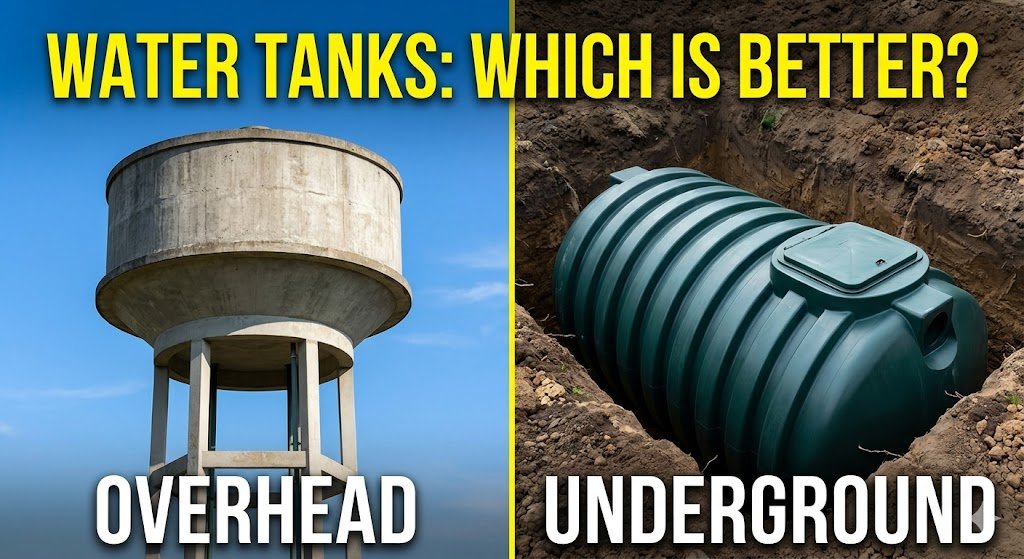
The answer depends on your priority. Overhead tanks cost less upfront and deliver water by gravity with zero pump energy. Underground tanks hold more water, last longer structurally, and protect stored water from heat and contamination — but cost more to install and require a pump for distribution. This guide breaks down the real differences so you can make the right choice for your site.
Before committing to either option, calculate exactly how much storage your household needs. The water tank size for home calculator factors in family size, daily usage, and supply frequency to give you a precise volume target.
How Do Overhead and Underground Tanks Actually Work?
An overhead tank sits on a raised platform — rooftop, tower, or stand — and uses gravity to push water to taps and fixtures (see how gravity feed water systems work for the full mechanics). The higher the tank, the more pressure it generates: every 1 metre of head produces approximately 0.1 bar (1.42 psi) — for the full breakdown of pressure units, see water pressure explained: psi, bar, and kPa. A tank mounted 5 m above the highest outlet produces around 0.5 bar, which is adequate for most residential fixtures but marginal for high-pressure showers or appliances.
An underground tank is buried in the ground, insulated from temperature swings, and fed by gravity or pump from the mains, borehole, or tanker. Water is retrieved by a submersible or surface pump. Because the tank is below the distribution point, a pump is always required — there is no gravity-feed option. Our guide on pump system vs gravity feed covers this trade-off in more depth if you’re deciding between the two distribution methods.
Overhead vs Underground: Side-by-Side Comparison
| Factor | Overhead Tank | Underground Tank |
| Installation cost | Low–Medium | High |
| Water pressure | Gravity-fed, low–moderate | Pump-dependent, adjustable |
| Capacity range (residential) | 500 L – 5,000 L | 2,000 L – 50,000+ L |
| Temperature protection | Poor (heats in sun) | Excellent (stable ground temp) |
| Structural load on building | Significant (1 kg per litre) | None |
| Contamination risk | Higher (bird droppings, UV degradation) | Lower (sealed underground) |
| Power dependency | None for distribution | Pump required always |
| Lifespan (typical) | 10–25 years | 25–50+ years (concrete/GRP) |
| Maintenance access | Easy | Requires manhole entry |
| Flood risk | None | Risk of groundwater ingress if unsealed |
When an Overhead Tank Is the Better Choice
An overhead tank wins when power cuts are frequent and you cannot rely on a pump. In South Asia and sub-Saharan Africa, where outages can last 8–16 hours daily, gravity feed from an overhead tank is the most reliable distribution method available. It is also the cheaper default for residential projects: a 1,000-litre HDPE overhead tank in India or Pakistan costs roughly $30–80, while a comparable underground tank costs $150–400 plus excavation.
Overhead tanks are also the default for urban apartments that already have a concrete rooftop slab rated for the load. Check the slab’s capacity with the rooftop load bearing calculator before purchasing — a full 2,000-litre tank weighs over 2 tonnes, which exceeds the safe limit of many older slabs. If you’re unsure whether your existing roof can take a full tank, our guide on will my roof hold a full water tank walks through what to check first.
When an Underground Tank Is the Better Choice
Underground tanks suit high-volume storage needs — agricultural holdings, large properties, or sites where above-ground aesthetics matter. Their biggest practical advantage is water quality preservation: buried tanks maintain a stable temperature of 10–15°C in most climates, which dramatically slows bacterial growth compared to overhead tanks that can reach 40°C+ in direct sun. If you’ve noticed off-tasting or smelly water from an overhead tank, our guide on why does my water taste or smell bad after storage explains the mechanism.
Underground tanks also carry no structural load on buildings, making them the only viable option for sites without a suitable load-bearing surface. Where supply is seasonal — farm rainwater capture, for example — underground tanks can store 20,000–100,000 litres that would require a forest of overhead towers to match.
Common Mistakes
Ignoring structural load for overhead tanks. A 2,000-litre tank full of water weighs approximately 2,050 kg. Many homeowners install large overhead tanks on rooftop slabs designed for foot traffic only (typically 150–200 kg/m²). The result is slab cracking or, in worst cases, collapse. Calculate the distributed load across the support area before installation — the rooftop load bearing calculator does this for you.
Choosing overhead for large-volume storage. Overhead tanks above 5,000 litres require heavy structural support that adds significant cost. At that volume, an underground tank is almost always cheaper per litre of storage capacity and causes no structural concerns.
Neglecting pump sizing for underground tanks. Buyers often purchase the tank and find afterwards that their existing pump cannot deliver adequate flow at the required head. A pump sized for a 10-metre head will underperform badly on a 25-metre rise. Size the pump alongside the tank, not after — see how pump head works and why it matters for water tanks for the underlying calculation.
Assuming underground tanks are maintenance-free. Buried tanks still need annual inspection through the manhole for sediment accumulation, seal integrity, and inlet screen condition. Concrete underground tanks require crack inspection every 3–5 years.
Related Calculators You Might Need
If you are choosing between tank types and have not yet sized your storage volume, start with the daily water requirement calculator to establish your baseline consumption. For overhead installations, verify structural safety with the safe rooftop tank load calculator before purchasing. If you are going underground and need a pump, the pump head pressure calculator will confirm whether your pump can deliver the required pressure at the distribution point. For gravity-feed overhead setups, check minimum mounting height with the minimum tank height for shower pressure calculator.
Frequently Asked Questions
Is an overhead tank or underground tank better for a family of 4? For a family of four in an area with daily supply interruptions, a 1,000–2,000 litre overhead tank is usually the practical choice. It delivers water without electricity. If supply is intermittent and you want 5+ days of backup, an underground tank of 5,000–10,000 litres combined with a pump is more suitable. Use the water tank size for home calculator to confirm the right size for your specific daily consumption.
How much does an underground water tank cost compared to overhead? Underground tank costs vary widely by material and size. A 5,000-litre fibreglass underground tank typically costs $800–2,000 in the US, plus $500–2,000 for excavation and backfill. An equivalent overhead HDPE tank costs $200–500, with a support structure adding $300–1,500. Underground tanks are consistently more expensive installed, but last significantly longer.
Can an underground tank be contaminated? Yes, if improperly sealed. Groundwater infiltration during high water-table periods is the main risk — particularly for older concrete tanks with cracked walls. Modern fibreglass and polyethylene underground tanks with sealed lids and watertight inlets carry very low contamination risk. Annual inspection and periodic chlorination mitigate this effectively.
What is the maximum size for a rooftop overhead tank? There is no universal maximum — it depends on the slab’s load rating and support structure. Most domestic rooftop slabs support 200–250 kg/m². A 2,000-litre tank on a 2 m² base puts roughly 1,025 kg/m² on the contact points — well beyond the slab limit. The load must be distributed via a properly engineered platform. Anything above 3,000 litres on a residential rooftop requires a structural engineer’s sign-off in most countries.
Does an underground tank need electricity? For filling, no — a tank can be filled by gravity from mains supply or tanker. For distribution, yes, always. Water stored below the outlet level requires a pump for every use. This makes underground tanks unsuitable as the sole storage solution in areas with prolonged power outages unless a generator or solar pump is available.

Licensed Professional Engineer (Texas, PE) with 13+ years in residential and light-commercial water storage systems. Reviews and writes the technical guides on this site — sizing, pressure, roof loading, and treatment — based on 180+ completed field projects.