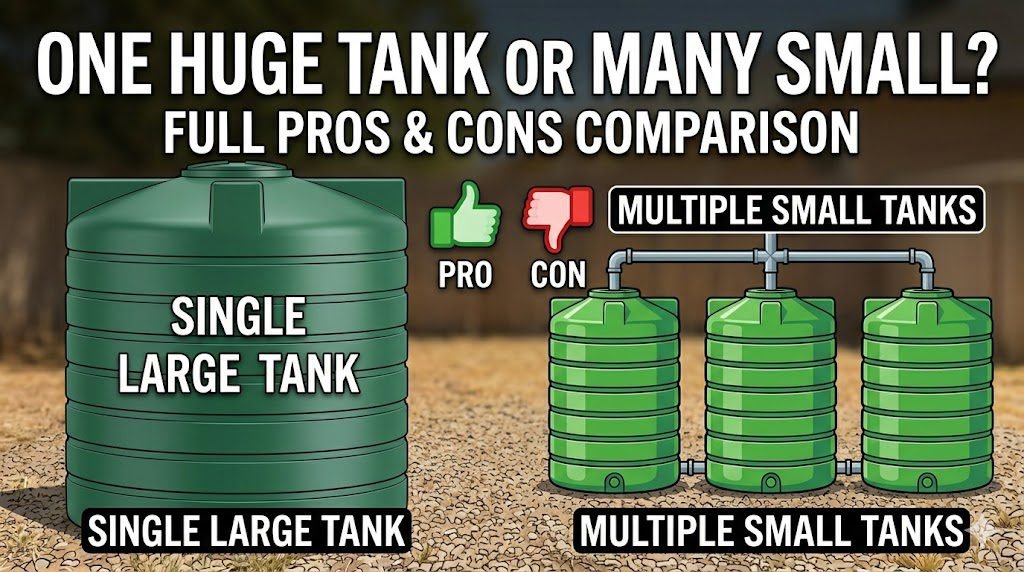
A single large tank costs less per litre of storage capacity and is simpler to install and maintain. Multiple smaller tanks in parallel cost more upfront but offer redundancy, easier installation in constrained sites, and the ability to expand capacity incrementally. The right answer depends on whether your site can accommodate a large tank, whether supply continuity under failure matters, and what your budget phasing looks like. This article covers both options across cost, reliability, installation, and site constraints.
The quick answer
For most residential applications with straightforward site access and a ground-level or purpose-built elevated pad, a single large tank is cheaper and simpler. Multiple tanks are the right call when the site physically constrains tank size, when continuity of supply is critical, or when you need to expand gradually. Use the Water Tank Cost Calculator to compare total installed cost for both configurations at your target capacity.
| Factor | Single Large Tank | Multiple Small Tanks |
| Unit cost per litre of capacity | Lower (economies of scale) | Higher (more units, more fittings) |
| Installation complexity | One connection point | Manifold plumbing required |
| Redundancy if one fails | None — total loss | Partial — others remain online |
| Site footprint | Larger single footprint | Distributed — flexible placement |
| Access to tight spaces | Poor (large tanks don’t fit) | Good (small tanks manoeuvrable) |
| Phased capacity expansion | Replace entire tank | Add another unit |
| Maintenance per litre | Lower | Higher (multiple entry points, fittings) |
| Pressure/flow uniformity | Higher (single head height) | Varies if tanks at different heights |
| Rooftop suitability | Limited (weight) | Better distributed load |
| Tank failure impact | Catastrophic loss | Isolated to one unit |
How the calculation works
Cost comparison at 10,000 litres total capacity: A single 10,000-litre HDPE tank: approximately $600–$900 purchase + $200 installation = $800–$1,100 total. Two 5,000-litre tanks with manifold plumbing: approximately $560–$1,200 purchase + $350–$500 installation = $910–$1,700 total. Four 2,500-litre tanks with manifold: $640–$1,200 purchase + $600–$900 installation = $1,240–$2,100 total.
Per litre of capacity, a single tank typically costs 15–40% less than an equivalent multi-tank arrangement at the same total volume. The premium for multiple tanks comes from: higher per-unit tank prices (smaller tanks have higher cost-per-litre than larger ones), additional fittings and plumbing for the manifold, and more installation time.
However, cost-per-litre is not the only metric. The economic case for multiple tanks includes: avoided loss on failure (if one of four tanks fails, you retain 75% of capacity; if the single large tank fails, you have zero), and phased capital outlay (buy two tanks now, add two more in 18 months when budget allows, without re-engineering the system if you plumbed for it upfront).
Key variables that change the answer
Site access and installation constraints. A 10,000-litre HDPE tank is typically 2.8–3.0 metres in diameter and 3.2–3.5 metres tall. It requires crane or telehandler delivery and a clear path to the installation site. Narrow access (less than 2.5 m gate width), trees, overhead lines, or basement locations make large tanks impractical. Four 2,500-litre tanks, each under 1.8 m diameter, can be manoeuvred by two people and installed almost anywhere. If your site is constrained, multiple small tanks may be the only option, and cost becomes secondary.
Rooftop load distribution. A single 5,000-litre HDPE tank fully loaded weighs 5,100 kg. Concentrated on one roof beam, this exceeds the safe capacity of most residential slabs. Four 1,250-litre tanks distributed across four beam positions, weighing 1,275 kg each, fall within the range of load-rated residential slabs if positioned correctly over structural supports. If rooftop installation is required and your total demand is above 2,000 litres, distributed tanks may be the only structurally sound approach, particularly on multi-storey buildings — see our guide on how to size a rooftop water tank for a multi-storey building. Verify with the Rooftop Load Bearing Calculator before specifying either option.
Supply continuity requirements. For residential use, a tank failure means an inconvenience — you call for a delivery or use mains supply. For a rural hospital, livestock operation, or off-grid property with no alternative source, a tank failure during a dry season is a crisis. Where continuity matters, redundancy in the tank system is not a luxury — it is part of the supply reliability specification. Two tanks with isolation valves means one can be taken offline for cleaning or repair without interrupting supply. For commercial or institutional sites with this kind of continuity requirement, our guide on sizing a water tank for a commercial building covers the additional considerations.
Cleaning and maintenance logistics. Tanks should be cleaned every 2–5 years (or annually in tropical climates with high biological activity). Cleaning a 10,000-litre tank requires full drainage — losing the entire stored volume. Cleaning one of four 2,500-litre tanks requires draining only 25% of total capacity. For operations where storage continuity during maintenance is important, the multiple-tank model wins on operational grounds, not just cost.
Future expansion plans. A properly designed multiple-tank system uses a manifold with isolation valves and enough port capacity to add further tanks. If your water demand may increase — more occupants, a garden, livestock, a new irrigation zone — the multiple-tank approach with expansion plumbing costs slightly more upfront but avoids a complete system replacement later. Plan the manifold for double the current tank count if future expansion is likely.
| Scenario | Recommended approach | Reason |
| Urban residential, reliable supply, 3,000–5,000 L needed | Single large tank | Lower cost, simple plumbing, site usually allows it |
| Rooftop installation with load constraints | 2–3 smaller tanks distributed | Spreads weight across beam lines |
| Remote farm, no access for large equipment | Multiple small tanks | Delivery and installation of large tanks may be impossible |
| Phased budget — buy now, expand later | Start with one, plumb for expansion | Manifold plumbing cost offset by flexibility |
| Mission-critical supply (hospital, commercial) | Multiple tanks in parallel | Redundancy prevents total supply failure |
| Rural off-grid — rainwater primary source | Single large tank if site allows | Maximises storage from infrequent rain events |
Common mistakes
Connecting multiple tanks without isolation valves. A manifold system without isolation valves cannot isolate a failing tank. If one tank develops a crack or leak in a no-isolation-valve manifold, the entire system drains to the level of the breach. Every tank in a parallel array should have its own inlet and outlet isolation valve. This is a $20–$50 addition per tank that makes the redundancy argument real.
Installing tanks at different heights in a gravity-fed system. Multiple tanks only deliver uniform pressure if the water surface is at the same height in all tanks. A manifold connecting tanks at different elevations will drain the lower tanks preferentially and leave the higher tanks unused until the lower ones are nearly empty. If your site requires different heights, use a pump system with a float controller that equalises fill levels, or arrange tanks in separate circuits for separate uses — not as a single gravity-fed array.
Using a single inlet without a flow splitter. A manifold with one mains inlet and no flow balancing will fill the tank nearest the inlet first, creating unequal levels across the array. Install a T-piece or distribution manifold at the inlet point so incoming water flows equally to all tanks. Unequal fill creates dead volume in under-used tanks and shortens lifespan in over-filled ones.
Assuming larger is always more economical long-term. Large tanks have higher failure risk per event — a 10,000-litre tank failing loses 10,000 litres of stored water and typically requires replacement of the full unit. Single-use tank warranties often exclude damage from incorrect installation, UV exposure, or overfilling. A multi-tank arrangement where each unit is well within its pressure and UV exposure specification may outlast a single large tank pushed to its limits. The Water Tank Weight Calculator can help verify load is within specification for both single and multi-tank configurations. If you’re also still deciding on tank material, our guide on plastic vs steel vs concrete water tanks is a useful companion read.
Related calculators you might need
To model total capacity needed before deciding on configuration, use the Water Tank Size for Home Calculator or the Farm Water Storage Calculator for agricultural sites. Once you have the total volume, the Plastic vs Steel Tank Cost Calculator lets you compare material options at that capacity. For any rooftop arrangement with either configuration, the Safe Rooftop Tank Load Calculator is the non-negotiable check before you commit to a layout.
Frequently asked questions
Is it cheaper to buy one big water tank or multiple smaller ones? One large tank is cheaper per litre of capacity in most cases. At 10,000 litres, a single tank costs 15–40% less all-in than an equivalent multi-tank manifold arrangement. The premium for multiple tanks reflects higher per-unit prices on smaller tanks, additional fittings, and more installation time. The cost advantage of a single tank is real but narrows as site constraints or redundancy requirements drive the specification toward multiple units.
Can I connect two water tanks together? Yes. Tanks in parallel connected at the base with a manifold equalise their water levels automatically via hydrostatic pressure — provided the tanks sit at the same elevation and the connecting pipe diameter is adequate (typically 50 mm minimum for a two-tank array). Each tank should have its own isolation valve. A properly designed two-tank manifold costs $150–$400 in fittings and takes 2–4 hours to install.
What is the advantage of multiple small water tanks? Redundancy (one tank failure does not lose all supply), easier installation in constrained sites, distributed rooftop load, the ability to phase capacity investment over time, and easier maintenance without full supply interruption. The cost premium over a single equivalent tank is real — justify it only when these operational advantages matter for your situation.
How do I connect water tanks in series vs parallel? Parallel connection (tanks connected at the base) is standard for residential and commercial storage — it equalises water levels and provides combined capacity automatically. Series connection (outlet of one tank feeds inlet of the next) is rare and generally used only in gravity-cascade rainwater systems where tanks are at different elevations. For combined storage capacity, always use parallel manifold configuration.
How many tanks can I connect together? There is no fixed limit, but practical constraints emerge above 4–6 tanks in a single manifold array. Beyond that, pressure drop through the manifold affects fill and drain uniformity, and the installation complexity increases non-linearly. Large commercial installations use multiple manifold groups, each serving 2–4 tanks, rather than a single large manifold serving many tanks.

Licensed Professional Engineer (Texas, PE) with 13+ years in residential and light-commercial water storage systems. Reviews and writes the technical guides on this site — sizing, pressure, roof loading, and treatment — based on 180+ completed field projects.