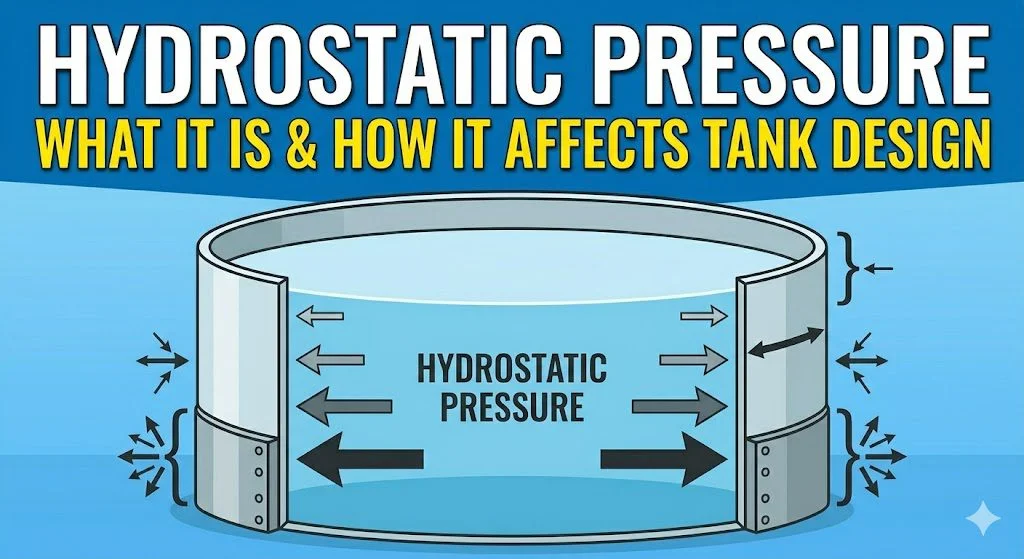
Hydrostatic pressure is the pressure that still water puts on any surface it touches, caused by the weight of the water above that point. In a tank it is zero at the water surface and greatest at the floor, and it rises by about 9.8 kPa (0.098 bar, 1.42 psi) for every metre of depth. At the bottom of a tank filled to 2 metres it is 19.6 kPa, whether the tank holds 500 litres or 50,000.
Those are small pressures. A car tyre holds ten times as much. What makes them matter in tank design is the area they act on: the same 19.6 kPa spread over a wall adds up to tonnes of force. This guide covers the formula, the forces on walls and floors, why round tanks cope better than flat-sided ones, and the three places where hydrostatic pressure causes real failures: unvented tanks, buried tanks and base fittings.
Quick answer
- Formula: P = ρ × g × h. For water, 9.8 kPa per metre of depth, or 0.433 psi per foot.
- Depth is all that counts. Volume, width and shape do not change the pressure.
- Load on the base: depth in metres × 1,000 = kilograms on every square metre.
- Force on a flat wall grows with the square of depth. Twice as deep means four times the push.
- A storage tank is not a pressure vessel. It must be vented, and nothing should be able to raise the water level above its top.
The hydrostatic pressure formula
P = ρ × g × h
P is pressure in pascals, ρ (rho) is the density of the liquid in kg/m³, g is gravity (9.81 m/s²) and h is the depth below the surface in metres.
Fresh water has a density of 1,000 kg/m³ at 4°C and about 998 kg/m³ at room temperature (USGS), so each metre of depth adds very nearly 9.8 kPa.
Example: a tank is filled to a depth of 2.5 m. Pressure at the floor = 1,000 × 9.81 × 2.5 = 24,525 Pa, which is 24.5 kPa, 0.245 bar or 3.56 psi. Halfway down, at 1.25 m, it is half that.
Divers know the same rule from the other end. In the sea, NOAA notes, “for every 33 feet (10.06 meters) you go down, the pressure increases by one atmosphere” (NOAA). A household tank a metre or two deep works in the first tenth or two of that.
This is gauge pressure, the amount above the surrounding air, which is what matters for tank walls because the air pushes equally on the outside. For the units, see water pressure explained in psi, bar and kPa.
Hydrostatic pressure at different tank depths
| Water depth | kPa | bar | psi | Load on the base |
|---|---|---|---|---|
| 0.5 m (1.6 ft) | 4.9 | 0.049 | 0.71 | 500 kg/m² |
| 1.0 m (3.3 ft) | 9.8 | 0.098 | 1.42 | 1,000 kg/m² |
| 1.5 m (4.9 ft) | 14.7 | 0.147 | 2.13 | 1,500 kg/m² |
| 2.0 m (6.6 ft) | 19.6 | 0.196 | 2.84 | 2,000 kg/m² |
| 2.5 m (8.2 ft) | 24.5 | 0.245 | 3.56 | 2,500 kg/m² |
| 3.0 m (9.8 ft) | 29.4 | 0.294 | 4.27 | 3,000 kg/m² |
| 4.0 m (13.1 ft) | 39.2 | 0.392 | 5.69 | 4,000 kg/m² |
| 5.0 m (16.4 ft) | 49.0 | 0.490 | 7.11 | 5,000 kg/m² |
If you know the volume of your tank but not its depth, the cylindrical and rectangular tank volume calculators work from the dimensions.
Why depth matters and volume does not
Pressure at a point depends only on the height of water straight above it. A narrow pipe filled to 2 m and a reservoir filled to 2 m press on their floors with exactly the same 19.6 kPa. Physicists call this the hydrostatic paradox, and it has three practical consequences for tanks:
- A bigger tank is not a higher-pressure tank. A 10,000 L tank filled to 1.5 m has less pressure at its floor (14.7 kPa) than a 500 L tank filled to 2 m (19.6 kPa).
- The load on the floor follows the depth. Each metre of water puts one tonne on every square metre beneath it. A tank 1.5 m deep loads its footprint at 1,500 kg/m², large or small. That is why a rooftop tank is a structural question: see will my roof hold a full water tank and the Rooftop Load Bearing Calculator.
- The same formula gives the pressure at your taps. There, h is the height from the water surface down to the tap. A tap 3 m below the surface gets 0.29 bar. How gravity feed water systems work covers that side.
From pressure to force: what the walls feel
Pressure is force per unit of area, so the force on a wall is the pressure multiplied by the wall’s area. Because pressure rises steadily from zero at the surface to its maximum at the floor, the average over the whole wall is half the floor value. For a flat wall, that gives:
Force on a flat wall, per metre of width = ½ × ρ × g × h²
| Water depth | Pressure at the floor | Total push on each metre of wall width |
|---|---|---|
| 1.0 m | 9.8 kPa | 4.9 kN (about 500 kg) |
| 1.5 m | 14.7 kPa | 11.0 kN (about 1,125 kg) |
| 2.0 m | 19.6 kPa | 19.6 kN (about 2,000 kg) |
| 3.0 m | 29.4 kPa | 44.1 kN (about 4,500 kg) |
Two things stand out. The force grows with the square of the depth: going from 1 m to 2 m doubles the pressure but quadruples the push. And the push is not centred. It acts one-third of the way up from the floor, because that is where most of the pressure is. The lower part of any tank wall does most of the work, and it is where bulges, cracks and leaks start.
Why round tanks handle pressure better than flat-sided ones
A flat wall resists water by bending, like a shelf under a load. A curved wall resists it by stretching, like the skin of a balloon, and a thin wall is far stronger when stretched than when bent. In a cylinder the stretch runs around the circumference and is called hoop stress:
Hoop stress = pressure × radius ÷ wall thickness
This is the standard thin-walled cylinder formula (Roylance, MIT). Since pressure depends on depth, the load in the wall depends on depth and on radius together:
| Tank diameter | Water depth | Pull in the wall at the base, per metre of height |
|---|---|---|
| 2 m | 2 m | 19.6 kN (about 2,000 kg) |
| 4 m | 2 m | 39.2 kN (about 4,000 kg) |
| 4 m | 3 m | 58.8 kN (about 6,000 kg) |
| 8 m | 3 m | 117.7 kN (about 12,000 kg) |
Double the diameter at the same depth and the wall has to carry twice the pull. This is why large tanks need thicker walls, more steel or more reinforcement even when they are shallow, and why the wall of a well-designed tank is strongest near the bottom.
Flat-sided tanks need help that round ones do not: thicker walls, moulded ribs, internal tie rods or an external frame. Round vs rectangular water tanks compares the two shapes on cost, space and cleaning.
How each tank material deals with it
| Material | How it carries the load | Where it goes wrong |
|---|---|---|
| Polyethylene | Flexible wall in hoop tension, made thicker in the lower third to match the pressure | Slow bulging under constant load, worse when warm; damage from a base that does not support the whole floor |
| Fibreglass (GRP) | Stiff shell with glass fibres carrying the tension | Cracking from impact or from high points in an uneven base |
| Concrete | Strong when squeezed, weak when pulled, so steel reinforcement carries the hoop tension | Too little steel, or cracks that let water reach the steel and corrode it |
| Steel | Thin wall carries tension well; corrugations add stiffness | Joints, bolts and seals between panels; corrosion thinning the wall |
Polyethylene shows the principle most clearly. Tank maker Poly Processing explains that the standard wall profile is thicker in the lower third and thinner near the top, which “matches the pressure distribution” inside (Poly Processing). The plastic also creeps: India’s standard for moulded water tanks tests for it by filling a tank for three days and allowing the circumference to grow by no more than 2% (IS 12701). A slight barrel shape in a full poly tank is expected. A bulge that keeps growing, or one low on a single side, is not.
Denser liquids raise the pressure. The formula includes density, so brine, liquid fertiliser or any liquid heavier than water presses harder at the same depth. Chemical tanks are sold with a specific gravity rating for this reason. A tank made for water should hold water.
For how the materials compare on lifespan and cost, see polyethylene vs fibreglass water tanks and plastic vs steel vs concrete water tanks.
A storage tank is not a pressure vessel
Everything above assumes the water surface inside the tank is open to the air. Storage tanks are designed on that assumption. Polyethylene tanks are rated for atmospheric pressure, not for internal pressure, and the American standard for fibreglass water tanks covers only vented tanks at atmospheric pressure. The lid and roof of a tank are built to keep dirt out, not to hold pressure in.
The danger is that hydrostatic pressure follows the highest water level connected to the tank, not the level inside it. If water can stand in a pipe above the tank, the whole tank feels that extra height:
Example: a sealed tank is fed from another tank 3 m higher, and its float valve sticks open. Water backs up the feed pipe and the tank is now under 3 m of extra head, which is 0.29 bar on every surface, including the roof. On a flat tank roof 1.5 m across, that is an upward force of more than 5 tonnes on a panel designed for none.
Three rules prevent it:
- Keep the vent clear. Air must leave as the tank fills and enter as it drains. A blocked vent lets a fast fill pressurise the tank and a fast drain pull the walls inward.
- Keep the overflow clear and at least as large as the inlet. It is the relief path if the float valve fails. Water tank overflowing covers the causes.
- Never extend a standpipe above a tank to gain pressure. It raises the pressure in the tank itself. To get more pressure at the taps, raise the whole tank or add a pump.
A vessel that is meant to hold pressure is a different product. See what a pressure tank is and how it differs from a storage tank.
Underground tanks: pressure from the outside
Bury a tank and the problem turns around. Soil presses inward on the walls, and if groundwater rises around the tank, hydrostatic pressure acts on the outside as well. A full tank balances it. An empty one does not, and two things can happen: the walls can buckle inward, or the whole tank can float.
Flotation follows Archimedes: “The buoyant force is equal to the weight of the displaced water” (Lentz, Septic Tank Buoyancy Control 101). That is about 1 kg of lift for every litre of tank below the water table.
Example: an empty 5,000 L tank sits fully below the water table after heavy rain. Uplift is about 5,000 kg. The same guide calls for a safety factor of at least 1.5, so the soil cover, anchors and tank weight together must hold down 7,500 kg. A plastic shell weighing a couple of hundred kilograms contributes almost nothing.
Makers deal with this in their installation rules. Norwesco tells installers to fill its polyethylene cisterns with water as the backfill rises, to leave them a quarter full afterwards, and not to install them in a high water table at all (Norwesco installation guide). Fibreglass tanks for wet ground are strapped to concrete anchors. Concrete tanks are heavy, which helps, but an empty one can still float.
So the rule for a buried tank is the opposite of the rule for a rooftop one: the risky moment is when it is empty. Do not pump one out in wet ground without checking the maker’s instructions. Overhead vs underground water tanks covers the wider choice, and the Underground Water Tank Volume Calculator gives the capacity of a buried tank from its dimensions.
Outlets and fittings at the base
The outlet is usually near the floor, where pressure is highest. Even so, pressure rating is almost never the problem. The floor of a 2.5 m tank sees 0.245 bar, and ordinary plumbing fittings are rated for many times that. Base fittings fail for other reasons:
- The seal. On plastic tanks the fitting passes through the wall and seals with a gasket. The Texas Manual on Rainwater Harvesting warns that such bulkhead fittings “might be subject to leakage” (TWDB). The lowest fitting is under pressure all day, every day, so a poor seal there weeps first.
- Rigid pipework. A plastic tank wall moves a little as the tank fills and empties. A rigid pipe fixed to the outlet turns that movement into stress on the fitting. Bushmans voids its guarantee unless a flexible hose is fitted at the outlet (Bushmans).
- Unsupported weight. A heavy valve or a long pipe hanging from the outlet levers on the wall. Support the pipe on its own bracket.
- New holes. Cutting an extra outlet removes wall material exactly where the load is highest. Use the flat mounting pads the maker moulded in, and ask the maker before cutting anywhere else.
Mistakes to avoid
- Thinking a bigger tank means more pressure. Only a deeper one does.
- Setting a tank on an uneven base. The floor carries a tonne per square metre for each metre of depth. Stones, steps or an undersized slab concentrate that load. IS 12701 says the base should be “fully supported over its whole bottom area”.
- Blocking the vent or sealing the lid airtight. A storage tank needs to breathe.
- Extending a pipe above the tank to gain head. It pressurises a tank that was never built for it.
- Emptying a buried tank in wet ground. That is when it can float or collapse.
- Storing something denser than water in a water tank. Pressure rises in proportion to density.
- Bolting rigid pipe straight to a plastic tank outlet. Use a flexible connection.
More calculators for this topic
- Water Column Pressure Calculator: pressure from any height of water, in psi, bar, kPa and head.
- Water Pressure Calculator: supply pressure at a tap from the heights of the tank and the outlet.
- Water Tank Weight Calculator: the full weight of a tank, shell included.
- Tank Weight per Square Foot Calculator: the load on the base in imperial units.
- Pump Head Pressure Calculator: the head a pump must overcome, explained in how pump head works.
Frequently asked questions
How do you calculate hydrostatic pressure?
Multiply the liquid’s density by gravity and by the depth: P = ρ × g × h. For water, that is 9.8 kPa for each metre of depth, or 0.433 psi for each foot. Water 3 m deep gives 29.4 kPa at the bottom, and water 10 ft deep gives 4.33 psi.
Does a bigger tank mean more hydrostatic pressure on the walls?
Not more pressure, unless it is also deeper. Pressure depends on depth alone. What a bigger tank does increase is the total force: the same pressure acts on more wall, and in a round tank the pull in the wall rises in proportion to the diameter. That is why large tanks need stronger walls even when they are shallow.
What is the hydrostatic pressure at the bottom of a 1,000-litre tank?
It depends on how tall the tank is, not on the 1,000 litres. A squat tank filled to 0.9 m has 8.8 kPa (0.088 bar, 1.28 psi) at the floor. A tall one filled to 1.5 m has 14.7 kPa (0.147 bar, 2.13 psi). Measure the water depth and multiply by 9.8 for kPa.
Does the shape of the tank change the pressure?
No. At a given depth the pressure is the same in a round tank, a square tank or a tapered one. Shape changes how well the walls carry that pressure: curved walls work in tension, and flat walls have to resist bending, so flat-sided tanks need ribs, ties or thicker walls.
Can hydrostatic pressure crack a concrete tank?
Yes, if the wall has too little reinforcement. Water pressure puts a round concrete wall into tension, and concrete is weak in tension, so the steel inside has to carry it. Once a crack lets water reach the steel, corrosion widens it. Regular inspection catches this early. Illinois EPA, for example, says public water storage tanks should be inspected “at least every five years” (Illinois EPA).
Does hydrostatic pressure change when the water is moving?
Strictly, hydrostatic pressure describes water at rest. When water flows, part of the pressure is converted into motion and part is lost to friction, so the pressure in a flowing pipe is lower than the static figure. For a tank wall the worst case is the simple one: full and still. Tanks are designed for that.
How do I know if my tank can take the pressure?
A tank is designed for its own full depth of water, open to the air, on a flat and fully supported base. Used that way, the pressure is what it was built for. You move outside the design when you add height above the tank, seal it, store a denser liquid, bury a tank not made for burial or set it on an uneven base. For anything unusual, ask the manufacturer in writing.
Sources
- US Geological Survey, Water Density. Density of water by temperature.
- NOAA National Ocean Service, How does pressure change with ocean depth? One atmosphere for every 33 feet (10.06 m).
- Roylance D, Pressure Vessels, Massachusetts Institute of Technology, 2001. Hoop stress in a thin-walled cylinder: pressure × radius ÷ wall thickness.
- Poly Processing, How to make sure your tank’s walls are thick enough and the importance of venting. ASTM D1998 wall profile, specific gravity ratings, atmospheric pressure rating.
- Bureau of Indian Standards, IS 12701:1996, Rotational Moulded Polyethylene Water Storage Tanks. Deformation test and base support.
- American Water Works Association, AWWA D120, Thermosetting Fiberglass-Reinforced Plastic Tanks. Scope limited to vented tanks at atmospheric pressure.
- Lentz D, Septic Tank Buoyancy Control 101, 2019. Buoyant force and the 1.5 safety factor.
- Norwesco, underground tank installation guide. Filling during backfill; no installation in a high water table.
- Texas Water Development Board, The Texas Manual on Rainwater Harvesting, 3rd edition. Bulkhead fittings on plastic tanks.
- Bushmans, warranty terms. Flexible hose at the outlet; sound base.
- Illinois EPA, Storage Tanks. Inspection at least every five years.

Licensed Professional Engineer (Texas, PE) with 13+ years in residential and light-commercial water storage systems. Reviews and writes the technical guides on this site — sizing, pressure, roof loading, and treatment — based on 180+ completed field projects.