Author: admin

  • Emergency water storage for US households: FEMA guidelines

    Emergency water storage for US households: FEMA guidelines

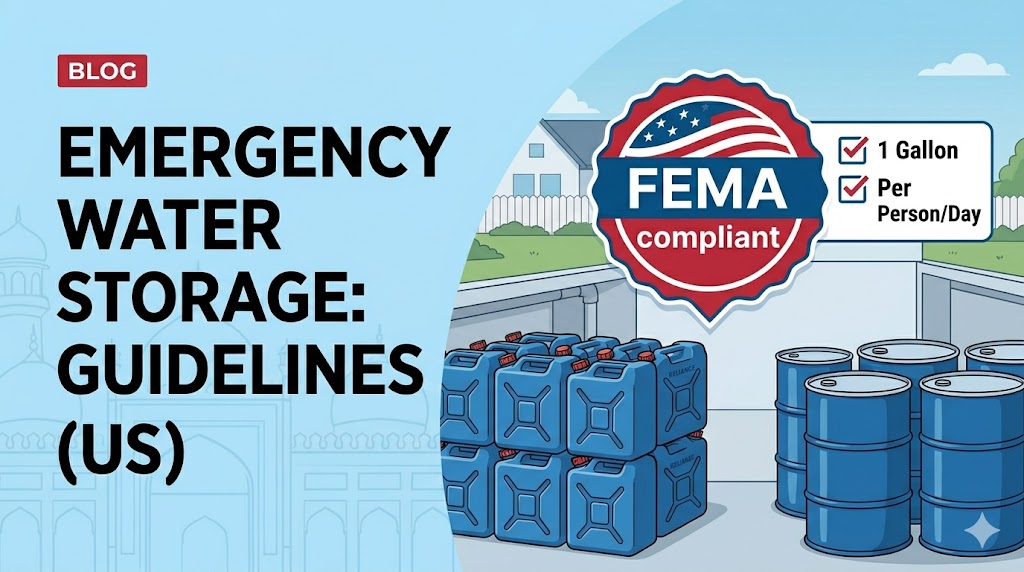
    FEMA’s baseline recommendation is 1 gallon per person per day (3.78 litres), with a minimum 3-day supply for short-term emergencies and a 2-week supply for extended grid-down scenarios. For a family of 4, that means a minimum of 12 gallons (45 litres) and ideally 56 gallons (212 litres) stored and ready. This guide explains how to size your emergency water storage correctly, what containers work, and how to keep stored water safe to drink — covering FEMA, CDC, and NFPA standards in one place.

    The quick answer

    FEMA and the CDC specify 1 gallon/person/day for drinking and sanitation under emergency conditions (FEMA IS-022.a). This is a survival floor, not comfort. It covers roughly 2 quarts of drinking water and 2 quarts for food preparation and minimal hygiene. Here are the storage volumes required under that standard:

    Household size3-day minimum2-week supply1-month supply
    1 person3 gal / 11 L14 gal / 53 L30 gal / 114 L
    2 people6 gal / 23 L28 gal / 106 L60 gal / 227 L
    4 people12 gal / 45 L56 gal / 212 L120 gal / 454 L
    6 people18 gal / 68 L84 gal / 318 L180 gal / 681 L

    These figures apply to adults in moderate-temperature conditions. Children under 2, pregnant women, people doing physical labour in heat, and those in hot climates require 1.5–2× the baseline. The CDC recommends doubling the per-person allocation when heat emergency conditions are in effect (CDC Emergency Preparedness, Water Supply Guidance).

    Skip the math: Use the emergency water storage calculator to input your household composition and get precise volumes for any duration.

    How the calculation works

    The formula used by FEMA and CDC for household emergency water planning:

    Total storage (gallons) = 1 gallon × number of people × number of days

    Worked example — a family of 4 in Texas preparing for hurricane season (planning for 14-day outage potential):

    1 gallon × 4 people × 14 days = 56 gallons (approximately 212 litres). If the family includes a nursing infant and a pregnant mother, FEMA guidance suggests multiplying the relevant individuals by 1.5: (2 standard adults × 14) + (1 pregnant × 1.5 × 14) + (1 infant × 1.5 × 14) = 28 + 21 + 21 = 70 gallons (265 litres).

    For a 72-hour kit — the immediate grab-and-go scenario — use the 72-hour water supply calculator, which accounts for special needs and physical activity level in the emergency period.

    Key variables that change the answer

    Regional hazard type. US households face different primary hazards depending on location. Gulf Coast households planning for hurricane outages should plan for 2 weeks minimum (Category 4–5 storms can disable water infrastructure for 1–3 weeks, as seen post-Katrina 2005 and Harvey 2017). Pacific Northwest households planning for Cascadia Subduction Zone scenarios should plan for 30+ days. FEMA Hazard Mitigation Plans by state list the most likely disaster duration for your region.

    Physical exertion level during emergency. FEMA’s 1 gallon/day assumes a sedentary adult in moderate temperatures. Someone doing physical labour to clear debris, cut wood, or operate a generator in summer heat may need 3–4 gallons per day to stay hydrated. Planning only to the survival floor for an active emergency response leaves no margin.

    Sanitation method during power outage. Flush toilets in city water systems often stop working when water pressure fails, but septic systems and well systems may remain functional. If flushing is possible but water supply is cut, add 1–2 gallons per person per day for toilet use on top of the consumption baseline.

    Pets and livestock. FEMA guidance does not include pets in the 1 gallon/person/day baseline. Dogs typically require 1 ounce per pound of body weight per day; cats require approximately 3.5–4.5 ounces per day. A 60-pound dog needs nearly 0.5 gallons per day — non-trivial over a 14-day emergency period.

    Container types, storage limits, and legal standards

    The FDA Food Safety Modernization Act and FEMA guidelines specify that emergency water should be stored in food-grade containers only. The most common options for US households:

    Container typeTypical sizeShelf life (treated)Notes
    Commercial bottled water0.5–1 gallon2 years (sealed)FDA 21 CFR 165.110 compliant
    Food-grade jerry cans (HDPE #2)5–7 gallons6–12 monthsBPA-free; rotate every 6 months
    WaterBOB bathtub bladder100 gallons16 weeksOne-time use; deploy before outage
    55-gallon drum (food-grade)55 gallons12 months w/ rotationRequires bung wrench and pump
    250–500 gallon IBC tote250–500 gallons12 months w/ rotationBest for 6+ person households

    The CDC recommends adding 8 drops of unscented liquid chlorine bleach per gallon (6% sodium hypochlorite) when storing tap water in food-grade containers. This maintains residual chlorine protection for 6 months. The bleach to water ratio calculator gives exact dosing for any container size and bleach concentration.

    Do not use: milk jugs (proteins degrade the plastic), non-food-grade containers, or any vessel previously used for chemicals. FEMA’s IS-022 course explicitly prohibits these.

    Common mistakes

    Storing water without treatment and assuming it stays safe indefinitely. Unscented chlorine bleach loses potency over time — treated stored water should be replaced or re-treated every 6 months. Commercially bottled water is good for 2 years sealed but degrades after opening. Many households fill their 55-gallon drum once and forget it for 3 years; by then, any residual chlorine has dissipated and bacterial regrowth is possible.

    Planning only for the 3-day minimum when living in a high-hazard zone. FEMA’s 3-day recommendation was designed for short-term acute emergencies with functioning supply infrastructure. Gulf Coast households, those in wildfire country (where contamination events can last weeks), and Pacific Northwest households in seismic zones should plan for a minimum of 14 days, not 72 hours. The water stockpile duration calculator shows exactly how many days your current storage covers.

    Storing water in a location that becomes inaccessible during the emergency. Water stored in a basement is useless after a flood. Water stored in an attached garage is useless if a wildfire forces immediate evacuation. FEMA recommends distributing storage across accessible locations — some in the home, some in a vehicle or outbuilding — to ensure access under different emergency scenarios.

    Ignoring water weight in structural planning. Water weighs 8.34 pounds per gallon (1 kg per litre). A 55-gallon drum full of water weighs 458 pounds. Stacking multiple drums, or placing them on an upper floor or in a structural weak spot, can exceed floor load ratings — particularly in older wood-frame homes common in the US Southeast and Midwest.

    Related calculators you might need

    If you are preparing a bug-out bag alongside your home storage, the bug-out bag water calculator gives the portable water volume you need for evacuation scenarios by duration and group size. For households in hurricane-prone areas specifically, the hurricane and disaster water prep calculator models the storage needed by storm category and projected outage length. Once you have your storage target, the safe water storage duration calculator tells you how long your containers are safe to drink from before rotation is needed.

    Frequently asked questions

    How much emergency water should I store per person? FEMA specifies 1 gallon per person per day as the minimum. For a 2-week supply — the recommended target for households in disaster-prone areas — that is 14 gallons per person. Children under 2, pregnant or nursing women, and anyone doing physical labour in heat should be allocated 1.5–2 gallons per day. Use the emergency water storage calculator to adjust for your household’s exact composition.

    How long can you store tap water in containers? Commercially treated municipal tap water stored in clean, food-grade, sealed containers remains safe for 6 months if treated with chlorine bleach at filling. Without added bleach, stored tap water should be replaced within 6 months regardless. The CDC recommends labelling containers with the fill date and rotating on a schedule — not waiting until an emergency to check.

    Does FEMA require a specific type of water storage container? FEMA does not mandate a specific container brand or type, but specifies food-grade plastic (HDPE #2 or equivalent), glass, or stainless steel. Any container previously used for chemicals, dairy, or juice is disqualified due to contamination risk. Commercially pre-filled water in FDA-compliant sealed containers is always acceptable.

    Is 72 hours of water storage really enough? For the majority of US emergencies — short-duration power outages, brief boil-water advisories — 72 hours is sufficient. For households in high-hazard zones (Gulf Coast, Pacific Northwest, wildfire corridors, major river floodplains), planning for 72 hours only is genuinely inadequate. FEMA’s own extended planning guidance recommends 2 weeks, and post-disaster analysis of events like Hurricane Katrina and the 2021 Texas freeze shows municipal water systems can be offline for 2–4 weeks.

    Can I use my swimming pool as emergency water storage? Swimming pool water is not safe to drink without treatment — chlorine levels and chemical additives vary widely. It can be used for sanitation (flushing toilets, washing) without treatment. If you plan to use it for drinking, it must be filtered and treated to drinking water standards. Pool water should not be assumed potable in an emergency without confirmed testing.
  • Off-grid water storage for rural Australia and New Zealand

    Off-grid water storage for rural Australia and New Zealand

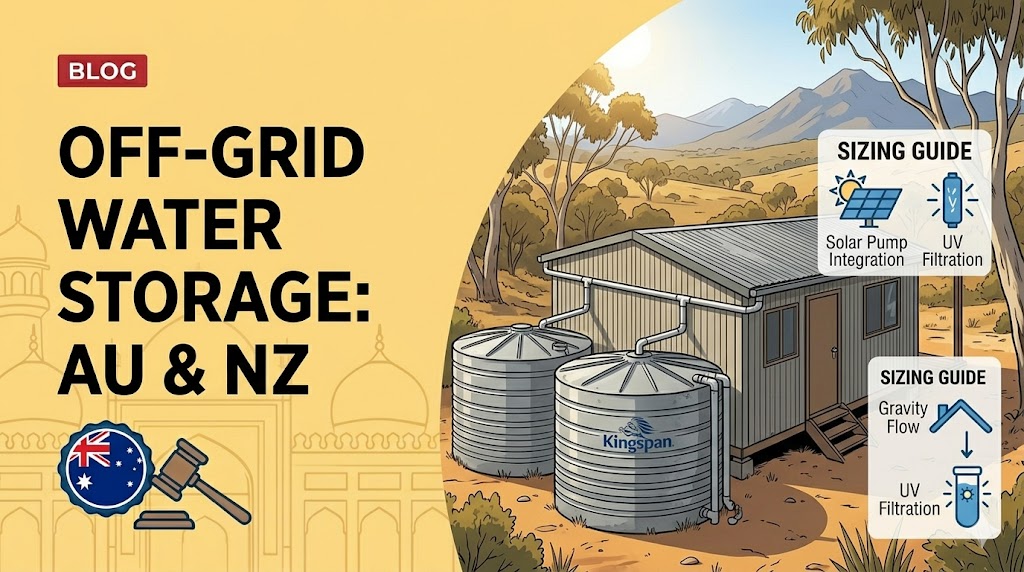
    Rural properties in Australia and New Zealand rely almost entirely on rainwater tanks, bores, or creeks — mains supply does not reach most land beyond a few kilometres from town. A correctly sized off-grid water storage system is therefore not a supplement to mains water; it is the entire supply. Undersizing it by even 20% means running out during drought, which in parts of inland Queensland or the South Island high country can mean waiting weeks for a trucked delivery at high cost. A household of 4 in a 600 mm/year rainfall zone needs a minimum of 90,000–120,000 litres of total tank storage — far beyond what most newcomers to rural living anticipate.

    The quick answer: how much storage do rural Australian and NZ properties need?

    The Australian government’s Your Home guide recommends a minimum of 22,500 litres per person per year for rainwater-only rural properties (at 150 L/person/day). For New Zealand, the Building Research Association of New Zealand (BRANZ) guidance for rainwater-supplied rural properties assumes 120–200 L/person/day depending on lifestyle and stock requirements. These figures do not include firefighting reserve, irrigation, or livestock water.

    Location / rainfall zoneHousehold sizeMin tank storageRecommended storage
    High rainfall >800mm/yr (Tas, NZ West Coast)4 people45,000 L90,000 L
    Medium rainfall 600–800mm/yr (VIC, SA, NZ North Island)4 people90,000 L135,000 L
    Low rainfall 400–600mm/yr (inland NSW, Qld)4 people135,000 L180,000 L
    Arid <400mm/yr (outback, central Australia)4 people180,000 L+200,000–300,000 L

    These figures account for seasonal variation, extended dry periods, and a 20% safety margin above average annual requirement. They do not include additional storage for livestock, irrigation, or bushfire reserves. Use the off-grid water storage calculator to model your specific rainfall zone, household size, and intended uses.

    How the calculation works

    For an off-grid property, the calculation must account for seasonal variability — not just annual average rainfall. The worst-case dry period in your region determines how much storage you need to bridge without running out.

    Storage required = (daily consumption × dry period days) + firefighting reserve + livestock allocation

    Worked example — a retired couple (2 people) on a 40-acre property near Armidale, NSW, in a 650 mm/year rainfall zone. Longest historical dry period: 90 days (Bureau of Meteorology climate data for Armidale 1910–2020).

    Daily household use: 2 × 150 L = 300 L/day. Dry period storage: 300 × 90 = 27,000 L. Firefighting reserve (NSW RFS recommendation for rural properties): 10,000 L. Total minimum storage: 37,000 L. Recommended size accounting for tank cleaning downtime and year-to-year variation: 45,000 L. Standard configuration: one 22,500 L corrugated steel tank plus one 22,500 L poly tank, positioned at separate locations on the property as fire resilience.

    To calculate the annual collection potential from your roof before finalising storage needs, the annual rainwater collection calculator lets you model your catchment area against local rainfall records.

    Key variables that change the answer

    Longest historical dry period in your region. This is the single most important variable and the one most commonly ignored. Bureau of Meteorology (BOM) data for Australia and NIWA data for New Zealand both provide historical consecutive dry-day records by region. Inland Queensland has recorded dry periods exceeding 200 consecutive days in drought years. If you size for average conditions and a drought year hits, you will run dry. Size for the 1-in-20-year dry period, not the median.

    Roof catchment area and material. Rural Australian properties typically have large roof areas — a standard 4-bedroom farmhouse with verandahs may have 250–350 m² of effective catchment. This dramatically increases collection potential: a 300 m² roof in a 700 mm/year zone collects approximately 168,000 litres per year (at 0.8 runoff coefficient). However, Zincalume and colorbond roofs — the dominant material in rural Australia — have runoff coefficients of 0.85–0.95 and are safe for drinking water collection. Old galvanised iron roofing may leach lead and should not feed drinking water tanks.

    Livestock and irrigation demands. A single dairy cow requires 50–100 litres per day; a beef cattle herd of 50 animals needs 2,500–5,000 litres per day. Sheep require 4–10 litres per day. If you are running stock off the same water system as the house, livestock demand will dwarf household consumption and must be calculated and stored separately. Purpose-built farm dam or stock dam infrastructure is separate from the domestic rainwater system in most rural Australian configurations.

    Fire season storage requirements. NSW RFS, CFA Victoria, and FENZ New Zealand all recommend rural properties maintain a minimum firefighting water reserve, ideally in a dedicated tank accessible to tankers. NSW RFS specifies 10,000 L minimum for residential rural properties, held separate from domestic supply and fitted with a 65 mm Storz coupling at ground level. This reserve must not be drawn down for household use during fire season (November–April in most of Australia).

    Tank types used in rural Australia and New Zealand

    Tank typeCommon sizesTypical lifespanConsiderations
    Corrugated steel (Aquaplate lined)22,500–363,000 L20–30 yearsMost cost-effective at large volumes; standard in rural Aus
    Polyethylene (poly)5,000–30,000 L15–25 yearsPortable, no liner required, UV-rated; standard in rural NZ
    Concrete (precast or poured)10,000–200,000 L40–60 yearsExcellent insulation; requires lime neutralisation when new
    Fibreglass5,000–50,000 L25–40 yearsGood for underground; no liner needed; expensive
    Farm dam (earthen)500,000+ LIndefiniteNot for drinking water without significant treatment

    The dominant choice for rural Australia is corrugated Aquaplate-lined steel from manufacturers like Kingspan (formerly Rhino Tanks), Tankmasta, or Ozzi Tanks. For rural NZ, polyethylene tanks from Polymaster or Permathene are most common, as they are lighter to transport to remote sites. Both countries’ configurations typically use gravity-feed from elevated tanks wherever site topography allows, eliminating pump energy costs.

    Common mistakes

    Sizing for annual average rainfall instead of worst-case dry period. This is the most common and most costly mistake in rural water planning. A property in the Western Slopes of NSW might average 650 mm/year historically, but experience 40 mm in a drought year. Annual average provides no useful guidance for sizing storage that must see you through a multi-month dry period. Use BOM 90th percentile dry period data for your location, not the mean.

    Connecting old galvanised iron or lead-flashed roofing to drinking water tanks without testing. Pre-1970 rural Australian roofing frequently used lead flashing at ridges and around chimneys, and older galvanised iron may contain lead-tin solder. NSW Health and SA Health both recommend testing tank water from properties with pre-1970 roofing for lead annually. Do not assume age-old roofing is safe without verification.

    Not installing first-flush diverters because the property ‘doesn’t have pollution’. Rural and remote roofs accumulate possum and bird droppings, insect nests, leaf debris, and dust from unsealed roads during dry periods. First-flush contamination in rural Australia is often worse than in urban areas. A correctly sized first-flush diverter — 1 litre per 25 m² of roof area — is mandatory for safe drinking water collection even on remote properties.

    Inadequate pressure for multi-storey homes without a pressure pump. Many rural Australian farmhouses are single-storey and gravity-feed from an elevated stand works well. For two-storey homes or properties where the tank cannot be elevated sufficiently, a pressure pump and pressure tank are required to maintain consistent flow at all outlets. A tank sitting 3 metres above the highest tap delivers only 29 kPa — below the 50–150 kPa required by most Australian standard showers (AS/NZS 3500.1). Use the gravity feed flow rate calculator to check your system before installation.

    Related calculators you might need

    Once you have your storage volume, verify that your roof delivers enough collection to refill it reliably using the roof catchment area calculator. For properties also running livestock, the livestock water requirement calculator calculates the daily water demand by animal type and herd size — a critical input before deciding whether the rainwater system can serve both house and stock. If you are evaluating a pump versus gravity-feed setup, the pump horsepower and flow rate calculator will size your pump correctly for the flow rate and head your property requires.

    Frequently asked questions

    How big a water tank do I need for a rural property in Australia? A household of 4 in a 600–800 mm/year rainfall zone needs a minimum of 90,000–135,000 litres of total tank storage for domestic use alone. Arid zone properties need 180,000–300,000 litres. Add 10,000 L separately for firefighting reserve (NSW RFS standard). These figures are based on a 90-day design dry period and 150 L/person/day consumption. Use the off-grid water storage calculator for your specific location.

    Is rainwater safe to drink in Australia without treatment? In most rural settings where the roof is clean (Zincalume, Colorbond, or concrete tile post-1970, with first-flush diversion), tank water is generally safe for healthy adults. However, the Australian Drinking Water Guidelines (ADWG 2022) recommend UV disinfection or chlorination for immunocompromised individuals, infants, elderly people, and pregnant women. SA Health, NSW Health, and Queensland Health all recommend testing annually for E. coli and at least every 5 years for heavy metals.

    How long can you go without rain before a rural property runs out of water? At 150 L/day for a family of 4 (600 L/day total), a 45,000 L tank lasts 75 days with no refill. A 90,000 L tank lasts 150 days. In drought conditions, inland NSW and Queensland have seen consecutive rainless periods exceeding 200 days — undersized storage runs out well before the drought breaks. The how long will my tank last calculator gives you the exact duration from your current volume and consumption rate.

    What is the largest rainwater tank I can buy in Australia? Corrugated steel tanks from manufacturers like Kingspan and Tankmasta are available up to 363,000 litres (363 kL) as a single tank. Larger volumes are achieved by linking multiple tanks or constructing a concrete reservoir. For most rural Australian households, the upper practical limit for a single-tank installation is around 100,000 litres before the cost per litre shifts in favour of multiple smaller tanks or a dam.

    Do I need council approval for a rainwater tank in rural Australia? In most rural zones (zoned RU1, RU2, or equivalent in each state), rainwater tanks are permitted development exempt from approval up to certain thresholds — typically 10,000 L above ground or 72,000 L below ground. In NSW, the State Environmental Planning Policy (Infrastructure) 2007 permits rainwater tanks as exempt development in most zones. Check your state’s equivalent before installation, especially if the tank exceeds 10,000 L or requires structural footing.

  • Rainwater Harvesting in The UK: Legal Rules and Sizing

    Rainwater Harvesting in The UK: Legal Rules and Sizing

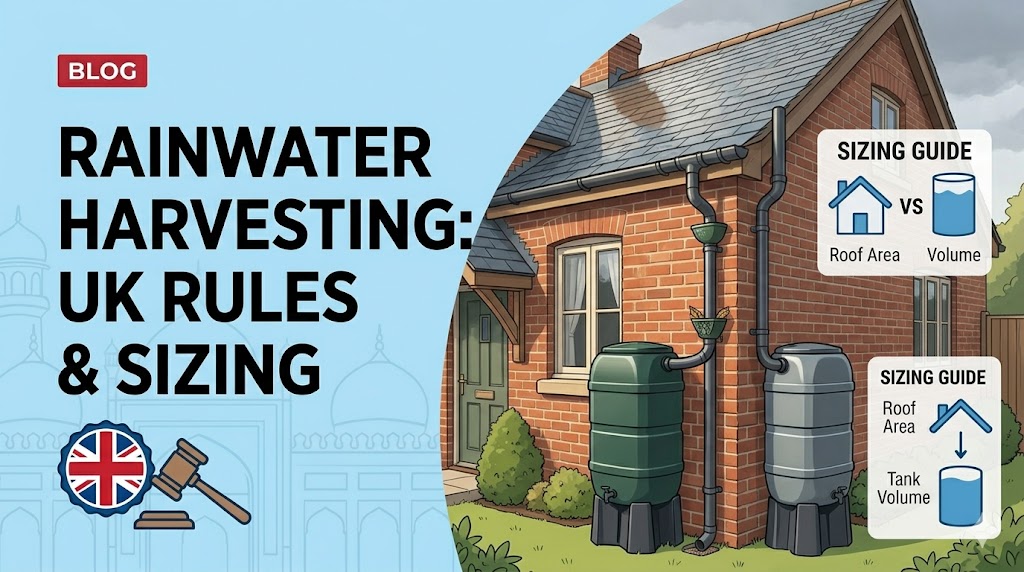
    Rainwater harvesting is fully legal in the UK with no permit required for standard domestic systems, but the use of harvested rainwater is restricted by law. In England and Wales, harvested rainwater cannot legally be connected to potable water systems without approval from Water Regulations Advisory Scheme (WRAS) under the Water Supply (Water Fittings) Regulations 1999. This guide covers the legal framework, realistic collection volumes by region, and how to size a storage tank for UK rainfall patterns.

    The quick answer

    A UK home with a 50 m² roof catchment area in an average rainfall area (England average: 885 mm/year, Met Office 1991–2020 climatology) collects approximately 35,000–40,000 litres per year after accounting for evaporation losses, first-flush discard, and roof efficiency factors (CIRIA C539 Rainwater and Greywater Use in Buildings). For garden irrigation alone, this is more than sufficient for most UK households. For toilet flushing, UK homes use approximately 30–40 litres per person per day for that purpose alone — a household of 4 would use 44,000–58,000 litres per year just on flushing.

    RegionAvg rainfall (mm/yr)50 m² yield (L/yr)Recommended tank size
    South East England610–70022,000–25,0001,500–2,500 L
    Midlands / East Anglia600–70021,000–25,0001,500–2,500 L
    North West England1,000–1,50036,000–54,0002,500–5,000 L
    Scotland (West)1,500–3,00054,000–108,0003,000–7,500 L
    Wales1,200–3,00043,000–108,0002,500–7,500 L

    Tank sizing is not simply a fraction of annual yield — it must account for the longest expected dry spell in your region, which determines how many days of storage you need to bridge. In the South East, summer dry spells of 3–6 weeks are common; in Scotland, the longest dry period rarely exceeds 2–3 weeks. Skip the math: Use the rainwater harvesting calculator to enter your postcode rainfall data, roof area, and intended use.

    How the calculation works

    The standard UK sizing method follows CIRIA C539 guidance. The formula for estimating annual rainwater yield:

    Annual yield (L) = Roof area (m²) × Annual rainfall (mm) × Runoff coefficient × Filter efficiency

    For a standard pitched clay tile roof: runoff coefficient = 0.75–0.85. For flat EPDM membrane roof: 0.90–0.95. For green roof: 0.35–0.60 (significantly lower). Filter efficiency for a standard first-flush diverter and leaf filter: 0.90.

    Worked example — a semi-detached in Manchester with a 45 m² catchment area, annual rainfall 900 mm, clay tile roof:

    45 × 900 × 0.80 × 0.90 = 29,160 litres per year. Monthly average: 2,430 litres. If the intended use is garden irrigation only (typical UK demand: 500–1,000 litres/month in summer), the system will run a surplus for most of the year. A 1,500 L tank is adequate for this use case; a 2,500 L tank is overkill unless a dry summer is the planning scenario.

    To verify your roof’s effective catchment dimensions, the roof catchment area calculator accounts for pitch and plan area correctly.

    Key variables that change the answer

    Rainfall seasonality. UK rainfall is not evenly distributed across the year. The South East receives its lowest rainfall in July and August — exactly when garden demand peaks. A rainwater system sized only for average rainfall conditions will routinely run dry in the South East summer unless the tank is large enough to carry a winter surplus through the dry season. This seasonal mismatch is the primary sizing challenge in England and Wales.

    Intended use and legal restriction. Under the Water Supply (Water Fittings) Regulations 1999, harvested rainwater used for toilet flushing, laundry (with appropriate treatment), or any point where cross-connection with the mains supply is possible must use a Type AA or AB air gap or other approved backflow prevention device. Systems not complying with this are illegal and void home insurance. Garden irrigation via a dedicated outdoor tap with no mains connection is legal without any additional approval.

    Roof material and contamination risk. Bituminous felt roofing leaches compounds including polycyclic aromatic hydrocarbons (PAHs) into collected rainwater. These are not removed by standard first-flush diverters. CIRIA C539 recommends harvested water from bituminous felt roofs not be used for vegetable garden irrigation or any potable application. Clay, concrete tile, and most metal roofs are acceptable for all non-potable harvesting uses.

    First-flush volume. The first 0.5–1 mm of rainfall over a roof washes off accumulated bird droppings, dust, and pollutants. For a 50 m² roof, that represents 25–50 litres per rainfall event. A correctly sized first-flush diverter discards this before allowing water into storage. A diverter that is too small passes contaminated first-flush water into the tank; too large wastes too much clean water. The first flush diverter size calculator gives the correct diverter volume for any roof area.

    UK legal framework: what you can and cannot do

    Permitted without approval: Garden irrigation, car washing, and outdoor cleaning using harvested rainwater stored in a butt or tank with no connection to the mains supply. No notification to Ofwat, Water Authority, or local council required.

    Permitted with compliance: Toilet flushing, laundry, and any indoor use where harvested rainwater is distributed through the building plumbing. Requires a WRAS-compliant backflow prevention device (typically a Type AA air gap cistern). The plumbing must be visibly labelled with “Non-potable water — do not drink” signage under BS EN 806-1. Building Regulations Part G applies; consult your local authority building control before installation.

    Not permitted without additional treatment: Use as drinking water, cooking water, or any potable application without treatment to drinking water standards. This would require compliance with the Private Water Supplies Regulations 2016 and periodic testing — not a standard domestic harvesting scenario.

    Common mistakes

    Installing a system where the mains backup cross-connects without an air gap. Virtually every commercial rainwater harvesting kit sold in the UK includes a mains backup fill to top up the tank during dry periods. If this backup is connected via a float valve below the waterline rather than via an air gap, it creates an illegal cross-connection under the 1999 Water Fittings Regulations. WRAS inspections post-installation have found this fault in a significant proportion of DIY installations. Always use a Type AA air gap for mains backup.

    Undersizing the tank for the intended use. A 200-litre water butt — the most common UK purchase — holds roughly 2–3 days of garden irrigation demand in peak summer. It will fill in a single moderate rainfall event and overflow the rest of the year. For any meaningful water savings, a minimum tank size of 1,500 litres is recommended for garden use; 2,500–5,000 litres for toilet flushing applications.

    Assuming financial payback is rapid. UK water and sewerage bills average approximately £430/year (Ofwat 2023–24 average). Harvested rainwater for toilet flushing saves roughly 30% of indoor water use — around £130/year at best. A properly installed underground tank system costs £3,000–£6,000 installed. Payback periods are typically 20–40 years, which exceeds most system lifespans. The environmental and resilience case is strong; the financial case is weak without grants.

    Neglecting mosquito and algae control. Above-ground tanks with inadequate sealing become mosquito breeding grounds during UK summers. All inlets and overflow pipes must be screened to ≤1 mm mesh. Tanks exposed to light develop algae that degrades water quality and clogs filters. Any above-ground storage tank should be opaque or UV-protected, with all openings sealed.

    Related calculators you might need

    To evaluate whether your system will pay back over time, the rainwater harvesting ROI calculator models your expected savings against installation cost using UK water tariff rates. Once you have your annual yield, the annual rainwater collection calculator breaks it down by month so you can see exactly how the system performs across seasons. If you are evaluating the system primarily for water bill reduction, the rainwater savings calculator converts your collection volume into annual cost savings by end-use category.

    Frequently asked questions

    Is rainwater harvesting legal in the UK? Yes, rainwater harvesting is legal in the UK for most non-potable uses without any permit or notification. The legal requirements apply when harvested water is connected to the building’s internal plumbing: specifically, the Water Supply (Water Fittings) Regulations 1999 require a WRAS-approved air gap to prevent cross-contamination with the mains supply. Garden-only use from a standalone butt or tank requires no approval whatsoever.

    How much rainwater can I collect from my roof in the UK? A typical UK semi-detached with a 50 m² catchment area collects 20,000–45,000 litres annually depending on location. South East homes collect towards the lower end; Welsh and Scottish homes towards the upper end. These figures are post-first-flush discard. Use the rainwater harvesting calculator with your postcode rainfall data for a precise estimate.

    Do I need planning permission for a rainwater harvesting tank? For underground or buried tanks, you may require planning permission depending on your local authority and whether you are in a conservation area. Above-ground tanks in gardens are generally permitted development. In Scotland, the rules are slightly different under the Town and Country Planning (Scotland) Act. Always confirm with your local planning authority before installing underground infrastructure.

    What size water butt do I need for a UK garden? A standard 200 L butt is adequate only for very small gardens with limited seasonal irrigation. For a typical UK garden of 50–100 m², a 1,000–1,500 L tank is more appropriate for consistent summer supply. The butt will fill quickly in autumn and winter; the key design challenge is storing enough winter rain to bridge the summer dry period.

    Can I drink rainwater collected from my roof in the UK? No, not safely without treatment to drinking water standards. UK roofs accumulate bird droppings, particulates, traffic pollution, and biological contaminants. Standard harvesting systems do not treat water to potable standards. Drinking untreated harvested roof water carries a risk of Cryptosporidium, E. coli, and other pathogens.

  • Rooftop tank guide for South African homes

    Rooftop tank guide for South African homes

    A rooftop tank in South Africa serves a different function than in most other countries — it is not a convenience, it is load-shedding and water shedding insurance. Municipal supply in metros including Johannesburg, Tshwane, and Buffalo City has deteriorated to the point where scheduled and unscheduled outages of 24–72 hours are routine. The standard South African rooftop installation is a 2,000–5,000 L polyethylene tank on a steel or concrete elevated platform, fed by a submersible pump from a ground-level sump. This guide covers sizing, structural requirements, municipal by-laws, and installation considerations specific to SA conditions.

    The quick answer: recommended tank sizes for SA homes

    South African municipal guidelines and the South African National Standards (SANS 10400-P) specify a basic minimum supply of 25 litres per person per day for basic sanitation compliance, but real household use in middle-income South African homes averages 150–200 litres per person per day (DWS Household Water Use Study, 2022). Using 175 L/person/day as the working baseline:

    Household size1-day storage3-day storage5-day storage
    2 people350 L1,050 L1,750 L
    4 people700 L2,100 L3,500 L
    6 people1,050 L3,150 L5,250 L
    8 people1,400 L4,200 L7,000 L

    For most Johannesburg, Cape Town, and Durban households experiencing outages of 1–3 days, a 2,000–4,000 L rooftop tank is the practical minimum. For households in areas with documented water shedding schedules of 5+ days (as occurred in parts of Hammanskraal and Buffalo City in 2022–2024), 5,000 L or a combination of rooftop and underground storage is required.

    Use the water tank size for home calculator to get a figure calibrated to your actual household usage and your municipality’s supply pattern.

    How the calculation works

    The formula for sizing a South African rooftop tank for water security:

    Tank size (L) = Daily household consumption (L) × Backup days required

    Worked example — a Pretoria family of 5 with Tshwane supply cutting 3 days per week:

    Daily consumption: 175 L × 5 people = 875 litres. Backup required: 3 days. Calculated size: 875 × 3 = 2,625 L. Nearest standard tank size: 3,000 L. Add a 15% maintenance buffer: 3,000 L × 1.15 = 3,450 L. Practical recommendation: a 4,000 L tank to allow for cleaning downtime and variable supply.

    This family would likely run a 4,000 L rooftop tank plus a 2,500 L underground sump with a 0.75 kW submersible pump — a configuration that has become standard in Gauteng suburbs over the past three years.

    Key variables that change the answer

    Municipality and water shedding schedule. South Africa’s supply disruption frequency is highly localised. Cape Town after Day Zero planning has significantly upgraded storage in its distribution system; unplanned outages are typically short (4–12 hours). By contrast, eThekwini (Durban) experienced extended supply failures in 2022–2023 affecting some areas for weeks following infrastructure damage. Check your municipality’s current water shedding status — not last year’s — before finalising storage sizing.

    Rooftop structure and load capacity. South African home construction is predominantly face-brick with concrete slab roofs in older suburbs, or lightweight steel frame with IBR or fibre cement sheeting in newer developments. A full 2,000 L polyethylene tank weighs approximately 2,060 kg. A concrete slab roof can typically support this if the tank is placed directly over or adjacent to a load-bearing wall. A steel-frame IBR roof cannot support a tank of this size without a dedicated freestanding steel platform alongside the structure — not on it.

    Gravity pressure and floor layout. Every metre of elevation above the highest tap in the house delivers approximately 9.81 kPa (0.1 bar) of static pressure. For adequate shower flow, a minimum of 30 kPa (0.3 bar) is required at the showerhead. With a rooftop tank 3 metres above the shower outlet, pressure is marginal at 29.4 kPa. Many SA installations add a pressure-boosting pump or a header tank elevated an additional 1–2 metres above the main tank. Use the minimum tank height for shower pressure calculator to confirm your setup delivers adequate flow.

    Borehole integration. An increasing number of Gauteng and Western Cape homes pair a rooftop or underground tank with a borehole. The borehole feeds the tank continuously, making the effective backup duration far longer than the tank volume alone would suggest. If a borehole is part of your system, size the tank primarily for the borehole pump’s output rate rather than for days-of-backup storage alone.

    South African rooftop tank installation: local specifics

    The dominant tank brands sold in South Africa — Jojo Tanks, Pioneer Plastics, and Harlequin — manufacture in sizes from 260 L to 10,000 L in black, green, and yellow. Black tanks are standard for South African conditions: they inhibit algae growth and UV degradation. Jojo’s most popular rooftop sizes are 2,500 L and 5,000 L; their structural tank stands are rated for the loaded weight of those sizes.

    Municipal by-laws relevant to rooftop tank installation in major metros:

    MetroPermit required?Backflow prevention?Key by-law
    City of JoburgNo for <10,000 LRequired (check valve)Water Services By-Law 2004
    City of Cape TownNo for residentialRequiredWater By-Law 2010
    eThekwini (Durban)No for residentialRequiredWater and Sanitation By-Law
    TshwaneNo for <10,000 LRequiredWater Services By-Law 2011

    All SA metros require a non-return (check) valve between the municipal supply and any supplementary tank to prevent backflow contamination into the municipal network. This is non-negotiable and failure to install one can result in disconnection from supply.

    Common mistakes

    Placing a large tank directly on an IBR or corrugated steel roof without a platform. South African lightweight roof sheeting — IBR, corrugated, or fibre cement — cannot bear concentrated loads. A 2,000 L tank sitting on three sheeting ribs will puncture through within weeks. All non-concrete roofs require a freestanding steel frame platform built off the walls or ground structure, independent of the roof sheet itself.

    Connecting the tank to mains supply without a backflow preventer. Every SA metro water by-law requires a check valve on the inlet. Without it, if mains pressure drops (which happens routinely during load shedding when pumping stations fail), backflow from your tank into the municipal network can contaminate the street supply. This has caused E. coli events in multiple SA suburbs. It is both illegal and a genuine public health risk.

    Not accounting for the pump head when selecting a pump. A submersible pump rated 1,000 L/hour at ground level may only deliver 300–400 L/hour when lifting to a rooftop 5 metres above. Pump performance curves drop sharply with head. Many South African homeowners install an undersized pump that takes 6–8 hours to fill the tank — far too slow for daily refilling. The pump head pressure calculator tells you what performance to demand from your pump specification.

    Neglecting tank cleaning. South African municipal water quality varies — Johannesburg mains water sometimes delivers with elevated turbidity and sediment. Sediment accumulates in tank bottoms and can exceed 20 cm depth in tanks that have never been cleaned. DWS guidelines recommend annual inspection and cleaning every 2–3 years for domestic storage tanks. A tank with heavy sediment loses effective capacity and can harbour Legionella if water temperatures exceed 25°C.

    Related calculators you might need

    Before committing to your tank size, use the rooftop load bearing calculator to verify your roof can bear the loaded weight — this is particularly critical for IBR or steel frame constructions. If you are comparing the cost of a rooftop tank system against underground storage, the underground vs rooftop tank cost calculator models the capital and running cost difference over a 10-year period. To understand how long your tank supply lasts under normal usage, the how long will my tank last calculator gives your days of supply at your household’s consumption rate.

    Frequently asked questions

    What size water tank do I need for a South African home of 4 people? A family of 4 using 175 L/person/day needs 700 litres per day. For 3 days of backup — appropriate for most Gauteng and KwaZulu-Natal supply conditions — this means a minimum 2,100 L tank, with a practical recommendation of 2,500 L to allow for cleaning and consumption variance. In areas with more severe water shedding, size for 5 days: 3,500 L minimum, with a 4,000 L or 5,000 L tank as the nearest standard size.

    Do I need a permit to install a water tank in South Africa? For residential rooftop tanks under 10,000 L, no permit is required in most SA metros. You do need to comply with local water by-laws — specifically, installing a non-return valve on the mains inlet and ensuring the structure meets local building regulations. If the tank requires a new support structure, that structure may require building plan submission depending on your municipality.

    Is a Jojo tank safe for drinking water? Jojo Tanks are manufactured from food-grade polyethylene and are SABS 1731 and SANS 1020 compliant for potable water storage. The black UV-resistant outer layer prevents algae growth. Water stored in a Jojo tank from a clean mains supply is safe for domestic use without additional treatment, provided the tank is cleaned periodically and the inlet is covered against insect and debris entry.

    How much does a 5,000 L water tank installation cost in South Africa? A complete 5,000 L Jojo rooftop tank installation including tank, stand, pump, pipework, and backflow preventer typically costs R18,000–R35,000 depending on Gauteng vs Western Cape labour rates, stand complexity, and pump specification. DIY installation of the tank and stand alone (with a plumber for connections) can reduce this to R12,000–R20,000.

    Can I connect my rooftop tank to my borehole? Yes. The typical configuration is: borehole pump feeds an underground sump, submersible sump pump fills the rooftop tank, gravity feeds the house from the rooftop tank. This completely eliminates municipal supply dependency for as long as the borehole yields. Ensure your borehole water is tested annually — borehole water in SA urban areas increasingly shows nitrate and coliform contamination from failing municipal sewer infrastructure.

  • Water Tank Sizing for Homes in Pakistan: A Practical Guide

    Water Tank Sizing for Homes in Pakistan: A Practical Guide

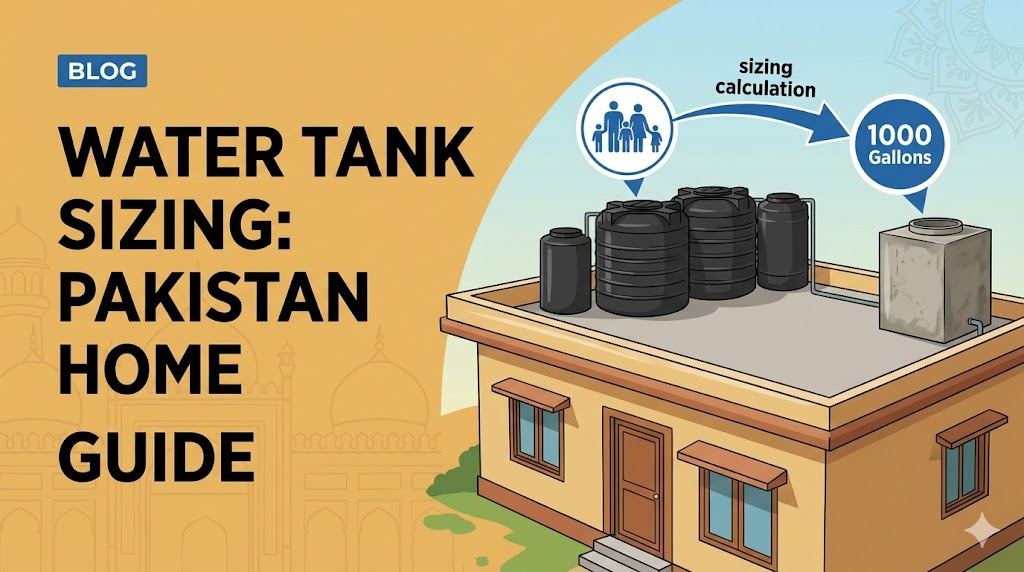
    Most urban Pakistani households need a minimum of 1,000 litres of on-site storage to survive a 24-hour water outage — and most WASA supply areas in Karachi, Lahore, and Rawalpindi cut supply for 12 to 36 hours at a time. A family of 4 with moderate use (150 litres/person/day) needs at least 1,500–2,000 litres for two days of reliable backup. This guide covers how to calculate exactly what your household needs, what tank configurations are standard in Pakistan, and the common mistakes that leave families short.

    The quick answer

    Pakistan’s water supply reliability varies dramatically by city and neighbourhood. Using 150 litres per person per day as the baseline (a realistic average for an urban Pakistani household with regular bathing, cooking, and flushing), here are the recommended tank sizes by household size and backup duration:

    Household size1-day backup2-day backup3-day backup
    2 people300 L600 L900 L
    4 people600 L1,200 L1,800 L
    6 people900 L1,800 L2,700 L
    8 people (joint family)1,200 L2,400 L3,600 L

    These figures assume municipal water refills the tank within the backup window. If supply is highly intermittent — as in parts of interior Sindh or rural Punjab — size for 3 to 5 days minimum.

    Skip the math: Use the water tank size for home calculator to get a number tailored to your household and supply pattern.

    How the calculation works

    The core formula is straightforward:

    Tank size (litres) = Daily consumption (L/person) × Number of people × Backup days

    For a Lahore family of 5 with WASA supply cutting 2 days a week:

    Daily consumption: 150 L × 5 = 750 litres per day. Backup needed: 2 days. Tank size required: 750 × 2 = 1,500 litres. A standard 1,500 L polyethylene overhead tank fits this need exactly.

    Add a 20% buffer for losses from tank cleaning cycles, evaporation, and miscalculated supply windows. Revised minimum: 1,500 × 1.2 = 1,800 litres. In practice, a household like this should install a 2,000 L tank — the next standard size up — rather than operating at 90% capacity perpetually.

    If you want to confirm your actual daily usage before sizing the tank, the daily water requirement calculator lets you input per-activity usage for a more accurate number.

    Key variables that change the answer

    Supply frequency and duration. This is the biggest variable in Pakistan. WASA Karachi zones may receive water every 48–72 hours in summer; some DHA sectors get daily supply. A household receiving water every 3 days needs triple the storage of one receiving daily supply. Verify your zone’s actual schedule — not the official schedule, the actual one — before sizing.

    Household activity type. A home with a working kitchen that does commercial food prep, a laundry business, or runs a guest house consumes 2–3× more water than a standard residential household. If any commercial activity runs from your property, calculate that load separately and add it to domestic needs.

    Tank configuration: overhead vs underground. Most Pakistani homes use overhead rooftop tanks of 500–2,000 L fed by a motor from a ground-level sump. Joint family homes or commercial properties increasingly use underground sumps of 5,000–10,000 L as primary storage, with a smaller overhead tank (500–1,000 L) for gravity-fed pressure. The underground tank effectively multiplies your storage capacity without requiring roof load upgrades.

    Seasonal demand shift. Summer demand in Karachi and interior Sindh — where temperatures exceed 45°C — can increase per-person consumption by 30–40% due to additional bathing, evaporative coolers, and garden use. Size for peak summer demand, not average demand.

    Roof load capacity. A full 1,000 L polyethylene tank weighs approximately 1,020 kg including tank weight. A 2,000 L tank exceeds 2,000 kg. Older construction in areas like the inner city of Lahore or Karachi’s older neighbourhoods may not support this without structural checks. Always verify with your structural engineer before installation.

    Local tank configurations used in Pakistan

    The most common configuration in urban Pakistani homes is a two-stage system: a ground-level underground sump (typically 2,000–5,000 L) fed directly from the municipal supply line, plus a rooftop tank (500–2,000 L) fed by a submersible or surface pump. The rooftop tank provides gravity-fed pressure throughout the day; the sump acts as the primary reserve.

    Standard overhead tank sizes sold in Pakistan (Polytank, National Plastics, Roto brands):

    Tank sizeApprox weight (full)Typical useApprox price (PKR, 2024)
    500 L~520 kgSingle flat/1–2 persons6,000–9,000
    1,000 L~1,030 kgSmall household (3–4 persons)12,000–18,000
    1,500 L~1,545 kgMedium household (4–6 persons)18,000–27,000
    2,000 L~2,060 kgLarge household (6–8 persons)24,000–35,000
    5,000 L~5,150 kgUnderground sump or commercial55,000–80,000

    Prices fluctuate with petrochemical costs. The 2024 figures above are indicative; verify with local suppliers. For apartment buildings and multi-floor properties, the apartment water tank size calculator accounts for floor count and pump head requirements.

    Common mistakes

    Sizing for the official supply schedule, not the actual one. WASA and other utilities publish supply schedules that often bear little relation to actual delivery. If your municipality officially supplies daily but actually delivers every 48–72 hours in your area, and you’ve sized your tank for one day of backup, you will run dry routinely. Benchmark your actual supply frequency over 2–4 weeks before finalising tank size.

    Ignoring the motor and pump sizing. A 2,000 L overhead tank requires a pump capable of lifting water to that height within a reasonable fill window. A pump undersized for the head (vertical lift) will take hours to fill the tank and may run continuously, burning out quickly. Use the pump head pressure calculator to match your pump to the vertical lift required.

    Installing an overhead tank the roof cannot support. A full 2,000 L tank exerts roughly 2,060 kg on its support points. Older reinforced concrete roofs in Pakistan are often designed to 150–200 kg/m², and a tank base of 1.2 m² concentrates enormous load on a small area. Without a proper beam or spread footing underneath, tanks have cracked roofs and collapsed in Pakistan — this is not a theoretical risk.

    Buying a tank that is too small and adding a second later. Two 1,000 L tanks cost significantly more than one 2,000 L tank, occupy more roof space, and complicate plumbing. Over-buying capacity initially is almost always the more economical decision in Pakistan’s supply environment.

    Related calculators you might need

    Once you know your required tank volume, check whether your roof can physically support it using the rooftop load bearing calculator. If you are using a two-stage sump-and-overhead system, the tank refill time calculator tells you how long your pump needs to run to fill the overhead tank from the sump — useful for setting timer controls. To assess whether your rooftop tank height delivers adequate shower pressure without a booster pump, the minimum tank height for shower pressure calculator gives the exact elevation required for your fixtures.

    Frequently asked questions

    How much water does a Pakistani family of 4 use per day? A typical urban Pakistani household of 4 uses between 400 and 800 litres per day depending on bathing habits, whether a flush toilet is used, and garden or vehicle washing activity. The daily water requirement calculator lets you input your actual activity pattern for a precise figure rather than using an average.

    What size water tank do I need for a 5 marla house in Lahore? A standard 5 marla house in Lahore typically houses 4–6 people. With WASA Lahore supply averaging every 24–48 hours, a minimum tank size of 1,500–2,000 L is appropriate. If your zone experiences more frequent disruptions, 3,000 L across two tanks or a combined sump-and-overhead system is a better configuration.

    Is it better to have one large tank or two smaller ones? One large tank is almost always better in Pakistan. Two 1,000 L tanks cost 30–50% more than one 2,000 L tank, create more plumbing complexity, and halve your effective storage if one develops a leak. The only exception is when roof load constraints prevent installing a single large tank.

    How do I know if my roof can hold a 1,000 L overhead tank? A full 1,000 L polyethylene tank weighs approximately 1,030 kg including the tank itself. Modern RCC roofs with proper beam support can typically handle this, but older or poorly constructed roofs cannot. Have a structural engineer check the slab rating — or install the tank directly over a load-bearing wall or column rather than in the centre of a span.

    Does tank colour matter for water quality in Pakistan’s heat? Yes. Black and dark-coloured tanks absorb more solar radiation, raising stored water temperatures above 40°C in summer — which accelerates bacterial growth including coliforms. White or light-coloured tanks keep water cooler but allow light penetration that promotes algae growth. A double-layer tank with a white outer layer and black inner layer is the best balance for Pakistani conditions.

  • Water Pressure Explained: PSI, bar and kPa — What Do They Mean?

    Water Pressure Explained: PSI, bar and kPa — What Do They Mean?

    Water pressure is measured in three units depending on where you are: PSI (pounds per square inch) in the US, bar in Europe and Australia, and kPa (kilopascals) in countries using strict SI units. They all measure the same thing — the force that water exerts per unit area — but with different numeric scales. Knowing how to convert between them and what values mean in practice determines whether your gravity-fed tank will run a shower, whether your pump is sized correctly, and whether your pipe fittings are rated for the load.

    The quick answer

    The three units relate to each other as follows: 1 bar = 100 kPa = 14.5 PSI. Domestic water systems typically run at 2–4 bar (200–400 kPa / 29–58 PSI). A gravity-fed rooftop tank at 3 metres of head delivers roughly 0.3 bar (30 kPa / 4.3 PSI) — enough for a shower only if flow rate requirements are modest.

    UnitFull name1 bar =Typical mains pressure
    PSIPounds per square inch14.5 PSI30–60 PSI
    barBar (metric)1 bar2–4 bar
    kPaKilopascal100 kPa200–400 kPa
    MPaMegapascal0.1 MPa0.2–0.4 MPa

    Use the water pressure calculator to convert between units and check whether your system pressure falls within safe operating ranges.

    How the calculation works

    Pressure from a static water column — which is what a gravity-fed tank produces — follows the hydrostatic formula: P = ρ × g × h, where P is pressure in pascals, ρ is water density (1,000 kg/m³ at 20°C), g is gravitational acceleration (9.81 m/s²), and h is the vertical height of the water column in metres.

    Worked example: A rooftop tank with its base 5 metres above the shower head.

    P = 1,000 × 9.81 × 5 = 49,050 Pa = 49.05 kPa = 0.49 bar = 7.1 PSI

    Most showers require at least 1.0 bar (100 kPa / 14.5 PSI) for comfortable flow. At 0.49 bar, that installation will run a low-flow shower head only. Adding a booster pump or raising the tank to 10 metres would double the pressure to 0.98 bar — just below the 1.0 bar threshold. At 11 metres: 1.08 bar, which clears it. Use the minimum tank height for shower pressure calculator to find the exact height required for your fixture.

    What these numbers mean in real systems

    Municipal mains supply in the UK is typically 1.0–3.0 bar at the meter. Australia’s water utilities target 500 kPa (5 bar) at the boundary — well above what residential fixtures need. US systems run at 40–80 PSI (2.8–5.5 bar), with 60 PSI considered optimal. India’s urban mains often deliver below 1 bar for much of the day, which is why overhead tanks are standard.

    Pressure reducers are required when mains pressure exceeds 5 bar (500 kPa / 72.5 PSI) — above this, standard fittings risk failure, and appliances like washing machines void their warranties. Pressure below 0.7 bar (70 kPa / 10 PSI) at the fixture is insufficient for most combi boilers and tankless water heaters, which will shut off on under-pressure protection.

    For tank-fed systems, pressure at the outlet depends on both the height of the tank and the friction losses in the pipe run. Longer or narrower pipes reduce effective pressure. Use the gravity feed flow rate calculator to account for pipe friction and get the actual delivered flow rather than theoretical head pressure.

    Converting between PSI, bar and kPa

    The conversion factors are exact or near-exact:

    FromToMultiply by
    PSIbar0.0689
    PSIkPa6.895
    barPSI14.504
    barkPa100
    kPabar0.01
    kPaPSI0.145

    The water column pressure calculator handles all unit conversions automatically and shows pressure at any depth or height in a water column.

    Common mistakes

    Confusing gauge pressure with absolute pressure. Pressure gauges in plumbing read gauge pressure — the pressure above atmospheric (101.3 kPa). If a fitting is rated to 600 kPa, that is gauge pressure. Absolute pressure is gauge + atmospheric. When specifying tank equipment, always confirm whether a rating is gauge (g) or absolute (a). Mixing them up can lead to choosing fittings that fail at operational pressure.

    Treating head height as the full story. A tank 8 metres above a tap theoretically delivers 0.78 bar. But a 20-metre run of 15mm pipe with two elbows can cut that to 0.45 bar at full flow. Engineers account for friction losses using the Darcy-Weisbach equation or simplified tables. For most residential installations, pipe runs over 15 metres should be upsized to 25mm to preserve pressure.

    Using PSI specifications on a bar-rated system. A pump rated to “60 PSI” is not a 60-bar pump — it is a 4.1 bar pump. Misreading this when selecting a booster pump for a high-pressure system is a common and expensive error. Double-check the unit on every specification sheet, especially on imported equipment where labels may be inconsistent.

    Ignoring pressure variation through the day. Municipal pressure is not constant. It peaks during low-demand hours (early morning) and drops during peak usage. In parts of South Asia and Sub-Saharan Africa, daytime pressure can drop to zero even when supply is nominally present. Size storage tanks based on nighttime refill assumptions and verify with a pressure logger rather than a single reading.

    Related calculators you might need

    If your pressure analysis points to a pump-fed system, the pump head pressure calculator will tell you the total dynamic head your pump needs to overcome — accounting for static lift, pipe friction, and required outlet pressure. For installations where the tank is on a rooftop, check structural implications with the rooftop load bearing calculator before adding water weight. If you are retrofitting an existing system and need to size replacement pipework, the pipe size and flow rate calculator matches pipe diameter to required flow at a given pressure. For emergency or off-grid contexts where you are relying solely on stored water with no boost pump, the hydrostatic pressure calculator confirms what pressure you can realistically expect from a fixed tank height.

    Frequently asked questions

    What is a good water pressure for a house? Most residential plumbing is designed for 2–3 bar (200–300 kPa / 29–43 PSI) at the highest fixture. Below 1.5 bar, some appliances will not function correctly. Above 5 bar, you should install a pressure reducer to protect fittings and appliances. The ideal range for most households is 2.5–3.5 bar — enough for good shower pressure without stressing the pipework.

    How much pressure does a rooftop tank produce? Every 1 metre of water height above the outlet produces approximately 9.81 kPa (0.098 bar / 1.42 PSI). A tank base at 5 metres above the lowest fixture delivers about 49 kPa (0.49 bar / 7.1 PSI). This is marginal for a conventional shower and insufficient for a power shower or combi boiler. Use the minimum tank height for shower pressure calculator to find the exact height you need for your specific fixtures.

    Is 40 PSI enough water pressure? 40 PSI (2.76 bar / 276 kPa) is within the acceptable range for residential use. Most fixtures are rated to work from 25–80 PSI. At 40 PSI you will get adequate flow from taps, showers, and most appliances. If pressure drops below 40 PSI during peak use — indicating insufficient supply or pipe losses — you may need a booster pump or larger pipework.

    Why does my water pressure drop when multiple taps are open? Simultaneous demand draws more flow through a fixed pipe diameter, which increases friction losses and reduces pressure at each outlet. This is a pipe sizing and pump capacity problem, not a pressure unit issue. Upsizing the supply main from 15mm to 22mm or 28mm, or adding a pressure-boosting pump with a buffer tank, typically resolves the problem. The water flow rate calculator can help quantify the flow demand.

    What is the difference between static and dynamic pressure? Static pressure is measured when no water is flowing — it represents the maximum available head from the tank or main. Dynamic pressure (residual pressure) is what remains at the outlet when flow is occurring. For system design, dynamic pressure is what matters. A tank at 8 metres static head might deliver only 5 metres of dynamic head at full flow once pipe friction is subtracted. Always design for dynamic conditions, not static.

  • What Is a First-Flush Diverter and Do You Need One?

    What Is a First-Flush Diverter and Do You Need One?

    A first-flush diverter is a device fitted in a rainwater harvesting downpipe that captures and discards the initial portion of roof runoff — the water most contaminated with dust, bird droppings, leaf debris, and atmospheric pollutants — before allowing cleaner water to flow into the storage tank. The principle is that the first rainfall washes the roof surface, and that wash water should not enter your tank.

    The volume of water to divert depends on your roof area and local contamination levels. Use the first flush diverter size calculator to work out the correct diverter capacity for your catchment.

    How a First-Flush Diverter Works

    The device sits in the downpipe between the roof gutter and the tank inlet. When rain starts, water flows into a standpipe or chamber within the diverter. This chamber fills first, holding the contaminated flush water. Once the chamber is full, subsequent runoff overflows or redirects through a bypass pipe into the storage tank. A slow-release valve (typically a small orifice of 2 to 4 mm) at the base of the chamber drains the captured flush water between rain events, resetting the device for the next storm.

    The slow-drain orifice is critical. Without it, the diverter chamber stays full after the first event and passes all subsequent runoff directly to the tank — defeating the purpose. The orifice must drain slowly enough that it empties between rain events but does not drain so fast it empties during a prolonged storm, allowing a second contamination flush to enter the tank.

    How Much Water Does a First Flush Actually Contain?

    The standard guideline is 1 litre of diverter capacity per 25 m² of roof catchment area, though some authorities specify 1 L per 10 m² in heavily polluted urban areas or near busy roads, and 1 L per 40 m² in rural areas with clean air and low bird activity. A 100 m² roof in a typical suburban area needs approximately 4 litres of first-flush diverter capacity.

    EnvironmentDiverter Sizing RuleExample: 100 m² Roof
    Rural, low pollution, low bird activity1 L per 40 m²2.5 L
    Suburban, standard conditions1 L per 25 m²4 L
    Urban, near roads or high bird density1 L per 10 m²10 L
    Industrial area or heavy pollution1 L per 5 m²20 L

    These are starting points. The actual contamination load depends on how long since the last rainfall, whether trees overhang the roof, proximity to roads, and local wildlife. In areas where rooftop water is used for drinking, err toward a larger diverter — the cost is a few litres of water per event.

    Do You Need a First-Flush Diverter?

    For non-potable uses — garden irrigation, toilet flushing, laundry (where permitted), and livestock troughs — a first-flush diverter is not strictly necessary but will extend tank cleanliness and reduce the frequency of tank cleaning. Sediment and organic matter from unfiltered roof runoff accumulate at the tank base over months, creating conditions for bacterial growth and odour.

    For any potable or near-potable application — drinking, cooking, bathing — a first-flush diverter is essential, not optional. It is the first line of defence in a harvesting system that should also include a pre-tank filter, tank screening, and post-tank treatment (UV, chlorination, or filtration). No single device makes roof-harvested water safe to drink on its own.

    In areas with long dry spells between rains — common in much of Australia, southern Africa, and inland India — contamination accumulates on the roof surface over weeks or months. After a six-week dry spell, the first flush is highly polluted. Diverting only 4 litres from a 100 m² roof may not be enough; some practitioners double the diverter volume in such climates.

    Common Mistakes

    Mistake 1: Undersizing the diverter based on roof area alone, ignoring local conditions. A house near a chicken farm, under a large tree, or next to a busy road carries a much higher contamination load than one in a clean rural setting. The 1 L per 25 m² rule is a baseline for average conditions. In high-contamination environments, undersizing means contaminated water enters the tank on every event.

    Mistake 2: Fitting a diverter and assuming the tank water is safe without further treatment. A diverter removes the worst of the surface contamination but does not filter bacteria, protozoa, or dissolved chemical contaminants. E. coli and other pathogens can be present in roof runoff even after a diverter. Any system supplying water for drinking requires downstream treatment.

    Mistake 3: Not maintaining the slow-drain orifice. The small drainage hole at the base of the diverter chamber blocks easily with leaf particles, insect nests, and mineral scale. A blocked orifice means the chamber never resets — all subsequent rainfall bypasses the diverter and goes directly to the tank. Check and clear the orifice every 3 to 6 months.

    Mistake 4: Fitting a diverter but not screening the tank inlet. Insects, frogs, and small animals will enter an unscreened tank inlet. A diverter stops the first flush; it does not stop creatures entering through open pipes. Fit a fine mesh screen (maximum 1 mm) at the tank inlet to exclude vectors.

    Related Calculators You Might Need

    Sizing a first-flush diverter is one step in designing a complete rainwater harvesting system. The roof catchment area calculator converts your roof dimensions to an effective catchment area accounting for pitch and material. From there, the annual rainwater collection calculator estimates how much water your roof actually yields over a year given local rainfall data. Once you know the yield, the rainwater harvesting calculator sizes the storage tank to balance yield against demand. And if you are evaluating the financial case for the system, the rainwater harvesting ROI calculator models payback against your current water costs.

    Frequently Asked Questions

    How much water does a first-flush diverter waste?

    A standard diverter for a 100 m² suburban roof discards approximately 4 litres per rain event. In a location with 80 rain events per year, that is 320 litres annually — a negligible loss against the thousands of litres collected. In drought-prone areas where every litre counts, some users fit diverters with a collection point for the flush water and use it for non-contact irrigation rather than discarding it to drain.

    Can I make a DIY first-flush diverter?

    Yes. A common DIY design uses a vertical PVC standpipe connected inline with the downpipe, sized to the required divert volume (roughly 20 mm pipe holds about 0.3 L per metre length). A ball float valve at the connection point closes when the standpipe is full, diverting subsequent flow to the tank. A 2 to 3 mm orifice drilled in the standpipe cap allows slow drainage. Commercial units offer the same function with better weathering and easier maintenance access.

    Does a first-flush diverter help with water quality testing results?

    It improves results but does not guarantee them. Studies show first-flush diversion reduces E. coli counts and turbidity significantly compared to undiverted systems, but detectable contamination often remains. For potable use, treat diverted roof water with chlorination or UV regardless. The water tank disinfection calculator helps you determine correct disinfection doses.

    How often should I clean a first-flush diverter?

    Inspect every 3 months minimum. Clean the slow-drain orifice with a pin or thin wire. Remove the standpipe or chamber cap and flush out any sediment annually. In areas with high leaf fall or heavy bird activity, inspect monthly. A blocked diverter is worse than no diverter — it gives a false sense of protection while passing unfiltered runoff into the tank.

    Do I need a first-flush diverter if I already have a pre-tank filter?

    Both serve different purposes and work best together. The diverter removes the most contaminated initial water before it reaches the filter. Without a diverter, the filter processes the full contamination load of the first flush on every event — shortening filter life and increasing maintenance frequency. A diverter upstream of a filter reduces clogging, extends filter media life, and produces cleaner water at the filter outlet.

  • How Gravity-Feed Water Systems Work (and Their Limits)

    How Gravity-Feed Water Systems Work (and Their Limits)

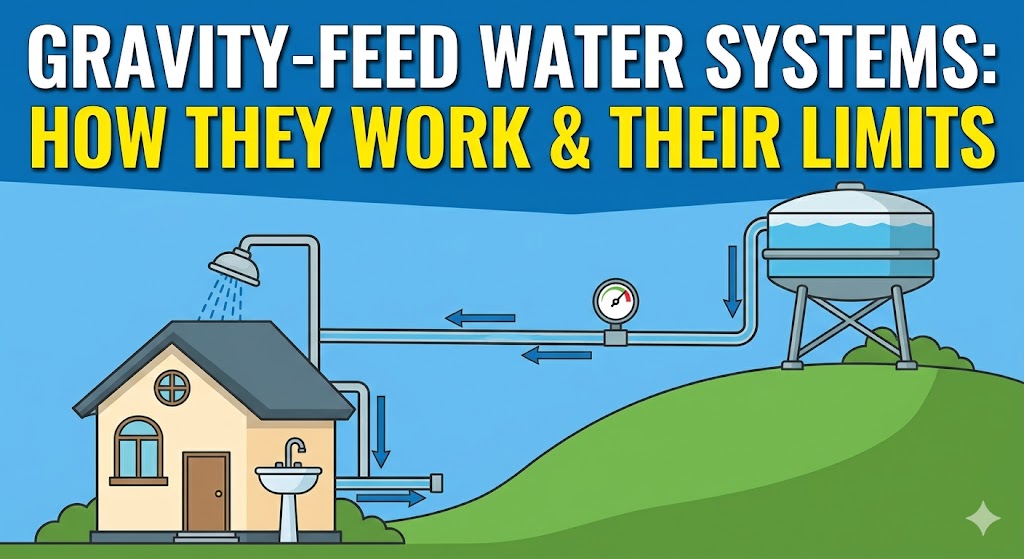
    A gravity-feed water system delivers water using elevation difference alone — no pump, no pressure vessel, no electricity. The tank sits above the point of use, and the weight of the water column above the outlet creates usable pressure. Every 1 metre of vertical height between the tank outlet and the tap produces approximately 0.098 bar (1.42 psi) of static pressure. That number determines everything: what you can and cannot run off a gravity-fed supply.

    Before sizing a tank for gravity feed, use the gravity feed flow rate calculator to confirm your height gives you enough flow for the fixtures you plan to run.

    How the Pressure Equation Works

    The physics is straightforward. Hydrostatic pressure at the base of a water column equals the fluid density multiplied by gravitational acceleration multiplied by height: P = ρgh. For water, this simplifies to roughly 9.81 kPa per metre of head, or 0.098 bar/m. A tank mounted 3 m above a shower outlet generates around 0.29 bar of static pressure before any friction losses in the pipework are accounted for.

    Static pressure is not the same as dynamic pressure. Once water flows, pressure drops due to pipe friction, fittings, and elevation changes along the route. A 25 mm pipe carrying 10 L/min loses significantly less pressure per metre than a 15 mm pipe carrying the same flow. If your pipes are undersized, the working pressure at the fixture will be well below what the height calculation suggests. Use the pipe size and flow rate calculator to account for friction losses.

    Pressure by Tank Height: What You Can Actually Run

    Tank Height Above OutletStatic Pressure (bar)Static Pressure (psi)Suitable For
    1 m0.101.4Cold fill cisterns, garden drip systems
    2 m0.202.8Low-pressure taps, livestock troughs
    3 m0.294.2Basic showers (minimum threshold)
    5 m0.497.1Standard showers, most household taps
    8 m0.7811.4Washing machines, multiple simultaneous outlets
    10 m0.9814.2Near-normal mains-equivalent flow

    Most shower heads require a minimum of 0.1 bar to function, but a comfortable shower requires at least 0.3 bar dynamic pressure at the head — meaning static pressure at the tank needs to be higher to cover friction losses. The minimum tank height for shower pressure calculator works this out for your specific setup.

    Hard Limits of Gravity-Feed Systems

    Gravity feed fails predictably in three scenarios. First, when height is insufficient: most modern appliances — washing machines, dishwashers, combination boilers — require a minimum inlet pressure of 0.5 to 1.5 bar. At 5 m head you get roughly 0.49 bar static, which leaves almost no margin once pipe losses are accounted for. These appliances will either refuse to operate or underperform.

    Second, when flow demand exceeds what the pipe and head can deliver simultaneously. A 3 m head through a 15 mm supply pipe might sustain one shower adequately. Open a second outlet and dynamic pressure at both drops sharply. This is not fixable by adding a bigger tank — the constraint is head height and pipe diameter, not storage volume.

    Third, when the tank position is constrained. Rooftop installations in single-storey buildings rarely achieve more than 2 to 3 m of usable head above upper-floor outlets. A second-storey bathroom fed from a rooftop tank at the same level has effectively zero pressure. The solution is either a pumped header tank or a pressurised system.

    Common Mistakes

    Mistake 1: Measuring height from the tank base rather than the tank outlet. The pressure equation uses the vertical distance from the water surface in the tank to the outlet — not the floor the tank sits on. A 1,000 L rooftop tank sitting 3 m above the roofline but with only 0.5 m of water remaining inside gives you only 3.5 m of effective head, not 4 m. As the tank empties, pressure drops.

    Mistake 2: Ignoring pipe friction over long horizontal runs. A tank 6 m above a tap sounds like plenty of head. But if the supply pipe runs 40 m horizontally in 15 mm copper with multiple bends, friction losses can consume 0.3 bar or more — cutting effective pressure at the outlet nearly in half.

    Mistake 3: Sizing the tank for storage without checking structural load. A 2,000 L tank weighs over 2 tonnes when full. Rooftop installations require a structural assessment before installation. The rooftop load bearing calculator gives a baseline figure, but a structural engineer sign-off is mandatory for anything over 500 L on a residential roof.

    Mistake 4: Assuming gravity feed works for all fixtures once it works for one. A system tested on a single ground-floor tap may fail completely when a first-floor shower is added. Every metre of vertical rise above the outlet subtracts from available head. Test with all intended fixtures active simultaneously.

    Related Calculators You Might Need

    Once you have confirmed your gravity head is adequate, the next check is whether your tank can sustain supply between refills. The how long will my tank last calculator tells you how many days of consumption your stored volume covers. If you are sizing a new tank from scratch, the water tank size for home calculator combines daily demand with backup duration to give a minimum capacity figure. For rooftop installations, check the safe rooftop tank load calculator before committing to a tank size — a full 2,000 L tank exerts over 2 tonnes of force on the mounting surface. And if you need to understand how long a gravity-fed tank takes to refill from a low-pressure supply, the tank refill time calculator handles that calculation.

    Frequently Asked Questions

    What is the minimum height for a gravity-fed shower?

    A shower needs at least 0.1 bar at the head to function, which equates to roughly 1 m of head. In practice, that produces a trickle. A usable gravity-fed shower requires at least 3 m of vertical distance between the tank water surface and the shower head — and more if the pipe run is long or has multiple bends. Premium shower heads with multiple jets need 0.5 bar or more, requiring at least 5 m of head before pipe losses are considered.

    Can I run a washing machine off a gravity-feed tank?

    Most washing machines require a minimum inlet pressure of 0.5 to 1.0 bar. That means your tank surface needs to sit at least 5 to 10 m above the machine’s inlet valve. In a standard residential setup, this is rarely achievable without a pump. Check your machine’s specification plate — the minimum operating pressure is listed there. If gravity head is insufficient, a small pressure-boosting pump in line is the practical solution.

    Why does my gravity-fed tap run fine but the shower is weak?

    The tap is almost certainly at a lower elevation than the shower head. Every metre of height you lose going up to a first-floor bathroom subtracts from your available head. A ground-floor tap 2 m below the tank might get 0.20 bar, while the shower head 1.5 m above that tap is only 0.5 m below the tank — giving 0.05 bar and barely any flow. Gravity systems are acutely sensitive to the elevation of the end fixture, not just the distance from the tank.

    How does tank volume affect pressure in a gravity system?

    Volume does not directly affect static pressure — only the height of the water surface matters. However, as the tank empties, the water level drops, reducing effective head and therefore pressure. A larger tank maintains a higher water level for longer, giving more consistent pressure throughout the day. Use the water pressure calculator to see how pressure changes at different fill levels.

    What pipe size should I use for a gravity-feed system?

    For a single household with moderate demand, 25 mm internal diameter pipe from tank to distribution point is the minimum worth installing. Smaller pipe generates higher friction losses per metre, which eats into your available head. For longer runs (over 20 m) or multi-fixture systems, 32 mm or 40 mm main supply pipe is preferable, stepping down at branch points. Avoid reducing pipe diameter at the tank outlet — this creates a bottleneck that limits the entire system regardless of how large the tank is.

    Does tank shape affect pressure in a gravity system?

    Shape does not affect pressure — only the vertical height of the water surface above the outlet matters. A tall, narrow tank and a wide, shallow tank at the same base elevation will produce the same pressure when both are full. The difference appears as they empty: the narrow tank maintains a higher water level and therefore more consistent pressure for longer, while the wide tank’s level drops more rapidly per litre consumed.

  • How Rainwater Harvesting Works: From Roof to Tank

    How Rainwater Harvesting Works: From Roof to Tank

    Rainwater harvesting captures precipitation from a roof, filters it of debris and first-flush contaminants, stores it in a tank, and delivers it for domestic or agricultural use. A typical residential system in a 600 mm/year rainfall area with a 100 m² roof can collect 48,000–54,000 litres per year — enough to cover toilet flushing, garden irrigation, and laundry for a family of four, or to provide full household supply in regions with reliable seasonal rain. This article explains each stage of the system, how collection volume is calculated, and what determines real-world yield.

    The quick answer

    Collection volume depends on three inputs: catchment area, annual rainfall, and runoff coefficient. The formula is:

    Annual yield (litres) = Roof area (m²) × Annual rainfall (mm) × Runoff coefficient

    Runoff coefficients by roof material (FAO Technical Paper 267, 1994):

    Roof materialRunoff coefficientYield from 100 m² roof, 800 mm rain
    Metal/corrugated iron0.80–0.9064,000–72,000 L
    Clay/concrete tiles0.75–0.8560,000–68,000 L
    Asphalt shingles0.70–0.8056,000–64,000 L
    Green/turf roof0.10–0.308,000–24,000 L

    Use the rainwater harvesting calculator to model your system, input local rainfall data, and get an annual yield estimate.

    How the collection system works

    The path from rainfall to storage involves four functional components: the catchment surface, the conveyance system, the first flush diverter, and the storage tank.

    Catchment surface. The roof acts as an impermeable collection surface. Effective catchment area is the horizontal projected area — not the total roof surface area if the roof is pitched. A 10 m × 12 m footprint building has a 120 m² catchment area regardless of roof pitch. Use the roof catchment area calculator if your roof has multiple sections at different angles.

    Gutters and downpipes. Gutters collect water from the roof edge and channel it to downpipes. Undersized gutters overflow during heavy rain, causing significant collection losses. The standard rule is 1 cm² of gutter cross-section per 1 m² of roof in moderate rainfall areas. In high-intensity tropical rainfall, double this. Downpipes should be sized to handle the peak gutter flow without backing up.

    First flush diverter. The first 2–3 mm of rain on a roof carries the highest concentration of bird droppings, dust, atmospheric fallout, and debris. A first flush diverter captures and discards this initial volume before directing clean water to the tank. The standard sizing rule is 1 litre of diverter capacity per 10 m² of roof — so a 100 m² roof needs a 10-litre first flush chamber. Use the first flush diverter size calculator to size yours correctly.

    Storage tank. The tank size determines how much of the collected rainfall you can actually store versus what overflows. Tank sizing depends on whether you are trying to smooth daily demand, bridge a dry season, or maximise annual collection. A tank that is too small overflows and wastes rain. A tank that is too large costs more and may allow water to sit long enough to degrade.

    Key variables that change the yield

    Seasonal distribution of rainfall. Annual rainfall figures can be misleading. Two locations with 800 mm/year may have completely different harvesting potential if one receives rain year-round and the other has a 5-month dry season. In the latter, you need a tank large enough to bridge the dry period — potentially 60,000–80,000 litres for a family-scale system. Local monthly rainfall data is essential for accurate tank sizing.

    Roof material and cleanliness. Moss, lichen, and accumulated debris reduce effective runoff coefficient and contribute contaminants. A metal roof in good condition with regular cleaning achieves the top end of its coefficient range. An old asphalt roof with moss may perform at 0.60 or below. Inspect the roof annually and factor in the actual condition, not theoretical specifications.

    Household demand versus yield. Harvesting only makes financial sense if annual yield exceeds a meaningful fraction of demand. For toilet flushing alone in a 4-person household (approximately 30 litres per person per day), annual demand is about 43,800 litres. In areas with 600 mm/year rainfall and a 100 m² roof, annual yield of 42,000–54,000 litres means rainwater can cover the full toilet demand in most years.

    First flush volume and its impact. If the first flush diverter is undersized, contaminated water enters the tank, increasing treatment load. If it is oversized, clean water is wasted. Proper sizing can recover an additional 2–5% of annual yield that would otherwise be discarded.

    Common mistakes

    Using total roof surface area instead of horizontal projection. A 45-degree pitched roof with 160 m² of actual surface has a horizontal catchment of only 113 m². Using the larger number overstates yield by 40%. Always calculate from plan (footprint) dimensions, not slope dimensions.

    Sizing the tank to peak collection without considering demand cycles. Selecting a tank that holds your full annual yield sounds safe but is rarely efficient. If you have moderate year-round demand, a smaller tank that turns over frequently holds fresher water and costs less. Tank sizing should be based on the longest expected dry period plus a buffer — not total annual yield. Model the demand-supply balance month by month.

    Ignoring the first flush diverter entirely. Systems without a first flush diverter accumulate bird droppings, animal contamination, and atmospheric pollutants in the tank over time. This leads to high bacterial counts, turbidity, and biofilm growth. Many harvesting system failures that are attributed to storage are actually caused by inadequate pre-filtration. This is especially critical in urban areas with higher atmospheric pollution.

    Connecting the overflow to a sealed drainage system. Tank overflow during heavy rain can be significant — a 100 mm event on a 100 m² roof generates 10,000 litres in a single event. Direct overflow to a soakaway, garden bed, or secondary tank rather than a sealed drain to avoid backing up the stormwater system or losing the overflow entirely.

    Related calculators you might need

    Once you have estimated your annual yield, compare it to your annual water costs with the rainwater savings calculator, which shows how much your water bill decreases. If you are evaluating whether a harvesting system is financially worthwhile, the rainwater harvesting ROI calculator and rainwater harvesting payback calculator model your break-even timeline against installation cost. For agricultural use, where water requirements scale with crop area, the irrigation water requirement calculator helps determine whether your harvested volume is sufficient for your crop needs.

    Frequently asked questions

    How much rainwater can I collect from my roof? Multiply your roof’s horizontal footprint in square metres by your local annual rainfall in millimetres, then by the runoff coefficient for your roof material (0.75–0.90 for most hard surfaces). A 120 m² metal roof in a 700 mm rainfall area yields approximately 67,200–75,600 litres per year. Use the annual rainwater collection calculator for a precise figure with monthly breakdown.

    Is harvested rainwater safe to drink? Collected rainwater contains bacteria, particulates, and potential chemical contamination from the roof and atmosphere. Without treatment, it is not reliably safe for drinking. For potable use, the minimum treatment is a first flush diverter, sediment filtration, and either chlorination or UV disinfection. In many jurisdictions, rainwater used for drinking must meet the same standards as tap water (WHO Guidelines for Drinking-water Quality, 2022). For non-potable uses — toilets, laundry, irrigation — basic screening and first flush diversion is typically sufficient.

    What size tank do I need for rainwater harvesting? Tank size depends on your consumption rate and the longest gap between rainfall events in your area. For supplementary use (toilet and garden only), 5,000–10,000 litres is typical for a residential system. For primary or sole supply, you need enough storage to bridge the dry season — often 30,000–60,000 litres in subtropical climates with a 4–6 month dry season. The rainwater harvesting calculator models tank sizing against local rainfall patterns.

    Does roof colour or material affect water quality? Yes. Lead-based paints, copper or zinc in metal roofing, and treated timber in roof structures can leach into collected water. Unpainted galvanised iron roofs can contribute zinc at levels that may exceed drinking water guidelines in acidic rainfall areas. Painted or powder-coated colorbond steel, concrete tiles, and terracotta are generally low-risk. Avoid collecting from roofs within 6 months of repainting and after any bitumen or asphalt application.

    Can I harvest rainwater in a dry climate? Yes, but tank sizing becomes critical. In arid areas with 200–300 mm/year rainfall and high evaporation, collection efficiency drops and storage requirements increase. A 200 m² roof receiving 250 mm of annual rainfall with a 0.85 coefficient yields only 42,500 litres — less than most households use for non-potable purposes alone. Supplementary storage with a well or delivered water is typically required for reliability in areas below 400 mm annual rainfall.

  • How UV Disinfection Works For Stored Water

    How UV Disinfection Works For Stored Water

    UV disinfection inactivates bacteria, viruses, and protozoa by exposing them to ultraviolet light at 254 nanometres — the wavelength at which UV energy most efficiently damages microbial DNA, preventing reproduction. It does not add chemicals, does not alter taste or pH, and leaves no residual in the water. For stored water that is then distributed through a pipe system, UV must be used as a point-of-entry treatment — at the outlet from the tank, not inside the tank itself. Understanding this distinction, plus the UV dose required for effective disinfection, is critical to sizing and operating a system correctly.

    The quick answer

    UV dose is measured in millijoules per square centimetre (mJ/cm²). The dose required depends on the target organism. EPA and NSF/ANSI Standard 55 require a minimum of 40 mJ/cm² for UV systems certified for drinking water treatment. This achieves a 4-log (99.99%) reduction in bacteria and viruses. Cryptosporidium and Giardia — protozoa resistant to chlorine — are inactivated at doses as low as 10–12 mJ/cm², making UV one of the few practical treatments for these pathogens in point-of-use systems (NSF/ANSI 55, Class A).

    OrganismLog reduction targetUV dose required (mJ/cm²)Notes
    E. coli / bacteria4-log (99.99%)6–16Low dose required
    Viruses4-log (99.99%)40–100NSF 55 Class A minimum: 40
    Cryptosporidium2-log (99%)5–10Chlorine-resistant; UV effective
    Giardia3-log (99.9%)11–22Chlorine-resistant at normal doses

    Use the UV disinfection tank calculator to determine the correct UV system flow rate for your tank’s output and verify whether your existing unit is appropriately sized.

    How the UV disinfection mechanism works

    UV-C light at 254 nm is absorbed by the nucleic acids in microbial DNA and RNA. This energy causes adjacent thymine bases to bond to each other (thymine dimers), creating physical damage that prevents the DNA strand from being replicated during cell division. The organism is effectively sterilised — it cannot reproduce even if it remains present in the water. Unlike chlorine, which chemically destroys the cell, UV does not physically destroy the microorganism’s body, which is why turbidity is the critical limiting factor for UV systems.

    If suspended particles are present — sediment, algae, organic matter — microorganisms can shelter inside or behind particles and receive insufficient UV dose. This is called shadowing. For this reason, UV systems are always installed after filtration. Most manufacturers require water turbidity below 1 NTU (Nephelometric Turbidity Unit) and UVT (UV transmittance) above 75% for reliable performance at rated dose.

    Key variables that change UV system performance

    Flow rate. UV dose = lamp output (mW/cm²) × exposure time (seconds). Exposure time depends on how long the water spends in the UV chamber, which is determined by flow rate and chamber volume. If flow rate doubles, exposure time halves, and UV dose halves. This is why UV systems are rated to a maximum flow rate — never exceed it. Undersized UV units used above their rated flow deliver insufficient dose regardless of lamp wattage. Use the water flow rate calculator to determine peak demand flow before selecting a UV system.

    Lamp intensity and age. UV lamps degrade over time. Most manufacturers specify lamp replacement at 9,000–12,000 hours of operation (~1 year of continuous use). At end of life, lamp output can drop to 60–70% of initial intensity — below the threshold for reliable 40 mJ/cm² delivery. UV intensity sensors and lamp-hour counters are standard on quality systems; never operate a UV system beyond its rated lamp life without replacing the lamp.

    Water UV transmittance (UVT). Different water sources have very different UV transmittance. High iron (above 0.3 mg/L), natural organic matter, tannins from surface water, and turbidity all reduce UVT. Manufacturers rate UV systems at a specified UVT — typically 75–95%. If your water has lower UVT, the effective dose is reduced proportionally. Pre-treatment with activated carbon filtration typically improves UVT significantly for surface-water-derived supply.

    Temperature. Low-pressure mercury UV lamps produce optimal output at a lamp temperature of around 40°C. In cold-water installations (below 10°C), lamp output can drop 20–30% unless the unit has a temperature-compensated sleeve. High-output amalgam lamps are more temperature-stable and preferred for cold climates or high-flow installations.

    UV disinfection versus chlorination: when to use each

    FactorUV disinfectionChlorination
    Residual protectionNone — must be point-of-entryResidual persists in tank and pipes
    Cryptosporidium / GiardiaEffective at low doseIneffective at normal doses
    Turbid waterNot suitable without pre-filtrationReduced but still some effect
    Taste / odour changeNoneDetectable above 0.6 mg/L
    Ongoing chemical costNone (electricity only)Chlorine cost ongoing
    Suitable for long storageNo — treats at point of use onlyYes — maintains residual

    For stored water in a tank that is refilled periodically and distributed over hours or days, chlorination with a maintained residual is the appropriate primary treatment. UV is best suited as a point-of-entry final polishing step before consumption, installed on the outlet pipe from the tank. In areas with Cryptosporidium risk — particularly surface water sources — combining both chlorination (for residual) and UV (for protozoa) is the recommended approach (WHO Guidelines for Drinking-water Quality, 2022).

    Common mistakes

    Installing UV inside or on the tank instead of on the outlet pipe. UV treats water that passes through the lamp chamber at the time of treatment. It does not create a disinfected environment in the tank — any water that bypasses the lamp (re-contamination, settling, biofilm growth) is untreated. The unit must be installed on the pipe delivering water to points of consumption, not inside the storage vessel.

    Not replacing lamps on schedule. Running a UV lamp beyond 12,000 hours — or one year of continuous operation — does not simply reduce effectiveness gradually. Output can collapse rapidly as the quartz sleeve ages and the mercury distribution changes. Many users operate on the assumption that a functioning lamp is an effective lamp. Install a lamp-hour counter and treat replacement as non-optional maintenance.

    Installing UV before filtration. UV must be the final treatment step, after sediment filtration and activated carbon (if required for UVT improvement). Installing UV upstream of a filter exposes the treated water to re-contamination from the filter. The correct order is: pre-filtration (sediment) → activated carbon (if needed) → UV lamp → point of use.

    Ignoring quartz sleeve fouling. The quartz sleeve surrounds the UV lamp and must be transparent to UV-C. Iron deposits, calcium carbonate scaling, and biofilm on the sleeve block UV transmission and reduce dose delivered to the water. Clean the sleeve with citric acid solution every 3–6 months depending on water quality. A fouled sleeve can reduce effective dose by 50% or more while the lamp appears to be functioning normally.

    Related calculators you might need

    Before installing a UV system, verify that your water’s turbidity and quality are suitable using the TDS water calculator as a starting point for water quality assessment. If you are using UV in combination with chlorination — which is recommended for surface water sources — calculate the chemical dose with the chlorine dosage calculator. For systems where the UV unit is installed in a filter housing or after a pressure filter, the water filter flow rate calculator ensures the pre-filter does not restrict flow below the UV system’s minimum operating threshold. And if your tank is sized for emergency storage rather than daily use, the safe water storage duration calculator helps determine when to re-treat or rotate stock.

    Frequently asked questions

    Does UV light disinfect the water tank itself? No. UV disinfection treats water as it flows through a lamp chamber at the point of delivery — it does not affect water sitting in the tank, biofilm on tank walls, or sediment at the bottom. For tank disinfection, use chemical treatment (chlorination) followed by physical scrubbing and rinsing. UV is a point-of-use or point-of-entry technology, not a tank treatment technology.

    How long does UV disinfection take? The treatment is instantaneous — as water passes through the UV chamber, it is exposed to the UV dose. There is no contact time requirement as with chlorination. The critical variable is ensuring that all water passes through the chamber without bypassing, and that flow rate does not exceed the system’s rated maximum. Use the UV disinfection tank calculator to confirm your system handles your peak flow rate.

    Can UV kill Cryptosporidium in water? Yes. Cryptosporidium oocysts are highly resistant to chlorination but are effectively inactivated by UV at doses as low as 5–10 mJ/cm² for 2-log (99%) reduction. This is well below the 40 mJ/cm² minimum for NSF 55 Class A certification, meaning any certified residential UV system will achieve adequate Cryptosporidium inactivation. This is the primary reason UV is the preferred treatment for surface water and rainwater sources in areas with known protozoan contamination.

    What maintenance does a UV water purifier need? Three maintenance tasks: (1) replace the UV lamp every 9,000–12,000 hours (approximately annually for continuous operation); (2) clean the quartz sleeve every 3–6 months with citric acid solution or as indicated by the manufacturer; (3) inspect and replace pre-filters as recommended. Systems with UV intensity monitors should be checked monthly — a drop in output below threshold triggers immediate lamp replacement regardless of hours elapsed.

    Is UV treatment enough on its own for drinking water? UV effectively inactivates biological contaminants but does not remove chemicals, heavy metals, nitrates, or dissolved solids. In areas with agricultural runoff, industrial contamination, or naturally high arsenic or fluoride, UV alone is not sufficient for drinking water safety. A complete treatment train for surface water or rainwater typically includes: coarse filtration → sediment filter → activated carbon → UV. For chemical contamination, reverse osmosis before UV may be required.