Author: admin

  • Single Large Tank vs Multiple Small Tanks: Pros and Cons

    Single Large Tank vs Multiple Small Tanks: Pros and Cons

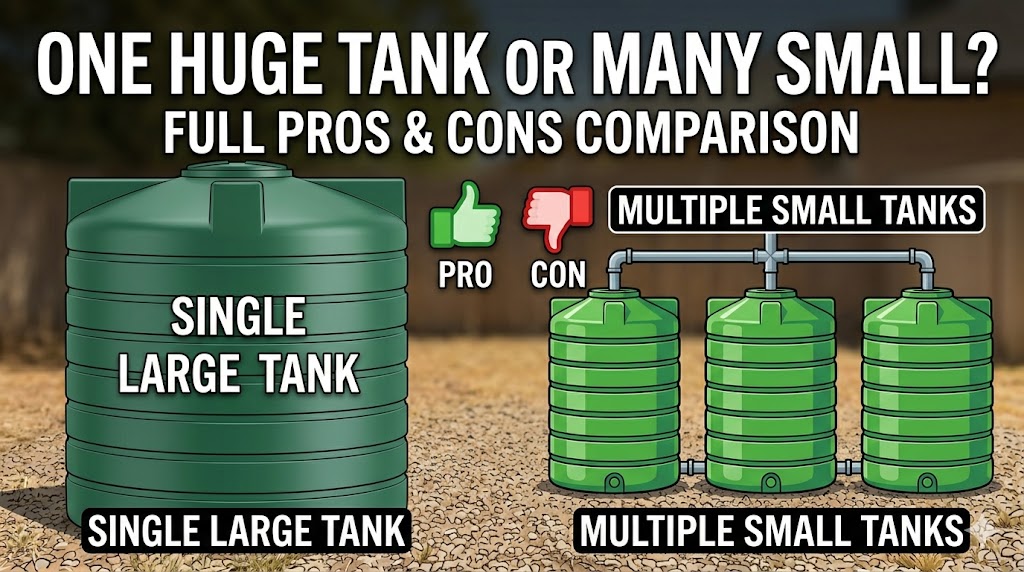
    A single large tank costs less per litre of storage capacity and is simpler to install and maintain. Multiple smaller tanks in parallel cost more upfront but offer redundancy, easier installation in constrained sites, and the ability to expand capacity incrementally. The right answer depends on whether your site can accommodate a large tank, whether supply continuity under failure matters, and what your budget phasing looks like. This article covers both options across cost, reliability, installation, and site constraints.

    The quick answer

    For most residential applications with straightforward site access and a ground-level or purpose-built elevated pad, a single large tank is cheaper and simpler. Multiple tanks are the right call when the site physically constrains tank size, when continuity of supply is critical, or when you need to expand gradually. Use the Water Tank Cost Calculator to compare total installed cost for both configurations at your target capacity.

    FactorSingle Large TankMultiple Small Tanks
    Unit cost per litre of capacityLower (economies of scale)Higher (more units, more fittings)
    Installation complexityOne connection pointManifold plumbing required
    Redundancy if one failsNone — total lossPartial — others remain online
    Site footprintLarger single footprintDistributed — flexible placement
    Access to tight spacesPoor (large tanks don’t fit)Good (small tanks manoeuvrable)
    Phased capacity expansionReplace entire tankAdd another unit
    Maintenance per litreLowerHigher (multiple entry points, fittings)
    Pressure/flow uniformityHigher (single head height)Varies if tanks at different heights
    Rooftop suitabilityLimited (weight)Better distributed load
    Tank failure impactCatastrophic lossIsolated to one unit

    How the calculation works

    Cost comparison at 10,000 litres total capacity: A single 10,000-litre HDPE tank: approximately $600–$900 purchase + $200 installation = $800–$1,100 total. Two 5,000-litre tanks with manifold plumbing: approximately $560–$1,200 purchase + $350–$500 installation = $910–$1,700 total. Four 2,500-litre tanks with manifold: $640–$1,200 purchase + $600–$900 installation = $1,240–$2,100 total.

    Per litre of capacity, a single tank typically costs 15–40% less than an equivalent multi-tank arrangement at the same total volume. The premium for multiple tanks comes from: higher per-unit tank prices (smaller tanks have higher cost-per-litre than larger ones), additional fittings and plumbing for the manifold, and more installation time.

    However, cost-per-litre is not the only metric. The economic case for multiple tanks includes: avoided loss on failure (if one of four tanks fails, you retain 75% of capacity; if the single large tank fails, you have zero), and phased capital outlay (buy two tanks now, add two more in 18 months when budget allows, without re-engineering the system if you plumbed for it upfront).

    Key variables that change the answer

    Site access and installation constraints. A 10,000-litre HDPE tank is typically 2.8–3.0 metres in diameter and 3.2–3.5 metres tall. It requires crane or telehandler delivery and a clear path to the installation site. Narrow access (less than 2.5 m gate width), trees, overhead lines, or basement locations make large tanks impractical. Four 2,500-litre tanks, each under 1.8 m diameter, can be manoeuvred by two people and installed almost anywhere. If your site is constrained, multiple small tanks may be the only option, and cost becomes secondary.

    Rooftop load distribution. A single 5,000-litre HDPE tank fully loaded weighs 5,100 kg. Concentrated on one roof beam, this exceeds the safe capacity of most residential slabs. Four 1,250-litre tanks distributed across four beam positions weight 1,275 kg each — within the range of load-rated residential slabs if positioned correctly over structural supports. If rooftop installation is required and your total demand is above 2,000 litres, distributed tanks may be the only structurally sound approach. Verify with the Rooftop Load Bearing Calculator before specifying either option.

    Supply continuity requirements. For residential use, a tank failure means an inconvenience — you call for a delivery or use mains supply. For a rural hospital, livestock operation, or off-grid property with no alternative source, a tank failure during a dry season is a crisis. Where continuity matters, redundancy in the tank system is not a luxury — it is part of the supply reliability specification. Two tanks with isolation valves means one can be taken offline for cleaning or repair without interrupting supply.

    Cleaning and maintenance logistics. Tanks should be cleaned every 2–5 years (or annually in tropical climates with high biological activity). Cleaning a 10,000-litre tank requires full drainage — losing the entire stored volume. Cleaning one of four 2,500-litre tanks requires draining only 25% of total capacity. For operations where storage continuity during maintenance is important, the multiple-tank model wins on operational grounds, not just cost.

    Future expansion plans. A properly designed multiple-tank system uses a manifold with isolation valves and enough port capacity to add further tanks. If your water demand may increase — more occupants, a garden, livestock, a new irrigation zone — the multiple-tank approach with expansion plumbing costs slightly more upfront but avoids a complete system replacement later. Plan the manifold for double the current tank count if future expansion is likely.

    ScenarioRecommended approachReason
    Urban residential, reliable supply, 3,000–5,000 L neededSingle large tankLower cost, simple plumbing, site usually allows it
    Rooftop installation with load constraints2–3 smaller tanks distributedSpreads weight across beam lines
    Remote farm, no access for large equipmentMultiple small tanksDelivery and installation of large tanks may be impossible
    Phased budget — buy now, expand laterStart with one, plumb for expansionManifold plumbing cost offset by flexibility
    Mission-critical supply (hospital, commercial)Multiple tanks in parallelRedundancy prevents total supply failure
    Rural off-grid — rainwater primary sourceSingle large tank if site allowsMaximises storage from infrequent rain events

    Common mistakes

    Connecting multiple tanks without isolation valves. A manifold system without isolation valves cannot isolate a failing tank. If one tank develops a crack or leak in a no-isolation-valve manifold, the entire system drains to the level of the breach. Every tank in a parallel array should have its own inlet and outlet isolation valve. This is a $20–$50 addition per tank that makes the redundancy argument real.

    Installing tanks at different heights in a gravity-fed system. Multiple tanks only deliver uniform pressure if the water surface is at the same height in all tanks. A manifold connecting tanks at different elevations will drain the lower tanks preferentially and leave the higher tanks unused until the lower ones are nearly empty. If your site requires different heights, use a pump system with a float controller that equalises fill levels, or arrange tanks in separate circuits for separate uses — not as a single gravity-fed array.

    Using a single inlet without a flow splitter. A manifold with one mains inlet and no flow balancing will fill the tank nearest the inlet first, creating unequal levels across the array. Install a T-piece or distribution manifold at the inlet point so incoming water flows equally to all tanks. Unequal fill creates dead volume in under-used tanks and shortens lifespan in over-filled ones.

    Assuming larger is always more economical long-term. Large tanks have higher failure risk per event — a 10,000-litre tank failing loses 10,000 litres of stored water and typically requires replacement of the full unit. Single-use tank warranties often exclude damage from incorrect installation, UV exposure, or overfilling. A multi-tank arrangement where each unit is well within its pressure and UV exposure specification may outlast a single large tank pushed to its limits. The Water Tank Weight Calculator can help verify load is within specification for both single and multi-tank configurations.

    Related calculators you might need

    To model total capacity needed before deciding on configuration, use the Water Tank Size for Home Calculator or the Farm Water Storage Calculator for agricultural sites. Once you have the total volume, the Plastic vs Steel Tank Cost Calculator lets you compare material options at that capacity. For any rooftop arrangement with either configuration, the Safe Rooftop Tank Load Calculator is the non-negotiable check before you commit to a layout.

    Frequently asked questions

    Is it cheaper to buy one big water tank or multiple smaller ones? One large tank is cheaper per litre of capacity in most cases. At 10,000 litres, a single tank costs 15–40% less all-in than an equivalent multi-tank manifold arrangement. The premium for multiple tanks reflects higher per-unit prices on smaller tanks, additional fittings, and more installation time. The cost advantage of a single tank is real but narrows as site constraints or redundancy requirements drive the specification toward multiple units.

    Can I connect two water tanks together? Yes. Tanks in parallel connected at the base with a manifold equalise their water levels automatically via hydrostatic pressure — provided the tanks sit at the same elevation and the connecting pipe diameter is adequate (typically 50 mm minimum for a two-tank array). Each tank should have its own isolation valve. A properly designed two-tank manifold costs $150–$400 in fittings and takes 2–4 hours to install.

    What is the advantage of multiple small water tanks? Redundancy (one tank failure does not lose all supply), easier installation in constrained sites, distributed rooftop load, the ability to phase capacity investment over time, and easier maintenance without full supply interruption. The cost premium over a single equivalent tank is real — justify it only when these operational advantages matter for your situation.

    How do I connect water tanks in series vs parallel? Parallel connection (tanks connected at the base) is standard for residential and commercial storage — it equalises water levels and provides combined capacity automatically. Series connection (outlet of one tank feeds inlet of the next) is rare and generally used only in gravity-cascade rainwater systems where tanks are at different elevations. For combined storage capacity, always use parallel manifold configuration.

    How many tanks can I connect together? There is no fixed limit, but practical constraints emerge above 4–6 tanks in a single manifold array. Beyond that, pressure drop through the manifold affects fill and drain uniformity, and the installation complexity increases non-linearly. Large commercial installations use multiple manifold groups, each serving 2–4 tanks, rather than a single large manifold serving many tanks.
  • Overhead vs Underground Water Tank: Which Is Better?

    Overhead vs Underground Water Tank: Which Is Better?

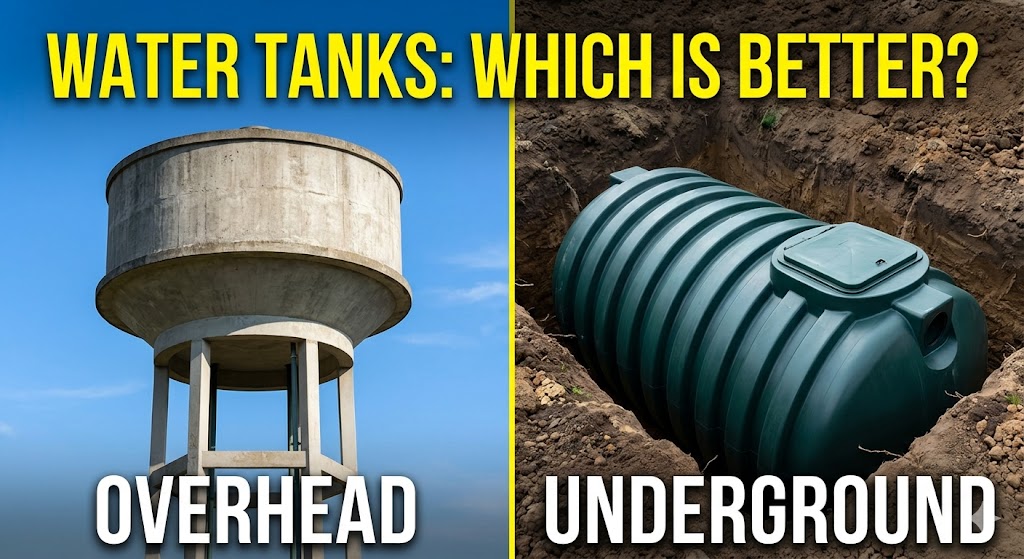
    The answer depends on your priority. Overhead tanks cost less upfront and deliver water by gravity with zero pump energy. Underground tanks hold more water, last longer structurally, and protect stored water from heat and contamination — but cost more to install and require a pump for distribution. This guide breaks down the real differences so you can make the right choice for your site.

    Before committing to either option, calculate exactly how much storage your household needs. The water tank size for home calculator factors in family size, daily usage, and supply frequency to give you a precise volume target.

    How Do Overhead and Underground Tanks Actually Work?

    An overhead tank sits on a raised platform — rooftop, tower, or stand — and uses gravity to push water to taps and fixtures. The higher the tank, the more pressure it generates: every 1 metre of head produces approximately 0.1 bar (1.42 psi). A tank mounted 5 m above the highest outlet produces around 0.5 bar, which is adequate for most residential fixtures but marginal for high-pressure showers or appliances.

    An underground tank is buried in the ground, insulated from temperature swings, and fed by gravity or pump from the mains, borehole, or tanker. Water is retrieved by a submersible or surface pump. Because the tank is below the distribution point, a pump is always required — there is no gravity-feed option.

    Overhead vs Underground: Side-by-Side Comparison

    FactorOverhead TankUnderground Tank
    Installation costLow–MediumHigh
    Water pressureGravity-fed, low–moderatePump-dependent, adjustable
    Capacity range (residential)500 L – 5,000 L2,000 L – 50,000+ L
    Temperature protectionPoor (heats in sun)Excellent (stable ground temp)
    Structural load on buildingSignificant (1 kg per litre)None
    Contamination riskHigher (bird droppings, UV degradation)Lower (sealed underground)
    Power dependencyNone for distributionPump required always
    Lifespan (typical)10–25 years25–50+ years (concrete/GRP)
    Maintenance accessEasyRequires manhole entry
    Flood riskNoneRisk of groundwater ingress if unsealed

    When an Overhead Tank Is the Better Choice

    An overhead tank wins when power cuts are frequent and you cannot rely on a pump. In South Asia and sub-Saharan Africa, where outages can last 8–16 hours daily, gravity feed from an overhead tank is the most reliable distribution method available. It is also the cheaper default for residential projects: a 1,000-litre HDPE overhead tank in India or Pakistan costs roughly $30–80, while a comparable underground tank costs $150–400 plus excavation.

    Overhead tanks are also the default for urban apartments that already have a concrete rooftop slab rated for the load. Check the slab’s capacity with the rooftop load bearing calculator before purchasing — a full 2,000-litre tank weighs over 2 tonnes, which exceeds the safe limit of many older slabs.

    When an Underground Tank Is the Better Choice

    Underground tanks suit high-volume storage needs — agricultural holdings, large properties, or sites where above-ground aesthetics matter. Their biggest practical advantage is water quality preservation: buried tanks maintain a stable temperature of 10–15°C in most climates, which dramatically slows bacterial growth compared to overhead tanks that can reach 40°C+ in direct sun.

    Underground tanks also carry no structural load on buildings, making them the only viable option for sites without a suitable load-bearing surface. Where supply is seasonal — farm rainwater capture, for example — underground tanks can store 20,000–100,000 litres that would require a forest of overhead towers to match.

    Common Mistakes

    Ignoring structural load for overhead tanks. A 2,000-litre tank full of water weighs approximately 2,050 kg. Many homeowners install large overhead tanks on rooftop slabs designed for foot traffic only (typically 150–200 kg/m²). The result is slab cracking or, in worst cases, collapse. Calculate the distributed load across the support area before installation.

    Choosing overhead for large-volume storage. Overhead tanks above 5,000 litres require heavy structural support that adds significant cost. At that volume, an underground tank is almost always cheaper per litre of storage capacity and causes no structural concerns.

    Neglecting pump sizing for underground tanks. Buyers often purchase the tank and find afterwards that their existing pump cannot deliver adequate flow at the required head. A pump sized for a 10-metre head will underperform badly on a 25-metre rise. Size the pump alongside the tank, not after.

    Assuming underground tanks are maintenance-free. Buried tanks still need annual inspection through the manhole for sediment accumulation, seal integrity, and inlet screen condition. Concrete underground tanks require crack inspection every 3–5 years.

    Related Calculators You Might Need

    If you are choosing between tank types and have not yet sized your storage volume, start with the daily water requirement calculator to establish your baseline consumption. For overhead installations, verify structural safety with the safe rooftop tank load calculator before purchasing. If you are going underground and need a pump, the pump head pressure calculator will confirm whether your pump can deliver the required pressure at the distribution point. For gravity-feed overhead setups, check minimum mounting height with the minimum tank height for shower pressure calculator.

    Frequently Asked Questions

    Is an overhead tank or underground tank better for a family of 4? For a family of four in an area with daily supply interruptions, a 1,000–2,000 litre overhead tank is usually the practical choice. It delivers water without electricity. If supply is intermittent and you want 5+ days of backup, an underground tank of 5,000–10,000 litres combined with a pump is more suitable. Use the water tank size for home calculator to confirm the right size for your specific daily consumption.

    How much does an underground water tank cost compared to overhead? Underground tank costs vary widely by material and size. A 5,000-litre fibreglass underground tank typically costs $800–2,000 in the US, plus $500–2,000 for excavation and backfill. An equivalent overhead HDPE tank costs $200–500, with a support structure adding $300–1,500. Underground tanks are consistently more expensive installed, but last significantly longer.

    Can an underground tank be contaminated? Yes, if improperly sealed. Groundwater infiltration during high water-table periods is the main risk — particularly for older concrete tanks with cracked walls. Modern fibreglass and polyethylene underground tanks with sealed lids and watertight inlets carry very low contamination risk. Annual inspection and periodic chlorination mitigate this effectively.

    What is the maximum size for a rooftop overhead tank? There is no universal maximum — it depends on the slab’s load rating and support structure. Most domestic rooftop slabs support 200–250 kg/m². A 2,000-litre tank on a 2 m² base puts 1,025 kg/m² on the contact points — well beyond the slab limit. The load must be distributed via a properly engineered platform. Anything above 3,000 litres on a residential rooftop requires a structural engineer’s sign-off in most countries.

    Does an underground tank need electricity? For filling, no — a tank can be filled by gravity from mains supply or tanker. For distribution, yes, always. Water stored below the outlet level requires a pump for every use. This makes underground tanks unsuitable as the sole storage solution in areas with prolonged power outages unless a generator or solar pump is available.

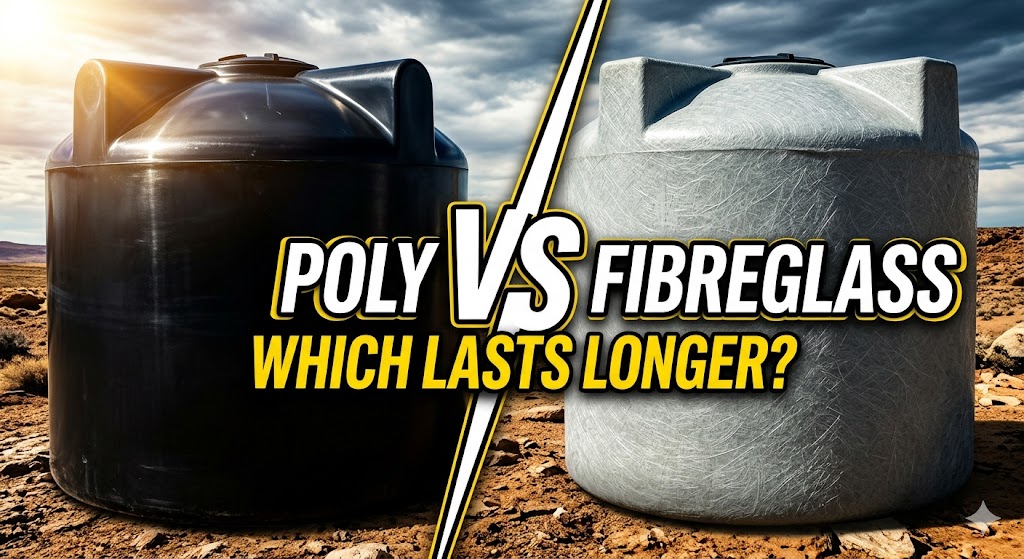
  • Polyethylene vs Fibreglass Water Tanks: Which Lasts Longer?

    Polyethylene vs Fibreglass Water Tanks: Which Lasts Longer?

    Fibreglass (GRP) tanks outlast polyethylene in the majority of conditions. A well-manufactured fibreglass tank has a rated lifespan of 30–50 years. Polyethylene tanks typically carry 10–20-year manufacturer warranties, with functional life often reaching 20–30 years under good conditions. The durability gap narrows significantly for tanks kept out of direct UV exposure, but fibreglass retains its structural advantage in underground, chemical-exposure, and high-temperature environments.

    Before comparing materials, confirm your required tank volume and dimensions. The water tank cost calculator factors in material type, size, and installation to give you a total-cost comparison for your specific situation.

    Material Properties: What Actually Determines Lifespan

    Polyethylene tanks are rotationally moulded from high-density polyethylene (HDPE) or linear low-density polyethylene (LLDPE). The material is impact-resistant, flexible, and chemically inert for most domestic water uses. Its vulnerability is UV radiation — extended direct sun exposure causes surface oxidation and embrittlement. Quality HDPE tanks include UV stabiliser additives that extend outdoor lifespan, but degradation still occurs over time. Above 60°C, HDPE begins to deform, limiting its use in applications with hot water exposure.

    Fibreglass tanks are manufactured from glass-reinforced plastic (GRP) — layers of fibreglass matting saturated with polyester or vinyl ester resin. The result is a rigid, dimensionally stable structure that does not flex under load, resists UV better than raw polyethylene (especially with gel-coat finishes), and maintains structural integrity up to 90–100°C in most formulations. Fibreglass is non-ductile — it does not flex before failure, it cracks.

    Head-to-Head Comparison by Performance Category

    PropertyPolyethylene (HDPE)Fibreglass (GRP)
    Typical lifespan20–30 years30–50 years
    UV resistanceModerate (UV stabilisers degrade over time)Good (gel-coat surface protects substrate)
    Impact resistanceHigh (flexible, dents before cracking)Low (rigid, cracks under impact)
    Temperature range−40°C to 60°C−40°C to 90°C+
    Chemical resistanceGood for most domestic waterExcellent; suitable for treated/saline water
    Underground usePossible (cylindrical only, with care)Preferred; standard for large underground tanks
    WeightLight (easier to handle and install)Heavier per volume
    Cost (1,000 L)$50–200$200–600
    Cost (10,000 L)$500–1,500$1,500–5,000
    RepairabilityPatch kits available; welding possibleGRP patch repair possible but complex
    Food-grade certificationStandard (PE is FDA-accepted)Available; requires food-grade resin grade

    Where Polyethylene Outperforms Fibreglass

    Polyethylene is the right choice for above-ground residential and agricultural tanks up to approximately 10,000 litres. The cost-per-litre advantage is significant, installation is simpler (lighter weight, standard fittings, no curing time), and for tanks replaced or relocated every 15–20 years, the lower initial investment often makes more economic sense than the longer fibreglass lifespan.

    HDPE also handles physical knocks better. On farm sites where tanks may be struck by machinery or livestock, HDPE dents and flexes rather than cracking catastrophically. A cracked fibreglass tank requires immediate repair; a dented HDPE tank usually continues to function.

    Where Fibreglass Outperforms Polyethylene

    Fibreglass wins in underground installations, chemical storage, high-temperature environments, and large-volume tanks above 15,000 litres. Underground, the rigid GRP shell resists lateral soil pressure without requiring concrete encasement that polyethylene demands. In water treatment facilities or industrial water storage, GRP’s broader chemical compatibility and higher temperature tolerance are decisive advantages.

    For large tanks, fibreglass is also more dimensionally stable. A 30,000-litre polyethylene tank will show measurable wall flex when full; a GRP tank of equivalent size does not. This matters for underground installations where wall movement can compromise soil seal integrity and allow ingress.

    Common Mistakes

    Assuming colour protects polyethylene from UV. Black polyethylene tanks are commonly marketed as UV-resistant because carbon black is an effective UV absorber. This is true — black HDPE does degrade more slowly in sunlight than natural or coloured tanks. However, black tanks absorb heat and raise water temperature, which accelerates bacterial growth and causes algae blooms in translucent walls. The correct approach is to shade any tank from direct sun, regardless of colour.

    Buying fibreglass assuming it needs no maintenance. Fibreglass gel-coat surfaces degrade over 10–15 years without treatment. Osmotic blistering, the intrusion of water through the gel-coat into the laminate, causes structural delamination in poorly manufactured tanks. Annual visual inspection of exterior surfaces and re-coating the gel-coat every 10–15 years significantly extends service life.

    Installing polyethylene tanks underground without proper bedding. HDPE is not structurally rated for soil pressure in the same way GRP is. A cylindrical HDPE tank installed underground must sit on a sand-and-gravel bed with engineered backfill to distribute lateral pressure. Without this, soil movement crushes the tank wall over 2–5 years. Rectangular HDPE tanks should never be buried.

    Choosing the cheapest polyethylene tank without checking wall thickness. Wall thickness in polyethylene tanks correlates directly with lifespan and structural integrity. A budget 1,000-litre tank with 4 mm walls will fail years before a quality tank with 8–10 mm walls. Always request wall thickness specifications — reputable manufacturers publish them.

    Related Calculators You Might Need

    To compare the true cost of polyethylene vs fibreglass tanks across their lifespans, the plastic vs steel tank cost calculator provides a structured comparison framework. If you are sizing an underground tank, use the underground tank volume calculator to confirm required capacity. For above-ground rooftop installations, always verify structural loading with the water tank weight calculator — fibreglass tanks are significantly heavier than polyethylene at equivalent volumes. And if you are evaluating water storage cost per litre across different material options, the water storage cost per litre calculator helps you compare total ownership cost.

    Frequently Asked Questions

    How long does a polyethylene water tank last? A quality HDPE tank kept out of prolonged direct sunlight, filled with clean water, and maintained annually typically lasts 20–30 years. Tanks left in direct sun without UV protection, or used for chemical storage outside their rated limits, can degrade in 10–12 years. Most manufacturers warranty HDPE tanks for 10–15 years.

    Is fibreglass safe for drinking water storage? Yes, provided the tank uses food-grade resin (specifically FDA 21 CFR-compliant or equivalent) and the interior surface has cured fully before filling. Under-cured fibreglass can leach styrene monomer into stored water. Always confirm food-grade certification before using any fibreglass tank for potable water.

    Which is cheaper, polyethylene or fibreglass water tank? Polyethylene is consistently cheaper at equivalent volumes. A 5,000-litre HDPE tank typically costs $300–800; the same volume in fibreglass costs $800–2,500. However, fibreglass’s longer lifespan means the cost-per-year of ownership is closer than the purchase price suggests. Over a 30-year period, a fibreglass tank that costs 3× more but lasts 2.5× longer has a lower annualised cost.

    Can polyethylene tanks be repaired? Minor cracks and splits can be repaired using HDPE welding rods and a heat gun, or polyethylene repair patches. This is a specialist task — polyethylene does not bond to standard adhesives. Fittings can be replaced by cutting and re-threading. Major structural cracks in large tanks are generally uneconomical to repair; replacement is more cost-effective.

    What causes a fibreglass tank to crack? Impact is the most common cause — dropping during installation, machinery contact, or freeze-thaw expansion in tanks left partially full in freezing conditions. Osmotic blistering from water ingress through a degraded gel-coat can cause internal delamination that looks like cracking. Manufacturing defects in fibre-resin ratios (too resin-rich) produce brittle sections prone to stress cracking under thermal expansion cycles.

  • Pump System vs Gravity Feed: Cost and Pressure Compared

    Pump System vs Gravity Feed: Cost and Pressure Compared

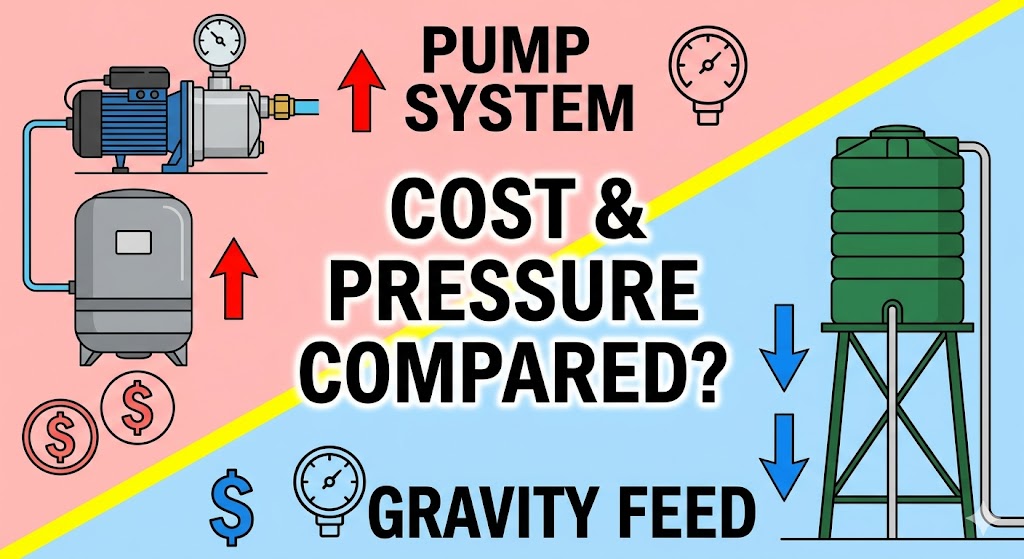
    A gravity-feed system uses tank elevation to create pressure — free, silent, and immune to power cuts. A pump system draws water from a low-level or underground tank and pressurises it on demand — flexible, high-pressure, but dependent on electricity and maintenance. The correct choice depends on your available head height, pressure requirements, and power reliability.

    Before comparing systems, confirm the pressure your gravity setup would actually deliver using the gravity feed flow rate calculator. This tells you whether gravity alone can meet your fixture requirements without any pump investment.

    How Each System Generates Pressure

    Gravity feed relies entirely on static head — the vertical distance between the water surface in the tank and the outlet point. The formula is simple: 1 metre of head = 0.098 bar (approximately 1.42 psi). A tank mounted 7 metres above the shower head delivers about 0.68 bar — adequate for standard showerheads (which typically require 0.1–0.3 bar) but insufficient for thermostatic mixer showers or high-pressure appliances that need 1–3 bar.

    A pump system pressurises water independently of tank position. A typical residential pressure-boosting pump delivers 2–5 bar consistently. This means a ground-level or underground tank can supply high-pressure water to the top floor of a multi-storey building — something impossible with gravity from a rooftop tank on the same building.

    Cost Comparison: Upfront and Ongoing

    Cost FactorGravity FeedPump System
    Initial setupTank stand/rooftop structure: $200–2,000Pump unit: $150–1,500; plumbing: $200–800
    Energy cost$0 (no electricity)$30–180/year (residential use)
    MaintenanceMinimal — inspect tank, clean annuallyAnnual service, impeller/seal replacement every 3–7 years
    Failure costLow — no moving partsPump replacement: $150–800+
    10-year total cost (estimate)$300–2,500 (structure + maintenance)$800–4,500 (pump + energy + servicing)

    These figures assume a residential installation. The pump energy cost is based on a 0.5 kW pump running 2 hours/day at $0.15/kWh. Larger commercial or agricultural systems have proportionally higher energy costs. Use the pump horsepower and flow rate calculator to size a pump correctly before estimating running costs.

    Pressure Performance by System Type

    Fixture / ApplicationGravity Feed Viable?Minimum Head RequiredPump Pressure Needed
    Standard tapYes1 mN/A
    Garden hoseYes3 mN/A
    Basic showerheadYes3–5 mN/A
    Thermostatic mixer showerMarginal10 m+1–2 bar
    Power showerNoNot feasible2–3 bar
    Washing machineYes (most models)3 mN/A
    DishwasherYes3 mN/A
    Drip irrigationYes1–3 mN/A
    Sprinkler system (large area)Marginal8 m+2–4 bar

    When Gravity Feed Is Sufficient

    Gravity feed is the better choice when: the tank can be mounted at least 5 metres above the highest outlet, the site has frequent power outages, and fixtures do not require high pressure. This describes the standard residential setup across South Asia, much of Africa, and rural areas globally where overhead tanks on 3–5 metre stands are the default.

    The water pressure calculator can convert your available head height directly into bar and psi values, letting you check against every fixture’s stated minimum pressure requirement before deciding whether to invest in a pump.

    When a Pump System Is Necessary

    A pump is necessary when: the tank cannot be elevated to the required head, pressure-sensitive fixtures (thermostatic showers, high-pressure appliances) are installed, the water source is below the distribution point, or you need consistent pressure regardless of tank water level. In gravity systems, pressure drops as the tank empties — a tank half-full delivers roughly half the head pressure of a full tank, which creates noticeable variation at outlets.

    Common Mistakes

    Underestimating head drop with a gravity system. A rooftop tank might be 6 metres above ground level, but the outlet in the master bathroom might only be 4 metres below the tank base — not 6. Calculate the actual head from the tank’s water surface (not the tank base) to the specific outlet, accounting for pipe friction losses. Friction loss in a 20-metre pipe run at typical residential flow can reduce effective pressure by 0.1–0.3 bar.

    Oversizing a pump. A pump delivering 5 bar when the system only needs 2 bar wastes energy, causes water hammer in pipes, and strains tap washers and valve seats. Match pump output to system requirements — not to the maximum available on the shelf.

    Assuming a pump solves all low-pressure problems. If your main supply pressure from the mains or borehole is already low, a booster pump only increases pressure from the supply point downstream. Low flow rate at the source — a borehole yielding only 0.5 L/s — cannot be overcome by increasing pump pressure. Flow rate and pressure are separate issues.

    Neglecting the gravity falloff as the tank empties. In a gravity system, pressure at the outlet is not constant. A 2,000-litre tank at full level delivers a certain pressure; at 25% full, the water surface is lower and pressure drops accordingly. If fixtures require a minimum pressure, design for the minimum tank level that will ever be in use, not the full-tank level.

    Related Calculators You Might Need

    To verify that gravity feed will deliver adequate pressure for your specific setup, start with the minimum tank height for shower pressure calculator. If you are sizing a pump, the pump head pressure calculator determines the total dynamic head the pump must overcome including friction losses. For systems sourcing from a borehole or mains with variable pressure, the hydrostatic pressure calculator helps model static water column behaviour. If you want to know how long your tank will last on gravity supply alone before running dry, use the how long will my tank last calculator.

    Frequently Asked Questions

    Is gravity feed enough for a shower? For a basic showerhead, yes — if the tank is at least 3–5 metres above the showerhead. For thermostatic mixer showers, most manufacturers specify a minimum dynamic pressure of 0.5–1.0 bar, which requires at least 5–10 metres of head. For power showers (which have a built-in pump) or rain-head installations, gravity alone is inadequate and a booster pump is required. Use the gravity feed flow rate calculator to check your specific head height.

    How much does it cost to run a water pump? A typical 0.5 kW residential pressure pump running 2 hours per day costs approximately $54/year at $0.15/kWh. A larger 1.5 kW pump on the same schedule costs around $165/year. Actual cost depends on run time and local electricity tariffs. Pumps triggered by every tap opening (pressure-switch systems) often run more frequently than expected — a faulty pressure vessel or loose fitting can cause the pump to cycle on and off continuously, multiplying energy consumption.

    What is the minimum height for a gravity-fed water tank? The minimum height depends on the pressure requirement of your lowest-pressure fixture. Most household taps and showerheads require 0.1–0.3 bar minimum, which corresponds to 1–3 metres of head. However, designing for the minimum means no margin for pipe friction losses. A practical minimum for a usable gravity system is 4–5 metres above the highest outlet point.

    Can I switch from gravity to pump without replacing the tank? Yes. Adding a booster pump downstream of an existing overhead or ground-level tank is straightforward. You plumb the pump into the main outlet pipe from the tank and install a pressure vessel and switch to maintain system pressure. The tank itself needs no modification. This is common when household pressure needs increase — new appliances, added bathrooms — after the original gravity system was installed.

  • Round vs Rectangular Water Tank: Space Efficiency Compared

    Round vs Rectangular Water Tank: Space Efficiency Compared

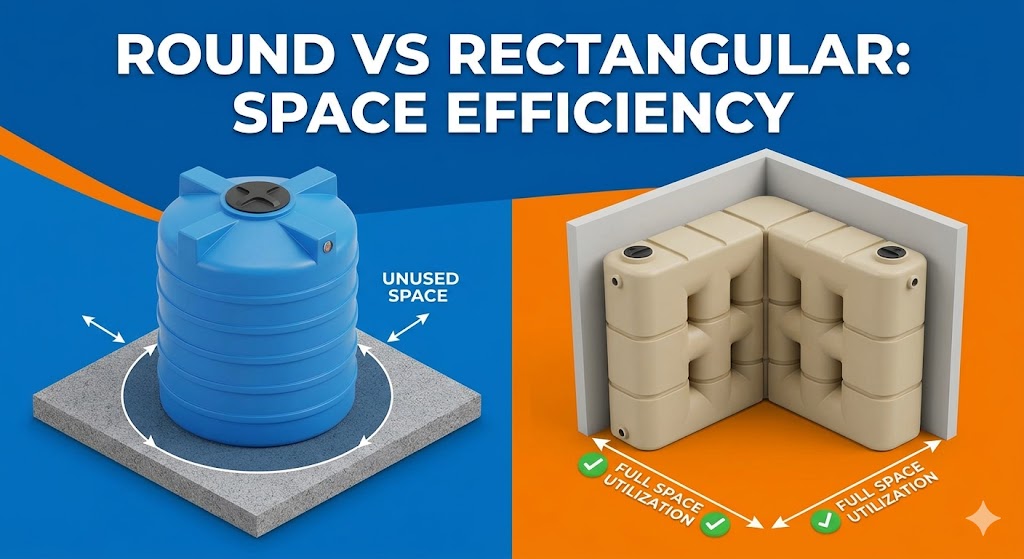
    Shape affects more than aesthetics. Round (cylindrical) tanks distribute internal water pressure more evenly across their walls, requiring less material to achieve the same structural strength. Rectangular tanks make better use of corners and straight wall spaces, fitting into building footprints that cylinders waste. Choosing the wrong shape for your installation site costs you either usable floor space or money spent on over-engineered walls.

    To see exactly how volume differs between a cylindrical and rectangular tank at your target dimensions, compare results from the cylindrical tank volume calculator and the rectangular tank volume calculator side by side before ordering.

    The Physics of Shape: Why It Matters for Storage

    Water pressure acts equally in all directions. A cylindrical wall converts that pressure into pure tension along its circumference — the most structurally efficient load path. A flat rectangular wall must resist bending in addition to tension, which requires thicker walls or internal bracing. This is why identical-volume cylindrical tanks typically weigh 15–25% less than rectangular equivalents: less material, same strength.

    The trade-off is footprint geometry. A cylinder with a 1-metre diameter takes up 0.785 m² of floor space. A rectangular tank 1 m × 1 m uses exactly 1 m² but holds the same volume at the same height. The cylinder wastes the 0.215 m² of unused space in every corner of the notional square it occupies. In tight plant rooms or rooftops, that dead corner space adds up.

    Space Efficiency: Round vs Rectangular by Scenario

    ScenarioBest ShapeWhy
    Rooftop with defined rectangular slabRectangularFills corners, maximises volume per m²
    Open ground-level installationRound (cylindrical)Easier to position, lower cost per litre
    Narrow utility corridor or roomRectangular (slim profile)Can be sized to fit exact wall-to-wall width
    Underground cisternRound (cylindrical)Handles soil pressure load more uniformly
    Multiple tanks in a row (manifolded)RectangularFlat sides allow direct adjacency
    High-volume farm storage (20,000 L+)Round (cylindrical)Available in large diameters, lower material cost
    Indoor apartment / housing complexRectangularFits corner spaces, stackable in some designs

    Cost Comparison: Where Each Shape Wins

    For tanks up to 5,000 litres, cylindrical polyethylene tanks are almost universally cheaper per litre than rectangular alternatives because they are blow-moulded in large quantities. Expect to pay 10–20% less for a cylindrical tank of the same volume from the same manufacturer. Rectangular tanks often command a premium due to added structural reinforcement.

    Above 10,000 litres, the cost gap narrows. Custom-fabricated rectangular GRP (glass-reinforced plastic) or stainless steel tanks are quoted by volume and site requirements, not shape. At this scale, the choice becomes about installation constraints rather than unit price.

    Cleaning and Maintenance Differences

    Cylindrical tanks have no corners where sediment accumulates in hard-to-reach pockets. Cleaning requires a brush against a continuous curved wall. Rectangular tanks have eight interior corners, each of which collects silt and biofilm. A manual clean of a rectangular tank typically takes 30–50% longer than the same volume cylindrical tank, and pressure-washing is less effective in corners without physical scrubbing.

    Rectangular tanks also have flat bases, which can bow under sustained water load if not properly supported across the entire base area. A cylindrical tank’s rounded base distributes load more evenly and is less prone to deformation over time.

    Common Mistakes

    Choosing rectangular to ‘maximise rooftop space’ without checking actual dimensions. A rectangular tank that fills a 2 m × 3 m rooftop alcove sounds efficient — until you realise the tank’s actual footprint is 1.8 m × 2.7 m to allow maintenance access, leaving unused strip space on all four sides anyway. Measure the usable installation zone, not the total slab.

    Selecting round tanks for wall-adjacent installations. Cylindrical tanks leave a curved gap against any flat wall. Installing a 1,500-litre cylinder against a straight wall wastes the crescent-shaped void behind it — roughly 20% of the square footprint. Use a rectangular tank flush against walls.

    Ignoring the structural difference for underground use. A rectangular underground tank must resist lateral soil pressure on flat walls. This requires concrete encasement or engineered GRP panels. Placing a standard rectangular polyethylene tank underground without proper support leads to wall collapse within months. Cylindrical tanks handle soil pressure structurally and are the standard for underground plastic installations.

    Assuming the same capacity from the same external dimensions. A round tank inscribed in a 2 m × 2 m square has a diameter of 2 m and a base area of 3.14 m². A rectangular 2 m × 2 m tank has a base area of 4 m². At 2 m height, the rectangular tank holds 27% more water despite fitting in the same square footprint.

    Related Calculators You Might Need

    If you have a specific rooftop or room dimension, use the rooftop tank size calculator to determine the maximum volume that fits your available space regardless of shape. Once you have your target volume, the water tank weight calculator tells you the structural load a full tank imposes. For non-standard shapes like tapered or oval-profile tanks, the oval/elliptical tank volume calculator handles the geometry. If you are converting between metric and imperial specs when comparing imported tanks, the litres to gallons converter saves time.

    Frequently Asked Questions

    Which is better, round or square water tank? Cylindrical (round) tanks are structurally stronger per kilogram of material and cheaper per litre in most residential sizes. Rectangular (square) tanks make more efficient use of wall-adjacent or corner spaces. If you are installing on open ground or underground, choose cylindrical. If you are fitting into a defined rectangular footprint, choose rectangular.

    Do round water tanks hold more water than rectangular ones of the same size? Not if ‘same size’ means the same external footprint. A cylindrical tank inscribed in a square footprint holds less volume than a rectangular tank that fills that footprint — because the cylinder’s curved sides leave unused corner space. However, cylindrical tanks are stronger for the same wall thickness, so the comparison is really volume vs structural efficiency.

    Why are most large water storage tanks cylindrical? Cylinders distribute internal pressure as tension along the wall circumference, which is the most material-efficient structural response. For very large volumes — 20,000 litres and above — the material savings of a cylindrical shell over a rectangular box are substantial enough to dominate the cost calculation. Most industrial and agricultural tanks above 10,000 litres are cylindrical for this reason.

    Can I install a round tank in a corner? You can, but it wastes space. The corner area behind a cylindrical tank is typically inaccessible dead space. If your installation site has one or more flat walls you want to use efficiently, a rectangular slim-profile tank will fit significantly better. Use the rectangular tank volume calculator to find the maximum volume for your exact corner dimensions.

    Are rectangular water tanks more expensive than round? At equivalent volumes under 5,000 litres, rectangular polyethylene tanks typically cost 10–20% more than cylindrical tanks due to added structural reinforcement. At larger custom-fabricated sizes, pricing depends on material and site requirements rather than shape.

  • Chlorine vs UV vs Filtration: Which Water Treatment Is Best?

    Chlorine vs UV vs Filtration: Which Water Treatment Is Best?

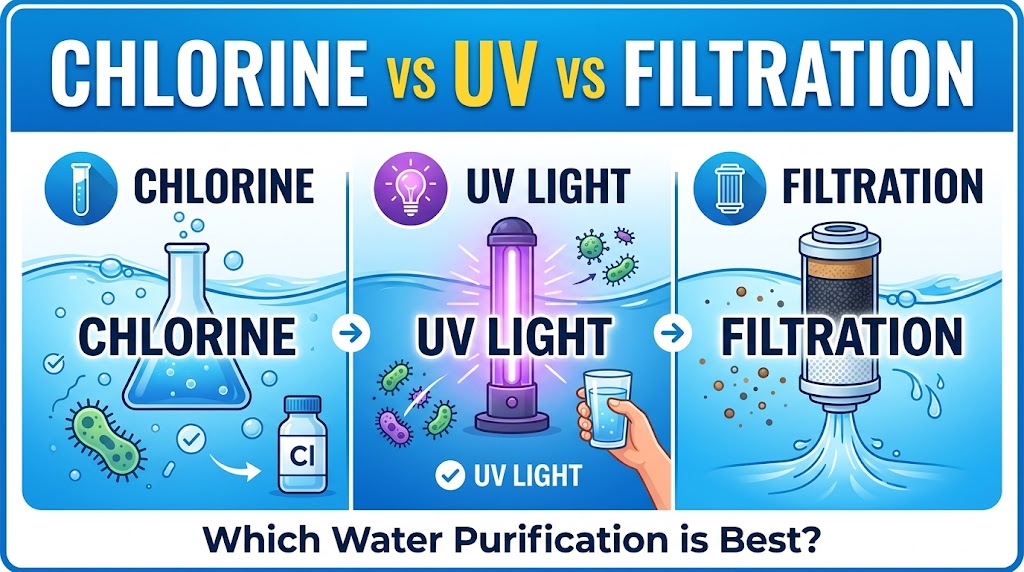
    No single method is best in all situations. Chlorination is the most cost-effective choice for large-volume tank disinfection and provides residual protection during storage. UV disinfection kills pathogens without chemicals and adds no taste or by-products, but leaves no residual protection once water leaves the UV unit. Filtration removes physical particulates and some chemical contaminants that neither chlorine nor UV can address, but is not a standalone disinfectant. Most robust water treatment systems combine at least two of these methods.

    If you are dealing with stored tank water, start by calculating your disinfection requirements with the water tank disinfection calculator, which gives you the correct treatment volume and contact time for your specific tank size and contamination level.

    How Each Method Works

    Chlorination introduces chlorine (as liquid sodium hypochlorite, granular calcium hypochlorite, or chlorine gas in municipal applications) into the water. Chlorine reacts with microbial cell walls and enzymes, killing bacteria, most viruses, and some protozoa within minutes at the correct dosage. A residual concentration of 0.2–0.5 mg/L free chlorine in stored water prevents regrowth during the storage period — the key advantage over other methods. At concentrations above 1 mg/L, taste and odour become noticeable to most people.

    UV disinfection exposes water to ultraviolet light at 254 nm wavelength, which damages the DNA and RNA of microorganisms, rendering them unable to reproduce. It is highly effective against Giardia and Cryptosporidium, which are chlorine-resistant protozoan cysts that resist standard chlorination doses. UV adds no chemicals and alters no taste. Its critical limitation: it provides no residual protection — water treated by UV can be immediately recontaminated if the pipe, tank, or fitting downstream is contaminated.

    Filtration is a physical or chemical separation process. Sediment filters (5–50 micron) remove suspended particles. Activated carbon filters adsorb chlorine, organic compounds, and some heavy metals. Ceramic filters (0.2–0.5 micron) can physically block bacteria. Reverse osmosis (RO) removes dissolved salts, nitrates, heavy metals, and most organic compounds. Filtration does not reliably kill pathogens unless the filter pore size is below 0.1 micron (ultrafiltration or nanofiltration territory). Most domestic filters are not rated for viral removal.

    Comparison: Chlorine vs UV vs Filtration

    PropertyChlorinationUV DisinfectionFiltration
    Kills bacteriaYesYesPartially (ceramic <0.5 µm)
    Kills virusesYes (most)YesNo (except UF/NF membranes)
    Kills protozoa (Giardia, Crypto)Partial (high dose)YesPartially (ceramic)
    Removes sediment/turbidityNoNoYes (sediment filter)
    Removes chemicals/heavy metalsNoNoPartially (activated carbon, RO)
    Residual protection in storageYes (0.2–0.5 mg/L)NoNo
    Adds taste/odourYes (at high doses)NoNo (removes chlorine taste)
    Works on turbid waterReduced efficacyReduced efficacyYes (sediment filter first)
    Ongoing costLow ($5–30/year for small tank)Medium (lamp replacement: $50–150/year)Medium–High (filter replacement)
    Power requiredNoYes (continuous)No (except RO pumps)
    Setup costVery low$200–1,500$50–2,000+

    When to Use Chlorination

    Chlorination is the standard treatment for stored tank water — rainwater tanks, emergency reserves, agricultural storage, and any tank that holds water for more than 24–48 hours before use. The residual chlorine prevents regrowth of bacteria during the storage period, which no other single treatment method offers.

    Use the chlorine dosage calculator to determine the correct dose for your tank volume and target residual. Overdosing produces disinfection by-products (trihalomethanes) at concentrations that may exceed WHO guidelines. Underdosing leaves the water vulnerable to regrowth. The target residual for potable water storage is 0.2–0.5 mg/L free chlorine after a minimum 30-minute contact time.

    Chlorination is less effective in turbid water. Suspended particles shield pathogens from chlorine contact. If your source water is turbid, filter to remove sediment before chlorinating — a 5-micron sediment pre-filter is sufficient for most cases.

    When to Use UV Disinfection

    UV is the right choice for point-of-use treatment in systems where water quality is already reasonably good and the primary concern is bacterial and protozoan contamination at the final delivery point — a tap, a bottling point, or a cooking water supply. It is the preferred method where no chemical residuals are acceptable (food production, brewing, some healthcare applications).

    UV is also the treatment of choice for Cryptosporidium and Giardia, which are resistant to standard chlorination doses and are a significant risk in surface water and poorly protected rainwater supplies. A UV dose of 40 mJ/cm² (standard for potable water) achieves 4-log (99.99%) reduction of these protozoa.

    Critical constraint: UV efficacy drops sharply as turbidity or colour (UV absorbance) increases. Water must have a UV transmittance above 75% for standard UV systems to meet their rated dose. Pre-filter turbid water before UV treatment. Check lamp condition and sleeve fouling at least every 6 months — a fouled quartz sleeve can reduce UV output by 50–80%.

    When Filtration Alone Is and Is Not Sufficient

    Filtration alone is sufficient for removing physical and chemical contaminants — sediment, chlorine taste, certain heavy metals, nitrates (with RO). It is not sufficient as a standalone disinfection method for water at risk of pathogen contamination. The common mistake is using an activated carbon filter and assuming the water is safe to drink without a disinfection step — carbon filters actively create favourable conditions for bacterial growth if not maintained, as the carbon surface provides attachment points and the filter captures organic nutrients.

    Common Mistakes

    Using UV on turbid water without pre-filtration. UV light is scattered by suspended particles, reducing the dose reaching pathogens. Water with turbidity above 1 NTU (nephelometric turbidity units) significantly compromises UV efficacy. Always install a sediment pre-filter (5 micron or finer) upstream of any UV unit.

    Chlorinating without checking pH. Chlorine’s disinfecting form — hypochlorous acid (HOCl) — is pH-dependent. At pH 7.5, roughly 50% of free chlorine is in the effective HOCl form. At pH 8.5, only about 10% is effective. Stored rainwater and some borehole sources have pH above 8. Check pH before chlorinating and adjust if above 7.8 for effective treatment. Use the water pH adjustment calculator to determine the acid dose needed.

    Forgetting UV lamp replacement schedules. UV lamps degrade gradually — most have a rated output life of 9,000–12,000 hours (approximately 12–16 months of continuous operation). A lamp near end-of-life may still illuminate but deliver only 60–70% of its rated UV dose, which may fall below the 40 mJ/cm² minimum for pathogen inactivation. Replace lamps on schedule, not when they visibly fail.

    Treating water once and assuming ongoing safety. Chlorine dissipates over time. A tank chlorinated to 0.5 mg/L will drop below 0.2 mg/L within 3–7 days under typical conditions, depending on temperature, light exposure, and organic loading. Check residual chlorine with a test kit and re-dose if it falls below 0.2 mg/L. Use the safe water storage duration calculator to estimate how long your treated water remains safe before re-treatment is needed.

    Related Calculators You Might Need

    For tank chlorination, the bleach to water ratio calculator converts household bleach concentration to the correct volume for your tank. If your water source has elevated TDS (dissolved solids), the TDS water calculator helps you understand whether filtration or a different source is needed before disinfection. For UV sizing, the UV disinfection tank calculator determines the correct UV unit specification for your flow rate. And where hard water scaling is a concern — particularly for UV quartz sleeves and filter membranes — the water hardness calculator quantifies scale risk and helps plan softening requirements.

    Frequently Asked Questions

    Which is better, UV or chlorine for drinking water? For point-of-use treatment in a reliable piped supply, UV is preferred — no chemical taste, no by-products, effective against Giardia and Cryptosporidium. For stored tank water that sits for days before use, chlorine is better because it provides residual protection against regrowth. In practice, the most robust home systems use both: chlorinate the tank for storage protection and install a UV unit at the final tap for point-of-use assurance.

    Is filtered water the same as purified water? No. Filtered water has had physical and some chemical contaminants removed, but may still contain viruses and bacteria unless the filter is rated for biological removal (ultrafiltration at 0.01 micron or below). Purified water — in the regulatory sense — has been treated to meet or exceed drinking water standards for microbial, chemical, and physical parameters. Standard domestic filters do not produce purified water without an additional disinfection step.

    How much chlorine do I put in a 1,000-litre water tank? For routine disinfection of a clean tank, you need approximately 5 mg of free chlorine per litre to achieve a contact-time dose sufficient for pathogen inactivation, then allow the residual to drop to 0.2–0.5 mg/L for storage. Using standard 5% sodium hypochlorite bleach, this is approximately 100 mL per 1,000 litres for initial shock, targeting a residual of 0.5 mg/L after 30 minutes. Use the chlorine dosage calculator for a precise dose based on your bleach concentration and target residual.

    Do I need a sediment filter before UV? Almost always. UV efficacy depends on water clarity — particles scatter and absorb UV light, shielding pathogens. Most UV manufacturers specify a maximum turbidity of 1 NTU and UV transmittance above 75% for the unit to deliver its rated dose. A 5-micron sediment pre-filter upstream of the UV unit is standard practice and costs $20–60 to install.

    How long does chlorine last in a water tank? At 0.5 mg/L initial dosage, free chlorine typically falls below 0.2 mg/L within 3–7 days in an outdoor tank at 20–30°C. Warmer temperatures, sunlight, and higher organic loads accelerate dissipation. Indoor tanks or insulated underground tanks retain chlorine residual longer — up to 14 days in cool, dark conditions. Test with a pool test kit and re-dose when the residual drops below 0.2 mg/L.

  • How Much Water Storage Do You Need for 3 Days of Backup?

    How Much Water Storage Do You Need for 3 Days of Backup?

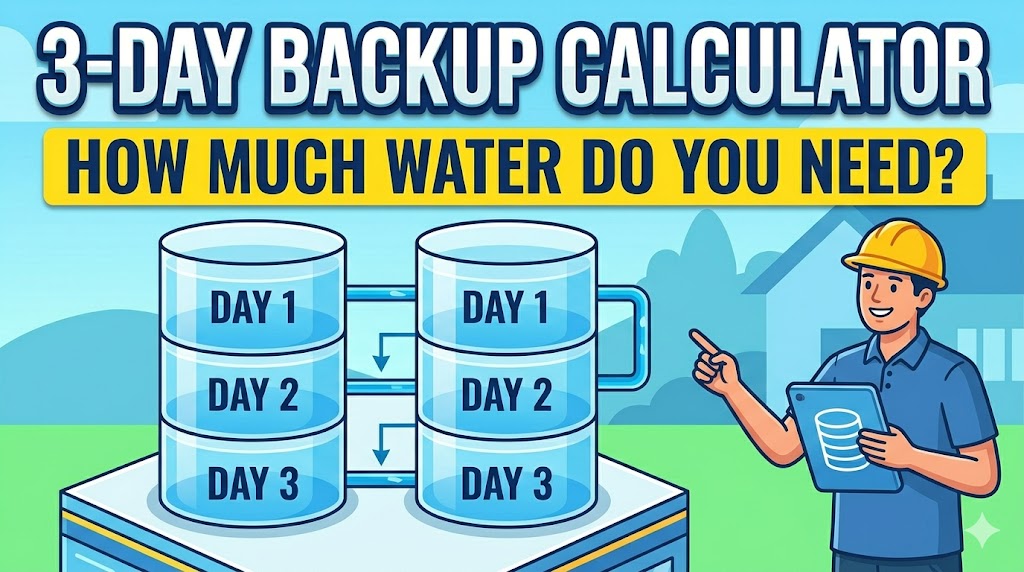
    For a 3-day water backup, FEMA recommends 1 US gallon (3.78 litres) per person per day as a survival minimum — but this covers only drinking and basic sanitation with no cooking, bathing, or toilet flushing. For functional 3-day backup that maintains normal household operations, the figure is 50–100 litres per person, meaning a family of four needs 600–1,200 litres in storage. This article explains the range, how to set the right number for your situation, and what infrastructure you need to store it reliably.

    The Quick Answer

    Three-day water storage targets depend on use level. FEMA’s minimum (1 gallon/person/day, per FEMA Ready.gov guidelines) is a survival threshold — it assumes no bathing, no toilet flushing, and minimal cooking. The WHO minimum for basic needs is 15 litres/person/day. Normal household operation requires 50–150 litres/person/day depending on climate and habits.

    Household sizeFEMA minimum (72 hrs)WHO basic (72 hrs)Normal household use (72 hrs)
    1 person11.4 L (3 gal)45 L150–450 L
    2 people22.7 L (6 gal)90 L300–900 L
    4 people45.4 L (12 gal)180 L600–1,800 L
    6 people68.1 L (18 gal)270 L900–2,700 L
    4 people + 1 infant45.4 L + 15 L formula220 L700–2,000 L

    Skip the math: Use the 72-Hour Water Supply Calculator to get a 3-day storage target based on your household size, climate, and intended use level — survival minimum through full household operation.

    How the Calculation Works

    Step 1 — Establish your daily consumption baseline. The most accurate figure comes from your water meter. Read it at the same time on two days with normal usage. Divide the total by 2 (or the number of days) and by the number of occupants. This is your actual per-capita daily consumption.

    Step 2 — Apply an emergency reduction factor. During a supply interruption, toilet flushing (which accounts for 25–30% of normal household use, per US EPA WaterSense data) can be reduced or eliminated. Outdoor water use stops entirely. Showers get shorter or are replaced with sponge bathing. A realistic emergency reduction factor is 50–70% of normal consumption for a household that is conserving actively.

    Step 3 — Worked example. Family of 4, normal consumption 180 litres per day per person = 720 litres/day total. Emergency mode consumption (60% reduction) = 720 × 0.4 = 288 litres/day. Over 3 days: 288 × 3 = 864 litres. Round to the next standard tank size: 1,000 litres

    Step 4 — Add a safety margin. FEMA recommends building in reserve beyond the 72-hour target because emergencies rarely resolve exactly on schedule. A 20% buffer is standard: 864 × 1.2 = 1,037 litres. A 1,000-litre tank is the minimum; 1,200–1,500 litres provides adequate margin.

    Key Variables That Change the 3-Day Storage Requirement

    Climate and ambient temperature. In hot climates (above 35°C), per-person drinking water requirements increase from 2 litres/day to 4–6 litres/day (WHO, 2011 Guidelines for Drinking Water Quality). Physical labour outdoors in heat raises this further. A 3-day minimum for active adults in a hot climate must account for this — the FEMA gallon-per-day figure was developed for temperate conditions.

    Medical and sanitary requirements. Dialysis patients typically require 120–150 litres of clean water per session, 3 sessions per week. A 3-day backup for a household with a dialysis patient requires this volume on top of household consumption. Similarly, households with infants need water for formula preparation and sterilisation — typically an additional 5–8 litres per day per infant.

    Whether you have flush toilets. Standard flush toilets use 6–13 litres per flush (US EPA data). At 5 flushes per person per day, a family of 4 uses 120–260 litres just for toilets. If supply is cut and mains pressure is lost, toilet flushing requires manual tank filling. Many households do not account for this — they calculate drinking and cooking water only, then find their storage depleted in 12–18 hours by toilet use alone.

    Whether the storage is pre-treated. Stored water must be treated for it to remain safe across a 72-hour period, particularly in warm climates. Untreated water from a tap stored in a clean container is safe for 6–12 hours at room temperature; treated water with 0.2–0.5 mg/L free chlorine (WHO standard) remains safe for 6–12 months in a sealed container. If your 3-day storage is not chemically treated, it needs to be rotated continuously or used immediately on a supply interruption.

    Pets. A medium-sized dog requires 30–50 ml per kg of body weight per day (approximately 1 litre/day for a 25 kg dog). A household with two dogs and a family of four needs to add 2+ litres per day — small in absolute terms but worth including in a precise calculation.

    Common Mistakes When Planning 3-Day Water Backup

    Calculating drinking water only and ignoring sanitation. The FEMA 1 gallon/day figure is explicitly a survival minimum for drinking only. People planning a ‘3-day emergency supply’ using this number are typically unprepared for toilet flushing, cooking, wound cleaning, and medication preparation. Real 72-hour preparedness for normal function requires 10–20× the FEMA minimum per person.

    Storing water in food-grade containers that are not food-grade. HDPE plastic containers rated food-grade (marked with recycling code 2) are suitable for water storage. Containers that previously held bleach or chemicals, or are made from non-food-grade plastics, leach compounds into stored water. Standard garden water barrels are often not food-grade. Containers must also be opaque — clear or translucent containers allow algae growth in any light.

    Not accounting for rotation. Water stored without treatment and without rotation becomes unsafe. Even treated water in a non-sealed container should be replaced every 6 months. Many households set up 3-day storage and forget it — inspecting it years later to find sediment, bacterial growth, or degraded container integrity.

    Ignoring access during power outages. If your backup storage depends on an electric pump to access it — for example, underground cisterns or pressurised systems — a power outage simultaneously cuts water supply and pump operation. Gravity-fed rooftop tanks or hand-pump accessible containers are the only reliable 3-day backup for power-cut scenarios.

    Related Calculators You Might Need

    The Emergency Water Storage Calculator lets you customise your target by intended use level and household composition. If you want to plan beyond 72 hours, the Water Stockpile Duration Calculator tells you how long any given stored volume will last at your consumption rate. For households preparing for specific events, the Hurricane and Disaster Water Prep Calculator applies scenario-specific guidance. And if you are evaluating the ongoing cost of maintaining emergency storage versus other supply options, the Water Delivery vs Tank Cost Calculator puts the numbers into context.

    Frequently Asked Questions

    How much water does a family of 4 need for 3 days?

    At FEMA’s survival minimum of 1 US gallon (3.78 L) per person per day: 45.4 litres total — covering drinking only. For normal household operation with emergency conservation: 600–900 litres. The correct figure depends entirely on how you define ‘backup’ — survival hydration only or maintained household function. Use the 72-Hour Water Supply Calculator to calculate for your specific household.

    What size water tank do I need for a 72-hour emergency supply?

    For most households aiming at functional (not survival) backup, the practical tank size is 200–300 litres per person for 72 hours. A family of four therefore needs an 800–1,200-litre tank dedicated to emergency use. This can be a standalone polyethylene tank with a sealed lid, a gravity-fed overhead unit, or a purpose-built underground cistern — depending on access and structural constraints.

    Can I use my existing water tank as a 3-day backup?

    Yes, if it meets three criteria: the stored volume is adequate for your 72-hour target, the water is treated and rotated on schedule, and you can access it independently of mains pressure and electric pumps. Many household overhead tanks already hold 500–2,000 litres — check whether the usable volume (subtracting the dead zone below the outlet) meets your 3-day requirement before purchasing additional storage.

    How long does stored water last before it goes bad?

    Treated tap water in a sealed, food-grade, opaque container remains safe for 6–12 months. Water stored in open or semi-open containers should be replaced every 48–72 hours. Commercially bottled water has a stated shelf life of 12–24 months, though this reflects container integrity, not water chemistry — properly stored water does not expire the way food does; the container degrades.

    Is 1 gallon of water per day per person enough for 3 days?

    For survival — yes. FEMA’s 1 gallon/person/day is sufficient to prevent dehydration in a temperate climate with minimal activity. It is not sufficient for cooking, hygiene, toilet flushing, or any medical needs. If you are planning for a functional emergency period rather than strict survival, multiply the FEMA figure by 5–15 depending on your specific household requirements.

  • How to size a water tank for a commercial building

    How to size a water tank for a commercial building

    Commercial building water tanks are sized against occupant count, building type, and supply reliability — not floor area. A 10-storey office building with 500 occupants and 8-hour daily supply needs a fundamentally different tank than a hotel of the same size with 24-hour occupancy and kitchen demand. The base formula is daily consumption per occupant type multiplied by occupant count and backup days, with fire reserve and regulatory minimums layered on top. This article covers the full calculation, occupancy benchmarks from WHO and international plumbing codes, and the structural and compliance constraints that bound your answer.

    The quick answer

    Use this formula for commercial building tank sizing:

    Tank size (L) = (daily demand per occupant × peak occupants × backup days × 1.15) + fire reserve (if required)

    The 1.15 factor covers distribution losses, dead volume, and system inefficiency. Fire reserve is a separate fixed volume determined by local fire codes — typically 5,000–45,000 L for commercial buildings depending on building class and jurisdiction.

    Building typeL/person/day500 occupants, 1-day500 occupants, 2-day
    Office (standard)45–6026,000–34,500 L52,000–69,000 L
    Hotel (mid-range)200–300 per roomVaries by roomsVaries by rooms
    Hospital (bed)350–500 per bed (WHO)Varies by bedsVaries by beds
    School (day use)30–4517,250–25,875 L34,500–51,750 L
    Restaurant / café70–100 per coverVaries by coversVaries by covers
    Shopping mall15–25 per visitor8,625–14,375 L17,250–28,750 L

    Use the commercial tank size calculator to enter your building type, occupant count, and backup requirements for a code-referenced tank size recommendation.

    How the calculation works

    Per-occupant consumption figures for commercial buildings are drawn from the International Plumbing Code (IPC), AS/NZS 3500, and WHO Healthcare Facility Water Standards — the appropriate standard depends on your jurisdiction.

    Worked example: 8-storey office building, 400 employees, 2-day backup, intermittent supply

    Daily demand: 400 × 55 L = 22,000 L/day (using IPC office benchmark of 55 L/person/day)

    2-day buffer with 15% losses: 22,000 × 2 × 1.15 = 50,600 L

    Fire reserve (mid-rise office, local code): 15,000 L

    Total tank capacity: 50,600 + 15,000 = 65,600 L — specify a 70,000 L system (two 35,000 L tanks in series or one large underground tank)

    Hotel example: 80-room hotel, 2-night average stay, full occupancy

    Daily demand: 80 rooms × 2.5 guests × 250 L = 50,000 L/day

    1-day backup: 50,000 × 1 × 1.15 = 57,500 L

    Fire reserve: 25,000 L (hotel classification)

    Total: 82,500 L — specify 85,000–100,000 L

    Key variables that change the answer

    Peak vs average occupancy. Commercial buildings are never at 100% occupancy throughout the day. An office building peaks at 70–80% of headcount capacity at midday, schools peak during school hours, shopping centres on weekends. Sizing to peak simultaneous occupancy — not headcount — avoids both oversizing and supply shortfalls. For offices, multiply by 0.85 × headcount. For hotels, use occupancy rate × room count × average guests per room.

    Fire suppression reserve. Most commercial building codes require a dedicated fire reserve stored in the same tank system. This volume is non-operational — it cannot be drawn for domestic use and must be maintained at full capacity. In the UK (BS EN 12845), US (NFPA 22), and Australian (AS 2419.1) codes, fire reserves for commercial buildings range from 5,000 L for low-rise to 45,000+ L for high-rise sprinkler systems. Confirm the required volume with your local fire authority before finalising tank size.

    Supply pressure and flow rate. Many urban commercial areas have intermittent mains supply — 8–12 hours per day in parts of South Asia, the Middle East, and East Africa. A commercial tank must be large enough to supply the building continuously through the full off-supply window while also refilling during the on-supply window. If the building consumes 5,000 L/hour and supply is off for 16 hours, that requires 80,000 L of buffer storage, independent of backup day calculations.

    Kitchen and catering demand. Restaurant kitchens, hospital catering, and hotel food preparation generate water demand far above the occupant benchmarks. A commercial kitchen serving 200 covers per day uses 10–25 L per cover for food preparation, washing, and cleaning — on top of the general building demand. Always add kitchen/catering water separately using measured or estimated cover counts rather than including it in a per-occupant figure that doesn’t account for it.

    Commercial building tank sizing scenarios

    ScenarioDaily demandBackup daysRecommended tank capacity
    200-person office, reliable supply11,000 L1 day27,650 L + fire reserve
    200-person office, 8-hr supply11,000 L2 days40,000 L + fire reserve
    100-bed hospital40,000 L2 days92,000 L + dedicated fire reserve
    500-student school18,750 L1 day21,563 L + fire reserve
    50-room hotel, full kitchen40,000 L1 day71,000 L + fire reserve

    Common mistakes

    Sizing without separating fire reserve from domestic storage. A 50,000 L tank that includes a 20,000 L fire reserve only provides 30,000 L for domestic use — but the building’s systems don’t enforce this separation unless the tank is physically partitioned or the fire reserve is in a separate tank. Buildings that draw against the fire reserve face code violations and lose protection during an actual fire event. Fire and domestic storage must be tracked separately and ideally physically separated.

    Using residential per-person benchmarks for commercial buildings. Residential use averages 100–200 L/person/day. Office occupants consume 45–60 L/day — they don’t shower, do laundry, or cook on site. Using residential figures for an office building overstates demand by 2–3×, leading to a massively oversized tank with capital cost implications and stagnation risk. Stagnant water in an oversized commercial tank creates Legionella risk — a genuine building liability.

    Ignoring demand profiling across the day. Commercial buildings have pronounced demand peaks — morning arrivals, lunchtime, and end-of-day account for 60–70% of daily consumption in a 3-hour window. The distribution system and tank outlet capacity must handle these peaks, not just the daily average. A tank correctly sized by total volume but connected to pipes with insufficient flow rate still fails at peak demand. Check both volume and peak flow rate (L/s or L/min) against your distribution system’s capacity.

    Not planning for tank access and maintenance. Commercial tanks require annual inspection, biennial cleaning at minimum, and water quality testing under most public health codes (WHO building plumbing guidelines; UK CIBSE TM13). A tank that can’t be physically entered, drained, and cleaned — or one so large it’s never fully emptied — creates ongoing compliance and water quality risk. For tanks above 5,000 L, plan for dual-tank configuration so one can be isolated for cleaning while the other remains in service.

    Related calculators you might need

    For buildings with school or institutional use specifically, the school and institutional water tank size calculator applies education-sector occupancy benchmarks rather than generic commercial figures. Once tank size is confirmed, the rooftop load bearing calculator tells you whether elevated tank placement is structurally viable — critical for buildings where underground installation isn’t an option. To establish refill logistics for large tanks, the tank refill time calculator models how long your supply connection takes to restore a depleted tank at a given flow rate. And if chlorination is part of your water quality management plan, the chlorine dosage calculator calculates the correct treatment volume for your tank capacity.

    Frequently asked questions

    How do I calculate the water tank size for a commercial building?

    Multiply your peak occupant count by the per-person daily demand for your building type (45–60 L for offices, 200–300 L per hotel room, 350–500 L per hospital bed). Multiply by backup days and add 15%. Add fire reserve as a separate figure from your local fire code. Use the commercial tank size calculator to apply code-referenced benchmarks to your specific building type.

    What is the standard water consumption per person per day in an office building?

    The International Plumbing Code (IPC) specifies 45–60 litres per person per day for office buildings. This covers toilet flushing (the dominant use at 40–60% of total), hand washing, and drinking water. It does not include showers or canteen/kitchen use — those must be added separately if the building has these facilities. Some jurisdictions use a lower figure of 30–40 L/person/day for buildings without kitchen facilities.

    Does a commercial water tank need to include fire storage?

    In most jurisdictions, yes — and the fire reserve volume is determined by fire codes (NFPA 22 in the US, AS 2419.1 in Australia, BS EN 12845 in the UK), not by the building owner’s preference. Required fire reserve volumes for commercial buildings typically range from 5,000 L for small low-rise buildings to 45,000 L or more for large or high-rise buildings with full sprinkler systems. Confirm the specific requirement with your local fire authority during design.

    How many days of water storage does a commercial building need?

    For buildings in areas with reliable 24-hour mains supply: 1 day is the standard minimum, providing a buffer against pressure fluctuations and short outages. For areas with scheduled supply interruptions of 8–16 hours per day: 2 days minimum. For critical facilities (hospitals, data centres, emergency services): 3–5 days, with some healthcare facility guidelines (WHO) recommending 72-hour storage as a minimum resilience standard.

    What causes water stagnation in commercial tanks and how do I prevent it?

    Stagnation occurs when water sits in a tank longer than 72 hours at temperatures that support bacterial growth (20–50°C). The main causes are oversized tanks (water turns over too slowly), low occupancy periods, and dead legs in the distribution pipework. Prevention involves right-sizing the tank to actual demand (not worst-case theoretical demand), maintaining chlorine residual above 0.2 mg/L, keeping tank water below 20°C where possible, and flushing distribution dead legs regularly. Annual water quality testing is mandatory in most commercial building codes.

  • How to Size a Rooftop Water Tank for a Multi-Storey Building

    How to Size a Rooftop Water Tank for a Multi-Storey Building

    A rooftop tank for a multi-storey building must satisfy three separate constraints simultaneously: enough volume for peak demand and supply gaps, enough height to generate adequate pressure at the lowest fixture, and within the structural load limit of the roof slab. Getting any one of these wrong creates problems the other two cannot fix. This article walks through each constraint with the actual numbers.

    The Quick Answer

    Rooftop tank sizing for multi-storey buildings follows this sequence: calculate total daily demand, add buffer for supply gaps, verify pressure at the lowest floor, and confirm the slab can carry the load. The table below gives indicative volumes for common building types.

    Building typeFloorsUnits/occupantsRecommended tank volume
    Residential apartmentG+316 units / ~48 people10,000–15,000 L
    Residential apartmentG+628 units / ~84 people18,000–25,000 L
    Residential apartmentG+1044 units / ~132 people30,000–45,000 L
    Mixed-use commercialG+4Office + 8 residential units12,000–20,000 L
    Small hotel (30 rooms)G+5~90 guests at peak25,000–35,000 L

    Skip the math: Use the Rooftop Tank Size Calculator to get a volume figure calibrated to your building’s actual occupancy and supply conditions.

    How the Calculation Works

    Step 1 — Total daily demand. Multiply occupants by per-capita consumption. For residential buildings in South Asia, 135 litres per person per day is the IS 1172 standard (Bureau of Indian Standards). For UK residential, 150 litres per person per day is the Approved Document G baseline. For hotels, CIBSE Guide G recommends 200–250 litres per bed per day.

    Step 2 — Buffer for supply gaps. The tank must cover the longest expected gap between supply fills. If municipal supply is 6 hours per day, the tank must hold at minimum 18 hours of demand. In areas with daily outages, a 1.5× to 2× daily demand buffer is standard practice.

    Step 3 — Worked example. A G+6 residential building: 28 units, average 3 occupants each = 84 people. Daily demand at 135 L/person = 11,340 L. Municipal supply is available 8 hours/day, so the tank must bridge 16 hours. Buffer factor = 11,340 × (16/24) = 7,560 L. Rounding up to the nearest standard tank size: 10,000 L tank, typically two 5,000-litre units on the roof.

    Step 4 — Pressure check. Every additional metre of head (vertical height from tank base to outlet) generates approximately 0.098 bar of pressure (9.8 kPa). A ground-floor shower typically requires a minimum of 1.0 bar (10 m of head). If the tank base sits 12 m above ground level, you have 1.18 bar at the ground floor — sufficient. If the building is only 8 m tall, gravity feed may be inadequate and a booster pump is required.

    Key Variables That Change the Answer

    Supply reliability. Buildings in cities with 24/7 mains supply can size their rooftop tank at just 50% of daily demand — it is a buffer, not primary storage. Buildings in areas with 4–8 hours of daily supply need to store 100–150% of daily demand. In areas with irregular or tanker-fed supply, 200–300% is not unusual.

    Number of simultaneously active outlets. Peak hour demand — typically morning and evening — can be 3–4× average hourly demand. The tank must be able to supply this without running dry or requiring pump assistance. Building services engineers typically apply a simultaneous demand factor of 0.6–0.8 for residential buildings (CIBSE Guide G).

    Roof slab load rating. Water weighs 1 kg per litre. A 10,000-litre tank weighs 10,000 kg plus the tank structure itself (200–800 kg depending on material). That is 10–11 tonnes concentrated on a small footprint. Most standard flat-slab residential construction in South Asia is designed for 150–200 kg/m². A tank footprint of 4 m × 2 m = 8 m² supporting 10,800 kg applies 1,350 kg/m² — far beyond standard slab capacity. Structural reinforcement or distribution over multiple tanks is almost always required.

    Tank material and insulation. In hot climates, uninsulated black polyethylene tanks can reach internal water temperatures of 45–55°C, accelerating bacterial growth. White or insulated tanks maintain safer temperatures. HDPE is standard; FRP (fibreglass) and stainless steel are used for larger volumes or potable-grade requirements.

    Building height and gravity pressure. Taller buildings have more head pressure at low floors but lower pressure at the top floors. A tank on a 10-storey building provides excellent pressure at floors 1–3 but may deliver less than 0.3 bar at floor 9. Top-floor units often require individual pressure-boosting or a separate pressure zone.

    Common Mistakes in Rooftop Tank Sizing for Multi-Storey Buildings

    Sizing by number of units without adjusting for actual occupancy. A 2-bedroom apartment averages 2.4 occupants in most markets — not 4 (full capacity) and not 1. Using design capacity inflates tank size; using census averages may undersize. For commercial buildings, using floor area rather than measured occupancy leads to significant errors.

    Ignoring the structural load calculation. The single most common and costly mistake. Rooftop tanks are frequently installed without a structural assessment, then cracks appear in the roof slab within 2–5 years. The correct sequence is: calculate required volume, check available roof area, calculate load per square metre, compare against slab rating — before purchasing any tank.

    Placing the tank too low for gravity pressure. In buildings where the tank sits on the same floor level as the top occupied storey, gravity pressure is near zero. This is common in retrofits where structural concerns limit tank height. Without at least 2–3 m of head above the highest fixture, a booster pump is non-negotiable.

    Ignoring evaporation and contamination in open tanks. Open-top rooftop tanks in hot, dusty, or high-UV environments degrade water quality rapidly. All potable rooftop tanks must be covered and ventilated with mesh screens. This is a health requirement, not an aesthetic preference.

    Related Calculators You Might Need

    Before finalising your tank volume, run the Rooftop Load Bearing Calculator to confirm your slab can take the load — this should happen before any purchase decision. If you need to verify the pressure reaching top-floor units, the Water Pressure Calculator converts tank height to bar or PSI. For the tank volume itself, the Rectangular Water Tank Volume Calculator and Cylindrical Tank Volume Calculator let you verify the dimensions of tanks you are comparing. And if you are evaluating the minimum height needed for shower pressure, use the Minimum Tank Height for Shower Pressure Calculator to get the exact figure for your building.

    Frequently Asked Questions

    How do I calculate the rooftop tank size for a 10-storey apartment building?

    Multiply total occupants by per-capita daily consumption (use 135 L/person/day for South Asia per IS 1172, or 150 L/person/day for the UK). Multiply the result by a supply buffer factor of 1.5–2.0 based on how many hours per day mains supply is available. Then verify the structural load of the selected tank volume against your roof slab rating — this step is frequently skipped and frequently causes structural damage.

    What is the minimum tank height needed for gravity-fed water pressure?

    Every metre of vertical height between the tank base and the outlet delivers approximately 0.098 bar of pressure. To meet the minimum 1.0 bar required for most showers and fixtures, the tank base must be at least 10.2 m above the fixture. For the top floor of a building, this is often physically impossible without a booster pump. Use the Minimum Tank Height for Shower Pressure Calculator for your specific installation height.

    How many tanks should I install on the roof versus one large tank?

    Multiple smaller tanks are usually preferable for load distribution. Two 5,000-litre tanks placed symmetrically distribute weight more efficiently across the roof slab than one 10,000-litre unit. Redundancy is also an operational benefit — if one tank fails or requires cleaning, supply continues through the other. The structural advantage is significant: distributed load vs. point load.

    How much does a full rooftop tank weigh?

    Water weighs exactly 1 kg per litre, regardless of tank material. A 5,000-litre HDPE tank weighs approximately 5,100–5,200 kg when full (tank shell adds 80–150 kg). A 10,000-litre FRP tank weighs 10,200–10,600 kg. Add the base frame or support structure. This total load, divided by the tank footprint area, gives the kg/m² figure to compare against your slab rating.

    Can I add a second rooftop tank to an existing building?

    Only after a structural assessment confirms the slab can carry the additional load. The assessment must account for the existing tank load, any other rooftop equipment, and the new addition. In many older residential buildings, the slab is already at or near capacity with the original tank. Adding more capacity underground and pumping up is often the structurally safer solution.

  • How to Calculate the Volume of a Cylindrical Water Tank

    How to Calculate the Volume of a Cylindrical Water Tank

    The volume of a cylindrical water tank is π × r² × h, where r is the internal radius and h is the internal height. A tank with an internal diameter of 1.2 m and height of 1.5 m holds approximately 1,696 litres. This article covers the full formula, unit conversions, worked examples in both metric and imperial, and the key measurement errors that cause tank volume to be miscalculated.

    The Quick Answer

    Volume (m³) = π × r² × h  |  Volume (litres) = π × r² × h × 1,000

    Where r = internal radius in metres, h = internal height in metres, and π = 3.14159.

    Internal diameter (m)Internal height (m)Volume (litres)Volume (gallons)
    0.60 m1.00 m283 L74.7 gal
    0.90 m1.00 m636 L168 gal
    1.00 m1.20 m942 L249 gal
    1.20 m1.50 m1,696 L448 gal
    1.50 m2.00 m3,534 L933 gal
    2.00 m2.50 m7,854 L2,074 gal
    2.44 m (8 ft)3.05 m (10 ft)14,253 L3,764 gal

    Skip the math: Use the Cylindrical Tank Volume Calculator to enter your dimensions and get volume in litres, gallons, or cubic metres instantly.

    How the Calculation Works

    The formula:  V = π × r² × h

    Where V is volume, r is the radius (half the internal diameter), and h is the internal height of the tank.

    Worked example — metric: A vertical cylindrical tank has an internal diameter of 1.4 m and an internal height of 1.8 m.

    Step 1: Find the radius. r = 1.4 ÷ 2 = 0.7 m

    Step 2: Square the radius. r² = 0.7 × 0.7 = 0.49 m²

    Step 3: Multiply by π. π × 0.49 = 1.5394 m²

    Step 4: Multiply by height. 1.5394 × 1.8 = 2.771 m³

    Step 5: Convert to litres. 2.771 × 1,000 = 2,771 litres

    Worked example — imperial: A tank is 4 feet in diameter and 5 feet tall.

    Step 1: Radius = 4 ÷ 2 = 2 feet

    Step 2: r² = 4 ft²

    Step 3: π × 4 = 12.566 ft²

    Step 4: 12.566 × 5 = 62.83 cubic feet

    Step 5: Convert to US gallons. 62.83 × 7.481 = 470 US gallons (approximately 1,779 litres)

    Key Variables That Change the Answer

    Internal vs external dimensions. Tank manufacturers typically list external dimensions on product labels. Wall thickness on HDPE tanks is commonly 6–12 mm; on FRP tanks, 8–16 mm; on steel tanks, 3–6 mm. For a tank with a 1.2 m external diameter and 10 mm wall thickness, the internal radius is 0.59 m, not 0.60 m. Over the height of the tank, this reduces volume by approximately 3.3% — significant when comparing to a stated 1,000-litre capacity.

    Tank orientation. Vertical cylinders use the formula above. Horizontal cylinders use a different formula because the liquid level changes the cross-sectional area of the wetted region — a horizontal tank at 50% fill is not at 50% volume. For horizontal tanks, use the Horizontal Tank Volume Calculator which applies the correct partial-fill formula.

    Domed or conical ends. Many cylindrical tanks have a domed or conical top or base. These add volume beyond the pure cylinder calculation. A hemispherical dome on a 1.2 m diameter tank adds approximately 452 litres of additional volume. Tanks with conical bottoms have less usable volume than their total volume suggests — the cone below the outlet level is dead space.

    Measurement method. Measuring with a tape measure over the outside of an installed tank introduces error from curvature, insulation, and operator technique. For accurate results, measure height with a rigid ruler dropped vertically through the inspection hatch, and diameter at the widest internal point. Do not assume external measurements are internal measurements.

    Common Mistakes When Calculating Cylindrical Tank Volume

    Using diameter instead of radius in the formula. This is the single most common error. V = π × d² × h (where d is diameter) overstates volume by a factor of 4. The correct formula always uses radius (half the diameter). A tank calculated as 4,000 litres this way actually holds 1,000 litres.

    Measuring in mixed units. Entering diameter in centimetres and height in metres without converting both to the same unit produces a wildly incorrect answer. Always convert all measurements to the same unit before calculating. If working in centimetres, the result is in cm³ — divide by 1,000 to get litres.

    Ignoring the dead zone. A cylindrical tank’s usable volume is not its geometric volume. If the outlet fitting sits 80 mm above the floor, and the tank has a 1 m radius, the dead volume below the outlet is π × 1² × 0.08 = 251 litres. For a 2,000-litre tank, that is 12.5% of rated capacity that can never be used.

    Assuming nominal rated volume matches geometry. Tank manufacturers’ stated volumes are nominal — often the rounded figure from the geometric calculation, sometimes slightly understated as a conservative rating, occasionally based on external dimensions by mistake. Always verify using the formula before making supply decisions.

    Related Calculators You Might Need

    For partially filled cylindrical tanks — where you need to know how much water is currently in the tank based on a measured depth — the Cylindrical Tank Volume Calculator supports partial-fill calculations. If you need to convert your result from litres to US or imperial gallons, use the Tank Litres to Gallons Converter. For tanks with more complex geometries, the Capsule Tank Volume Calculator handles cylinders with hemispherical ends, and the Cone Bottom Tank Volume Calculator handles tanks with conical bases. Once you know the volume, the Water Tank Weight Calculator converts this to the structural load your installation must support.

    Frequently Asked Questions

    What is the formula for the volume of a cylindrical water tank?

    V = π × r² × h, where r is the internal radius (half the internal diameter) and h is the internal height. The result is in cubic units — multiply by 1,000 to convert from m³ to litres, or by 7.481 to convert ft³ to US gallons. Use the Cylindrical Tank Volume Calculator to avoid manual calculation errors.

    How do I calculate the volume of a horizontal cylindrical tank?

    For a full horizontal cylinder, use the same formula: V = π × r² × L (where L is the length). However, if the tank is partially filled, the formula changes because the wetted cross-section is no longer a full circle. You need to calculate the area of a circular segment, which requires the height of the liquid level. This is why a separate calculator is used for horizontal tanks at partial fill — the formula is significantly more complex.

    How many litres does a cylinder 1m diameter and 2m high hold?

    V = π × 0.5² × 2 = π × 0.25 × 2 = 1.5708 m³ = 1,571 litres. Note that this is the geometric volume — subtract any dead zone below the outlet to get usable volume.

    How do I convert cubic metres to litres for a water tank?

    Multiply by exactly 1,000. One cubic metre = 1,000 litres. This is exact, not an approximation — 1 litre is defined as 0.001 m³ by the International System of Units (SI). Similarly, 1 cubic foot = 28.317 litres, and 1 US gallon = 3.785 litres.

    Does the shape of the tank bottom affect the volume calculation?

    Yes. A flat-bottom cylinder uses V = π × r² × h exactly. A domed base adds volume (a hemispherical dome of radius r adds (2/3)πr³). A conical base reduces usable volume — if the cone apex is at the outlet, all of the cone volume is dead space. For tanks with non-flat ends, the total geometric volume exceeds the simple cylinder formula, but usable volume depends on outlet placement.