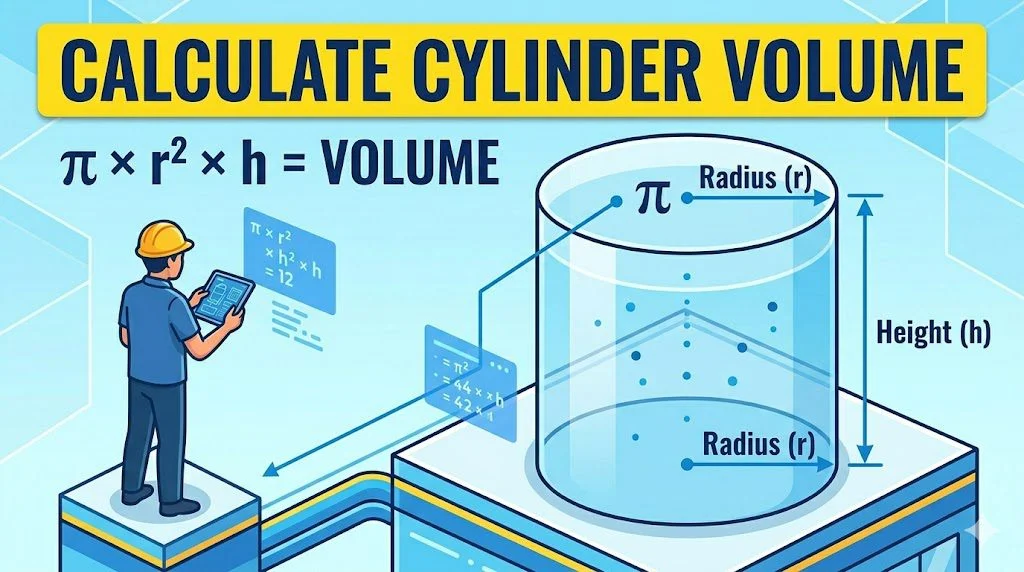
The volume of a cylindrical water tank is π × r² × h, where r is the internal radius and h is the internal height. A tank with an internal diameter of 1.2 m and height of 1.5 m holds approximately 1,696 litres. This article covers the full formula, unit conversions, worked examples in both metric and imperial, and the key measurement errors that cause tank volume to be miscalculated. If you’re deciding between a cylindrical and rectangular tank in the first place, our comparison guide Round vs Rectangular Water Tank is worth reading first.
The Quick Answer
Volume (m³) = π × r² × h | Volume (litres) = π × r² × h × 1,000
Where r = internal radius in metres, h = internal height in metres, and π = 3.14159.
| Internal diameter (m) | Internal height (m) | Volume (litres) | Volume (gallons) |
| 0.60 m | 1.00 m | 283 L | 74.7 gal |
| 0.90 m | 1.00 m | 636 L | 168 gal |
| 1.00 m | 1.20 m | 942 L | 249 gal |
| 1.20 m | 1.50 m | 1,696 L | 448 gal |
| 1.50 m | 2.00 m | 3,534 L | 933 gal |
| 2.00 m | 2.50 m | 7,854 L | 2,075 gal |
| 2.44 m (8 ft) | 3.05 m (10 ft) | 14,234 L | 3,760 gal |
Skip the math: Use the Cylindrical Tank Volume Calculator to enter your dimensions and get volume in litres, gallons, or cubic metres instantly.
How the Calculation Works
The formula: V = π × r² × h
Where V is volume, r is the radius (half the internal diameter), and h is the internal height of the tank.
Worked example — metric: A vertical cylindrical tank has an internal diameter of 1.4 m and an internal height of 1.8 m.
Step 1: Find the radius. r = 1.4 ÷ 2 = 0.7 m
Step 2: Square the radius. r² = 0.7 × 0.7 = 0.49 m²
Step 3: Multiply by π. π × 0.49 = 1.5394 m²
Step 4: Multiply by height. 1.5394 × 1.8 = 2.771 m³
Step 5: Convert to litres. 2.771 × 1,000 = 2,771 litres
Worked example — imperial: A tank is 4 feet in diameter and 5 feet tall.
Step 1: Radius = 4 ÷ 2 = 2 feet
Step 2: r² = 4 ft²
Step 3: π × 4 = 12.566 ft²
Step 4: 12.566 × 5 = 62.83 cubic feet
Step 5: Convert to US gallons. 62.83 × 7.481 = 470 US gallons (approximately 1,779 litres)
Key Variables That Change the Answer
Internal vs external dimensions. Tank manufacturers typically list external dimensions on product labels. Wall thickness on HDPE tanks is commonly 6–12 mm; on FRP tanks, 8–16 mm; on steel tanks, 3–6 mm. For a tank with a 1.2 m external diameter and 10 mm wall thickness, the internal radius is 0.59 m, not 0.60 m. Over the height of the tank, this reduces volume by approximately 3.3% — significant when comparing to a stated 1,000-litre capacity.
Tank orientation. Vertical cylinders use the formula above. Horizontal cylinders use a different formula because the liquid level changes the cross-sectional area of the wetted region — a horizontal tank at 50% fill is not at 50% volume. For horizontal tanks, use the Horizontal Tank Volume Calculator which applies the correct partial-fill formula.
Domed or conical ends. Many cylindrical tanks have a domed or conical top or base. These add volume beyond the pure cylinder calculation. A hemispherical dome on a 1.2 m diameter tank adds approximately 452 litres of additional volume. Tanks with conical bottoms have less usable volume than their total volume suggests — the cone below the outlet level is dead space.
Measurement method. Measuring with a tape measure over the outside of an installed tank introduces error from curvature, insulation, and operator technique. For accurate results, measure height with a rigid ruler dropped vertically through the inspection hatch, and diameter at the widest internal point. Do not assume external measurements are internal measurements.
Common Mistakes When Calculating Cylindrical Tank Volume
Using diameter instead of radius in the formula. This is the single most common error. V = π × d² × h (where d is diameter) overstates volume by a factor of 4. The correct formula always uses radius (half the diameter). A tank calculated as 4,000 litres this way actually holds 1,000 litres.
Measuring in mixed units. Entering diameter in centimetres and height in metres without converting both to the same unit produces a wildly incorrect answer. Always convert all measurements to the same unit before calculating. If working in centimetres, the result is in cm³ — divide by 1,000,000 to get litres (1 litre = 1,000 cm³, so cm³ ÷ 1,000 gives millilitres, and ÷ 1,000 again gives litres).
Ignoring the dead zone. A cylindrical tank’s usable volume is not its geometric volume. If the outlet fitting sits 80 mm above the floor, and the tank has a 1 m radius, the dead volume below the outlet is π × 1² × 0.08 = 251 litres. For a 2,000-litre tank, that is 12.5% of rated capacity that can never be used.
Assuming nominal rated volume matches geometry. Tank manufacturers’ stated volumes are nominal — often the rounded figure from the geometric calculation, sometimes slightly understated as a conservative rating, occasionally based on external dimensions by mistake. Always verify using the formula before making supply decisions.
Related Calculators You Might Need
For partially filled cylindrical tanks — where you need to know how much water is currently in the tank based on a measured depth — the Cylindrical Tank Volume Calculator supports partial-fill calculations. If you need to convert your result from litres to gallons, use the Tank Litres to US Gallons Converter or the Tank Litres to UK Gallons Converter, depending on which gallon standard you need. For tanks with more complex geometries, the Capsule Tank Volume Calculator handles cylinders with hemispherical ends, and the Cone Bottom Tank Volume Calculator handles tanks with conical bases. If your tank is rectangular instead, see our companion guide on calculating the volume of a rectangular water tank. Once you know the volume, the Water Tank Weight Calculator converts this to the structural load your installation must support.
Frequently Asked Questions
What is the formula for the volume of a cylindrical water tank?
V = π × r² × h, where r is the internal radius (half the internal diameter) and h is the internal height. The result is in cubic units — multiply by 1,000 to convert from m³ to litres, or by 7.481 to convert ft³ to US gallons. Use the Cylindrical Tank Volume Calculator to avoid manual calculation errors.
How do I calculate the volume of a horizontal cylindrical tank?
For a full horizontal cylinder, use the same formula: V = π × r² × L (where L is the length). However, if the tank is partially filled, the formula changes because the wetted cross-section is no longer a full circle. You need to calculate the area of a circular segment, which requires the height of the liquid level. This is why a separate calculator is used for horizontal tanks at partial fill — the formula is significantly more complex.
How many litres does a cylinder 1m diameter and 2m high hold?
V = π × 0.5² × 2 = π × 0.25 × 2 = 1.5708 m³ = 1,571 litres. Note that this is the geometric volume — subtract any dead zone below the outlet to get usable volume.
How do I convert cubic metres to litres for a water tank?
Multiply by exactly 1,000. One cubic metre = 1,000 litres. This is exact, not an approximation — 1 litre is defined as 0.001 m³ by the International System of Units (SI). Similarly, 1 cubic foot = 28.317 litres, and 1 US gallon = 3.785 litres.
Does the shape of the tank bottom affect the volume calculation?
Yes. A flat-bottom cylinder uses V = π × r² × h exactly. A domed base adds volume (a hemispherical dome of radius r adds (2/3)πr³). A conical base reduces usable volume — if the cone apex is at the outlet, all of the cone volume is dead space. For tanks with non-flat ends, the total geometric volume exceeds the simple cylinder formula, but usable volume depends on outlet placement.

Licensed Professional Engineer (Texas, PE) with 13+ years in residential and light-commercial water storage systems. Reviews and writes the technical guides on this site — sizing, pressure, roof loading, and treatment — based on 180+ completed field projects.