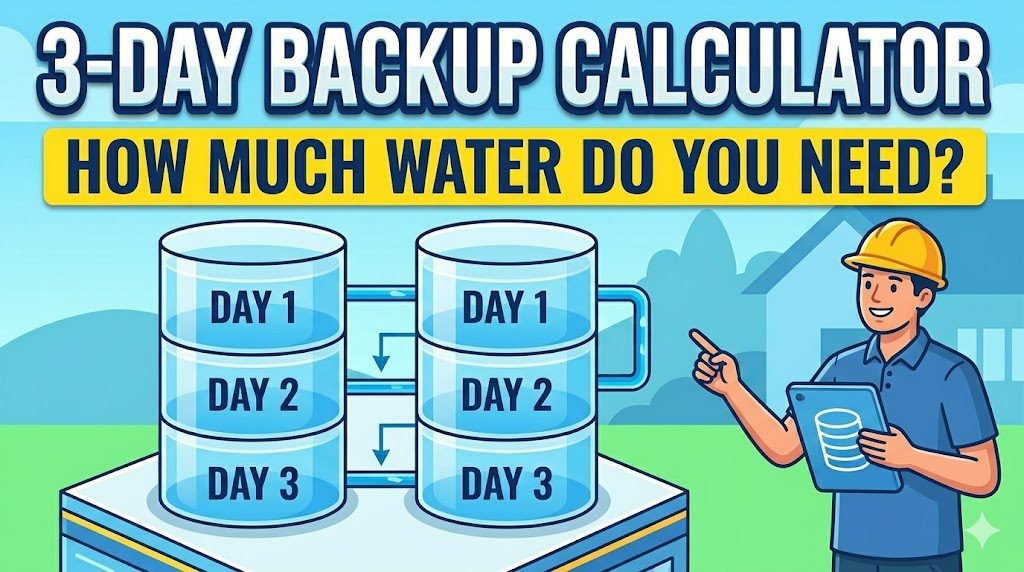
Category: Sizing & How-to

  • How Much Water Storage Do You Need for 3 Days of Backup?

    How Much Water Storage Do You Need for 3 Days of Backup?

    For a 3-day water backup, FEMA recommends 1 US gallon (3.78 litres) per person per day as a survival minimum — but this covers only drinking and basic sanitation with no cooking, bathing, or toilet flushing. For functional 3-day backup that maintains normal household operations, the figure is 50–100 litres per person, meaning a family of four needs 600–1,200 litres in storage. This article explains the range, how to set the right number for your situation, and what infrastructure you need to store it reliably.

    The Quick Answer

    Three-day water storage targets depend on use level. FEMA’s minimum (1 gallon/person/day, per FEMA Ready.gov guidelines) is a survival threshold — it assumes no bathing, no toilet flushing, and minimal cooking. The WHO minimum for basic needs is 15 litres/person/day. Normal household operation requires 50–150 litres/person/day depending on climate and habits.

    Household sizeFEMA minimum (72 hrs)WHO basic (72 hrs)Normal household use (72 hrs)
    1 person11.4 L (3 gal)45 L150–450 L
    2 people22.7 L (6 gal)90 L300–900 L
    4 people45.4 L (12 gal)180 L600–1,800 L
    6 people68.1 L (18 gal)270 L900–2,700 L
    4 people + 1 infant45.4 L + 15 L formula220 L700–2,000 L

    Skip the math: Use the 72-Hour Water Supply Calculator to get a 3-day storage target based on your household size, climate, and intended use level — survival minimum through full household operation.

    How the Calculation Works

    Step 1 — Establish your daily consumption baseline. The most accurate figure comes from your water meter. Read it at the same time on two days with normal usage. Divide the total by 2 (or the number of days) and by the number of occupants. This is your actual per-capita daily consumption.

    Step 2 — Apply an emergency reduction factor. During a supply interruption, toilet flushing (which accounts for 25–30% of normal household use, per US EPA WaterSense data) can be reduced or eliminated. Outdoor water use stops entirely. Showers get shorter or are replaced with sponge bathing. A realistic emergency reduction factor is 50–70% of normal consumption for a household that is conserving actively.

    Step 3 — Worked example. Family of 4, normal consumption 180 litres per day per person = 720 litres/day total. Emergency mode consumption (60% reduction) = 720 × 0.4 = 288 litres/day. Over 3 days: 288 × 3 = 864 litres. Round to the next standard tank size: 1,000 litres

    Step 4 — Add a safety margin. FEMA recommends building in reserve beyond the 72-hour target because emergencies rarely resolve exactly on schedule. A 20% buffer is standard: 864 × 1.2 = 1,037 litres. A 1,000-litre tank is the minimum; 1,200–1,500 litres provides adequate margin.

    Key Variables That Change the 3-Day Storage Requirement

    Climate and ambient temperature. In hot climates (above 35°C), per-person drinking water requirements increase from 2 litres/day to 4–6 litres/day (WHO, 2011 Guidelines for Drinking Water Quality). Physical labour outdoors in heat raises this further. A 3-day minimum for active adults in a hot climate must account for this — the FEMA gallon-per-day figure was developed for temperate conditions.

    Medical and sanitary requirements. Dialysis patients typically require 120–150 litres of clean water per session, 3 sessions per week. A 3-day backup for a household with a dialysis patient requires this volume on top of household consumption. Similarly, households with infants need water for formula preparation and sterilisation — typically an additional 5–8 litres per day per infant.

    Whether you have flush toilets. Standard flush toilets use 6–13 litres per flush (US EPA data). At 5 flushes per person per day, a family of 4 uses 120–260 litres just for toilets. If supply is cut and mains pressure is lost, toilet flushing requires manual tank filling. Many households do not account for this — they calculate drinking and cooking water only, then find their storage depleted in 12–18 hours by toilet use alone.

    Whether the storage is pre-treated. Stored water must be treated for it to remain safe across a 72-hour period, particularly in warm climates. Untreated water from a tap stored in a clean container is safe for 6–12 hours at room temperature; treated water with 0.2–0.5 mg/L free chlorine (WHO standard) remains safe for 6–12 months in a sealed container. If your 3-day storage is not chemically treated, it needs to be rotated continuously or used immediately on a supply interruption.

    Pets. A medium-sized dog requires 30–50 ml per kg of body weight per day (approximately 1 litre/day for a 25 kg dog). A household with two dogs and a family of four needs to add 2+ litres per day — small in absolute terms but worth including in a precise calculation.

    Common Mistakes When Planning 3-Day Water Backup

    Calculating drinking water only and ignoring sanitation. The FEMA 1 gallon/day figure is explicitly a survival minimum for drinking only. People planning a ‘3-day emergency supply’ using this number are typically unprepared for toilet flushing, cooking, wound cleaning, and medication preparation. Real 72-hour preparedness for normal function requires 10–20× the FEMA minimum per person.

    Storing water in food-grade containers that are not food-grade. HDPE plastic containers rated food-grade (marked with recycling code 2) are suitable for water storage. Containers that previously held bleach or chemicals, or are made from non-food-grade plastics, leach compounds into stored water. Standard garden water barrels are often not food-grade. Containers must also be opaque — clear or translucent containers allow algae growth in any light.

    Not accounting for rotation. Water stored without treatment and without rotation becomes unsafe. Even treated water in a non-sealed container should be replaced every 6 months. Many households set up 3-day storage and forget it — inspecting it years later to find sediment, bacterial growth, or degraded container integrity.

    Ignoring access during power outages. If your backup storage depends on an electric pump to access it — for example, underground cisterns or pressurised systems — a power outage simultaneously cuts water supply and pump operation. Gravity-fed rooftop tanks or hand-pump accessible containers are the only reliable 3-day backup for power-cut scenarios.

    Related Calculators You Might Need

    The Emergency Water Storage Calculator lets you customise your target by intended use level and household composition. If you want to plan beyond 72 hours, the Water Stockpile Duration Calculator tells you how long any given stored volume will last at your consumption rate. For households preparing for specific events, the Hurricane and Disaster Water Prep Calculator applies scenario-specific guidance. And if you are evaluating the ongoing cost of maintaining emergency storage versus other supply options, the Water Delivery vs Tank Cost Calculator puts the numbers into context.

    Frequently Asked Questions

    How much water does a family of 4 need for 3 days?

    At FEMA’s survival minimum of 1 US gallon (3.78 L) per person per day: 45.4 litres total — covering drinking only. For normal household operation with emergency conservation: 600–900 litres. The correct figure depends entirely on how you define ‘backup’ — survival hydration only or maintained household function. Use the 72-Hour Water Supply Calculator to calculate for your specific household.

    What size water tank do I need for a 72-hour emergency supply?

    For most households aiming at functional (not survival) backup, the practical tank size is 200–300 litres per person for 72 hours. A family of four therefore needs an 800–1,200-litre tank dedicated to emergency use. This can be a standalone polyethylene tank with a sealed lid, a gravity-fed overhead unit, or a purpose-built underground cistern — depending on access and structural constraints.

    Can I use my existing water tank as a 3-day backup?

    Yes, if it meets three criteria: the stored volume is adequate for your 72-hour target, the water is treated and rotated on schedule, and you can access it independently of mains pressure and electric pumps. Many household overhead tanks already hold 500–2,000 litres — check whether the usable volume (subtracting the dead zone below the outlet) meets your 3-day requirement before purchasing additional storage.

    How long does stored water last before it goes bad?

    Treated tap water in a sealed, food-grade, opaque container remains safe for 6–12 months. Water stored in open or semi-open containers should be replaced every 48–72 hours. Commercially bottled water has a stated shelf life of 12–24 months, though this reflects container integrity, not water chemistry — properly stored water does not expire the way food does; the container degrades.

    Is 1 gallon of water per day per person enough for 3 days?

    For survival — yes. FEMA’s 1 gallon/person/day is sufficient to prevent dehydration in a temperate climate with minimal activity. It is not sufficient for cooking, hygiene, toilet flushing, or any medical needs. If you are planning for a functional emergency period rather than strict survival, multiply the FEMA figure by 5–15 depending on your specific household requirements.

  • How to size a water tank for a commercial building

    How to size a water tank for a commercial building

    Commercial building water tanks are sized against occupant count, building type, and supply reliability — not floor area. A 10-storey office building with 500 occupants and 8-hour daily supply needs a fundamentally different tank than a hotel of the same size with 24-hour occupancy and kitchen demand. The base formula is daily consumption per occupant type multiplied by occupant count and backup days, with fire reserve and regulatory minimums layered on top. This article covers the full calculation, occupancy benchmarks from WHO and international plumbing codes, and the structural and compliance constraints that bound your answer.

    The quick answer

    Use this formula for commercial building tank sizing:

    Tank size (L) = (daily demand per occupant × peak occupants × backup days × 1.15) + fire reserve (if required)

    The 1.15 factor covers distribution losses, dead volume, and system inefficiency. Fire reserve is a separate fixed volume determined by local fire codes — typically 5,000–45,000 L for commercial buildings depending on building class and jurisdiction.

    Building typeL/person/day500 occupants, 1-day500 occupants, 2-day
    Office (standard)45–6026,000–34,500 L52,000–69,000 L
    Hotel (mid-range)200–300 per roomVaries by roomsVaries by rooms
    Hospital (bed)350–500 per bed (WHO)Varies by bedsVaries by beds
    School (day use)30–4517,250–25,875 L34,500–51,750 L
    Restaurant / café70–100 per coverVaries by coversVaries by covers
    Shopping mall15–25 per visitor8,625–14,375 L17,250–28,750 L

    Use the commercial tank size calculator to enter your building type, occupant count, and backup requirements for a code-referenced tank size recommendation.

    How the calculation works

    Per-occupant consumption figures for commercial buildings are drawn from the International Plumbing Code (IPC), AS/NZS 3500, and WHO Healthcare Facility Water Standards — the appropriate standard depends on your jurisdiction.

    Worked example: 8-storey office building, 400 employees, 2-day backup, intermittent supply

    Daily demand: 400 × 55 L = 22,000 L/day (using IPC office benchmark of 55 L/person/day)

    2-day buffer with 15% losses: 22,000 × 2 × 1.15 = 50,600 L

    Fire reserve (mid-rise office, local code): 15,000 L

    Total tank capacity: 50,600 + 15,000 = 65,600 L — specify a 70,000 L system (two 35,000 L tanks in series or one large underground tank)

    Hotel example: 80-room hotel, 2-night average stay, full occupancy

    Daily demand: 80 rooms × 2.5 guests × 250 L = 50,000 L/day

    1-day backup: 50,000 × 1 × 1.15 = 57,500 L

    Fire reserve: 25,000 L (hotel classification)

    Total: 82,500 L — specify 85,000–100,000 L

    Key variables that change the answer

    Peak vs average occupancy. Commercial buildings are never at 100% occupancy throughout the day. An office building peaks at 70–80% of headcount capacity at midday, schools peak during school hours, shopping centres on weekends. Sizing to peak simultaneous occupancy — not headcount — avoids both oversizing and supply shortfalls. For offices, multiply by 0.85 × headcount. For hotels, use occupancy rate × room count × average guests per room.

    Fire suppression reserve. Most commercial building codes require a dedicated fire reserve stored in the same tank system. This volume is non-operational — it cannot be drawn for domestic use and must be maintained at full capacity. In the UK (BS EN 12845), US (NFPA 22), and Australian (AS 2419.1) codes, fire reserves for commercial buildings range from 5,000 L for low-rise to 45,000+ L for high-rise sprinkler systems. Confirm the required volume with your local fire authority before finalising tank size.

    Supply pressure and flow rate. Many urban commercial areas have intermittent mains supply — 8–12 hours per day in parts of South Asia, the Middle East, and East Africa. A commercial tank must be large enough to supply the building continuously through the full off-supply window while also refilling during the on-supply window. If the building consumes 5,000 L/hour and supply is off for 16 hours, that requires 80,000 L of buffer storage, independent of backup day calculations.

    Kitchen and catering demand. Restaurant kitchens, hospital catering, and hotel food preparation generate water demand far above the occupant benchmarks. A commercial kitchen serving 200 covers per day uses 10–25 L per cover for food preparation, washing, and cleaning — on top of the general building demand. Always add kitchen/catering water separately using measured or estimated cover counts rather than including it in a per-occupant figure that doesn’t account for it.

    Commercial building tank sizing scenarios

    ScenarioDaily demandBackup daysRecommended tank capacity
    200-person office, reliable supply11,000 L1 day27,650 L + fire reserve
    200-person office, 8-hr supply11,000 L2 days40,000 L + fire reserve
    100-bed hospital40,000 L2 days92,000 L + dedicated fire reserve
    500-student school18,750 L1 day21,563 L + fire reserve
    50-room hotel, full kitchen40,000 L1 day71,000 L + fire reserve

    Common mistakes

    Sizing without separating fire reserve from domestic storage. A 50,000 L tank that includes a 20,000 L fire reserve only provides 30,000 L for domestic use — but the building’s systems don’t enforce this separation unless the tank is physically partitioned or the fire reserve is in a separate tank. Buildings that draw against the fire reserve face code violations and lose protection during an actual fire event. Fire and domestic storage must be tracked separately and ideally physically separated.

    Using residential per-person benchmarks for commercial buildings. Residential use averages 100–200 L/person/day. Office occupants consume 45–60 L/day — they don’t shower, do laundry, or cook on site. Using residential figures for an office building overstates demand by 2–3×, leading to a massively oversized tank with capital cost implications and stagnation risk. Stagnant water in an oversized commercial tank creates Legionella risk — a genuine building liability.

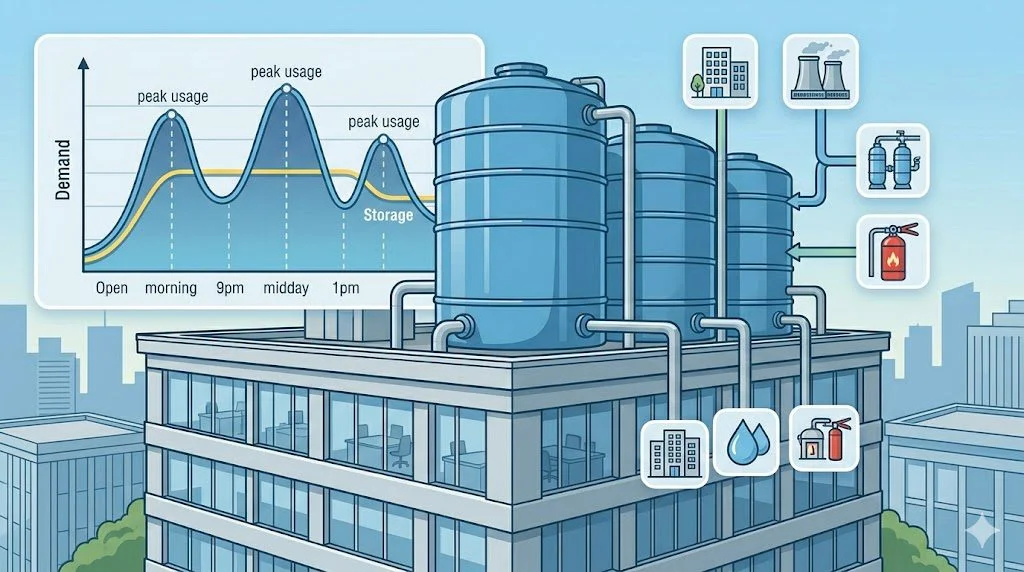
    Ignoring demand profiling across the day. Commercial buildings have pronounced demand peaks — morning arrivals, lunchtime, and end-of-day account for 60–70% of daily consumption in a 3-hour window. The distribution system and tank outlet capacity must handle these peaks, not just the daily average. A tank correctly sized by total volume but connected to pipes with insufficient flow rate still fails at peak demand. Check both volume and peak flow rate (L/s or L/min) against your distribution system’s capacity.

    Not planning for tank access and maintenance. Commercial tanks require annual inspection, biennial cleaning at minimum, and water quality testing under most public health codes (WHO building plumbing guidelines; UK CIBSE TM13). A tank that can’t be physically entered, drained, and cleaned — or one so large it’s never fully emptied — creates ongoing compliance and water quality risk. For tanks above 5,000 L, plan for dual-tank configuration so one can be isolated for cleaning while the other remains in service.

    Related calculators you might need

    For buildings with school or institutional use specifically, the school and institutional water tank size calculator applies education-sector occupancy benchmarks rather than generic commercial figures. Once tank size is confirmed, the rooftop load bearing calculator tells you whether elevated tank placement is structurally viable — critical for buildings where underground installation isn’t an option. To establish refill logistics for large tanks, the tank refill time calculator models how long your supply connection takes to restore a depleted tank at a given flow rate. And if chlorination is part of your water quality management plan, the chlorine dosage calculator calculates the correct treatment volume for your tank capacity.

    Frequently asked questions

    How do I calculate the water tank size for a commercial building?

    Multiply your peak occupant count by the per-person daily demand for your building type (45–60 L for offices, 200–300 L per hotel room, 350–500 L per hospital bed). Multiply by backup days and add 15%. Add fire reserve as a separate figure from your local fire code. Use the commercial tank size calculator to apply code-referenced benchmarks to your specific building type.

    What is the standard water consumption per person per day in an office building?

    The International Plumbing Code (IPC) specifies 45–60 litres per person per day for office buildings. This covers toilet flushing (the dominant use at 40–60% of total), hand washing, and drinking water. It does not include showers or canteen/kitchen use — those must be added separately if the building has these facilities. Some jurisdictions use a lower figure of 30–40 L/person/day for buildings without kitchen facilities.

    Does a commercial water tank need to include fire storage?

    In most jurisdictions, yes — and the fire reserve volume is determined by fire codes (NFPA 22 in the US, AS 2419.1 in Australia, BS EN 12845 in the UK), not by the building owner’s preference. Required fire reserve volumes for commercial buildings typically range from 5,000 L for small low-rise buildings to 45,000 L or more for large or high-rise buildings with full sprinkler systems. Confirm the specific requirement with your local fire authority during design.

    How many days of water storage does a commercial building need?

    For buildings in areas with reliable 24-hour mains supply: 1 day is the standard minimum, providing a buffer against pressure fluctuations and short outages. For areas with scheduled supply interruptions of 8–16 hours per day: 2 days minimum. For critical facilities (hospitals, data centres, emergency services): 3–5 days, with some healthcare facility guidelines (WHO) recommending 72-hour storage as a minimum resilience standard.

    What causes water stagnation in commercial tanks and how do I prevent it?

    Stagnation occurs when water sits in a tank longer than 72 hours at temperatures that support bacterial growth (20–50°C). The main causes are oversized tanks (water turns over too slowly), low occupancy periods, and dead legs in the distribution pipework. Prevention involves right-sizing the tank to actual demand (not worst-case theoretical demand), maintaining chlorine residual above 0.2 mg/L, keeping tank water below 20°C where possible, and flushing distribution dead legs regularly. Annual water quality testing is mandatory in most commercial building codes.

  • How to Size a Rooftop Water Tank for a Multi-Storey Building

    How to Size a Rooftop Water Tank for a Multi-Storey Building

    A rooftop tank for a multi-storey building must satisfy three separate constraints simultaneously: enough volume for peak demand and supply gaps, enough height to generate adequate pressure at the lowest fixture, and within the structural load limit of the roof slab. Getting any one of these wrong creates problems the other two cannot fix. This article walks through each constraint with the actual numbers.

    The Quick Answer

    Rooftop tank sizing for multi-storey buildings follows this sequence: calculate total daily demand, add buffer for supply gaps, verify pressure at the lowest floor, and confirm the slab can carry the load. The table below gives indicative volumes for common building types.

    Building typeFloorsUnits/occupantsRecommended tank volume
    Residential apartmentG+316 units / ~48 people10,000–15,000 L
    Residential apartmentG+628 units / ~84 people18,000–25,000 L
    Residential apartmentG+1044 units / ~132 people30,000–45,000 L
    Mixed-use commercialG+4Office + 8 residential units12,000–20,000 L
    Small hotel (30 rooms)G+5~90 guests at peak25,000–35,000 L

    Skip the math: Use the Rooftop Tank Size Calculator to get a volume figure calibrated to your building’s actual occupancy and supply conditions.

    How the Calculation Works

    Step 1 — Total daily demand. Multiply occupants by per-capita consumption. For residential buildings in South Asia, 135 litres per person per day is the IS 1172 standard (Bureau of Indian Standards). For UK residential, 150 litres per person per day is the Approved Document G baseline. For hotels, CIBSE Guide G recommends 200–250 litres per bed per day.

    Step 2 — Buffer for supply gaps. The tank must cover the longest expected gap between supply fills. If municipal supply is 6 hours per day, the tank must hold at minimum 18 hours of demand. In areas with daily outages, a 1.5× to 2× daily demand buffer is standard practice.

    Step 3 — Worked example. A G+6 residential building: 28 units, average 3 occupants each = 84 people. Daily demand at 135 L/person = 11,340 L. Municipal supply is available 8 hours/day, so the tank must bridge 16 hours. Buffer factor = 11,340 × (16/24) = 7,560 L. Rounding up to the nearest standard tank size: 10,000 L tank, typically two 5,000-litre units on the roof.

    Step 4 — Pressure check. Every additional metre of head (vertical height from tank base to outlet) generates approximately 0.098 bar of pressure (9.8 kPa). A ground-floor shower typically requires a minimum of 1.0 bar (10 m of head). If the tank base sits 12 m above ground level, you have 1.18 bar at the ground floor — sufficient. If the building is only 8 m tall, gravity feed may be inadequate and a booster pump is required.

    Key Variables That Change the Answer

    Supply reliability. Buildings in cities with 24/7 mains supply can size their rooftop tank at just 50% of daily demand — it is a buffer, not primary storage. Buildings in areas with 4–8 hours of daily supply need to store 100–150% of daily demand. In areas with irregular or tanker-fed supply, 200–300% is not unusual.

    Number of simultaneously active outlets. Peak hour demand — typically morning and evening — can be 3–4× average hourly demand. The tank must be able to supply this without running dry or requiring pump assistance. Building services engineers typically apply a simultaneous demand factor of 0.6–0.8 for residential buildings (CIBSE Guide G).

    Roof slab load rating. Water weighs 1 kg per litre. A 10,000-litre tank weighs 10,000 kg plus the tank structure itself (200–800 kg depending on material). That is 10–11 tonnes concentrated on a small footprint. Most standard flat-slab residential construction in South Asia is designed for 150–200 kg/m². A tank footprint of 4 m × 2 m = 8 m² supporting 10,800 kg applies 1,350 kg/m² — far beyond standard slab capacity. Structural reinforcement or distribution over multiple tanks is almost always required.

    Tank material and insulation. In hot climates, uninsulated black polyethylene tanks can reach internal water temperatures of 45–55°C, accelerating bacterial growth. White or insulated tanks maintain safer temperatures. HDPE is standard; FRP (fibreglass) and stainless steel are used for larger volumes or potable-grade requirements.

    Building height and gravity pressure. Taller buildings have more head pressure at low floors but lower pressure at the top floors. A tank on a 10-storey building provides excellent pressure at floors 1–3 but may deliver less than 0.3 bar at floor 9. Top-floor units often require individual pressure-boosting or a separate pressure zone.

    Common Mistakes in Rooftop Tank Sizing for Multi-Storey Buildings

    Sizing by number of units without adjusting for actual occupancy. A 2-bedroom apartment averages 2.4 occupants in most markets — not 4 (full capacity) and not 1. Using design capacity inflates tank size; using census averages may undersize. For commercial buildings, using floor area rather than measured occupancy leads to significant errors.

    Ignoring the structural load calculation. The single most common and costly mistake. Rooftop tanks are frequently installed without a structural assessment, then cracks appear in the roof slab within 2–5 years. The correct sequence is: calculate required volume, check available roof area, calculate load per square metre, compare against slab rating — before purchasing any tank.

    Placing the tank too low for gravity pressure. In buildings where the tank sits on the same floor level as the top occupied storey, gravity pressure is near zero. This is common in retrofits where structural concerns limit tank height. Without at least 2–3 m of head above the highest fixture, a booster pump is non-negotiable.

    Ignoring evaporation and contamination in open tanks. Open-top rooftop tanks in hot, dusty, or high-UV environments degrade water quality rapidly. All potable rooftop tanks must be covered and ventilated with mesh screens. This is a health requirement, not an aesthetic preference.

    Related Calculators You Might Need

    Before finalising your tank volume, run the Rooftop Load Bearing Calculator to confirm your slab can take the load — this should happen before any purchase decision. If you need to verify the pressure reaching top-floor units, the Water Pressure Calculator converts tank height to bar or PSI. For the tank volume itself, the Rectangular Water Tank Volume Calculator and Cylindrical Tank Volume Calculator let you verify the dimensions of tanks you are comparing. And if you are evaluating the minimum height needed for shower pressure, use the Minimum Tank Height for Shower Pressure Calculator to get the exact figure for your building.

    Frequently Asked Questions

    How do I calculate the rooftop tank size for a 10-storey apartment building?

    Multiply total occupants by per-capita daily consumption (use 135 L/person/day for South Asia per IS 1172, or 150 L/person/day for the UK). Multiply the result by a supply buffer factor of 1.5–2.0 based on how many hours per day mains supply is available. Then verify the structural load of the selected tank volume against your roof slab rating — this step is frequently skipped and frequently causes structural damage.

    What is the minimum tank height needed for gravity-fed water pressure?

    Every metre of vertical height between the tank base and the outlet delivers approximately 0.098 bar of pressure. To meet the minimum 1.0 bar required for most showers and fixtures, the tank base must be at least 10.2 m above the fixture. For the top floor of a building, this is often physically impossible without a booster pump. Use the Minimum Tank Height for Shower Pressure Calculator for your specific installation height.

    How many tanks should I install on the roof versus one large tank?

    Multiple smaller tanks are usually preferable for load distribution. Two 5,000-litre tanks placed symmetrically distribute weight more efficiently across the roof slab than one 10,000-litre unit. Redundancy is also an operational benefit — if one tank fails or requires cleaning, supply continues through the other. The structural advantage is significant: distributed load vs. point load.

    How much does a full rooftop tank weigh?

    Water weighs exactly 1 kg per litre, regardless of tank material. A 5,000-litre HDPE tank weighs approximately 5,100–5,200 kg when full (tank shell adds 80–150 kg). A 10,000-litre FRP tank weighs 10,200–10,600 kg. Add the base frame or support structure. This total load, divided by the tank footprint area, gives the kg/m² figure to compare against your slab rating.

    Can I add a second rooftop tank to an existing building?

    Only after a structural assessment confirms the slab can carry the additional load. The assessment must account for the existing tank load, any other rooftop equipment, and the new addition. In many older residential buildings, the slab is already at or near capacity with the original tank. Adding more capacity underground and pumping up is often the structurally safer solution.

  • How to Calculate the Volume of a Cylindrical Water Tank

    How to Calculate the Volume of a Cylindrical Water Tank

    The volume of a cylindrical water tank is π × r² × h, where r is the internal radius and h is the internal height. A tank with an internal diameter of 1.2 m and height of 1.5 m holds approximately 1,696 litres. This article covers the full formula, unit conversions, worked examples in both metric and imperial, and the key measurement errors that cause tank volume to be miscalculated.

    The Quick Answer

    Volume (m³) = π × r² × h  |  Volume (litres) = π × r² × h × 1,000

    Where r = internal radius in metres, h = internal height in metres, and π = 3.14159.

    Internal diameter (m)Internal height (m)Volume (litres)Volume (gallons)
    0.60 m1.00 m283 L74.7 gal
    0.90 m1.00 m636 L168 gal
    1.00 m1.20 m942 L249 gal
    1.20 m1.50 m1,696 L448 gal
    1.50 m2.00 m3,534 L933 gal
    2.00 m2.50 m7,854 L2,074 gal
    2.44 m (8 ft)3.05 m (10 ft)14,253 L3,764 gal

    Skip the math: Use the Cylindrical Tank Volume Calculator to enter your dimensions and get volume in litres, gallons, or cubic metres instantly.

    How the Calculation Works

    The formula:  V = π × r² × h

    Where V is volume, r is the radius (half the internal diameter), and h is the internal height of the tank.

    Worked example — metric: A vertical cylindrical tank has an internal diameter of 1.4 m and an internal height of 1.8 m.

    Step 1: Find the radius. r = 1.4 ÷ 2 = 0.7 m

    Step 2: Square the radius. r² = 0.7 × 0.7 = 0.49 m²

    Step 3: Multiply by π. π × 0.49 = 1.5394 m²

    Step 4: Multiply by height. 1.5394 × 1.8 = 2.771 m³

    Step 5: Convert to litres. 2.771 × 1,000 = 2,771 litres

    Worked example — imperial: A tank is 4 feet in diameter and 5 feet tall.

    Step 1: Radius = 4 ÷ 2 = 2 feet

    Step 2: r² = 4 ft²

    Step 3: π × 4 = 12.566 ft²

    Step 4: 12.566 × 5 = 62.83 cubic feet

    Step 5: Convert to US gallons. 62.83 × 7.481 = 470 US gallons (approximately 1,779 litres)

    Key Variables That Change the Answer

    Internal vs external dimensions. Tank manufacturers typically list external dimensions on product labels. Wall thickness on HDPE tanks is commonly 6–12 mm; on FRP tanks, 8–16 mm; on steel tanks, 3–6 mm. For a tank with a 1.2 m external diameter and 10 mm wall thickness, the internal radius is 0.59 m, not 0.60 m. Over the height of the tank, this reduces volume by approximately 3.3% — significant when comparing to a stated 1,000-litre capacity.

    Tank orientation. Vertical cylinders use the formula above. Horizontal cylinders use a different formula because the liquid level changes the cross-sectional area of the wetted region — a horizontal tank at 50% fill is not at 50% volume. For horizontal tanks, use the Horizontal Tank Volume Calculator which applies the correct partial-fill formula.

    Domed or conical ends. Many cylindrical tanks have a domed or conical top or base. These add volume beyond the pure cylinder calculation. A hemispherical dome on a 1.2 m diameter tank adds approximately 452 litres of additional volume. Tanks with conical bottoms have less usable volume than their total volume suggests — the cone below the outlet level is dead space.

    Measurement method. Measuring with a tape measure over the outside of an installed tank introduces error from curvature, insulation, and operator technique. For accurate results, measure height with a rigid ruler dropped vertically through the inspection hatch, and diameter at the widest internal point. Do not assume external measurements are internal measurements.

    Common Mistakes When Calculating Cylindrical Tank Volume

    Using diameter instead of radius in the formula. This is the single most common error. V = π × d² × h (where d is diameter) overstates volume by a factor of 4. The correct formula always uses radius (half the diameter). A tank calculated as 4,000 litres this way actually holds 1,000 litres.

    Measuring in mixed units. Entering diameter in centimetres and height in metres without converting both to the same unit produces a wildly incorrect answer. Always convert all measurements to the same unit before calculating. If working in centimetres, the result is in cm³ — divide by 1,000 to get litres.

    Ignoring the dead zone. A cylindrical tank’s usable volume is not its geometric volume. If the outlet fitting sits 80 mm above the floor, and the tank has a 1 m radius, the dead volume below the outlet is π × 1² × 0.08 = 251 litres. For a 2,000-litre tank, that is 12.5% of rated capacity that can never be used.

    Assuming nominal rated volume matches geometry. Tank manufacturers’ stated volumes are nominal — often the rounded figure from the geometric calculation, sometimes slightly understated as a conservative rating, occasionally based on external dimensions by mistake. Always verify using the formula before making supply decisions.

    Related Calculators You Might Need

    For partially filled cylindrical tanks — where you need to know how much water is currently in the tank based on a measured depth — the Cylindrical Tank Volume Calculator supports partial-fill calculations. If you need to convert your result from litres to US or imperial gallons, use the Tank Litres to Gallons Converter. For tanks with more complex geometries, the Capsule Tank Volume Calculator handles cylinders with hemispherical ends, and the Cone Bottom Tank Volume Calculator handles tanks with conical bases. Once you know the volume, the Water Tank Weight Calculator converts this to the structural load your installation must support.

    Frequently Asked Questions

    What is the formula for the volume of a cylindrical water tank?

    V = π × r² × h, where r is the internal radius (half the internal diameter) and h is the internal height. The result is in cubic units — multiply by 1,000 to convert from m³ to litres, or by 7.481 to convert ft³ to US gallons. Use the Cylindrical Tank Volume Calculator to avoid manual calculation errors.

    How do I calculate the volume of a horizontal cylindrical tank?

    For a full horizontal cylinder, use the same formula: V = π × r² × L (where L is the length). However, if the tank is partially filled, the formula changes because the wetted cross-section is no longer a full circle. You need to calculate the area of a circular segment, which requires the height of the liquid level. This is why a separate calculator is used for horizontal tanks at partial fill — the formula is significantly more complex.

    How many litres does a cylinder 1m diameter and 2m high hold?

    V = π × 0.5² × 2 = π × 0.25 × 2 = 1.5708 m³ = 1,571 litres. Note that this is the geometric volume — subtract any dead zone below the outlet to get usable volume.

    How do I convert cubic metres to litres for a water tank?

    Multiply by exactly 1,000. One cubic metre = 1,000 litres. This is exact, not an approximation — 1 litre is defined as 0.001 m³ by the International System of Units (SI). Similarly, 1 cubic foot = 28.317 litres, and 1 US gallon = 3.785 litres.

    Does the shape of the tank bottom affect the volume calculation?

    Yes. A flat-bottom cylinder uses V = π × r² × h exactly. A domed base adds volume (a hemispherical dome of radius r adds (2/3)πr³). A conical base reduces usable volume — if the cone apex is at the outlet, all of the cone volume is dead space. For tanks with non-flat ends, the total geometric volume exceeds the simple cylinder formula, but usable volume depends on outlet placement.

  • How to Calculate How Long a Water Tank Will Last

    How to Calculate How Long a Water Tank Will Last

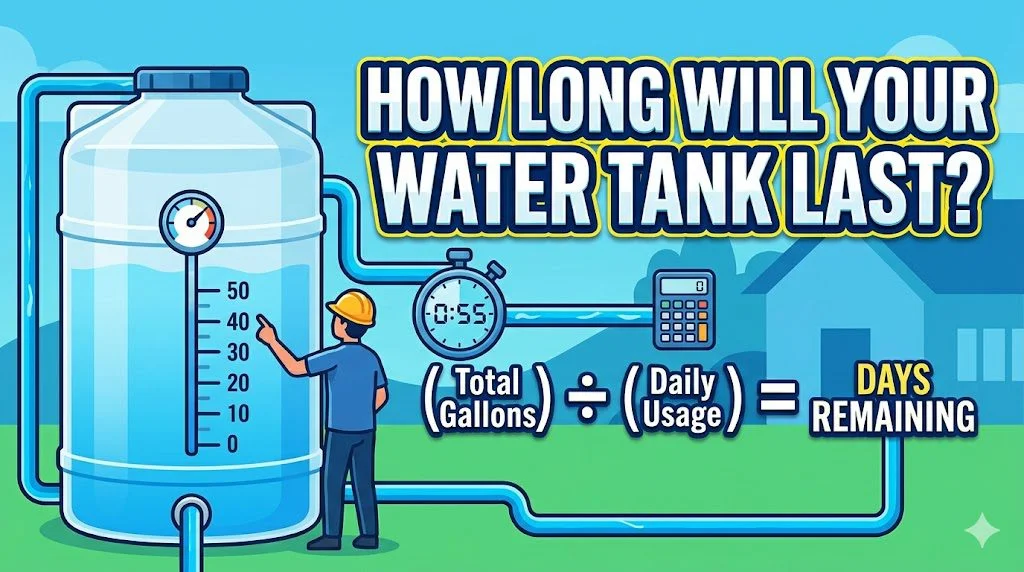
    A 500-litre tank used by a household of four consuming 50 litres per person per day will last exactly 2.5 days. That is the entire calculation — tank volume divided by daily consumption. This article breaks down how to get both numbers right, what variables compress or extend your supply, and the mistakes that cause people to run dry earlier than expected.

    The Quick Answer

    Tank duration (days) = Tank volume (litres) ÷ Daily consumption (litres/day). For most planning purposes, WHO guidance sets minimum survival water needs at 15 litres per person per day; FEMA recommends at least 3.78 litres (1 US gallon) per person per day for short-term emergency storage, though this covers only drinking and basic sanitation.

    Household sizeDaily use (litres)500 L lasts1,000 L lasts2,000 L lasts
    1 person50 L10 days20 days40 days
    2 people100 L5 days10 days20 days
    4 people200 L2.5 days5 days10 days
    6 people300 L1.7 days3.3 days6.7 days
    Emergency (15 L/person × 4)60 L8.3 days16.7 days33.3 days

    Skip the math: Use the How Long Will My Tank Last Calculator to enter your exact tank size and household consumption for an instant result.

    How the Calculation Works

    Formula:  Days of supply = Usable tank volume (L) ÷ Total daily demand (L/day)

    Worked example: A family of 5 in a warm climate uses an average of 65 litres per person per day — cooking, bathing, toilet flushing, and laundry. Their tank is a 2,000-litre overhead tank, but the outlet is 50 litres above the tank floor, so usable volume is 1,950 litres.

    1,950 ÷ (5 × 65) = 1,950 ÷ 325 = 6 days of supply.

    If their municipal supply fails, they have six days before the tank runs dry — assuming no wastage. Add a 20% safety margin (standard practice in building services engineering) and the effective planning duration becomes 4.8 days before they need to act.

    Key Variables That Change the Answer

    Usable vs total volume. Most tanks have a dead zone at the bottom — sediment, the physical position of the outlet pipe, or a valve installed 50–100 mm above the floor. Subtract this from your nominal capacity. On a 1,000-litre tank, the dead zone can be 30–80 litres depending on design.

    Per-capita consumption varies significantly by context. In Australia, average household consumption runs 200–250 litres per person per day (Water Services Association of Australia, 2023). In sub-Saharan Africa, per-capita access can be under 20 litres/day. If you are sizing for backup rather than primary supply, use your actual metered daily consumption, not a regional average.

    Seasonal demand shifts. In summer, outdoor watering, cooling, and higher personal hygiene use can push consumption up 30–50% above winter baseline. A tank that lasts 10 days in January may last only 6–7 days in July in a hot climate.

    Top-up frequency. If your municipal supply is intermittent — common across South Asia, parts of Africa, and the Middle East — your effective tank duration is not full drain to empty. It is the gap between supply windows. Design your tank size around the longest expected gap, not the average.

    Evaporation and leakage. Uncovered tanks in hot climates can lose 1–3% of volume per week to evaporation. A slow float valve leak can waste 20–50 litres per day without being audible. These losses silently reduce your effective duration.

    Common Mistakes When Estimating Tank Duration

    Using nominal tank volume without subtracting dead space. A tank labelled 1,000 litres delivers 1,000 litres only if the outlet is at the absolute base. In practice, 5–8% is often inaccessible. This matters most with smaller tanks where the error is proportionally larger.

    Using per-capita averages from the wrong context. Applying a 250-litre Australian average to a household that actually uses 90 litres per person will cause significant overbuilding — and vice versa. Pull your actual water meter reading over two to four weeks, divide by occupants and days. That number is your real input.

    Ignoring children and elderly occupants. Caregiving for infants (formula preparation, frequent washing) and elderly individuals can add 20–40 litres per day per dependent beyond base adult consumption. Household composition matters.

    Calculating for normal use during an emergency. During supply failures, toilet flushing (which accounts for 25–30% of typical home water use per UK Environment Agency data) often gets reduced or eliminated. Factoring in emergency-mode behaviour can stretch a 5-day tank to 7–8 days without any additional capacity.

    Related Calculators You Might Need

    Once you know how long your current tank lasts, the logical next step is confirming whether that duration is sufficient — or sizing a new tank to meet a specific backup target. The Water Tank Size for Home Calculator lets you work in reverse: enter your household size and required backup days to get a recommended tank volume. If you are sizing for an emergency scenario specifically, the Emergency Water Storage Calculator applies FEMA and WHO-based minimums to your household. For apartment buildings with multiple units, the Apartment Water Tank Size Calculator handles multi-unit demand stacking. And before committing to a tank volume, check your Daily Water Requirement Calculator to verify your consumption figure is accurate.

    Frequently Asked Questions

    How long does a 1000-litre water tank last for a family of 4?

    At typical South Asian or African consumption of 50 litres per person per day, a 1,000-litre tank lasts 5 days for a family of four. At Australian or UK average consumption of 150–200 litres per person per day, the same tank lasts 1.25–1.67 days. The number is entirely dependent on your actual daily demand — use your water meter to measure it rather than relying on regional averages.

    What is the formula to calculate water tank duration?

    Duration (days) = Usable tank volume (litres) ÷ Daily household consumption (litres/day). Usable volume is your tank’s total capacity minus the dead zone at the bottom (typically 3–8% of total). Use the How Long Will My Tank Last Calculator to run this automatically with your specific inputs.

    Does tank shape affect how long it lasts?

    Shape does not change duration directly — only usable volume matters. However, tanks with conical or sloped bottoms have smaller dead zones than flat-bottomed rectangular tanks, so they yield slightly more usable volume per rated capacity. A cone-bottom tank rated at 1,000 litres may give you 960–980 litres of usable water versus 920–950 litres from a flat-bottom design.

    How do I account for leaks in my tank duration calculation?

    Add a 10–15% wastage buffer to your daily consumption figure. If you suspect a leak, measure the tank level at the same time on two consecutive days when no one is using water (e.g., overnight). Any unexplained drop in litres divided by hours gives you the leak rate. A 20-litre overnight drop indicates roughly 480 litres per day of loss — a problem that eliminates the usefulness of any size calculation.

    How long can water be stored in a tank before it goes bad?

    Treated municipal water stored in a clean, covered tank typically remains safe for 6–12 months under cool, dark conditions. Without treatment, storage life drops to 2–3 days in warm climates. UV exposure, algae, and bacterial growth are the primary risks. The WHO recommends maintaining a free chlorine residual of 0.2–0.5 mg/L in stored water for ongoing safety.

  • What Size Water Tank Does A Family Of 4 Need?

    What Size Water Tank Does A Family Of 4 Need?

    A family of four needs a water tank sized between 2,000 and 5,000 litres (530–1,320 US gallons), depending on how reliable your supply is, how many days of backup you want, and your household’s actual consumption. The WHO baseline is 50 litres per person per day for basic needs; real household use in developed countries runs 100–200 litres per person per day. This article walks through the calculation, the variables that shift it, and the most common sizing mistakes so you can commit to a number with confidence.

    The quick answer

    At 50 L/person/day (WHO minimum), four people need 200 L/day. At 150 L/person/day (typical urban household), they need 600 L/day. The tank size you need depends on how many days of backup storage you require — a single-day buffer is useless if your supply cuts out for three days.

    Usage levelL/person/day1-day buffer3-day buffer
    Minimum (WHO)50200 L600 L
    Moderate100400 L1,200 L
    Typical urban150600 L1,800 L
    High-use household200800 L2,400 L

    Skip the math: Use the water tank size for home calculator to get a figure tailored to your household’s actual consumption and supply conditions.

    How the calculation works

    The formula is straightforward:

    Tank size (L) = persons × daily use (L/person/day) × backup days + safety buffer (10–15%)

    For a family of four at 150 L/person/day wanting three days of storage:

    4 × 150 × 3 = 1,800 L. Add a 10% safety buffer: 1,800 × 1.10 = 1,980 L. Round up to a standard 2,000 L tank.

    That 10% buffer matters. Tanks are measured at full capacity but operated below it — sediment accumulates at the bottom, and most tank gauges lose accuracy in the bottom 5–10% of the tank. You’ll also never get a delivery that tops it up to exactly zero headroom.

    Key variables that change the answer

    Supply reliability. If your mains supply fails daily for 4–6 hours (common in parts of South Asia and Sub-Saharan Africa), you need at minimum 1 day’s buffer. In areas with weekly or irregular supply, plan for 5–7 days of storage — that moves a family-of-four tank into the 4,000–7,000 L range.

    Climate and seasonal demand. Household water use rises 20–40% in hot months due to increased bathing, garden watering, and evaporative cooling. In hot climates, size the tank against peak-season demand, not the annual average.

    Household composition. A family of four with two teenagers uses significantly more than one with two young children. Teenagers average 20–30% higher water use than children under 10 (IWA household benchmarks).

    Appliance efficiency. Low-flow showerheads cut shower consumption from ~15 L/min to ~7 L/min. A household with water-efficient appliances throughout can drop daily per-person use from 150 L to 90–100 L — a meaningful difference when sizing for 5+ days of backup.

    Tank placement. Rooftop tanks are limited by structural load capacity. A 2,000 L tank full of water weighs roughly 2,100 kg including the tank shell. If your roof wasn’t engineered for that load, you’re constrained regardless of what the calculation says.

    Family of 4 sizing scenarios

    ScenarioDaily useBackup daysRecommended tank size
    Urban, reliable supply150 L/person1 day660 L (round to 1,000 L)
    Urban, intermittent supply150 L/person3 days2,000 L
    Rural, borehole or irregular tanker100 L/person7 days3,000–3,500 L
    Off-grid or emergency prep50–80 L/person14 days3,000–4,500 L

    Common mistakes

    Sizing for minimum rather than typical use. Many households size for the WHO’s 50 L/person/day because it looks conservative. That’s the survival minimum — drinking, cooking, basic sanitation. It excludes laundry, dishwashing, showers, and garden use. A family of four sized to 50 L/person will drain a 1,000 L tank in five days during normal operation, which is 2–3 days less than they expected.

    Ignoring the no-supply scenario duration. Buyers in areas with intermittent supply ask ‘how much for a family of four?’ without specifying backup days. A 1,000 L tank and a 5,000 L tank are both ‘for a family of four’ — the difference is whether you’re sizing for 1-day inconvenience or week-long outages. Know your worst-case supply gap before committing to a size.

    Forgetting structural limits before buying. A 3,000 L rooftop tank weighs over 3 tonnes when full. Residential rooftop slabs in many regions are designed for 150–200 kg/m². Placing an oversized tank on an inadequately reinforced roof causes structural damage over time — cracking, deflection, and in extreme cases, collapse. Check the load rating first.

    Not accounting for dead volume. The bottom 5–10% of a tank is typically unusable due to sediment accumulation. A nominally 2,000 L tank delivers closer to 1,800 L of usable water. Size up by at least 10% to account for this, which the safety buffer in the formula above captures — but only if you actually apply it.

    Related calculators you might need

    Once you have a tank size in mind, the next question is usually whether your roof can support it. Use the rooftop load bearing calculator to check your slab’s capacity before purchasing. If you’re on intermittent supply, the how long will my tank last calculator lets you enter your tank size and daily consumption to find out exactly how many days it covers. For daily use estimates you haven’t nailed down yet, the daily water requirement calculator walks through each household activity and totals it up. And if you’re also considering water treatment after storage, the chlorine dosage calculator gives you the correct disinfection amount based on your tank’s volume.

    Frequently asked questions

    What size water tank do I need for a family of 4?

    For a typical family of four using 150 L/person/day with three days of backup, you need approximately 2,000 litres (530 US gallons). If your supply is reliable and you only need one day’s buffer, 600–1,000 litres is sufficient. In areas with weekly supply interruptions, size up to 3,500–4,000 litres. Use the water tank size for home calculator to model your specific scenario.

    How many litres of water does a family of 4 use per day?

    In developed countries, the average is 100–200 litres per person per day, putting a family of four at 400–800 litres daily. In regions with limited infrastructure, usage drops to 50–80 litres per person. The WHO emergency minimum is 15 litres per person per day for survival. Actual household use varies significantly with appliance efficiency and lifestyle — teenagers and frequent bathers push that number toward the higher end.

    Is a 1,000-litre tank enough for a family of 4?

    Only if your mains supply is reliable and interruptions are rare. At 150 L/person/day, a family of four drains 600 litres daily — a 1,000 L tank gives you fewer than two days of backup. For areas with regular outages, 1,000 litres is undersized. If supply is consistent and the tank is just a pressure buffer, 1,000 litres can work.

    How do I calculate my family’s daily water use?

    Add up each activity: toilet flushing (6–9 L per flush, average 5 flushes/person/day), showers (8–15 L/min for 5–10 minutes), laundry (50–80 L per load), dishwashing (15–35 L per cycle), drinking and cooking (5–10 L/person/day). Total it per person, then multiply by four. Most households land between 100 and 180 litres per person per day through this method.

    Does tank size affect water pressure?

    For gravity-fed systems, yes. Pressure is determined by the height of the water above the outlet, not the tank’s volume. A 2,000 L rooftop tank at 5 metres height generates approximately 0.5 bar of pressure — adequate for showers but marginal for high-pressure appliances. A larger tank at the same height gives no additional pressure. If pressure is a concern, focus on elevation rather than volume.

    How often does a 2,000-litre tank need to be refilled at normal use?

    A family of four at 150 L/person/day consumes 600 litres daily, meaning a 2,000 L tank lasts roughly three days at full capacity. Accounting for dead volume (10%), usable capacity is closer to 1,800 L — just under three days. If supply refills the tank partially each day, that gap extends indefinitely; if supply is batch-delivered, plan refills every 2–3 days.

  • How to Size A Water Tank For Daily Household Use

    How to Size A Water Tank For Daily Household Use

    Sizing a household water tank correctly comes down to two numbers: daily consumption and backup days required. Multiply them, add a 10% buffer, and you have your minimum tank size. The difficulty is pinning down accurate consumption figures — most households underestimate by 30–50% compared to actual metered use. This article gives you the formula, the per-activity benchmarks to estimate consumption accurately, and the supply-scenario adjustments that change the answer significantly.

    The quick answer

    Use this formula:

    Tank size (L) = persons × L/person/day × backup days × 1.10

    The 1.10 factor adds a 10% safety buffer to account for dead volume, sediment, and gauge inaccuracy.

    Household sizeL/person/day1-day buffer3-day buffer
    1 person100–150110–165 L330–495 L
    2 persons100–150220–330 L660–990 L
    4 persons100–150440–660 L1,320–1,980 L
    6 persons100–150660–990 L1,980–2,970 L

    Skip the math: use the water tank size for home calculator to enter your household details and get a tailored recommendation immediately.

    How the calculation works

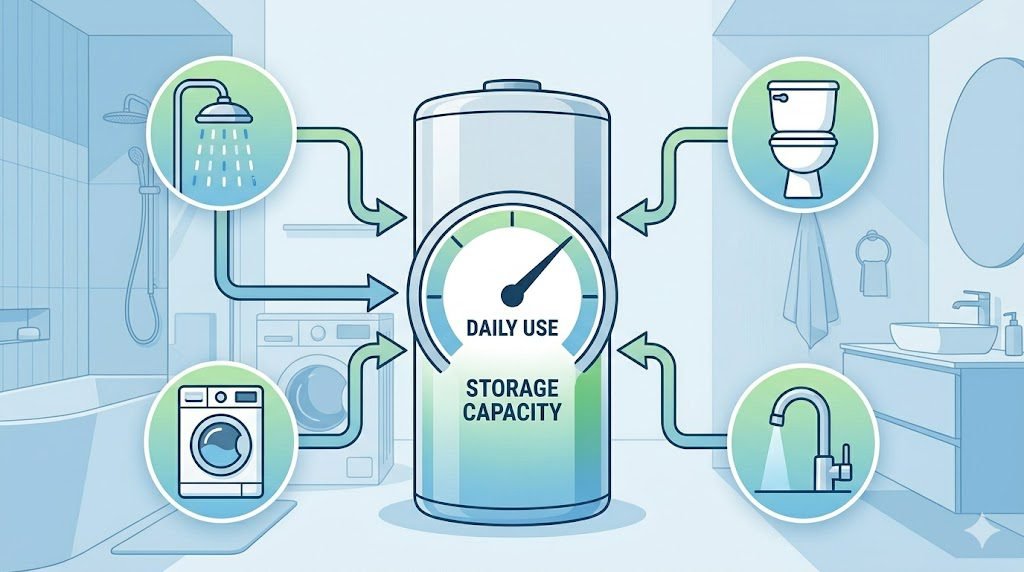
    Daily consumption per person is the key variable. The benchmark figures used in the table above come from IWA (International Water Association) household use studies across urban residential properties. Here is where that 100–150 L/person/day goes:

    ActivityLitres per useDaily total (per person)
    Toilet flushing6–9 L per flush30–45 L
    Shower (5 min, standard head)60–75 L60–75 L
    Shower (5 min, low-flow head)35–40 L35–40 L
    Drinking & cooking5–10 L
    Laundry (shared, 1 load/day)50–80 L per load12–20 L
    Dishwashing (machine)15–20 L per cycle4–7 L
    Hand washing, misc.5–10 L

    A household with standard-efficiency appliances and typical shower habits lands at 120–150 L/person/day. Fitting low-flow showerheads and a water-efficient washing machine drops this to 90–110 L/person/day — a reduction that allows sizing down by 20–25% on the same backup target.

    Worked example: 4 people, 3-day backup, standard appliances

    Daily use: 4 × 140 L = 560 L/day. Target: 3 days. Raw figure: 560 × 3 = 1,680 L. Add 10% buffer: 1,680 × 1.10 = 1,848 L. Round up to the nearest standard size: 2,000 L tank

    Key variables that change the answer

    Supply reliability. This is the single biggest factor. In cities with reliable 24-hour mains supply, a tank sized for 1 day’s buffer is a pressure-head buffer, not emergency storage — 500–800 L is adequate for most households. In areas where supply runs for 4–6 hours per day, you need enough to cover the off-supply window plus a margin — typically 2–3 days. Where tanker deliveries are the only source and arrive weekly or fortnightly, size for the full delivery interval: 7–14 days of storage

    Rooftop vs underground placement. Rooftop tanks are governed by structural load limits. A full 2,000 L tank weighs roughly 2,100 kg — most residential slabs rated for rooftop loads in developing markets are engineered for 200–300 kg/m². On a 2 m × 1.5 m footprint, that’s 400–600 kg maximum — a 500 L tank ceiling without structural assessment. Underground tanks have no such constraint and are the right choice for larger household storage volumes.

    Seasonal demand variation. Hot climates see water use spike 25–40% in summer — more frequent showers, garden irrigation, evaporative coolers. If you’re sizing for a region with hot dry seasons, apply your peak-season consumption figure, not the annual average. A tank sized for average demand runs dry during the months you need it most.

    Household type. Young children (under 10) use 30–40% less water than adults. Elderly residents use less shower water but more frequent toilet flushes. Teenagers and young adults are consistently the highest per-person users. Weighting your household composition against these patterns gives a more accurate daily total than simply multiplying people by a fixed per-person average.

    Common mistakes

    Using the WHO 15 L/person/day survival figure for tank sizing. The WHO’s 15 L/person/day is the humanitarian emergency threshold — drinking and basic sanitation only. It does not include showers, laundry, or dishwashing. Using it to size a residential household tank produces a tank that runs out in days under normal operation. The correct baseline for residential sizing is 100 L minimum; 140–160 L for a typical household.

    Ignoring the supply pattern and sizing by household size alone. A 1,000 L tank serves a family of two with reliable mains and a family of two in a water-scarce region very differently. Without factoring in supply frequency, tank size recommendations are meaningless. Define your worst-case supply gap first, then size.

    Underestimating garden and outdoor use. Garden irrigation, car washing, and outdoor cleaning add 50–150 L/day to a household’s consumption during active months. This frequently pushes per-person consumption above 200 L/day for households with moderate-sized gardens. Exclude it only if your outdoor area is fully paved or you source outdoor water separately.

    Not accounting for tank accessibility for maintenance. Tanks that are never fully drained and cleaned accumulate biofilm and sediment — reducing usable capacity and degrading water quality over 2–5 years. An undersized tank that’s topped up continuously without ever being emptied causes more problems than one correctly sized and periodically cleaned. Factor in a cleaning interval (every 6–12 months) when planning tank size.

    Related calculators you might need

    If you don’t yet know your daily consumption, the daily water requirement calculator walks through each household activity to build a total. Once you’ve settled on a tank size, the how long will my tank last calculator confirms how many days it covers at your consumption rate. For underground or larger tanks, check the total filled weight with the water tank weight calculator before finalising placement. And if your area has treated water supply, the safe water storage duration calculator tells you how long stored water remains safe before requiring retreatment.

    Frequently asked questions

    How do I size a water tank for daily household use?

    Multiply the number of people in your household by litres per person per day (use 140–160 L for a standard household), then multiply by your backup days, and add 10%. For a family of four needing 3 days’ backup: 4 × 150 × 3 × 1.10 = 1,980 L — round to a 2,000 L tank. Use the water tank size for home calculator to refine this for your specific usage pattern.

    What is the minimum water tank size for a household?

    The minimum that makes practical sense is 500–1,000 L for a single person or couple with reliable mains supply — enough to buffer daily supply interruptions. Below 500 L, a tank provides almost no meaningful backup. For a family of four with any supply variability, 2,000 L should be considered the floor, not the target.

    How much water does a household use per day?

    In OECD countries, average residential water use is 100–200 litres per person per day (WHO/OECD data). In urban South Asia and Sub-Saharan Africa, actual delivered supply is often 40–80 L/person/day due to infrastructure limits. Your actual number depends on appliance efficiency, climate, and lifestyle — the per-activity breakdown in the table above will give you a household-specific total.

    How many days should a household tank last?

    Size for your realistic worst-case supply gap, not the average. If your area loses supply for one day twice a week, size for 2–3 days. If tanker deliveries are the only source and arrive every 7–10 days, size for the full interval. A tank that runs dry before the next refill provides no safety margin — add at least 1.5–2 days beyond your expected gap.

    Does a larger tank mean better water pressure?

    Not from volume — pressure in a gravity-fed system depends on the height of the water surface above the outlet, not the tank’s capacity. A 500 L tank at 5 m elevation produces the same pressure as a 5,000 L tank at 5 m elevation. To improve gravity-feed pressure, raise the tank or install a pump booster. Volume and pressure are independent variables.

  • How To Calculate The Volume of a Rectangular Water Tank

    How To Calculate The Volume of a Rectangular Water Tank

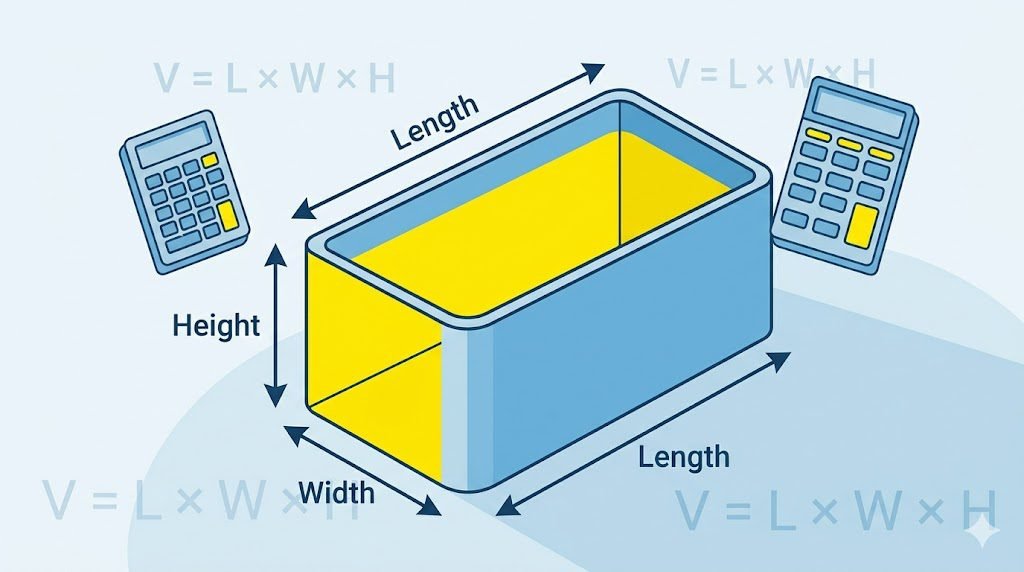
    The volume of a rectangular water tank equals length × width × height, measured in the same unit throughout. The result is in cubic units — multiply by 1,000 to convert cubic metres to litres, or multiply cubic feet by 7.48 to get US gallons. This article covers the formula, unit conversions, partial-fill calculations, and the adjustments needed for tanks with wall thickness or irregular proportions.

    The quick answer

    For a rectangular tank, the calculation has one step:

    Volume = Length × Width × Height

    All three dimensions must be in the same unit before you multiply. Use metres for litres, feet for cubic feet, or inches for cubic inches (then convert). Here are the most common unit conversions:

    Measurement unitVolume resultConvert to litres by
    Metres (m)Cubic metres (m³)× 1,000
    Centimetres (cm)Cubic centimetres (cm³)÷ 1,000
    Feet (ft)Cubic feet (ft³)× 28.317
    Inches (in)Cubic inches (in³)÷ 61.024

    Skip the conversion math: the rectangular water tank volume calculator handles all unit conversions and outputs results in litres, gallons, and cubic metres simultaneously.

    How the calculation works

    The formula treats the interior of the tank as a cuboid. Each dimension — length (L), width (W), height (H) — contributes directly and proportionally to the result. Double the height, you double the volume.

    Worked example: residential rooftop tank

    A concrete rooftop tank is 2.5 m long, 1.5 m wide, and 1.2 m high.

    Volume = 2.5 × 1.5 × 1.2 = 4.5 m³ = 4,500 litres

    At 150 litres per person per day, this serves a household of four for 7.5 days without refill.

    Worked example: US gallon conversion

    A tank measuring 8 ft × 4 ft × 3 ft:

    Volume = 8 × 4 × 3 = 96 ft³ × 7.48 = 718 US gallons (2,718 litres)

    Key variables that change the answer

    Wall thickness. Many concrete and brick tanks have walls 100–200 mm thick. If you measure the external dimensions, you need to subtract wall thickness from each side to get the internal dimensions. For a tank with 150 mm walls: a 2.5 m external length becomes 2.5 − 0.30 = 2.2 m internally. Ignoring this on a brick tank overstates volume by 10–20%.

    Fill level. Tanks are almost never filled to capacity. If you’re calculating usable volume or checking how much water is currently stored, use the actual fill height rather than the tank height. Volume at partial fill = L × W × fill depth.

    Freeboard. Rooftop and open-top tanks are typically filled to 50–100 mm below the rim to prevent overflow and splashing. This effective height reduction of 5–8% on a standard 1.2 m tank reduces usable volume by 40–60 litres — not trivial if you’re sizing tightly.

    Internal fittings. Tanks with inlet baffles, sediment chambers, or structural pillars have obstructions that displace water. Commercial and agricultural tanks sometimes have internal dividers — measure the usable chambers separately and sum them.

    Rectangular vs other tank shapes

    Tank shapeFormulaBest useVolume efficiency
    RectangularL × W × HRooftop, underground, concrete100% space used
    Cylindricalπ × r² × HPolyethylene tanks, silos~79% of bounding box
    Horizontal cylinderπ × r² × LUnderground, transport~79% of bounding box
    Cone-bottomCylinder + 1/3 coneAgriculture, mixingVaries

    Rectangular tanks are the most space-efficient shape — they fill every cubic centimetre of the space they occupy. A cylindrical tank of the same external dimensions holds only 78.5% as much water.

    Common mistakes

    Measuring external instead of internal dimensions. For plastic tanks this barely matters — walls are thin. For concrete, brick, or fibreglass tanks with walls 100–200 mm thick, external measurement overstates volume by 15–25%. Always measure from inside face to inside face.

    Mixing units mid-calculation. Multiplying 2 metres × 150 centimetres × 1,200 millimetres is a common error — the dimensions aren’t in the same unit. Convert everything to one unit first. The most reliable approach: use metres throughout for litres, or centimetres throughout and divide the cm³ result by 1,000.

    Using nominal tank capacity instead of calculating it. Tank manufacturers list nominal capacities that sometimes reflect design intent rather than actual internal volume. A ‘5,000 L’ tank measured physically may hold 4,750 L due to wall thickness, baffles, or manufacturing tolerances. For critical sizing — hospital storage, agricultural irrigation — always calculate from measured dimensions rather than the label.

    Ignoring the dead zone at the bottom. Sediment accumulates at the base of rectangular tanks over time, particularly in concrete tanks supplied by surface water. The bottom 50–100 mm is effectively dead volume. A 2.5 × 1.5 m tank loses 188–375 litres to sediment accumulation — deduct this from usable capacity in your planning.

    Related calculators you might need

    If your tank isn’t a simple rectangle — it has a sloped bottom, a cone section, or it’s cylindrical — the cylindrical tank volume calculator or the cone bottom tank volume calculator will handle the correct geometry. If you’ve calculated litres and need US gallons or imperial gallons for purchasing or regulatory purposes, use the litres to gallons converter. And if you’re installing a rectangular concrete tank on a rooftop, cross-check the filled weight against your slab rating using the water tank weight calculator before pouring or placing.

    Frequently asked questions

    How do I calculate the volume of a rectangular water tank?

    Multiply length × width × height, with all three dimensions in the same unit. If using metres, the result is cubic metres — multiply by 1,000 for litres. Example: a tank 2 m × 1 m × 1.5 m holds 3 m³ or 3,000 litres. Use the rectangular water tank volume calculator for instant results across multiple units simultaneously.

    What is the formula for tank volume in litres?

    Volume (litres) = Length (m) × Width (m) × Height (m) × 1,000. Alternatively, measure in centimetres: Volume (litres) = L (cm) × W (cm) × H (cm) ÷ 1,000. Both produce the same result. For feet and gallons: L (ft) × W (ft) × H (ft) × 7.48 = US gallons.

    How do I calculate how much water is in my rectangular tank?

    Measure the current depth of water in the tank (the fill level, not the tank height). Then: Volume = Length × Width × Fill depth. All measurements in the same unit. If your 2.5 × 1.5 m tank currently has water 0.8 m deep: 2.5 × 1.5 × 0.8 = 3 m³ = 3,000 litres currently stored.

    Does wall thickness affect the calculation?

    Yes, for any tank with walls thicker than 20 mm — concrete, brick, fibreglass, or thick HDPE. Subtract twice the wall thickness from each external dimension to get internal dimensions. A tank with 150 mm walls has 300 mm (0.3 m) deducted from both length and width. Ignoring this on a large concrete tank can overstate volume by hundreds of litres.

    How accurate is the rectangular tank volume formula?

    Mathematically exact for a perfect cuboid with uniform walls. Real-world accuracy depends on how carefully you measure. A 10 mm error in a 1,000 mm dimension is 1% — acceptable. For a 2,500 mm length, a 25 mm measurement error creates a 1% volume error. Measure each dimension at multiple points and use the smallest reading if walls are uneven.

  • How to Calculate the Right Water Tank Size for Your Home

    How to Calculate the Right Water Tank Size for Your Home

    A household of 4 people in an area with daily municipal supply needs a minimum 1,000-litre (264-gallon) overhead tank — but that number can double or triple depending on your supply reliability, climate, and usage habits. This article walks you through the formula, the variables that shift the answer, and the sizing benchmarks used by water engineers globally. By the end, you will know exactly what size tank your home needs and why.

    The Quick Answer

    The standard formula is: Tank Size = Daily Water Consumption × Backup Days × Safety Margin. The WHO recommends a baseline of 50 litres per person per day for basic domestic use (WHO, 2017 Guidelines for Drinking Water Quality). FEMA recommends a minimum of 1 gallon (3.8 litres) per person per day for emergency survival — but that is the floor, not a sizing standard for a home. For normal household use, engineer-recommended minimums sit between 50–200 litres per person per day depending on climate and appliance load.

    Household SizeDaily Use (50L/person)1-Day Tank3-Day Tank
    1–2 people50–100 L100–200 L300–600 L
    3–4 people150–200 L200–400 L600–1,200 L
    5–6 people250–300 L300–600 L900–1,800 L
    7–8 people350–400 L400–800 L1,200–2,400 L
    10+ people500+ L1,000+ L3,000+ L

    Note: These figures use WHO baseline (50L/person/day). Actual use in South Asia, the Middle East, and sub-Saharan Africa often ranges 80–150L/person/day. Australia and the US average 150–300L/person/day (World Bank, 2020).

    ▶  Skip the math: Use the Water Tank Size for Home Calculator to get a number tailored to your situation.

    How the Calculation Works

    The formula:  Tank Capacity (litres) = P × D × B × SF

    Where:

    P = number of people in the household

    D = daily consumption per person (litres)

    B = backup days required (how long supply may be interrupted)

    SF = safety factor (typically 1.2 to 1.3 to account for leakage, sediment, and irregular supply)

    Worked example: Family of 4, warm climate, 2-day backup

    P = 4, D = 120 litres (warm climate, includes toilet flushing, cooking, bathing), B = 2 days, SF = 1.25

    Calculation:  4 × 120 × 2 × 1.25 = 1,200 litres

    This household needs a minimum 1,200-litre tank — a standard size widely available as a polyethylene overhead tank. If supply interruptions in your area extend to 3 days, the same household would need 1,800 litres.

    To calculate your daily water requirement precisely before running this formula, use the Daily Water Requirement Calculator.

    Key Variables That Change the Answer

    1. Supply reliability

    This is the biggest driver. A home with 24-hour mains supply needs only a 1-day buffer — roughly 200–400 litres for a family of 4. A home in Karachi, Lagos, or Chennai where supply arrives for 2–4 hours every 2–3 days needs a 3–5 day buffer, pushing the requirement to 1,500–3,000 litres. If you are on a borehole or tanker delivery, calculate for 7–14 days

    2. Climate and appliance load.

    Hot climates increase personal water consumption by 20–40% through additional bathing and drinking. If your household has a washing machine, dishwasher, or garden irrigation, add 40–60 litres per day per appliance. Air conditioning condensate recovery can offset 5–10 litres/day in humid climates — marginal, but worth noting if you are optimising.

    3. Household type.

    A family of 4 adults uses more than a family with 2 adults and 2 young children. Adults consume 15–30% more water than children under 12 (WHO, 2017). Cooking habits matter — households that prepare meals from scratch use 10–20 litres more per day than those relying on pre-prepared food.

    4. Tank placement — overhead vs underground.

    An underground tank can typically be 2–4x larger than a rooftop tank because it is not constrained by structural load limits. Rooftop tanks are capped by slab capacity — most residential slabs in South Asia support 200–500 kg/m², which limits practical tank size to 1,000–2,000 litres without reinforcement. Underground tanks can go to 10,000 litres or more.

    5. Tank shape and fill efficiency.

    Cylindrical tanks have no dead corners, giving 95–98% usable volume. Rectangular tanks lose 3–8% to sediment accumulation in corners over time. Factor this into sizing — a 1,000-litre rectangular tank realistically delivers 920–970 litres of usable water.

    Sizing by Scenario: What Engineers Recommend

    The table below applies the formula across real-world conditions. All figures use the WHO 50L baseline adjusted for climate and supply reliability, with a 1.25 safety factor.

    ScenarioDaily UseBackup DaysRecommended Tank
    Urban apartment, reliable supply200 L (4 people)1 day300–500 L
    Urban house, intermittent supply (2–3 days)240 L (4 people)3 days900–1,200 L
    Suburban home, daily 4-hr window300 L (4 people)2 days750–1,000 L
    Rural household, tanker delivery weekly280 L (4 people)7 days2,450–3,000 L
    Off-grid property320 L (4 people)14 days5,600–7,000 L
    Small guesthouse (10 guests)1,500 L2 days3,750–4,500 L

    Common Mistakes When Sizing a Home Water Tank

    Sizing for minimum supply, not worst-case supply. Most homeowners calculate for how often supply interruptions normally occur, not for the longest gap they have ever experienced. A Lahore household that typically gets water every 2 days should size for 5 days — not 2 — because summer shortages regularly push that gap past 4 days. Under-sized tanks run dry exactly when water stress is highest.

    Ignoring roof load capacity before buying. A 2,000-litre tank full of water weighs over 2,000 kg. Residential rooftop slabs in older construction often have a load limit of 150–200 kg/m². Installing a tank without checking this is a structural risk. Always check slab capacity before committing to a tank size, especially if the building is more than 20 years old.

    Buying the tank, then buying the wrong pump. A larger tank at height requires more pump head pressure to fill. Homeowners who size up their tank without recalculating pump requirements end up with tanks that take 4–6 hours to fill from a pump rated for the old smaller tank — or that never fill to capacity during short supply windows.

    Treating nominal capacity as usable capacity. A tank labelled 1,000 litres stores 1,000 litres — but 5–10% is typically dead volume below the outlet fitting. For a gravity-fed system, the effective pressure head also drops as the tank empties. Size for 110–120% of your calculated need to ensure you always have usable water even when the tank is at 20% full.

    Related Calculators You Will Need

    Once you have your tank size calculated, structural capacity is the next check. Use the Rooftop Load Bearing Calculator to confirm your slab can hold a full tank before you purchase — a 2,000-litre poly tank weighs roughly 2,050 kg when full, and that load concentrates on the tank’s footprint, not the entire roof.

    If your supply window is short, your tank size is only part of the equation — you also need to confirm the tank fills completely within that window. The Tank Refill Time Calculator tells you exactly how long filling takes given your inlet pipe size and mains pressure.

    For homes that want to cut dependence on mains supply, the Rainwater Harvesting Calculator calculates how much rainwater your roof can realistically collect per year based on your catchment area and local rainfall — useful for sizing a supplementary storage tank.

    If you are deciding between overhead and underground storage, the Underground vs Rooftop Tank Cost Calculator compares the lifetime cost of both options including installation, pump running costs, and maintenance.

    Apartment residents have a different sizing problem — shared risers, limited roof space, and body corporate rules. The Apartment Water Tank Size Calculator handles the specific constraints of multi-storey residential buildings.

    Frequently Asked Questions

    What size water tank do I need for a family of 4?

    A family of 4 using 120 litres per person per day (realistic for warm climates with normal appliance use) needs a 600-litre tank for 1-day backup and a 1,200-litre tank for 2-day backup — applying a 1.25 safety factor. In areas with unreliable supply, size for 3 days minimum, which gives 1,800 litres. Use the Water Tank Size for Home Calculator to enter your specific daily use and backup requirements for a precise figure.

    How long will a 1,000-litre tank last a family of 4?

    At 120 litres per person per day (480 litres/day for 4 people), a 1,000-litre tank lasts approximately 2 days — just over 48 hours. In a heatwave or if guests are present, consumption can spike 20–30%, cutting that to 36–40 hours. The How Long Will My Tank Last Calculator lets you enter your actual daily usage and current tank level for a precise depletion estimate.

    Is 500 litres enough for a house?

    500 litres is adequate only for a 1–2 person household with reliable daily mains supply. For a family of 3 or more, or any location where supply interruptions exceed 12 hours, 500 litres is undersized. It provides roughly 1 day of water for 4 people at minimum usage — no margin for a shower, laundry, or cooking beyond the basics.

    Should the tank be overhead or underground?

    Overhead tanks deliver water by gravity — no pump required for distribution, lower electricity costs, simpler maintenance. Underground tanks allow larger volumes (5,000–20,000 litres) without roof load issues but require a transfer pump to push water upward, adding electricity cost and a failure point. In areas with long supply gaps, the most reliable setup is a combination: underground sump + overhead overhead tank, where a pump fills the overhead tank automatically when the underground sump has water.

    How do I calculate water tank size in litres?

    Multiply people × daily litres per person × backup days × 1.25 safety factor. Example: 5 people × 100 litres × 3 days × 1.25 = 1,875 litres. Round up to the nearest standard tank size — in most markets, standard sizes are 500L, 750L, 1,000L, 1,500L, 2,000L, 2,500L, 3,000L, and 5,000L.

    What is the minimum tank size for a home with no mains supply?

    Off-grid homes should size for a minimum 14-day supply — longer if delivery logistics are difficult. For a family of 4 using 150 litres/person/day, that is 4 × 150 × 14 × 1.25 = 10,500 litres minimum. This typically means one or more underground tanks in the 5,000–10,000 litre range. The Off-Grid Water Storage Calculator accounts for seasonal rainfall variation and consumption fluctuations for a more accurate off-grid sizing.