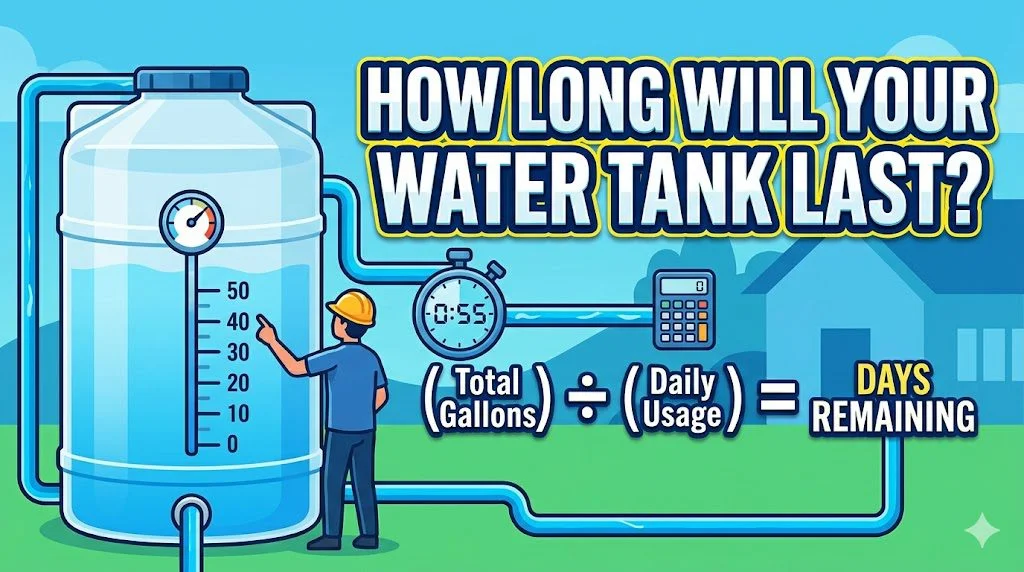
A 500-litre tank used by a household of four consuming 50 litres per person per day will last exactly 2.5 days. That is the entire calculation — tank volume divided by daily consumption. This article breaks down how to get both numbers right, what variables compress or extend your supply, and the mistakes that cause people to run dry earlier than expected.
The Quick Answer
Tank duration (days) = Tank volume (litres) ÷ Daily consumption (litres/day). For most planning purposes, WHO guidance sets minimum survival water needs at 15 litres per person per day; FEMA recommends at least 3.78 litres (1 US gallon) per person per day for short-term emergency storage, though this covers only drinking and basic sanitation.
| Household size | Daily use (litres) | 500 L lasts | 1,000 L lasts | 2,000 L lasts |
| 1 person | 50 L | 10 days | 20 days | 40 days |
| 2 people | 100 L | 5 days | 10 days | 20 days |
| 4 people | 200 L | 2.5 days | 5 days | 10 days |
| 6 people | 300 L | 1.7 days | 3.3 days | 6.7 days |
| Emergency (15 L/person × 4) | 60 L | 8.3 days | 16.7 days | 33.3 days |
Skip the math: Use the How Long Will My Tank Last Calculator to enter your exact tank size and household consumption for an instant result.
How the Calculation Works
Formula: Days of supply = Usable tank volume (L) ÷ Total daily demand (L/day)
Worked example: A family of 5 in a warm climate uses an average of 65 litres per person per day — cooking, bathing, toilet flushing, and laundry. Their tank is a 2,000-litre overhead tank, but the outlet is 50 litres above the tank floor, so usable volume is 1,950 litres.
1,950 ÷ (5 × 65) = 1,950 ÷ 325 = 6 days of supply.
If their municipal supply fails, they have six days before the tank runs dry — assuming no wastage. Add a 20% safety margin (standard practice in building services engineering) and the effective planning duration becomes 4.8 days before they need to act.
Key Variables That Change the Answer
Usable vs total volume. Most tanks have a dead zone at the bottom — sediment, the physical position of the outlet pipe, or a valve installed 50–100 mm above the floor. Subtract this from your nominal capacity. On a 1,000-litre tank, the dead zone can be 30–80 litres depending on design.
Per-capita consumption varies significantly by context. In Australia, average household consumption runs 200–250 litres per person per day (Water Services Association of Australia, 2023). In sub-Saharan Africa, per-capita access can be under 20 litres/day. If you are sizing for backup rather than primary supply, use your actual metered daily consumption, not a regional average.
Seasonal demand shifts. In summer, outdoor watering, cooling, and higher personal hygiene use can push consumption up 30–50% above winter baseline. A tank that lasts 10 days in January may last only 6–7 days in July in a hot climate.
Top-up frequency. If your municipal supply is intermittent — common across South Asia, parts of Africa, and the Middle East — your effective tank duration is not full drain to empty. It is the gap between supply windows. Design your tank size around the longest expected gap, not the average.
Evaporation and leakage. Uncovered tanks in hot climates can lose 1–3% of volume per week to evaporation. A slow float valve leak can waste 20–50 litres per day without being audible. These losses silently reduce your effective duration.
Common Mistakes When Estimating Tank Duration
Using nominal tank volume without subtracting dead space. A tank labelled 1,000 litres delivers 1,000 litres only if the outlet is at the absolute base. In practice, 5–8% is often inaccessible. This matters most with smaller tanks where the error is proportionally larger. If your tank seems to be emptying faster than these numbers suggest it should, our troubleshooting guide on why your water runs out in 2 days covers the likely causes.
Using per-capita averages from the wrong context. Applying a 250-litre Australian average to a household that actually uses 90 litres per person will cause significant overbuilding — and vice versa. Pull your actual water meter reading over two to four weeks, divide by occupants and days. That number is your real input.
Ignoring children and elderly occupants. Caregiving for infants (formula preparation, frequent washing) and elderly individuals can add 20–40 litres per day per dependent beyond base adult consumption. Household composition matters.
Calculating for normal use during an emergency. During supply failures, toilet flushing (which accounts for 25–30% of typical home water use per UK Environment Agency data) often gets reduced or eliminated. Factoring in emergency-mode behaviour can stretch a 5-day tank to 7–8 days without any additional capacity. For US households planning around this specifically, see our guide on emergency water storage and FEMA guidelines.
Related Calculators You Might Need
Once you know how long your current tank lasts, the logical next step is confirming whether that duration is sufficient — or sizing a new tank to meet a specific backup target. The Water Tank Size for Home Calculator lets you work in reverse: enter your household size and required backup days to get a recommended tank volume, and our guide on how to tell if your water tank is the wrong size for your home covers the warning signs. If you are sizing for an emergency scenario specifically, the Emergency Water Storage Calculator applies FEMA and WHO-based minimums to your household. For apartment buildings with multiple units, the Apartment Water Tank Size Calculator handles multi-unit demand stacking. And before committing to a tank volume, check your Daily Water Requirement Calculator to verify your consumption figure is accurate.
Frequently Asked Questions
How long does a 1000-litre water tank last for a family of 4?
At typical South Asian or African consumption of 50 litres per person per day, a 1,000-litre tank lasts 5 days for a family of four. At Australian or UK average consumption of 150–200 litres per person per day, the same tank lasts 1.25–1.67 days. The number is entirely dependent on your actual daily demand — use your water meter to measure it rather than relying on regional averages.
What is the formula to calculate water tank duration?
Duration (days) = Usable tank volume (litres) ÷ Daily household consumption (litres/day). Usable volume is your tank’s total capacity minus the dead zone at the bottom (typically 3–8% of total). Use the How Long Will My Tank Last Calculator to run this automatically with your specific inputs.
Does tank shape affect how long it lasts?
Shape does not change duration directly — only usable volume matters. However, tanks with conical or sloped bottoms have smaller dead zones than flat-bottomed rectangular tanks, so they yield slightly more usable volume per rated capacity. A cone-bottom tank rated at 1,000 litres may give you 960–980 litres of usable water versus 920–950 litres from a flat-bottom design.
How do I account for leaks in my tank duration calculation?
Add a 10–15% wastage buffer to your daily consumption figure. If you suspect a leak, measure the tank level at the same time on two consecutive days when no one is using water (e.g., overnight). Any unexplained drop in litres divided by the number of hours between readings gives you the leak rate. A 20-litre drop measured over an 8-hour overnight period is 2.5 litres per hour, or roughly 60 litres per day of loss — a problem that eliminates the usefulness of any size calculation.
How long can water be stored in a tank before it goes bad?
Treated municipal water stored in a clean, covered tank typically remains safe for 6–12 months under cool, dark conditions. Without treatment, storage life drops to 2–3 days in warm climates. UV exposure, algae, and bacterial growth are the primary risks. The WHO recommends maintaining a free chlorine residual of 0.2–0.5 mg/L in stored water for ongoing safety.

Licensed Professional Engineer (Texas, PE) with 13+ years in residential and light-commercial water storage systems. Reviews and writes the technical guides on this site — sizing, pressure, roof loading, and treatment — based on 180+ completed field projects.