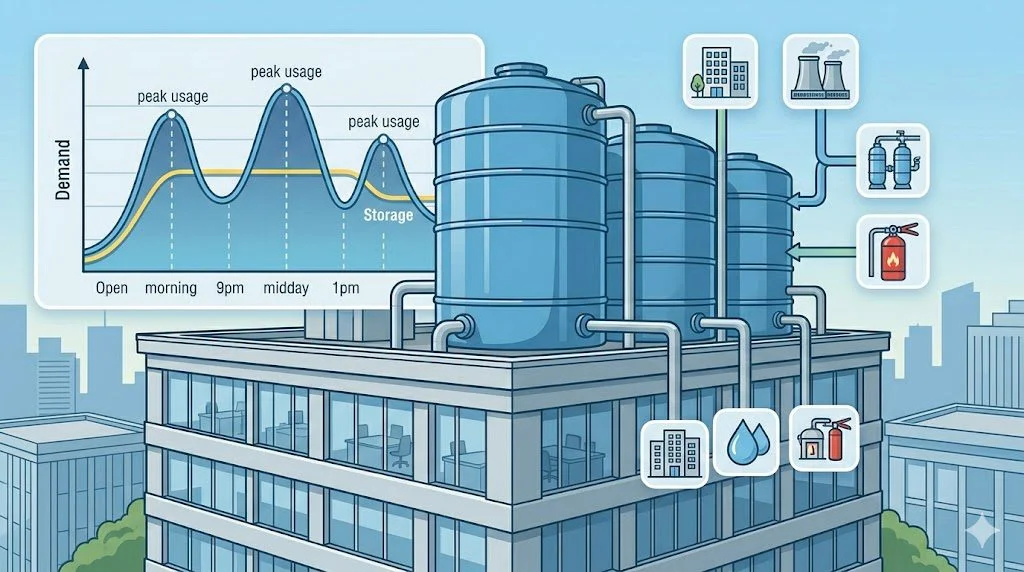
A commercial building’s water tank is sized from three numbers: how many people use the building, how much each one uses in a day for that type of building, and how long the tank must last without a refill. Multiply them together and add 20%. An office with 300 staff, at 45 litres each, covering a 2-day gap needs 300 × 45 × 2 × 1.2 = 32,400 litres.
Floor area does not come into it, and neither does the figure you would use for a house. An office worker uses about a third of what the same person uses at home, while a hospital bed uses three times as much. Fire-fighting water is a separate volume again, set by the fire code and never part of this sum. This guide gives the formula, the per-person figures by building type, four worked examples and the checks to make before ordering.
Quick answer
- Formula: Tank size (L) = Occupants × Litres per occupant per day × Storage days × 1.2
- Typical daily rates: office 45 L per person, hotel 180 L per guest, hospital 340–450 L per bed, day school 45 L per student, restaurant 70 L per seat.
- Storage days: 1 on reliable mains, 2 or more where supply is intermittent.
- Fire water is extra. Get that volume from the fire code or your fire engineer and add it on top.
- Do not oversize. Water that sits too long in a large tank goes stale.
The commercial tank sizing formula
Tank size (litres) = Occupants × Litres per occupant per day × Storage days × 1.2
Then add fire-fighting water separately, if your building needs it.
| Input | What it means | Where to get it |
|---|---|---|
| Occupants | The people, beds or seats that drive water use at the busiest normal time | Headcount, room count, bed count or seating plan (Step 2) |
| Litres per occupant per day | A daily rate for that type of building | A code table, or better, the building’s own meter (Step 1) |
| Storage days | How long the tank must supply the building with nothing coming in | Your supply pattern (Step 3) |
| × 1.2 | A 20% buffer | Covers busy days, growth and the water below the outlet |
Step 1: Find the daily rate for your building type
Daily rates come from building codes, and the codes do not all agree. The most complete public table is in India’s standard for water supply in buildings, and the second column below shows the rounded planning rates used in our calculator. Use the figure from the code that applies where you build.
| Building type | IS 1172 (India), litres per day | Our calculator’s planning rate |
|---|---|---|
| Office | 45 per person | 45 per staff member |
| Hotel | 180 per guest | 200 per guest |
| Hospital, up to 100 beds | 340 per bed, including laundry | 300 per bed |
| Hospital, over 100 beds | 450 per bed, including laundry | 300 per bed |
| Day school | 45 per student | 30 per student |
| Boarding school or hostel | 135 per resident | Not listed |
| Restaurant | 70 per seat | 40 per meal served |
| Factory | 30 per worker, or 45 where bathrooms are provided | 65 per worker |
| Cinema, concert hall, theatre | 15 per seat | Not listed |
| Retail or shopping centre | Not listed | 30 per occupant |
Three points about using a table like this:
- Watch the unit. “Per seat” and “per meal served” are different counts, and so are “per bed” and “per guest”. A 60-seat restaurant that serves 200 meals a day gives two different answers depending on which rate you pick. Use the unit that matches the rate.
- These are design figures, not minimums. For comparison, WHO’s emergency guidance for health facilities is 40–60 litres per inpatient per day and 5 litres per outpatient (WHO technical note). That is a survival floor for a field hospital. A permanent hospital with laundry, kitchens and flush toilets is designed for roughly six to ten times as much.
- A meter beats a table. If the building exists, or a similar one does, take a month of metered use and divide by the days it was open. How to read a water meter shows the method, and the Water Meter Reading Calculator does the arithmetic.
Do not use a household figure. The same standard allows 135 litres or more per person per day in homes, three times the office rate, because people bathe, cook and wash clothes at home. Sizing an office on the household figure gives a tank three times too large.
Step 2: Count the right people
- Offices: the number of staff present on a normal busy day, plus regular visitors. If half the workforce is at home on any given day, the registered headcount overstates demand.
- Hotels: rooms × guests per room at full occupancy. A hotel has to cope with a full house.
- Hospitals: beds, not staff. The per-bed rate already allows for the staff and services each bed needs.
- Schools: enrolled students, plus staff.
- Mixed buildings: work out each part at its own rate and add them. Shops on the ground floor, offices above and flats at the top are three separate sums. For the residential part, use the Apartment Water Tank Size Calculator.
Then add anything the per-person rate does not cover. A staff canteen or hotel restaurant is added at the restaurant rate. Cooling towers, laundries taking outside work, landscape irrigation, vehicle washing and process water are all extra, and each needs its own estimate from the equipment supplier or from meter records.
Step 3: Choose the storage period
| Supply to the building | Storage to plan for | Why |
|---|---|---|
| Continuous mains, rare outages | 1 day | Covers a burst main or a day of repair work |
| Mains for a few hours every day | 1–2 days | One missed window should not close the building |
| Mains on alternate days or irregular | 2–3 days | The normal gap, plus one skipped turn |
| Tanker delivery | Days between deliveries, plus 1–2 | Deliveries run late when demand is highest |
| Hospital or other critical facility | As your health authority requires | Resilience rules are set locally and are stricter than for ordinary buildings |
Where supply is intermittent there is a second test: the tank has to refill inside the supply window. Divide a day’s demand by the minutes of supply to get the inflow you need.
Example: an office uses 13,500 L a day and the mains runs for 4 hours each night. It needs 13,500 ÷ 240 = 56 L/min coming in during that window just to break even. If the connection delivers less, no tank size will keep the building supplied.
Check the inflow with the Tank Refill Time Calculator, and see why a water tank takes so long to refill if it falls short.
Step 4: Add the buffer and split the storage
The × 1.2 adds 20%, which is the default in our calculator. It covers unusually busy days, some growth in occupancy and the water below the outlet that the tank cannot deliver.
At commercial volumes, plan the storage as two tanks or two compartments, not one. Either can then be drained for cleaning or repair while the other keeps the building open. Single large tank vs multiple small tanks covers the trade-offs.
Worked examples
Office, 300 staff, intermittent supply
- Daily demand: 300 × 45 = 13,500 L.
- Two days of storage: 13,500 × 2 = 27,000 L.
- Buffer: 27,000 × 1.2 = 32,400 L.
- Specify: about 35,000 L, as two tanks.
Hotel, 80 rooms with a 60-seat restaurant, reliable supply
- Guests: 80 rooms × 2 = 160 guests at full occupancy. 160 × 180 = 28,800 L.
- Restaurant: 60 seats × 70 = 4,200 L.
- Daily demand: 28,800 + 4,200 = 33,000 L.
- One day with buffer: 33,000 × 1.2 = 39,600 L. Specify 40,000 L.
Hospital, 120 beds
- Daily demand: 120 × 450 = 54,000 L (the over-100-bed rate, including laundry).
- Two days of storage: 54,000 × 2 = 108,000 L.
- Buffer: 108,000 × 1.2 = 129,600 L. Specify 130,000 L, and confirm the storage period with the health authority.
Day school, 500 students
- Daily demand: 500 × 45 = 22,500 L.
- One day with buffer: 22,500 × 1.2 = 27,000 L.
For schools, colleges, hostels and hospitals, the School and Institutional Water Tank Size Calculator has the rates built in.
Office tank size chart
Domestic storage in litres for an office at 45 L per person per day, with the 20% buffer included and fire water excluded.
| Staff | 1 day | 2 days | 3 days |
|---|---|---|---|
| 100 | 5,400 L | 10,800 L | 16,200 L |
| 250 | 13,500 L | 27,000 L | 40,500 L |
| 500 | 27,000 L | 54,000 L | 81,000 L |
| 1,000 | 54,000 L | 108,000 L | 162,000 L |
Fire-fighting water is a separate volume
Nothing in the formula above provides water for fire-fighting. That volume is set by the fire code for your building’s height, use and fire systems, and it has to be available in full at all times. The building’s daily use must never be able to draw it down.
Water-supply standards say this themselves. IS 1172 gives no fire quantity and instead directs the designer elsewhere: “For fire demand in buildings refer IS 9668”. Our calculator leaves fire water out for the same reason. The standards that set it include NFPA 13 and NFPA 22 in the United States, BS EN 12845 in the UK and Europe, AS 2419.1 in Australia and the National Building Code in India.
Get the fire volume from the fire engineer or the fire authority, in writing, before you size anything. It depends on the systems installed, and for a sprinklered building it can be larger than the whole of the daily-use storage. Do not estimate it from a rule of thumb, and do not count it as usable water.
Bigger is not safer: avoid stale water
In a house, an oversized tank wastes a little money. In a commercial building it creates a water-quality problem. Water that sits in a tank for days loses the chlorine it arrived with and warms towards room temperature, and those are the conditions bacteria need. The measure to watch is turnover:
Turnover (days) = Tank volume ÷ Daily demand
The 35,000 L office tank above, at 13,500 L a day, turns over every 2.6 days.
Practical ways to keep stored water fresh:
- Size for the demand you have, not for a worst case that may never come. Add a second tank later if occupancy grows.
- Make the water pass through. UK guidance for storage cisterns puts the outlet on the opposite side from the inlet, so fresh water sweeps across the tank instead of leaving a dead corner.
- Connect twin tanks so both are in use, not one working and one standing.
- Keep tanks cool. The same guidance calls for cisterns to be “sited away from heat sources and insulated”.
- Plan for closures. A school over the summer or an office over a long holiday has full tanks and no demand. Lower the level beforehand or flush the system before reopening.
For treatment, see how chlorination of water tanks works and the Chlorine Dosage Calculator. The Safe Water Storage Duration Calculator gives guidance on how long stored water keeps.
Four checks before you order
1. Where will the weight go?
Water weighs one tonne per 1,000 litres. The 32,400 L office tank is 32 tonnes of water, and the hospital example is 130 tonnes. Volumes like these normally go in a ground-level or basement tank, with a pump lifting water to a much smaller roof tank or straight into the building. Overhead vs underground water tanks explains the arrangement. Anything on the roof needs a structural engineer: start with the Rooftop Load Bearing Calculator and how to size a rooftop water tank for a multi-storey building.
2. Will the top floor have pressure?
A roof tank gives about 0.1 bar for each metre of height, so the top floor always gets the least. If the top-floor washrooms sit only 2 or 3 metres below the tank, they will need a booster pump. How gravity feed water systems work has the figures.
3. Can the pipes meet the peak?
Commercial demand comes in bursts: arrival time, breaks, lunch, the end of the day. A tank with the right volume still fails if the pipes cannot deliver the peak flow. Our calculator shows the average flow while the building is open, which is daily demand divided by operating hours; the peak is higher than that. Check the outlet and riser sizes with the Pipe Size and Flow Rate Calculator, and the pump with the Pump Head Pressure Calculator.
4. Can it be inspected and cleaned?
A tank needs a way in, a way to drain it and room to work. UK guidance asks for “a rigid close fitting and securely fixed lid or cover”, a screen on the overflow with mesh no larger than 0.65 mm to keep insects out, and proper support under the base (Water Regs UK). On inspection intervals, Illinois EPA’s guidance for public water systems is a useful benchmark: a storage tank “should be inspected at least every five years, or more often, depending on local conditions” (Illinois EPA). Commercial buildings often fall under stricter local health rules, so check yours.
Mistakes to avoid
- Sizing from floor area. People use water. Square metres do not.
- Using a household rate for an office. It triples the tank.
- Counting fire water as part of the daily storage, or letting daily use draw on it.
- Mixing up units. Per seat is not per meal, and per bed is not per guest.
- Leaving out the kitchen, laundry or cooling towers. Per-person office and hotel rates do not include them.
- Oversizing “to be safe”. Slow turnover is a water-quality risk.
- Buying one tank. It cannot be cleaned without closing the building’s water supply.
- Checking volume but not refill rate. Where supply is intermittent, the inflow decides whether the tank ever fills.
More calculators and guides
- Water Tank Weight Calculator: the full weight of any tank.
- Water Tank Cost Calculator: budget figures by material and size.
- Plastic vs steel vs concrete water tanks and polyethylene vs fibreglass water tanks: choosing the material for large storage.
- How to calculate the right water tank size for your home: the household version of this method.
Frequently asked questions
How do I calculate the water tank size for a commercial building?
Multiply the number of occupants by the daily rate for the building type, then by the days of storage, then by 1.2. For 300 office staff at 45 L each and 2 days of storage: 300 × 45 × 2 × 1.2 = 32,400 L. Add fire-fighting water separately if the fire code requires it.
How much water does an office use per person per day?
India’s IS 1172 uses 45 litres per person per day for offices, and that is the planning rate in our calculator. It covers toilets, hand washing and drinking water. A canteen, showers or cooling towers are extra. Other codes use different figures, so check the one that applies to your project.
Does a commercial water tank need to include fire storage?
Many commercial buildings must store water for fire-fighting, but it is a separate volume from the daily-use storage and is set by the fire code, not by a water-use formula. Ask the fire engineer or the fire authority for the figure, and make sure daily use cannot draw it down.
How many days of water storage does a commercial building need?
Enough to cover the longest normal gap in supply. That is about 1 day on reliable mains and 2 to 3 days where supply is intermittent. Hospitals and other critical buildings follow their health authority’s resilience rules. More is not better: storage beyond what the building uses in a few days sits and goes stale.
How much water does a hotel need per room?
Work it out per guest. IS 1172 allows 180 litres per guest per day, so a room with two guests needs 360 L. An 80-room hotel at full occupancy needs 28,800 L a day for guests, plus the restaurant at 70 L per seat and any laundry or pool.
Should a commercial building have one tank or two?
Two, or one tank with two compartments. Tanks have to be drained for cleaning and repair, and a building with a single tank has no water while that happens. Connect the pair so water flows through both in normal use.
What causes water to stagnate in a commercial tank?
Too much storage for the demand. Divide the tank volume by the daily use to get the turnover in days. Oversized tanks, low occupancy, holiday closures and a second tank that is never drawn from all leave water standing. Size to real demand, arrange the inlet and outlet so water passes through the whole tank, and flush after any long closure. If stored water already smells or tastes wrong, see why water tastes or smells bad after storage.
Sources
- Bureau of Indian Standards, IS 1172:1993, Code of Basic Requirements for Water Supply, Drainage and Sanitation. Table 1: water requirements for buildings other than residences. Clause 5.2.1: fire demand referred to IS 9668.
- World Health Organization, Minimum water quantity needed for domestic uses, technical note for emergencies. Health centres: 5 litres per outpatient and 40–60 litres per inpatient per day.
- Water Regs UK, Cold water storage cisterns (February 2024). Lid, overflow screen, insulation, support, and outlet opposite the inlet.
- Illinois EPA, Storage Tanks. Inspection at least every five years.

Licensed Professional Engineer (Texas, PE) with 13+ years in residential and light-commercial water storage systems. Reviews and writes the technical guides on this site — sizing, pressure, roof loading, and treatment — based on 180+ completed field projects.