Author: admin

  • How Pump Head Works and Why It Matters for Water Tanks

    How Pump Head Works and Why It Matters for Water Tanks

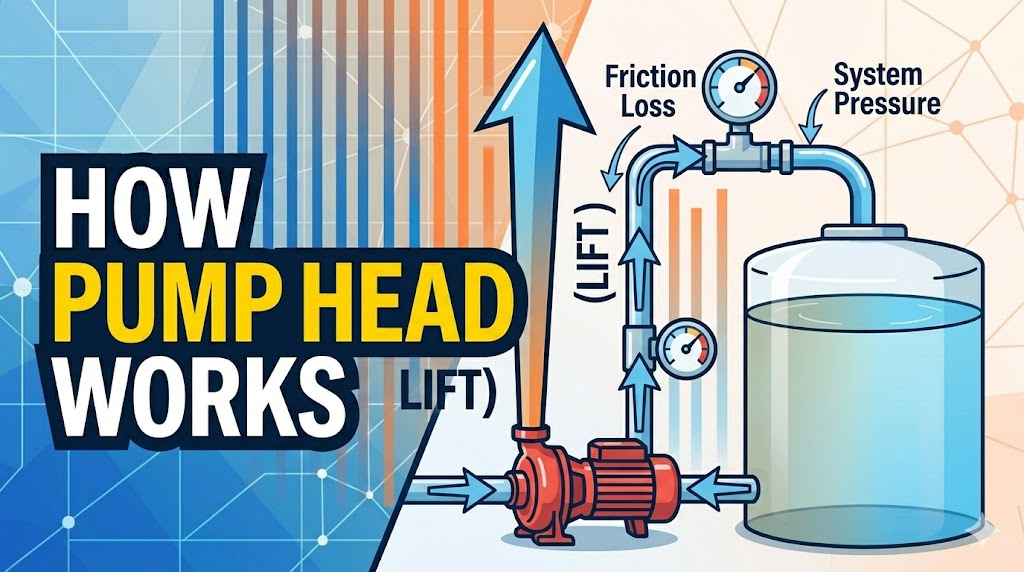
    Pump head is the total height, expressed in metres of water, that a pump can raise water against gravity and system resistance. It determines whether a pump can move water from a borehole to a rooftop tank, from a storage tank up a hill, or through a long pipe run with significant friction. Selecting a pump based on flow rate alone — without checking head — is the most common cause of pump failure to perform in water tank installations. A pump rated at 50 metres of head can lift water to 50 metres of elevation at near-zero flow, but delivers its rated flow at a lower effective head. Understanding this relationship is essential for correct pump selection.

    The quick answer

    Total Dynamic Head (TDH) is the sum of three components: static head (vertical lift), friction head (pipe resistance), and pressure head (required outlet pressure converted to metres of water).

    TDH = Static head + Friction head + Pressure head

    ComponentDefinitionTypical value
    Static headVertical lift from pump to delivery point5–40 m for most installations
    Friction headResistance of pipes, fittings, valves10–30% of static head
    Pressure headRequired outlet pressure (1 bar = 10.2 m)5–15 m for residential fixtures

    Use the pump head pressure calculator to calculate TDH for your specific installation, including pipe sizing, elevation change, and outlet pressure requirements.

    How the calculation works

    Worked example: A pump at ground level filling a rooftop tank on a 3-storey building, with the tank inlet 10 metres above grade. The pipe run is 25 metres of 25mm pipe with 4 elbows. Required delivery pressure is 0.5 bar.

    Static head: 10 m

    Friction head from pipe: Using Darcy-Weisbach, 25mm pipe at 15 L/min flow generates approximately 0.8 m friction per 10 m of pipe. For 25 m: 2.0 m. Each 90° elbow adds ~0.6 m equivalent. Four elbows: 2.4 m. Total friction head: 4.4 m

    Pressure head: 0.5 bar × 10.2 = 5.1 m

    TDH = 10 + 4.4 + 5.1 = 19.5 m

    A pump rated to 25 m head at 15 L/min would handle this comfortably. A pump rated to only 15 m head would fail to deliver adequate flow — not because of motor power alone, but because it cannot overcome the total resistance. The pump curve (head vs. flow rate graph provided by manufacturers) shows exactly how much flow the pump delivers at 19.5 m head.

    Understanding the pump curve

    Every centrifugal pump has a characteristic performance curve that shows how head and flow interact. At zero flow, the pump achieves its maximum head (shut-off head). As flow increases, achievable head decreases. The intersection of the pump curve with the system curve — which represents TDH at various flow rates — is the operating point.

    A pump operating to the right of its best efficiency point (BEP) on the curve is working harder than designed, heating up, and wearing faster. A pump operating far to the left is deadheading or near deadheading, generating heat without useful work. Correctly calculating TDH ensures the operating point falls within 80–110% of the BEP flow rate

    For installations that vary in demand — such as a farm tank that fills at night during low demand and delivers during high-demand irrigation — the system curve shifts. Using the pump horsepower and flow rate calculator helps verify that the motor is appropriately sized for both conditions.

    Key variables that change total dynamic head

    Pipe diameter. Friction head scales approximately with the square of velocity in the pipe. Doubling pipe diameter from 20mm to 40mm reduces velocity by a factor of 4, cutting friction head by approximately 16 times. For long pipe runs, upsizing the pipe is almost always cheaper than buying a higher-head pump. As a rule: for runs over 30 metres, increase pipe diameter by one standard size above the minimum.

    Number of fittings. Elbows, tees, gate valves, and check valves all add equivalent pipe length. A check valve (non-return valve) required for most pump installations adds 5–10 metres of equivalent pipe length depending on the valve type. Ball valves are low-resistance (0.3–0.5 m equivalent); globe valves and angle valves are high-resistance (10–20 m equivalent). Account for every fitting in the calculation.

    Suction lift. Centrifugal pumps have a maximum practical suction lift of around 7–8 metres under ideal conditions (atmospheric pressure minus vapour pressure of water). In practice, due to leaks, turbulence, and elevation of the installation site, 5–6 metres is the reliable limit. Exceeding this causes cavitation — a rapid implosion of vapour bubbles that erodes impellers and casings. Always install submersible pumps for borehole depths greater than 6 metres.

    Elevation above sea level. Atmospheric pressure decreases at altitude, reducing the net positive suction head available (NPSHA). At 1,500 m above sea level, effective suction lift drops to approximately 4.5 metres. At 3,000 m, it falls to around 3 metres. This matters for installations in highland agricultural regions and mountain communities.

    Common mistakes

    Selecting a pump based on flow rate alone. A pump delivering 30 L/min at 5 m head cannot deliver 30 L/min at 20 m head — it delivers less, sometimes drastically less depending on the pump curve. Always cross-reference the flow requirement with the TDH on the manufacturer’s pump curve. Buy the combination, not either variable in isolation.

    Ignoring friction in short pipe runs. Installers routinely assume friction head is negligible for short runs. A 10-metre run of 20mm pipe at 20 L/min generates approximately 4 metres of friction head — equivalent to lifting water an extra 4 metres. At 30 L/min in the same pipe, friction head exceeds 8 metres. In tight-budget pump selections, this unaccounted loss causes the pump to underperform from day one.

    Using flow rate at max head as the selection criterion. Manufacturer specifications often show maximum head and maximum flow separately. These are not simultaneously achievable — they are the two endpoints of the performance curve. The maximum flow occurs at zero head; maximum head occurs at zero flow. Select based on the specific combination of head and flow your system demands.

    Not accounting for future expansion. A pump selected to exactly meet current TDH and flow leaves no margin for expansion — adding a second building, extending the pipe run, or adding more fixtures. Size the pump for 120–130% of current TDH to allow for system growth and age-related efficiency decline.

    Related calculators you might need

    The water pressure calculator converts between pressure units and head so you can work consistently in metres of water throughout the TDH calculation. If you are designing a gravity-fed system and comparing it to a pumped system, the gravity feed flow rate calculator shows how much flow a tank at a given height can deliver without a pump. For sizing the pipe diameter in the pump delivery line, the pipe size and flow rate calculator gives the friction loss per metre for any pipe diameter and flow rate combination. Once the pump is selected and installed, the tank refill time calculator confirms how long it will take to fill the storage tank at the actual delivered flow rate.

    Frequently asked questions

    What does pump head mean in simple terms? Pump head is how high a pump can push water, measured in metres. A pump with 20 m of head can raise water 20 metres against gravity with no flow. In a real installation, the effective head available for lift is reduced by pipe friction and required outlet pressure. Total dynamic head (TDH) is the true measure of what a pump must overcome — and the number to match against the pump’s performance curve.

    How do I calculate total dynamic head for my pump? Add three components: (1) static head — the vertical height from the pump inlet to the delivery point; (2) friction head — calculated from pipe diameter, length, and fittings using a friction loss table or formula; (3) pressure head — the required outlet pressure converted to metres (1 bar = 10.2 m). Use the pump head pressure calculator for a step-by-step calculation without manual arithmetic.

    What happens if my pump head is too low? If TDH exceeds the pump’s capacity at the required flow rate, the pump will deliver less flow than needed — or none at all if TDH exceeds shut-off head. The pump will run continuously, heat up, and eventually fail. Common symptoms include the pump running without water reaching the tank, the tank filling slowly and only partially, or pressure cuts out during high-demand periods.

    Is more pump head always better? Not necessarily. Over-specifying head means the pump operates far to the left of its best efficiency point — delivering low flow at unnecessarily high energy consumption. This also puts mechanical stress on the pump and may cause pipe pressure to exceed fitting ratings. Match pump head to TDH within a 15–20% margin, rather than buying the highest-head pump in the range.

    Can I use a submersible pump to fill a rooftop tank? Yes — submersible pumps are commonly used in boreholes and underground cisterns to deliver water to elevated tanks. The head rating must account for the full depth of submergence plus the height of the rooftop tank above grade. A borehole 20 m deep feeding a tank 10 m above grade requires a pump rated to at least 30 m static head, plus friction and pressure head.

  • What Is Hydrostatic Pressure and How Does It Affect Tank Design?

    What Is Hydrostatic Pressure and How Does It Affect Tank Design?

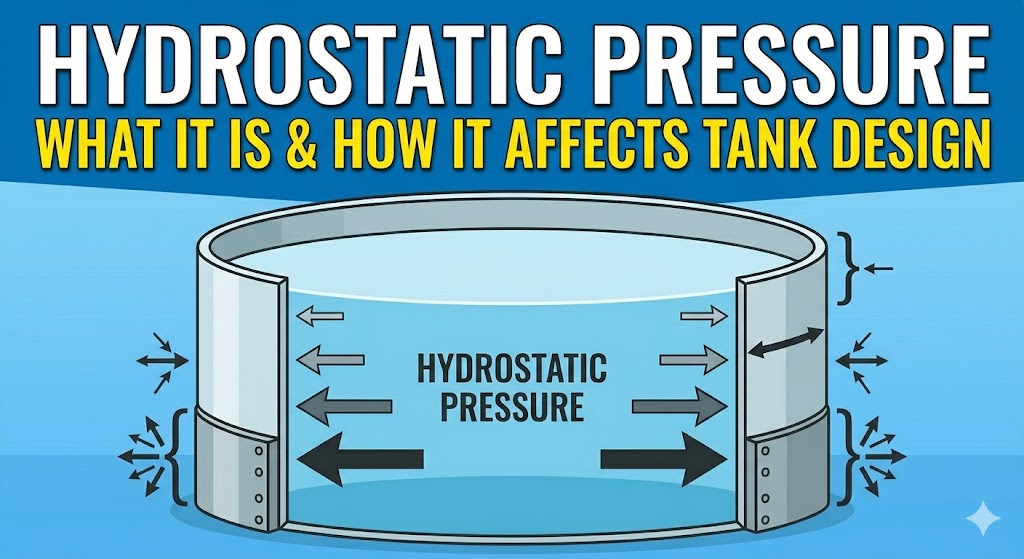
    Hydrostatic pressure is the pressure exerted by a stationary fluid on any surface it contacts, caused by the weight of the fluid above that surface. In a water tank, hydrostatic pressure acts on the tank walls and floor — and it increases with depth. At the base of a tank filled to 2 metres, the pressure is roughly 19.6 kPa (0.196 bar or 2.84 psi), regardless of the tank’s width, shape, or total volume.

    Use the hydrostatic pressure calculator to find the exact pressure at any depth in your tank — useful for checking whether fittings, outlets, and wall panels are rated for the load they will experience when the tank is full.

    The Physics: How Hydrostatic Pressure Is Calculated

    The formula is: P = ρ × g × h, where P is pressure in Pascals, ρ (rho) is fluid density (1,000 kg/m³ for fresh water), g is gravitational acceleration (9.81 m/s²), and h is the depth below the water surface in metres. This simplifies to 9,810 Pa per metre of depth, or approximately 9.81 kPa/m (0.098 bar/m, 1.42 psi/m).

    Critically, hydrostatic pressure depends only on depth — not on the volume of water above. A 10,000 litre tank filled to 2 metres exerts exactly the same pressure at its base as a 100 litre tank filled to 2 metres. This is why tall, narrow tanks present more structural challenge per unit volume than wide, shallow tanks at the same capacity.

    Hydrostatic Pressure at Different Tank Depths

    Water Depth (m)Pressure at Base (kPa)Pressure at Base (bar)Pressure at Base (psi)
    0.54.90.0490.71
    1.09.80.0981.42
    1.514.70.1472.13
    2.019.60.1962.84
    2.524.50.2453.55
    3.029.40.2944.27
    4.039.20.3925.69
    5.049.10.4917.12

    How Hydrostatic Pressure Determines Tank Wall Design

    Tank walls do not experience uniform pressure. The pressure is zero at the water surface and maximum at the base. This means the lower sections of a tank wall bear the greatest structural load, and this is where failures most commonly occur in under-engineered tanks.

    Plastic tanks (polyethylene, fibreglass) are moulded to handle the hydrostatic pressure at their rated capacity. They must be installed on a level, fully supporting surface — any point load concentration (a rock, an uneven pad) effectively adds localised stress to a wall already under hydrostatic load. A plastic tank on a poorly prepared surface can fail at well below its rated capacity.

    Concrete tanks are naturally strong in compression but weak in tension. Hydrostatic pressure creates tensile hoop stress in cylindrical concrete tank walls — the outward push of the water column tries to split the cylinder apart. This is why concrete water tanks require steel reinforcement: the rebar handles tensile forces that concrete alone cannot resist.

    Steel tanks (corrugated, bolted panel, welded) rely on wall thickness and rib geometry to resist hydrostatic pressure. Corrugated galvanised iron tanks use the corrugation profile to add bending resistance. Bolted panel tanks distribute load through the panel-to-panel connections, which are the critical failure points — any gap in sealing or loosening of bolts under hydrostatic load results in seepage.

    Underground Tanks: External Hydrostatic Pressure

    For underground tanks, the hydrostatic pressure concern reverses. External groundwater pressure pushes inward against the tank walls, trying to collapse or float the structure. An empty or partially filled underground tank in a high water table area experiences net inward pressure — the buoyancy of the tank structure working against the weight of water inside. Concrete underground tanks are routinely over-engineered to handle this scenario. Plastic underground tanks require a specific minimum water fill level to prevent flotation and inward collapse. Use the underground tank volume calculator when sizing buried installations.

    Hydrostatic Pressure and Outlet/Fitting Selection

    Every outlet, valve, bulkhead fitting, and pipe penetration in a tank wall must be rated for the hydrostatic pressure at the depth it is installed. A fitting at the base of a 2.5 m tall tank is under 24.5 kPa of continuous pressure. Fittings rated for a lower pressure will fail — not immediately, but through slow seepage that worsens over time. For pressurised pipework downstream of an elevated tank, use the water pressure calculator to confirm the pressure at any point in the system.

    The rule of thumb is to use fittings with a pressure rating at least twice the maximum hydrostatic pressure at installation depth — providing a safety factor that accounts for water hammer, temperature cycling, and material degradation over the tank’s service life.

    Common Mistakes

    Mistake 1: Confusing hydrostatic pressure with water supply pressure. Hydrostatic pressure in a tank is the structural load on the walls. Water supply pressure at a tap connected to an elevated tank is the gravitational head pressure — a separate calculation. A tank sitting 3 m above a tap delivers roughly 0.29 bar at the tap; the same tank’s base wall is under 0.20 bar of hydrostatic load if filled to 2 m. These are different values serving different design purposes.

    Mistake 2: Installing a plastic tank on an unprepared surface. Plastic tanks under full hydrostatic load require 100% uniform base support. Gravel, bare earth with stones, or a cracked concrete pad all create point loading that concentrates stress at specific wall locations. Manufacturers specify a compacted sand pad or smooth concrete slab for this reason. Installing on uneven ground voids warranty and risks wall failure at much lower fill levels than the tank’s rating.

    Mistake 3: Using standard irrigation fittings for base-level tank outlets. Standard poly irrigation fittings are often rated to 6 bar — more than enough for the hydrostatic pressure in any household tank. However, the bulkhead seal and thread engagement must also be appropriate for continuous immersion. Fittings designed for drip irrigation lines are not designed for permanent pressurised contact with standing water and will weep over time.

    Mistake 4: Ignoring hydrostatic load when cutting inspection hatches or additional outlets into existing tanks. Cutting any opening into a tank wall removes material that was contributing to structural integrity. Any new penetration creates a stress concentration point. On high tanks (over 2 m fill depth), reinforcement or a flanged fitting is mandatory around new penetrations to restore wall strength. This applies to both plastic and concrete tanks.

    Related Calculators You Might Need

    If you are using an elevated tank for gravity-fed supply, the water column pressure calculator converts your tank height directly to supply pressure at any point downstream. For understanding how pressure builds in a pump-and-tank system, the pump head pressure calculator accounts for both static head and friction losses. If your tank is rooftop-mounted, the weight of a full tank is a separate structural concern from hydrostatic pressure — the water tank weight calculator gives total loaded weight, and the rooftop load bearing calculator checks whether the structure can support it.

    Frequently Asked Questions

    Does a bigger tank mean more hydrostatic pressure on the walls?

    Not necessarily. Hydrostatic pressure depends on water depth, not volume. A 10,000 litre tank filled to 1.5 m generates less base pressure (14.7 kPa) than a 500 litre tank filled to 2 m (19.6 kPa). What changes with volume is the total force on the tank wall — the same pressure acting over a larger surface area creates a larger total load. This is why very wide large-capacity tanks require thicker walls or more structural ribbing even if fill depth is modest.

    What is the hydrostatic pressure at the bottom of a 1,000 litre tank?

    It depends on the tank’s height, not its volume. A 1,000 litre cylindrical tank might be 0.9 m tall or 1.5 m tall depending on its diameter. At 0.9 m fill depth, base pressure is approximately 8.8 kPa (0.088 bar). At 1.5 m fill depth, it is 14.7 kPa (0.147 bar). Check your tank’s dimensions and use the hydrostatic pressure calculator to get the exact figure for your installation.

    Can hydrostatic pressure crack a concrete tank?

    Yes, if the tank is under-reinforced or if the concrete has cured poorly. Hydrostatic pressure generates hoop tension in cylindrical walls — concrete has very low tensile strength (roughly 10% of its compressive strength). Without adequate steel reinforcement, tensile cracking is the expected failure mode. Cracks allow water to reach the reinforcement, which then corrodes and expands, causing spalling and progressive structural failure. This is why concrete tanks require inspection every 5 to 10 years.

    Does hydrostatic pressure change if the water is moving?

    When water flows, static pressure converts partly to velocity (dynamic) pressure — total energy is conserved but distributed differently. In a moving flow, static pressure at any point is lower than when the water is stationary. For tank wall design purposes, the worst case is the tank full and water stationary — which gives maximum hydrostatic pressure. Systems are always designed for this static condition.

    How do I know if my tank is rated for the hydrostatic pressure it will experience?

    Reputable tank manufacturers publish a maximum fill height or working pressure rating. If a plastic tank is rated for 2.0 m fill depth and you are considering extending a standpipe above the tank to increase gravity pressure, you are operating outside the design envelope. For any non-standard installation, contact the manufacturer directly and get written confirmation of the rated operating pressure, including any safety margin.

  • What Is Water Tank Runoff Coefficient and How Is It Calculated?

    What Is Water Tank Runoff Coefficient and How Is It Calculated?

    The runoff coefficient is the fraction of rainfall that actually reaches your tank after accounting for losses from absorption, evaporation, splashing, and wetting of the catchment surface. It is expressed as a decimal between 0 and 1: a coefficient of 0.85 means 85% of the rain that falls on your roof ends up as collectible water. The remaining 15% is lost.

    Every rainwater harvesting calculation depends on this number. Apply it using the annual rainwater collection calculator, which incorporates roof area, local rainfall, and runoff coefficient to give you a realistic annual yield figure.

    The Calculation: How Runoff Coefficient Is Applied

    The core formula is: Collectible volume = Rainfall depth × Catchment area × Runoff coefficient. For metric units: if 50 mm of rain falls on a 100 m² roof with a coefficient of 0.85, the collectible volume is 0.050 m × 100 m² × 0.85 = 4.25 m³ (4,250 litres). Without the coefficient, you would overestimate yield by 15%, leading to a tank that runs out more often than modelled.

    The coefficient is not a fixed property of the roof material alone — it varies with rainfall intensity, roof condition, antecedent dryness, and slope. A light drizzle on a dry tile roof loses more to initial wetting and evaporation than a heavy downpour on the same roof. Long-run average coefficients, used for annual yield calculations, account for this variation across all event types.

    Runoff Coefficients by Roof Material

    Roof MaterialTypical Runoff CoefficientNotes
    Metal roofing (Colorbond, Zincalume, tin)0.90 – 0.95Best performer; minimal absorption
    Glazed ceramic tiles0.85 – 0.90Good; some absorption at joints
    Concrete tiles0.75 – 0.85Absorbs water when dry; lower initial coefficient
    Fibreglass / polycarbonate0.90 – 0.95Similar to metal
    Painted or sealed concrete0.70 – 0.80Depends on surface condition and age
    Asphalt shingles0.70 – 0.80Absorbs and leaches more than metal
    Green / living roof0.10 – 0.30High absorption by growing medium
    Gravel-topped flat roof0.40 – 0.60High losses to absorption and evaporation

    These ranges reflect long-run average performance. For a conservative tank sizing calculation — where you want to avoid running out — use the lower bound of the coefficient range for your roof material. For estimating maximum potential yield, use the upper bound.

    Other Factors That Adjust the Coefficient

    Roof slope: Steeper roofs shed water faster, reducing evaporation time during and after rain. A roof pitched at 30° or more performs closer to the upper end of its material coefficient range. Flat roofs (under 5° slope) retain water longer and experience more evaporation, shifting performance toward the lower end.

    Roof condition and age: Cracked, porous, or moss-covered roofing absorbs substantially more water than the same material in good condition. A 20-year-old concrete tile roof may perform 10 to 15 percentage points below a new one. Lichen and moss on any roof surface can reduce effective coefficient by 0.05 to 0.15.

    First-flush losses: If your system includes a first-flush diverter, the volume diverted reduces effective yield and is sometimes incorporated into an adjusted runoff coefficient. For a system diverting 4 litres per event across 80 annual events, that is 320 litres of annual loss — subtract this from gross yield when sizing storage.

    Gutter and downpipe losses: Water remaining in gutters after rain, overflow from gutters during high-intensity events, and evaporation from hot metal gutters between events all reduce effective yield. A system efficiency factor of 0.85 to 0.90 is applied on top of the roof coefficient in some Australian standards to account for these distribution losses.

    Worked Example: Sizing a Tank Using Runoff Coefficient

    A homeowner in a semi-arid region has a 120 m² metal roof (coefficient 0.90) and 450 mm average annual rainfall. Annual collectible volume = 0.450 m × 120 m² × 0.90 = 48.6 m³ (48,600 litres). Applying a 0.87 system efficiency factor for gutter losses gives approximately 42,300 litres of usable annual yield.

    This figure feeds directly into tank sizing — the rainwater harvesting calculator matches this yield against household demand and seasonal rainfall distribution to give a minimum tank size that avoids running dry.

    Common Mistakes

    Mistake 1: Using a coefficient of 1.0 (or ignoring it entirely) for metal roofs. Even the best metal roofing loses 5 to 10% to wetting, evaporation, and splashback. Assuming 100% collection consistently overestimates yield, leading to a tank that runs dry more often than planned. Use 0.90 to 0.95 as the realistic range for metal roofing.

    Mistake 2: Using the same coefficient year-round in climates with marked wet and dry seasons. In a dry season, the roof surface is hotter and drier — initial wetting losses and evaporation rates are higher for every event. An annual average coefficient of 0.80 may mask a dry-season effective coefficient of 0.65 and a wet-season coefficient of 0.88. If you are sizing storage for dry-season survival, use dry-season figures for that calculation.

    Mistake 3: Applying the coefficient to the building footprint rather than the effective catchment area. The catchment area is the horizontal projection of the roof, not its surface area. A steeply pitched roof covers more surface than footprint, but rainfall is measured vertically. The roof catchment area calculator converts roof dimensions to correct horizontal catchment area.

    Mistake 4: Applying a textbook coefficient to a roof that has not been inspected. A roof listed as concrete tiles gets the concrete tile coefficient in most calculations, but if it is covered in moss and has cracked or missing tiles, actual performance may be 20 points below the standard figure. Inspect the roof surface before using any coefficient value in a sizing calculation.

    Related Calculators You Might Need

    Once you have your runoff coefficient and roof area, the annual rainwater collection calculator is the natural next step — it applies your coefficient to local rainfall data to give an annual yield. From yield, the rainwater harvesting calculator sizes the storage tank to your demand profile. If your system includes a first-flush diverter and you want to factor its volume loss into yield, the first flush diverter size calculator gives the diverter capacity, which you can then subtract from gross yield. Finally, the rainwater savings calculator translates your adjusted yield into annual cost savings against mains supply.

    Frequently Asked Questions

    What runoff coefficient should I use for my roof?

    Start with the material type from the table above, then adjust for slope, age, and condition. For a clean metal roof at moderate pitch, 0.90 is a reliable working figure. For concrete tiles in average condition, 0.80. If you are unsure of your roof’s condition, use the lower end of the range for that material — it produces a conservative (safer) tank size estimate.

    Does the runoff coefficient change with rainfall intensity?

    Yes. During heavy rainfall (over 25 mm/hr), coefficients approach the upper limit of the range — there is little time for evaporation and surface absorption is overwhelmed by volume. During light rain (under 5 mm/hr), initial wetting losses are proportionally larger, and coefficients drop toward the lower end. Annual yield calculations using average annual rainfall implicitly blend these events, making the long-run average coefficient the appropriate value for sizing.

    How do I measure my actual runoff coefficient?

    The simplest method is empirical: know your roof area precisely, measure rainfall with a gauge, measure how much actually enters the tank, and divide tank inflow by (rainfall × roof area). Do this over 10 or more events across different rainfall intensities and average the results. This gives a site-specific coefficient that accounts for your specific roof, gutters, and downpipes — far more accurate than any table value.

    Does roof colour affect the runoff coefficient?

    Colour affects surface temperature, not porosity. A dark roof in full sun evaporates water faster during and immediately after light rain events — this can reduce the effective coefficient by 0.02 to 0.05 compared to a light-coloured roof of the same material. For heavy rainfall events, the effect is negligible. In hot climates where light drizzle events are common, colour is worth accounting for; in cool or high-rainfall climates, it is not a meaningful factor.

    Can I increase my runoff coefficient?

    The primary levers are roof material and condition. Replacing cracked concrete tiles with metal roofing increases the effective coefficient by 0.10 to 0.20. Cleaning moss, lichen, and debris from any roof improves performance noticeably. Improving gutter capacity to prevent overflow during high-intensity events also retains water that would otherwise be lost. None of these changes affect how the roof catchment area calculator computes your catchment size, but they directly increase the yield that coefficient delivers.

  • What Is TDS in Water and Why Does It Matter for Storage?

    What Is TDS in Water and Why Does It Matter for Storage?

    Total Dissolved Solids (TDS) is the combined concentration of all inorganic and organic substances dissolved in water — measured in milligrams per litre (mg/L) or parts per million (ppm), where 1 mg/L = 1 ppm. It includes calcium, magnesium, sodium, potassium, carbonates, chlorides, sulfates, and trace amounts of metals and organics. TDS does not measure bacteria or suspended particles — it specifically captures what is chemically dissolved and invisible to the naked eye.

    Use the TDS water calculator to assess your stored water quality against WHO and national drinking standards.

    What TDS Levels Mean in Practice

    TDS Level (ppm)ClassificationTaste ProfileSuitable For
    < 50Very lowFlat, blandNot recommended for prolonged drinking
    50–150LowClean, slightly blandDrinking, cooking, RO permeate
    150–300AcceptableNeutral to pleasantIdeal for drinking
    300–600ModerateSlightly mineralAcceptable for drinking
    600–900HighNoticeably mineralMarginal for drinking; taste complaints common
    900–1,200Very highSalty or metallicNot recommended for drinking
    > 1,200UnsafeStrongly salineUnsuitable for human consumption

    The WHO guideline for drinking water is 600 ppm, though palatability typically declines above 300 ppm. Most national standards cap acceptable TDS between 500 and 1,000 ppm. India’s BIS standard sets 500 ppm as desirable and 2,000 ppm as the maximum permissible limit. The US EPA sets a secondary standard of 500 ppm (non-enforceable, taste-based).

    Why TDS Changes During Tank Storage

    Water sitting in a tank does not stay chemically static. Several mechanisms alter TDS over time. First, evaporation from open or poorly sealed tanks removes pure water vapour but leaves dissolved solids behind — concentrating TDS in the remaining water. In hot climates with high evaporation rates, a tank losing 5% of its volume to evaporation will see TDS rise by approximately 5%.

    Second, concrete and metal tanks leach minerals into stored water. Freshly cured concrete tanks add calcium hydroxide and other alkalis, which raises TDS and pH simultaneously. Corroding iron or galvanised steel tanks contribute iron and zinc ions. Plastic tanks are largely inert but can leach additives if they are low-grade or degraded by UV exposure.

    Third, biological activity in improperly treated or uncovered tanks produces metabolic by-products that contribute to organic TDS. Algae and biofilm formation can raise TDS measurably in warm, light-exposed storage.

    If you are treating stored water with chlorine, the residual chlorine reacts with organic matter to produce disinfection by-products — adding to TDS. Use the chlorine dosage calculator to dose accurately and avoid over-chlorination.

    TDS and Storage Safety: What the Number Does Not Tell You

    TDS is a proxy measure, not a safety guarantee. Low TDS water is not automatically safe — pathogens, pesticides, and industrial contaminants may be present at dangerous levels while TDS reads below 100 ppm. Conversely, high-TDS water from a mineral-rich aquifer may be microbiologically safe but taste unpleasant and cause scaling in appliances.

    TDS testing should always be paired with pH testing and, where there is any doubt about the source, microbiological testing. The water pH adjustment calculator helps correct pH imbalances that often accompany abnormal TDS readings.

    For long-term tank storage, TDS alone cannot confirm water is safe to drink after several weeks. Combine TDS measurement with a residual chlorine check and a visual inspection for sediment, colour change, or odour.

    TDS Thresholds for Specific Uses

    ApplicationMaximum TDS (ppm)Notes
    Drinking water (WHO)600Taste acceptable up to ~300 ppm
    Baby formula preparation< 100Low mineral content required
    Aquarium (freshwater)< 500Species-dependent
    Hydroponics / irrigation< 1,500Depends on crop type
    Livestock (cattle)< 3,000Short-term tolerance higher
    Reverse osmosis membrane< 2,000 feedHigher TDS accelerates membrane fouling
    Boiler/hot water system< 200Scaling risk above this level

    Common Mistakes

    Mistake 1: Treating TDS as a pass/fail safety test. A TDS reading of 250 ppm tells you the total dissolved load but nothing about what is dissolved. Arsenic contamination, nitrates, and E. coli are invisible to a TDS meter. Use TDS as a screening tool and first-line quality indicator, not as a definitive safety assessment.

    Mistake 2: Ignoring TDS rise in sealed tanks during extended storage. Even sealed tanks concentrate dissolved solids slowly over weeks due to minor evaporation through vents and leaching from tank materials. Water stored longer than 30 days should be re-tested. The safe water storage duration calculator estimates how long treated water remains safe under your conditions.

    Mistake 3: Interpreting very low TDS (under 50 ppm) as superior quality. RO-purified or distilled water with near-zero TDS is demineralised. Prolonged consumption of very low-TDS water leaches minerals from body tissue over time and can be mildly corrosive to metal plumbing. The WHO recommends a minimum of 100 ppm for regular drinking water.

    Mistake 4: Testing TDS once and assuming it stays constant. TDS changes with season, supply source variation, tank condition, and treatment. Test at minimum quarterly for stored water, and after any change to the supply source or tank.

    Related Calculators You Might Need

    TDS is one part of a broader water quality picture. If your TDS is elevated due to water hardness, the water hardness calculator will tell you whether scaling is a risk for your appliances and pipes. If the storage itself is the source of contamination, the water tank disinfection calculator guides you through a cleaning protocol. For water that requires UV treatment rather than chemical dosing, the UV disinfection tank calculator sizes the system correctly for your flow rate. And if you are purchasing a filtration unit to reduce TDS, confirm it can handle your demand with the water filter flow rate calculator.

    Frequently Asked Questions

    What is a good TDS level for drinking water?

    Between 150 and 300 ppm is considered ideal for drinking water — enough minerals for taste and health, below the threshold where most people notice off-flavours. Water in the 300 to 600 ppm range is acceptable but may taste noticeably mineral. Above 600 ppm, WHO considers the water outside its palatability guideline. Below 50 ppm is demineralised and not recommended for regular long-term consumption.

    Can high TDS make you sick?

    High TDS alone is not acutely toxic for most people. The health concern depends entirely on what is causing the high reading. Elevated TDS from calcium and magnesium is generally harmless. TDS elevated by nitrates, arsenic, heavy metals, or industrial contaminants is a direct health hazard at much lower concentrations. A TDS meter cannot distinguish between these — laboratory analysis is needed to identify specific ions.

    How do I reduce TDS in my storage tank?

    The only effective method is to treat or replace the water. Reverse osmosis reduces TDS by 90 to 98%. Distillation removes nearly all dissolved solids. Ion exchange softeners reduce hardness-related TDS. Boiling does not reduce TDS — it concentrates it by driving off pure water as steam. If TDS is rising due to tank leaching, the tank surface needs cleaning or lining.

    Does chlorination affect TDS?

    Yes. Adding chlorine or bleach to water introduces sodium, chloride ions, and disinfection by-products — all of which raise TDS slightly. A standard shock dose for tank disinfection typically adds 5 to 15 ppm to TDS, which is negligible for most applications. Accurate dosing matters: the bleach to water ratio calculator prevents over-dosing that would unnecessarily spike TDS and create off-flavours.

    Why does my TDS reading spike after heavy rainfall fills the tank?

    Roof runoff carries atmospheric dust, bird droppings, leaf decomposition products, and surface contaminants — all of which dissolve in the collected water and raise TDS. First-flush events (the first few minutes of rainfall) carry the highest contamination load. A first-flush diverter removes the most contaminated initial runoff before it reaches the tank, protecting baseline TDS. After major rain events, re-test TDS before using the stored water for drinking.

  • How Chlorination of Water Tanks Actually Works

    How Chlorination of Water Tanks Actually Works

    Chlorination kills or inactivates bacteria, viruses, and protozoa by oxidising their cell membranes and disrupting metabolic processes. For stored water, the effective dose is 2–5 mg/L of free chlorine (also expressed as 2–5 ppm), held in contact for a minimum of 30 minutes before the water is used. The key variables — tank volume, initial contamination level, pH, and water temperature — all affect how much chlorine you need and whether a residual remains after treatment. This article explains the chemistry, the dose calculation, and the practical steps for disinfecting a storage tank.

    The quick answer

    To disinfect a tank, you need to know its volume and whether you are doing routine maintenance or treating a contaminated tank. WHO guidelines recommend 0.5 mg/L free chlorine residual after 30 minutes of contact time for routine disinfection. For a contaminated or newly installed tank, dose to achieve 2 mg/L residual after contact.

    ScenarioTarget residualSodium hypochlorite (5%)Contact time
    Routine maintenance0.5 mg/L10 mL per 1,000 L30 min
    Post-contamination shock2 mg/L40 mL per 1,000 L30–60 min
    Algae or heavy turbidity5 mg/L100 mL per 1,000 L60 min minimum

    Use the chlorine dosage calculator to compute the exact amount of chlorine product required for your tank volume and target residual.

    How the calculation works

    The dose formula is: Chlorine product volume = (Tank volume in litres × Target dose in mg/L) ÷ (Product concentration × 10,000). For a 5,000-litre tank dosed to 2 mg/L using 5% sodium hypochlorite (household bleach):

    Volume = (5,000 × 2) ÷ (5 × 10,000) = 10,000 ÷ 50,000 = 0.2 litres = 200 mL

    This is the amount of bleach to add, not the amount of active chlorine. Bleach concentration varies by brand — always check the label. Granular calcium hypochlorite (65–70% available chlorine) requires a very different quantity: for the same scenario, approximately 15 grams for a 5,000-litre tank at 2 mg/L. The bleach to water ratio calculator handles both liquid and granular forms.

    The chemistry of chlorine disinfection

    When sodium hypochlorite (NaOCl) dissolves in water, it produces hypochlorous acid (HOCl) and hypochlorite ion (OCl-). HOCl is the active disinfecting species — it is approximately 80 times more effective than OCl-. The ratio between the two depends on pH. At pH 7.5, roughly 50% of free chlorine is in the HOCl form. At pH 8.5, only about 10% is HOCl — meaning at high pH you need significantly more chlorine to achieve the same kill rate (EPA Guidance Manual for Compliance, 1999).

    Temperature also matters. Chlorine reacts faster at higher temperatures but dissipates more quickly. At 25°C, a well-dosed tank may lose half its free chlorine residual within 48–72 hours through oxidation of organic matter, UV degradation (in uncovered tanks), and off-gassing. An enclosed, dark tank at moderate temperature retains residual for considerably longer. The safe water storage duration calculator models this decay based on your storage conditions.

    Key variables that change the required dose

    Water pH. As described above, high pH (above 8.0) dramatically reduces chlorine effectiveness. If your source water is alkaline — common with borehole or hard water supplies — test pH before chlorinating and consider acidifying to pH 6.5–7.5 with citric acid or CO₂ injection before adding chlorine. Use the water pH adjustment calculator to determine the adjustment dose.

    Turbidity and organic load. Chlorine reacts with organic matter — soil particles, algae, biofilm — to form disinfection by-products (DBPs) and is consumed in the process without providing any disinfection. WHO recommends water be clarified to below 1 NTU before chlorination. A visibly turbid tank may consume 5–10 mg/L of chlorine just in DBP formation before any residual remains. Always settle and filter heavily turbid water before chlorinating.

    Tank condition and biofilm. A tank that has never been cleaned accumulates biofilm — a bacterial community embedded in a protective polysaccharide matrix. Chlorine at normal doses does not penetrate mature biofilm effectively. Tanks must be drained, physically scrubbed, and rinsed before chemical disinfection. Shock chlorination alone of a fouled tank produces a false sense of safety.

    Chlorine product age and storage. Liquid bleach degrades at roughly 20% per month at room temperature. A bottle stored for 6 months at 30°C may have lost 50–60% of its stated concentration. Always check the manufacture date and factor in degradation — or use fresh product. Granular calcium hypochlorite is more stable if kept dry and sealed, retaining potency for 2–5 years.

    Common mistakes

    Dosing by tank size alone without accounting for concentration. Adding “one capful” of bleach to a 10,000-litre tank based on a rough estimate delivers an unknown dose. Calculate using the exact product concentration and target residual. Under-dosing leaves pathogens alive. Over-dosing (above 5 mg/L free chlorine) creates taste and odour problems and may form excessive trihalomethanes.

    Not testing for residual after contact time. The dose calculation gives you the starting concentration, not the end result. Chlorine demand — the amount consumed by organic matter and reactions in the water — reduces the residual. After 30 minutes, test with a DPD test kit or strip to confirm at least 0.2 mg/L free chlorine remains. If residual is zero, re-dose and wait. If it never holds residual, the tank requires physical cleaning first.

    Chlorinating without isolating the tank. If the supply line feeds directly into the distribution system, chlorinating the tank without isolation will push high-chlorine water into pipes serving sinks and appliances. Isolate the tank outlet valve before dosing. Only reconnect after testing confirms the residual has dropped to below 0.5 mg/L — or flush the tank before reconnecting.

    Ignoring pH when treating borehole water. Borehole water commonly has pH 7.8–8.5 and high hardness. At these pH levels, chlorination is inefficient — you may dose correctly and still leave viable pathogens because HOCl is too low a fraction of the free chlorine. Test and correct pH before dosing. This single step is the most commonly skipped in rural and peri-urban settings.

    Related calculators you might need

    If you are treating a contaminated tank, start with the water tank disinfection calculator, which walks through the full disinfection sequence including drain-down, rinsing, and re-dosing phases. For tanks where biofilm or iron bacteria are the problem, the potassium permanganate dosage calculator provides an alternative oxidative treatment. If you need to assess your water’s overall quality before deciding on a treatment approach, the TDS water calculator gives a baseline reading of dissolved solids. For long-term water quality monitoring, the water hardness calculator helps assess scaling risk that affects chlorine contact efficiency in pipes and fittings.

    Frequently asked questions

    How much bleach do I add to a 1,000-litre water tank? For routine disinfection using 5% sodium hypochlorite (household bleach), add approximately 10 mL (two teaspoons) per 1,000 litres. For shock disinfection after contamination, use 40 mL per 1,000 litres. Wait 30 minutes, then test with a chlorine test strip to confirm a residual of at least 0.2 mg/L before use. Adjust if your bleach concentration differs — check the label.

    How long does chlorine last in a water tank? In a covered, dark, well-maintained tank with low organic load, a 0.5 mg/L residual typically falls below detectable levels within 3–5 days at 25°C. In an open or algae-affected tank, this may happen within hours. WHO recommends re-testing residual every 24–48 hours for stored drinking water and re-dosing if it drops below 0.2 mg/L. Use the safe water storage duration calculator to estimate based on your conditions.

    Is it safe to drink water after chlorinating a tank? Yes, provided the free chlorine residual is between 0.2 and 0.5 mg/L at the point of consumption (WHO Guidelines for Drinking-water Quality, 2022). Above 5 mg/L, the water should not be consumed without dilution or further treatment. Always test with a DPD kit or test strip before resuming use. If residual exceeds 1 mg/L after contact time, flush the tank until it drops to an acceptable level.

    Why does my chlorinated tank still smell bad? Persistent odour in a chlorinated tank usually indicates chloramines — compounds formed when chlorine reacts with ammonia or organic nitrogen. Chloramines are a sign of under-treatment (not enough chlorine to complete oxidation) or high organic load in the water. The fix is to shock-dose to breakpoint chlorination — typically 7–10 mg/L — which fully oxidises the nitrogen compounds. After breakpoint, the odour disappears and free chlorine residual is restored.

    Can I use swimming pool chlorine for drinking water tank treatment? Only if it is pure calcium hypochlorite without stabilisers. Many pool products contain cyanuric acid (a stabiliser) which is not approved for drinking water use. Look for food-grade or NSF-certified calcium hypochlorite at 65–70% available chlorine. Trichlor and dichlor tablets used in pools are not suitable for potable water treatment.

  • How to Size a Farm Water Tank for Irrigation Season

    How to Size a Farm Water Tank for Irrigation Season

    A farm irrigation tank needs to hold enough water to bridge the gap between your source (bore, river, rain, mains) and your peak daily crop demand — typically across the hottest, driest stretch of the season when source flow drops and crop stress peaks simultaneously. The minimum tank size equals peak daily demand × buffer days, where buffer days is determined by your source reliability, not personal preference. This article covers the FAO-based calculation method, crop-specific benchmarks, and the sizing errors that cause tanks to run dry during critical growth windows.

    The Quick Answer

    The core formula is:

    Tank size (L or m³) = irrigated area (ha) × crop water need (mm/day) × 10,000 × buffer days × 1.15

    Where 10,000 converts mm/ha to litres/ha (1 mm of water over 1 hectare = 10,000 L), and 1.15 adds a 15% safety margin for distribution losses and pump inefficiency.

    Crop typePeak water need (mm/day)1 ha, 3-day buffer (L)5 ha, 3-day buffer
    Maize (corn)6–8207,000–276,000 L~1.4 ML
    Wheat4–6138,000–207,000 L~900 KL
    Tomato (field)5–7172,500–241,500 L~1.2 ML
    Pasture / fodder grass5–9172,500–310,500 L~1.5 ML
    Tree fruits (orchard)3–5103,500–172,500 L~750 KL

    Use the farm water storage calculator to enter your crop type, irrigated area, and source reliability for a precise tank size recommendation.

    How the calculation works

    Crop water need (also called ETc — crop evapotranspiration) is derived from the FAO Penman-Monteith method (FAO Irrigation and Drainage Paper No. 56). It accounts for reference evapotranspiration (ETo) — a climate-driven baseline — multiplied by a crop coefficient (Kc) that varies by growth stage.

    ETc (mm/day) = ETo × Kc

    During peak growing season in a semi-arid climate, ETo runs 6–10 mm/day. Kc for maize at mid-season is 1.20 (FAO), giving a peak ETc of 7.2–12 mm/day. For wheat at mid-season, Kc is 1.15.

    Worked example: 3 ha of tomatoes, 3-day buffer, semi-arid region

    Peak ETc for tomatoes: 6 mm/day (conservative estimate).

    Daily demand: 3 ha × 6 mm × 10,000 = 180,000 L/day

    3-day buffer: 180,000 × 3 = 540,000 L

    15% safety margin: 540,000 × 1.15 = 621,000 L (621 m³). This requires either one large above-ground bladder tank or a concrete/earthen storage pond of that capacity.

    Key variables that change the answer

    Source refill rate vs demand rate. If your bore pumps 5 L/second and your peak demand is 4 L/second, you may not need buffer storage at all — the bore keeps pace. If your bore pumps 2 L/second but demand peaks at 5 L/second, you need buffer storage equal to the deficit × peak hours. A bore pumping 10 hours per day at 2 L/s delivers 72,000 L/day — if your crop demands 120,000 L/day, you need to buffer 48,000 L minimum, plus supply gap coverage.

    Irrigation method efficiency. Drip irrigation delivers water directly to the root zone with 85–95% application efficiency. Sprinklers run 70–80%. Surface flooding runs 40–60%. A switch from flood to drip on the same crop area reduces water demand — and therefore tank size — by 35–55%. The buffer days required also drop because less water is lost to evaporation between the tank and the root zone.

    Soil water holding capacity. Clay-heavy soils hold 150–200 mm of plant-available water per metre of depth. Sandy soils hold 50–80 mm/m. A deep clay soil acts as a natural buffer — crops can draw from stored soil moisture for 3–5 days without irrigation before stress onset. Sandy soils have almost no buffer — daily irrigation is required. Soil type directly affects how many buffer days your tank must cover.

    Seasonal rainfall during irrigation season. If your irrigation season overlaps with partial rainfall — common in Mediterranean or monsoon-adjacent climates — effective rainfall reduces net irrigation requirement. FAO’s CROPWAT method accounts for effective rainfall (typically 70–80% of actual rainfall is plant-available). A 20 mm rainfall event on 3 ha = 600,000 L, replacing approximately 3 days of irrigation demand in a moderate-use crop.

    Irrigation system and tank sizing scenarios

    Farm typeAreaMethodBuffer daysMin tank
    Market garden0.5 haDrip3 days90–130 KL
    Arable crop farm10 haSprinkler3 days1.5–2.5 ML
    Orchard (tree fruit)5 haDrip5 days750 KL–1.2 ML
    Dairy farm (pasture)20 haFlood/spray3 days3–6 ML

    Common mistakes

    Sizing to average ETc rather than peak ETc. Average crop water need across a full growing season is 20–40% lower than peak mid-season demand. A tank sized for average demand runs dry during the 4–6 weeks of peak demand when crop stress causes the most economic damage. Always size to peak ETc — typically mid-season for most crops — not the season average.

    Not accounting for pump flow rate vs tank draw rate. A common error: the farmer calculates daily crop demand correctly but chooses a pump sized for average flow rather than peak demand. If the irrigation system draws 8 L/s for 6 hours per day but the bore pump delivers 3 L/s continuously, the tank must absorb the deficit (5 L/s × 6 hours = 108,000 L buffer minimum). Undersizing here means the tank empties before the irrigation run completes.

    Treating the tank as a season-long reserve rather than a daily buffer. Farm irrigation tanks are not intended to store an entire season’s water requirement — that volume is impractical to store. The tank’s job is to smooth out the mismatch between source availability (often time-of-use restricted or flow-rate limited) and daily crop demand peaks. Size for 3–7 days of peak daily demand, not the full irrigation season.

    Ignoring evaporation losses from open storage. Open concrete ponds and earthen dams lose 5–15 mm/day to evaporation in hot, dry conditions (equivalent to 50–150 m³/ha/day). A 500,000 L earth tank in a hot semi-arid climate can lose 30,000–60,000 L per day to evaporation alone. Covered poly tanks or sealed concrete eliminates this loss. When comparing tank types, factor evaporation into the effective storage capacity.

    Related calculators you might need

    The irrigation water requirement calculator takes your crop type, climate zone, and irrigated area to output daily and seasonal water needs without manual ETc calculations. If you’re using drip irrigation, the drip irrigation tank size calculator accounts for the application efficiency of drip systems specifically. For farms also running livestock, the livestock water requirement calculator produces the daily drinking and management water needed per animal type — combine this with your irrigation figure for total farm storage. And if you’re choosing between a bore pump and a gravity-fed tank system, the irrigation pump size calculator tells you the pump specification needed to meet your peak demand.

    Frequently asked questions

    How do I size a farm water tank for irrigation?

    Multiply your irrigated area in hectares by your crop’s peak water need in mm/day by 10,000 to get litres per day. Multiply that by your buffer days (3–7 for most farms) and add 15% for losses. Example: 2 ha of tomatoes at 6 mm/day peak = 120,000 L/day × 3 days × 1.15 = 414,000 L minimum. Use the farm water storage calculator to model your specific crop and source conditions.

    What size water tank do I need for 1 hectare of irrigation?

    At a mid-range crop water need of 6 mm/day, 1 hectare requires 60,000 litres per day. For a 3-day buffer with 15% losses, that is 60,000 × 3 × 1.15 = 207,000 L (207 m³). High-demand crops like maize in peak summer can push this to 300,000+ L for the same area and buffer period. Low-demand crops like orchards may require only 120,000–150,000 L.

    How many days of irrigation water should I store?

    Size for your realistic source gap — the longest period your source cannot deliver at full rate. For bore-fed farms with reliable bores: 2–3 days. For surface water systems subject to seasonal low flow: 5–7 days. For farms relying on water deliveries or seasonal rainfall collection: size to span the full expected dry interval. Never size for less than 2 days regardless of source type — equipment failures always occur at peak demand.

    What is the difference between crop water need and irrigation water requirement?

    Crop water need (ETc) is the water a crop demands from all sources — rain, soil moisture, and irrigation combined. Irrigation water requirement (IWR) is ETc minus effective rainfall and soil moisture contribution. IWR is always less than or equal to ETc. In dry seasons with no rainfall, IWR = ETc. In wet seasons, IWR can be near zero. Tank sizing should use IWR during the irrigation season, not ETc, to avoid oversizing.

    Can I use a rainwater harvesting system to fill a farm irrigation tank?

    Yes, where catchment area and rainfall are adequate. A farm shed roof of 500 m² with 600 mm annual rainfall captures approximately 270,000 L per year (at 90% efficiency). Whether that meets irrigation demand depends entirely on when rain falls vs when crops need water. In most agricultural regions, peak irrigation demand coincides with the dry season — meaning rainwater harvesting supplements rather than replaces irrigation storage. Size the tank to the irrigation need, not the catchment capacity.

  • 1000L vs 2000L vs 5000L Water Tank: Which Size is Right?

    1000L vs 2000L vs 5000L Water Tank: Which Size is Right?

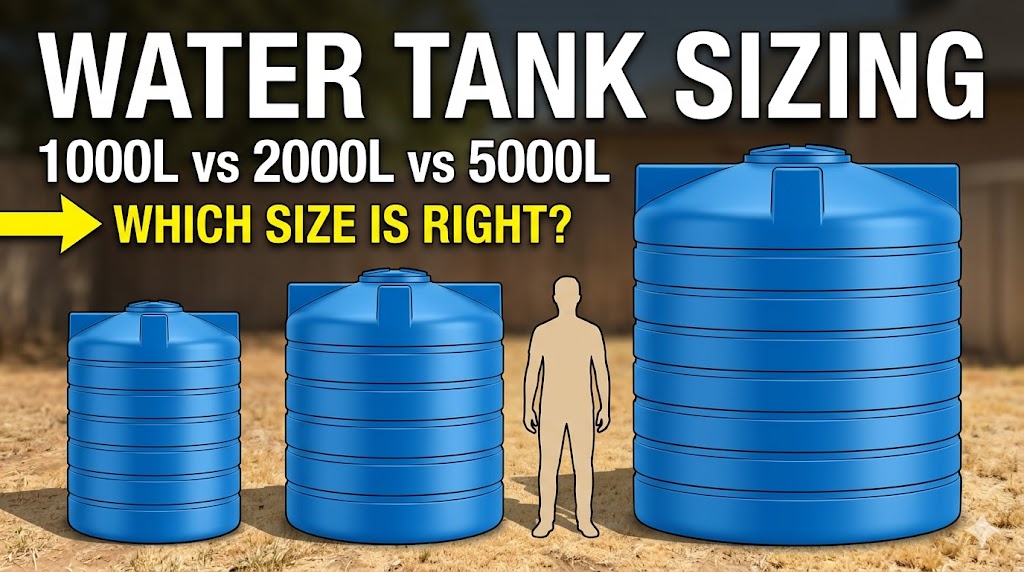
    A 2,000-litre tank is the right starting point for a household of 3–4 people with a reasonably reliable municipal supply. A 1,000-litre tank only works for 1–2 people or as a secondary top-up tank. A 5,000-litre tank is correct when supply is intermittent, the household is large, or irrigation is involved. This article gives you the formula to confirm the right size for your actual usage, supply pattern, and site constraints.

    The quick answer

    Tank sizing comes down to three numbers: daily consumption, how many backup days you need, and what you can physically fit on the site. Use the Water Tank Size for Home Calculator to get a number tailored to your household size, climate, and supply reliability.

    Household / Use CaseDaily use (L)Backup daysRecommended size
    1–2 people, city supply100–150 L7 days1,000 L
    3–4 people, city supply200–300 L7 days2,000 L
    3–4 people, intermittent supply200–300 L14 days5,000 L
    5–6 people, city supply300–450 L7 days3,000–5,000 L
    5–6 people, rural/borehole300–450 L21 days5,000–10,000 L
    Small farm or livestock (<20 head)500–1,000 L7 days5,000 L

    Daily use figures are based on WHO guidelines (50–100 L/person/day for basic use, up to 150 L in high-income households). Backup days assume one supply interruption per week at the stated duration.

    How the calculation works

    The formula is straightforward: Tank size = Daily household consumption (L) × Backup days required.

    Every variable matters. Here is a worked example:

    Household: 4 people. Average daily use: 250 L (62.5 L/person, mid-range WHO figure for basic needs). Supply reliability: city mains, 10-day worst-case outage. Tank size = 250 × 10 = 2,500 L. Round up to 3,000 L for a safety margin, or 2,000 L if you are confident outages rarely exceed 7 days.

    If you are adding irrigation or livestock, calculate those demands separately and add to the household figure before sizing. A vegetable garden of 50 m² uses 3–5 L/m²/day in hot climates — that adds 150–250 L/day to the calculation. Use the Daily Water Requirement Calculator to model combined household and garden demand.

    Key variables that change the answer

    Supply reliability. This is the single biggest variable. In cities with 24/7 mains pressure, a 7-day backup (the most common outage scenario in South Asian urban centres) drives the tank size. In rural areas or regions with scheduled outages — parts of sub-Saharan Africa, Pakistan, India — 14–21 day buffers are standard. Doubling the backup period doubles the required tank size.

    Household size. Per-person water use does not scale linearly. A single person in a large house uses more water than a per-head average suggests — shared facilities change the maths. Per-capita use typically drops from 120–150 L/person for 1–2 person households to 80–100 L/person for households of 5+.

    Climate and season. In arid climates, a household of 4 uses 20–30% more water during summer months due to increased showering, garden watering, and evaporative cooling. Size for peak-season demand, not annual average. A tank sized on annual averages will run dry for 3 months of every year.

    Rooftop vs ground installation. A filled 5,000-litre tank weighs 5,025 kg. Most residential reinforced concrete roof slabs in South Asia are rated for 150–200 kg/m². A 5,000-litre tank requires a 25–33 m² load distribution or a purpose-built concrete plinth — it cannot sit on a typical residential roof. The 2,000-litre tank at 2,020 kg filled requires careful load distribution. The 1,000-litre tank at 1,015 kg filled is the only one that routinely clears standard residential roof loading without engineering input.

    Spec1,000 L2,000 L5,000 L
    Typical footprint (HDPE)1.0 m dia.1.3–1.4 m dia.1.8–2.0 m dia.
    Height (vertical HDPE)1.4 m1.7 m2.5 m
    Filled weight1,015 kg2,020 kg5,025 kg
    Typical rooftop fit?Yes (most slabs)Verify loadNo — ground only
    Price range (HDPE)$50–$150$120–$280$280–$600
    Price range (steel)$180–$350$300–$550$700–$1,400

    Common mistakes

    Sizing for average demand instead of peak demand. Average daily use across the year is not the number to use. A family of 4 that uses 250 L/day in winter can hit 380 L/day in summer when children are home, gardens need watering, and temperatures push daily showering up. Tank sized at 250 × 7 = 1,750 L will run out in 4–5 days at peak summer demand. Size for peak-season use or you will constantly supplement with deliveries.

    Ignoring the refill rate. A tank only works if it refills before the next demand cycle. If your mains pressure delivers 200 L/hour and your household uses 300 L/day, your 2,000-litre tank refills in 10 hours — fine. If your supply is gravity-fed at 50 L/hour, refill takes 40 hours and you will drain the tank faster than it fills. Check refill time with the Tank Refill Time Calculator. If refill is slower than consumption rate, size up.

    Buying the cheapest tank without checking wall thickness. 1,000-litre HDPE tanks range from 3.5 mm wall thickness (entry-level) to 8+ mm (heavy-duty). A thin-walled tank stored at ground level under direct sun in a hot climate will deform and develop stress cracks within 5 years. Wall thickness is not always advertised — ask the manufacturer for the specification sheet or check for a 10-year warranty as a minimum proxy.

    Not accounting for dead volume. The outlet fitting on most tanks is positioned 5–15 cm above the base — this is dead volume you cannot use. On a 1,000-litre tank, 50–100 litres (5–10%) may be inaccessible without a pump. Factor this into your usable capacity calculation, especially for tanks near the bottom of your backup requirement.

    Related calculators you might need

    Once you know the tank size you need, the next check is whether your roof structure can support it. Run the Rooftop Load Bearing Calculator before ordering anything above 1,000 litres for an elevated position. If your situation is an apartment with limited space, the Apartment Water Tank Size Calculator accounts for the space and load constraints typical of multi-storey buildings. To verify your current tank is lasting as expected, use the How Long Will My Tank Last Calculator to model drawdown against your daily usage.

    Frequently asked questions

    Is a 1000-litre tank enough for a family of 4? Only if your mains supply is continuous and reliable. At 200–300 L/day for 4 people, a 1,000-litre tank provides 3–5 days of backup — not enough for extended outages. If your city experiences outages longer than 3 days, move to 2,000 L minimum. Use the Water Tank Size for Home Calculator with your specific outage data to confirm.

    What is the standard water tank size for a house? There is no universal standard, but 2,000–3,000 litres is the most common residential tank size across South Asia, Australia, and sub-Saharan Africa for households of 3–5 people. This covers 7–14 days of typical household use and fits within standard residential roof load limits when properly distributed.

    Can a 5000-litre tank go on a rooftop? Rarely. At 5,025 kg filled, a 5,000-litre tank exceeds the load capacity of most residential rooftops. It typically requires a purpose-built ground-level pad or a reinforced concrete structure. Even purpose-built elevated plinths need structural engineering signoff for this weight. A 5,000-litre tank is a ground-level or below-ground installation in most residential contexts.

    How do I calculate the right tank size for my home? The basic formula is: daily household water use (litres) × maximum backup days required. If you use 250 L/day and need 10 days of backup, you need 2,500 L minimum. Add 20% margin for peak-season demand variation. If you have irrigation or livestock, add those daily volumes before multiplying by backup days.

    Does a bigger tank mean better pressure? No. Water pressure from a gravity-fed tank depends on the height of the water surface above the outlet, not the tank volume. A 1,000-litre tank mounted 5 metres high gives the same pressure as a 5,000-litre tank at the same height. To calculate the pressure you will get from your tank elevation, use the Water Pressure Calculator.

  • Buying A Water Tank vs Water Delivery: Which Saves More Money?

    Buying A Water Tank vs Water Delivery: Which Saves More Money?

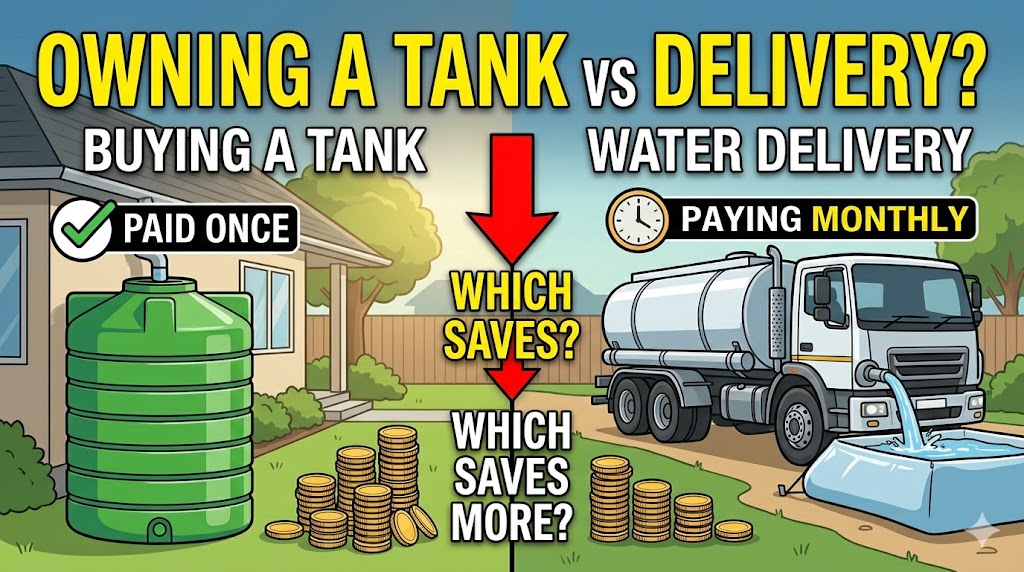
    If you are spending more than $80–$120/month on water delivery, buying a tank almost always saves money within 24 months. Below that threshold, the calculation depends on your delivery frequency, local tank prices, and how reliably you can refill the tank from mains or rainwater. This article gives you the break-even formula and the numbers for common real-world scenarios so you can decide which is cheaper for your situation.

    The quick answer

    Water delivery costs $5–$50 per 1,000 litres in most markets — 10 to 100 times more expensive per litre than stored mains water. A household spending $100/month on deliveries will typically recover the cost of a $1,500 tank system in 15 months. Use the Water Delivery vs Tank Cost Calculator to enter your actual delivery spend and get a personalised break-even date.

     Water Tank (owned)Water Delivery (recurring)
    Upfront cost$200–$2,500+ (tank + install)Near zero
    Cost per 1,000 L$0.05–$0.50 (amortised)$5–$50 (delivered)
    Supply controlFull — fill on your scheduleDependent on supplier
    Quality consistencyDepends on storage hygieneVariable by supplier
    Long-term cost trendFixed (depreciating asset)Rising (market-linked)
    Break-even vs delivery12–36 months typicalN/A
    Space requiredYes (footprint + height)None
    Right for intermittent needs?No — tank sits idleYes — pay only when needed

    How the calculation works

    The break-even formula: Break-even (months) = Total tank system cost ÷ Monthly delivery savings.

    Monthly delivery savings = Current monthly delivery spend − Monthly tank operating cost (maintenance + refill if paid for).

    Worked example — rural Kenya: A household buys 4,000 litres/month from a water vendor at KES 80/20L jerrycan = KES 16,000/month ($120 USD). A 5,000-litre HDPE tank installed costs KES 35,000 ($262). Mains connection unavailable, so they refill with tanker delivery at bulk rate KES 25/20L = KES 5,000/month ($37.50). Monthly saving = $120 − $37.50 = $82.50. Break-even = $262 ÷ $82.50 = 3.2 months. After break-even, the tank saves $990/year ongoing.

    Worked example — suburban Australia: Household spends A$180/quarter on delivered spring water for drinking. Tank system with pump and filter: A$1,200. Quarterly saving: A$180 − A$15 maintenance = A$165. Break-even = A$1,200 ÷ A$165/quarter = 7.3 quarters (22 months). After break-even: A$660/year saved.

    Monthly delivery spendTank cost ($1,500 total)Break-even point
    $50/month$1,50030 months (2.5 years)
    $100/month$1,50015 months
    $200/month$1,5007.5 months
    $500/month$1,5003 months

    Key variables that change the answer

    Delivery cost per litre. This drives the entire calculation. Urban water delivery in developed markets runs $1–$5 per 20-litre container ($50–$250/m³). Rural delivery via tanker in developing markets runs $5–$30/m³. Municipal mains water averages $0.30–$2.50/m³. The gap between what you pay for delivery and what you could pay for refilling a tank is the core economic engine of the decision.

    Delivery frequency and minimum orders. Delivery services charge per trip, not per litre. A household taking one 5,000-litre delivery per month pays a trip fee once. A household taking eight 500-litre deliveries pays the trip fee eight times. If you are currently ordering in small quantities due to lack of storage, a tank dramatically reduces your effective cost per litre even before the volume discount on bulk delivery is factored in.

    Access to low-cost refill. A tank only saves money if you can refill it cheaply. If mains water is available at $0.50/m³, a 5,000-litre tank costs $2.50 to refill — replacing $25–$250 of delivery cost. If your only option is another (slightly cheaper) tanker service, the savings are real but smaller. The Water Storage Cost Per Litre Calculator shows the all-in cost per litre of owning and filling your own tank at various refill tariffs.

    Permanence of need. Water delivery makes economic sense for temporary or irregular needs: construction sites, seasonal properties, emergency backup. If you are in a location for 3+ years and water is a recurring cost, a tank almost always wins on 5-year economics. If you are renting short-term, the upfront capital cannot be recovered. In that case, delivery remains the pragmatic choice regardless of unit cost.

    Common mistakes

    Comparing tank cost to a single delivery rather than cumulative spend. A $1,200 tank sounds expensive compared to a $40 delivery. Compared to 30 months of $40 deliveries ($1,200 total), it looks different. Always calculate cumulative delivery cost over 2–3 years before concluding that a tank is too expensive.

    Under-sizing the tank for delivery economics. If you buy a 1,000-litre tank but need 3,000 litres/month, you still need 2–3 deliveries per month and lose most of the benefit of tank ownership. The tank needs to be large enough to reduce your delivery frequency to once per month or less — otherwise trip fees dominate the cost. Use the How Long Will My Tank Last Calculator to confirm your tank lasts the intended interval between refills.

    Not factoring in installation and access costs. Tank prices quoted online are often ex-works. Add delivery of the tank itself ($50–$300 depending on distance), installation labour ($100–$500), and site preparation if needed (concrete pad, plumbing connections). The all-in cost is routinely 40–80% higher than the sticker price for the tank alone. Always use the installed cost in your break-even calculation, not the purchase price.

    Ignoring water quality differences between delivery and stored water. Delivered water is often tested and certified at point of sale. Stored water quality depends entirely on tank hygiene, UV exposure (algae risk), and whether the tank is properly sealed against contamination. A poorly maintained tank can deliver water that is worse quality than the delivery service it replaced. Clean and inspect tanks every 12–24 months and use the Water Tank Disinfection Calculator to calculate chlorination doses correctly.

    Related calculators you might need

    To model the total financial picture, start with the Water Tank Cost Calculator for an all-in purchase and installation estimate. Then use the Water Tank Installation Cost Estimator to account for site-specific labour and preparation costs. If a borehole is a potential alternative to both delivery and mains supply, the Borehole vs Mains Water Cost Calculator adds that option to the comparison. For sizing the tank correctly so it bridges the interval between refills, use the Daily Water Requirement Calculator first.

    Frequently asked questions

    How much does water delivery cost? Water delivery costs vary widely: $1–$5 per 20-litre container in urban developed markets ($50–$250/m³), $5–$30/m³ for tanker delivery in rural or developing-country settings, and $0.10–$0.50/m³ for municipal mains supply. The gap between mains and delivery is the economic case for tank ownership.

    How do I calculate if buying a tank is worth it? Divide the all-in cost of the tank system (tank + installation + filtration) by your current monthly delivery spend minus the projected monthly tank operating cost (maintenance + cheap refill). The result is your break-even in months. If break-even is under 24 months and you plan to stay in the location 3+ years, buying a tank almost always makes sense.

    Is water delivery safe compared to a tank? Reputable delivery services test water at point of filling. Stored tank water is safe if the tank is food-grade HDPE or stainless steel, sealed against insects and contamination, cleaned annually, and treated if stored for more than 6 months. Neither is inherently safer — maintenance practices determine quality in both cases.

    What size tank do I need to reduce water delivery costs? Size the tank to last at least 30 days between refills at your current usage rate. If your household uses 300 L/day, you need a 9,000-litre minimum for a 30-day interval. In practice, most households buying 3,000–5,000-litre tanks reduce delivery frequency from weekly to monthly — cutting the trip-fee component by 75%.

    Does buying a tank make sense for a rental property? Rarely. The upfront cost cannot typically be recovered in 1–2 year rental periods, and the tank is a fixed asset that may not transfer with you. Water delivery remains the rational choice for tenancies under 3 years unless the landlord is willing to invest in and retain the tank as part of the property.

  • Plastic vs steel vs concrete water tanks: full comparison

    Plastic vs steel vs concrete water tanks: full comparison

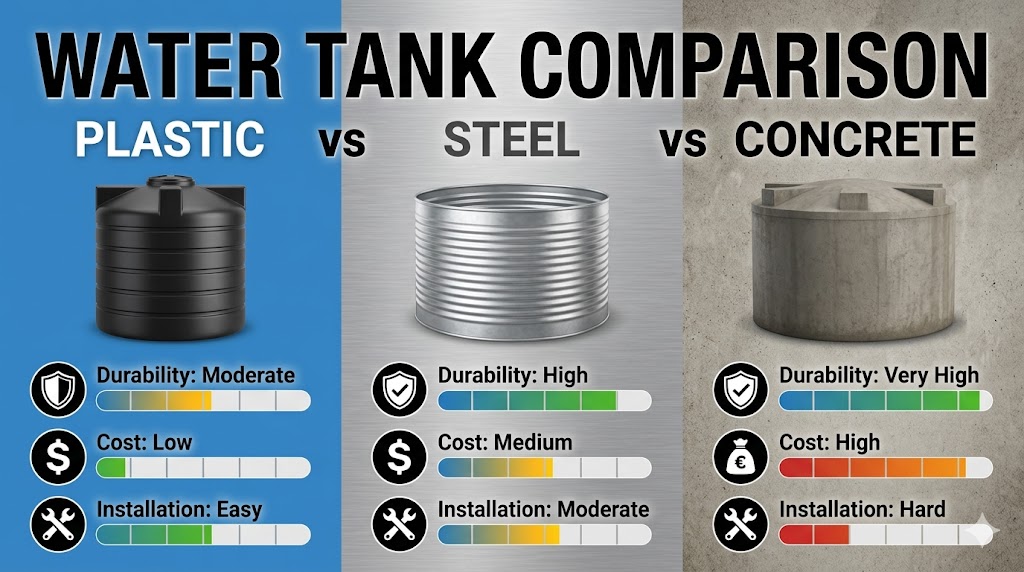
    For most households and small commercial sites, HDPE plastic tanks deliver the best value: lowest upfront cost, easiest installation, and adequate lifespan for most use cases. Steel wins on fire resistance and aesthetics in commercial settings. Concrete is the right call only when permanence and very high capacity are the primary requirements. This article breaks down all three across cost, durability, maintenance, safety, and climate suitability so you can make a call that holds up over decades.

    The quick answer

    Plastic tanks dominate residential markets globally because they are cheap, light, and food-safe. Galvanised steel tanks serve farms and light industry where structural durability matters. Reinforced concrete tanks are built when nothing else will survive the environment — underground cisterns, bushfire zones, high-load commercial sites. Use the Plastic vs Steel Tank Cost Calculator to run a side-by-side cost comparison for your specific capacity and region.

    FactorPlastic (HDPE/PP)Steel (GI/SS)Concrete (RCC)
    Cost (1,000L)$50–$150$120–$400$180–$600+
    Lifespan10–25 years15–30 years30–50+ years
    Weight (empty, 1,000L)8–25 kg60–120 kg500–1,000 kg
    InstallationDIY-possibleSkilled labour neededCivil work required
    MaintenanceLowModerate (rust risk)Low (seal/crack checks)
    Algae riskHigh (translucent)LowLow
    Taste/odour riskLow (food-grade)Moderate (galvanised)Low (lined)
    BPA riskNone (HDPE/PP)NoneNone
    Seismic riskLow (flexible)ModerateHigh (brittle)
    RecyclableYes (partially)Yes (fully)No

    All cost ranges are indicative for a 1,000-litre tank installed in a residential setting. Regional prices vary by up to 40%.

    How the calculation works

    Tank material selection is not purely a cost decision — it is a total cost of ownership calculation. The variables are: upfront purchase price, installation labour, maintenance over the expected lifespan, likelihood of early failure, and replacement cost.

    A simple total cost of ownership (TCO) formula: TCO = Purchase price + Installation cost + (Annual maintenance cost × lifespan in years) + (Replacement cost if lifespan exceeded).

    Worked example for a 5,000-litre tank, 20-year horizon, warm-climate residential site:

    Plastic (HDPE): $400 purchase + $100 installation + ($20/year × 20 years) = $900 total. Expected lifespan: 15–20 years. One replacement likely over 40 years.

    Steel (galvanised): $900 purchase + $350 installation + ($80/year × 20 years) = $2,850 total. Includes annual rust inspection and repainting every 7–10 years.

    Concrete: $2,000 construction + $1,000 civil labour + ($30/year × 20 years) = $3,600 total. Lifespan 40–50 years means no replacement on that horizon — TCO per year is competitive over longer timescales.

    Key variables that change the answer

    Climate and UV exposure. UV radiation degrades standard polyethylene over 10–15 years. UV-stabilised HDPE tanks extend this to 20–25 years. In tropical zones above 25°C mean annual temperature, plastic tank walls can soften and deform if water is stored above ground without shade. Steel and concrete are immune to UV degradation but concrete cracks under thermal cycling — a 30°C daily temperature swing increases crack propagation by approximately 2× compared to stable-temperature environments (ACI 350 guidance).

    Seismic zone. In seismic zones 3 and 4 (IS 1893 / ASCE 7), unreinforced concrete tanks above ground fail catastrophically under lateral loading. HDPE flexes and survives. Steel tanks anchored to a pad survive if the anchor bolts are rated correctly. If you are in a high-seismic zone, plastic or properly anchored steel is the default recommendation.

    Firefighting requirements. Australian bushfire-prone areas (BAL-40 and above) typically require steel or concrete tanks. AS 3959 fire exposure testing shows standard HDPE tanks can deform and fail at sustained 300°C radiant heat. Steel tanks survive direct flame impingement for 30+ minutes without structural failure.

    Water quality — hardness and pH. Hard water (above 200 mg/L CaCO3) accelerates scale buildup in galvanised steel tanks and can corrode the zinc coating, releasing zinc at levels above WHO’s 3 mg/L guideline. Concrete tanks leach lime into stored water initially, raising pH to 10–12 for the first 2–3 filling cycles. Plastic is pH-neutral and scale-resistant across the full potable water range.

    Roof loading. A 1,000-litre concrete tank fully loaded weighs approximately 2,500 kg including structure. A comparable HDPE tank weighs 1,020 kg. Most residential roof slabs in South Asia are designed for 150–200 kg/m² live load. No 1,000-litre concrete tank should be placed on a residential rooftop without a structural engineer’s sign-off. Use the Rooftop Load Bearing Calculator before specifying any overhead storage tank.

    Common mistakes

    Buying a translucent plastic tank. Light penetration drives algae growth. Blue or black HDPE tanks block 99%+ of light; translucent white or yellow tanks let light through. Algae blooms are not just aesthetic — they consume dissolved oxygen and can produce toxins. Always specify opaque tanks. If you already have a translucent tank, paint the exterior with food-safe reflective paint.

    Installing a galvanised tank without pH testing the water. Galvanised steel corrodes rapidly below pH 6.5. Water in granite-geology catchments frequently sits at pH 5.5–6.0. At that level, a galvanised tank can shed zinc at 3–5× the WHO safe limit within 12 months. Check water pH with the Water pH Adjustment Calculator and treat if needed, or switch to stainless steel or HDPE.

    Skipping curing on new concrete tanks. Uncured concrete leaches calcium hydroxide, pushing stored water above pH 11. At that pH, chlorine disinfection is 80% less effective and water tastes strongly alkaline. Cure new concrete tanks by filling and draining three times, or applying a food-grade epoxy liner before commissioning.

    Using tank volume as the only sizing criterion. Material choice affects how you should size the tank. Concrete tanks are typically oversized at construction because adding capacity later is nearly impossible. HDPE tanks can be added in series cheaply. If your requirements might grow — more occupants, irrigation expansion — size for future demand now if choosing concrete, or buy modular plastic and expand later.

    Related calculators you might need

    Before purchasing, confirm the numbers hold up. The Water Tank Cost Calculator gives a full purchase and installation estimate by material type and capacity. If the tank is going on a roof, the Safe Rooftop Tank Load Calculator will tell you whether your slab can handle the filled weight before you commit. For treatment planning — particularly relevant for steel and new concrete tanks — the Water Hardness Calculator and TDS Water Calculator will flag whether your source water is corrosive or scaling.

    Frequently asked questions

    How long does a plastic water tank last? Food-grade HDPE tanks last 10–25 years depending on UV exposure, water chemistry, and whether the tank was manufactured with UV stabilisers. Cheap tanks without UV inhibitors in tropical climates can fail in 7–10 years. Premium brands with UV-stabilised HDPE and 10-year warranties are widely available and worth the 20–30% price premium.

    Are plastic water tanks safe for drinking water? Yes, provided the tank is manufactured from food-grade polyethylene (HDPE or PP) and marked as such. The material itself does not leach harmful chemicals into water under normal storage conditions. BPA is not present in HDPE or PP — it is associated with polycarbonate (PC), which is not used in water storage tanks.

    Which is better for a rooftop water tank — plastic or steel? Plastic (HDPE) is the correct default for rooftop installation. A 2,000-litre HDPE tank weighs approximately 30–40 kg empty vs 150–200 kg for a comparable steel tank. Lighter structure means lower structural load on the slab, lower installation cost, and no risk of rust staining. Confirm the filled weight is within your roof’s rated capacity using the Water Tank Weight Calculator.

    Do concrete tanks need to be lined? Not always, but lining is recommended for potable water storage. Bare concrete leaches lime during the first several months of use. A food-grade epoxy or polyurea coating applied to the interior eliminates this and adds 10–15 years to the effective life of the tank. Cost is typically $8–$25 per square metre of internal surface, depending on tank size and coating type.

    What is the most durable water tank material? For structural longevity: reinforced concrete tanks correctly built and lined last 50+ years with minimal maintenance. For practical durability in residential settings accounting for cost, repairability, and ease of installation: UV-stabilised HDPE with a 20+ year warranty from a reputable manufacturer is the most pragmatic choice for the vast majority of homeowners.

  • Rainwater Harvesting vs Municipal Supply: Real Cost Comparison

    Rainwater Harvesting vs Municipal Supply: Real Cost Comparison

    In most urban settings, municipal supply remains cheaper on a per-litre basis than rainwater harvesting — but that comparison ignores reliability, price trajectories, and the value of supply independence. Rainwater harvesting becomes cost-competitive when municipal tariffs exceed $1.50/m³, when supply is unreliable, or when the system is sized to supplement rather than replace mains water. This article sets out the real numbers so you can make the calculation for your location.

    The quick answer

    Municipal water costs $0.30–$2.50/m³ in most countries (WHO/IWA data). Rainwater harvesting amortised over a 20-year system life costs $0.50–$3.00/m³ depending on system size, rainfall, and local construction costs. Use the Rainwater Harvesting ROI Calculator to enter your roof area, local rainfall, and current water bill for a site-specific comparison.

    FactorRainwater HarvestingMunicipal Supply
    Setup cost$500–$5,000 (residential)$0 (connection included)
    Ongoing cost (annual)$30–$80 maintenance$200–$800 (bills)
    Water qualityVariable — needs treatmentRegulated (safe by default)
    ReliabilityClimate-dependentHigh (in most cities)
    Volume availableLimited by catchment + rainfallEssentially unlimited
    Carbon footprintLow (pumping only)Higher (treatment + distribution)
    Regulatory statusPermitted with conditions in most regionsNo restrictions
    Typical payback period5–15 yearsN/A

    How the calculation works

    Step 1 — Quantify what you can collect. Annual collection (litres) = Roof catchment area (m²) × Annual rainfall (mm) × Runoff coefficient × 0.85 first-flush loss factor. A typical runoff coefficient is 0.80–0.90 for metal roofs, 0.70–0.80 for tiles, 0.60–0.70 for concrete (FAO Irrigation and Drainage Paper No. 25).

    Worked example — Sydney, Australia: 100 m² metal roof. Annual rainfall: 1,200 mm. Runoff coefficient: 0.85. First-flush factor: 0.90. Annual collection = 100 × 1,200 × 0.85 × 0.90 = 91,800 litres (91.8 m³) per year.

    Step 2 — Value the collected water. Sydney water tariff: approximately A$2.35/kL (2024, Sydney Water). Value of 91.8 m³ = 91.8 × $2.35 = A$215.6/year

    Step 3 — Calculate system cost. Basic residential system (100 m² catchment, 2,000-litre tank, first-flush diverter, pump): A$1,500–$2,500 installed. Annual maintenance: A$50–$80.

    Step 4 — Payback: At A$215/year savings and A$2,000 system cost, payback = 9.3 years. After payback, net saving of A$135–$165/year (after maintenance). Over 20-year system life: net saving of A$650–$1,350 after accounting for setup cost.

    In higher-tariff cities (Copenhagen at $6.70/m³, Berlin at $5.30/m³, or private water delivery in low-income urban areas at $10–$20/m³), payback compresses to 3–5 years.

    Key variables that change the answer

    Local water tariff. This is the most important variable. A $0.30/m³ tariff (common in subsidised city systems across South Asia and parts of Africa) makes rainwater harvesting economically marginal — the free municipal supply is simply too cheap to beat on cost alone. At $2.00/m³ and above, rainwater harvesting is clearly economical. At tariffs above $4.00/m³ (typical in Northern Europe, parts of Australia, and commercial metered supplies globally), it is financially compelling without any reliability argument.

    Annual rainfall and distribution. A city with 800 mm annual rainfall concentrated in 4 months captures and uses water differently from one with 1,200 mm spread across 9 months. The critical metric is not annual rainfall but the length of the dry gap — if you have 5+ months of zero or near-zero rainfall, your tank needs to be large enough to bridge that gap, which drives up system cost significantly. Use the Annual Rainwater Collection Calculator to model your specific climate.

    Supply reliability and quality. Where municipal supply is intermittent, contaminated, or subject to boil-water orders, the value of rainwater harvesting goes beyond cost — supply independence has real dollar value. In cities where households already pay for bottled water or water delivery because mains quality is poor, harvested rainwater (properly filtered and treated) eliminates that supplementary spend. This can add $300–$1,000/year in effective savings that a pure cost-per-litre comparison misses.

    System sizing. Over-sizing a rainwater system is the most common economic error. A tank that collects more than your catchment can supply during dry months costs money to build but delivers no additional water. The optimal tank size for most residential systems is 2–6 weeks of average demand — enough to bridge dry spells without building excess storage capacity that never fills. The Rainwater Savings Calculator models this against your actual usage pattern.

    Common mistakes

    Comparing rainwater cost to municipal cost without including treatment. Rainwater requires filtration and disinfection for potable use — minimum a sediment filter plus UV or chlorination. Add $200–$600 upfront and $50–$100/year running costs. Many cost comparisons omit these and make rainwater look cheaper than it is. For non-potable uses (irrigation, toilet flushing, laundry) treatment costs are lower, which is why these end-uses give better economics.

    Assuming rainfall translates directly to collection. First-flush contamination (bird droppings, dust, organic matter on the roof surface) means the first 1–2 mm of each rain event should be diverted to waste. On a 100 m² roof, the first 100–200 litres of every rain event are typically discarded. Without a properly sized first-flush diverter, this contaminated water enters your tank. Size the diverter correctly using the First Flush Diverter Size Calculator.

    Ignoring local regulations. Rainwater harvesting is restricted or regulated in some jurisdictions. In parts of the US (historically Colorado, now relaxed; still regulated in Utah and Oregon), collection was legally restricted for water rights reasons. In Australia, South Australia and Queensland have mandatory requirements for new dwellings. In most of South Asia and Africa, harvesting is encouraged or required in new construction. Check local planning rules before investing in any system.

    Not accounting for roof material contamination. Asbestos cement, copper, lead-painted, and pressure-treated timber roofs contaminate runoff with material-specific toxins. HDPE, Colorbond/Zincalume, and uncoated concrete tile roofs are the safest catchment surfaces for potable water collection (ANZECC guidelines). If your roof material is incompatible with potable collection, restrict harvested water to non-potable uses only.

    Related calculators you might need

    Before committing to a system, run the Roof Catchment Area Calculator to establish your maximum possible collection volume — this sets the upper limit on system value. If you are evaluating whether the investment is worthwhile, the Rainwater Harvesting Payback Calculator models your specific tariff, rainfall, and system cost to give you a payback period in years. For sites with existing mains supply where cost reduction is the primary goal, the Water Bill Savings Calculator quantifies the annual bill reduction from partial or full rainwater substitution.

    Frequently asked questions

    Is rainwater harvesting worth it financially? It depends on your local water tariff and rainfall. At tariffs above $1.50/m³ and with 700+ mm annual rainfall, a correctly sized system typically pays back in 7–12 years and generates positive returns over its 20-year life. At tariffs below $0.80/m³ or with less than 500 mm annual rainfall, the economics are marginal and the case rests on supply reliability rather than cost.

    How much does a rainwater harvesting system cost? A basic residential system with 2,000-litre tank, guttering, first-flush diverter, and sediment filter runs $800–$2,500 installed depending on the region and labour rates. Larger systems with pumps, UV treatment, and 5,000+ litre tanks cost $3,000–$8,000. Add 15–25% for below-ground installation.

    Can harvested rainwater replace municipal supply entirely? In high-rainfall regions (above 1,200 mm/year, well-distributed), large systems (10,000+ litres) can supply 80–100% of household demand for toilet, laundry, and irrigation. Full potable supply replacement is technically feasible but requires multi-stage treatment (sediment + activated carbon + UV minimum) and is subject to regulatory approval in many regions. Most systems are sized to supplement, not replace.

    Does rainwater harvesting make sense in dry climates? It can, but tank sizing becomes critical. A dry climate with seasonal rainfall requires enough storage to bridge the dry months. In Phoenix, AZ (200 mm/year), a 100 m² roof collects only 14,000 litres annually — enough for garden irrigation but not meaningful household supply. In Brisbane (1,000 mm/year), the same roof collects 75,000+ litres — a significant household contribution.

    What is the environmental benefit of harvesting rainwater? Reduced demand on municipal systems lowers energy use for water treatment and pumping — typically 0.3–0.8 kWh/m³ for conventional treatment and distribution. At a household scale, a system delivering 80 m³/year substitutes approximately 40–64 kWh of embedded energy annually. Carbon benefit is real but small compared to the supply resilience and cost arguments in most residential cases.