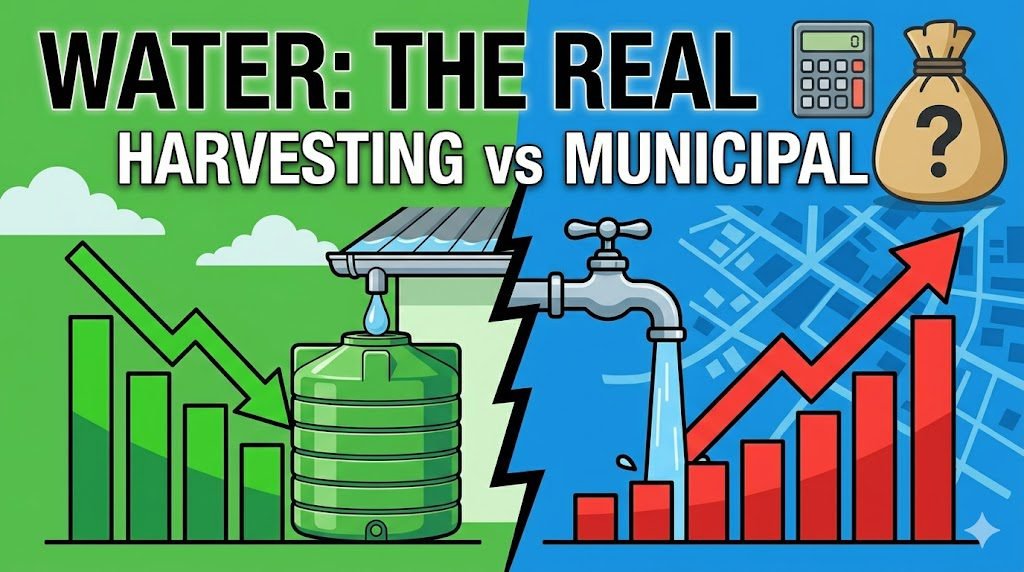
In most urban settings, municipal supply remains cheaper on a per-litre basis than rainwater harvesting — but that comparison ignores reliability, price trajectories, and the value of supply independence. Rainwater harvesting becomes cost-competitive when municipal tariffs exceed $1.50/m³, when supply is unreliable, or when the system is sized to supplement rather than replace mains water. This article sets out the real numbers so you can make the calculation for your location. For the mechanics behind how a system actually collects and stores water, see how rainwater harvesting works.
The quick answer
Municipal water costs $0.30–$2.50/m³ in most countries (WHO/IWA data). Rainwater harvesting amortised over a 20-year system life costs $0.50–$3.00/m³ depending on system size, rainfall, and local construction costs. Use the Rainwater Harvesting ROI Calculator to enter your roof area, local rainfall, and current water bill for a site-specific comparison.
| Factor | Rainwater Harvesting | Municipal Supply |
| Setup cost | $500–$5,000 (residential) | $0 (connection included) |
| Ongoing cost (annual) | $30–$80 maintenance | $200–$800 (bills) |
| Water quality | Variable — needs treatment | Regulated (safe by default) |
| Reliability | Climate-dependent | High (in most cities) |
| Volume available | Limited by catchment + rainfall | Essentially unlimited |
| Carbon footprint | Low (pumping only) | Higher (treatment + distribution) |
| Regulatory status | Permitted with conditions in most regions | No restrictions |
| Typical payback period | 5–15 years | N/A |
How the calculation works
Step 1 — Quantify what you can collect. Annual collection (litres) = Roof catchment area (m²) × Annual rainfall (mm) × Runoff coefficient × 0.85 first-flush loss factor. A typical runoff coefficient is 0.80–0.90 for metal roofs, 0.70–0.80 for tiles, 0.60–0.70 for concrete (FAO Irrigation and Drainage Paper No. 25) — see what is water tank runoff coefficient and how is it calculated for a fuller explanation of this factor.
Worked example — Sydney, Australia: 100 m² metal roof. Annual rainfall: 1,200 mm. Runoff coefficient: 0.85. First-flush factor: 0.90. Annual collection = 100 × 1,200 × 0.85 × 0.90 = 91,800 litres (91.8 m³) per year. For more on how Australian rainfall patterns and local rules affect system sizing, see rainwater harvesting in Australia.
Step 2 — Value the collected water. Sydney water tariff: approximately A$2.35/kL (Sydney Water). Value of 91.8 m³ = 91.8 × $2.35 = A$215.7/year
Step 3 — Calculate system cost. Basic residential system (100 m² catchment, 2,000-litre tank, first-flush diverter, pump): A$1,500–$2,500 installed. Annual maintenance: A$50–$80.
Step 4 — Payback: At A$216/year savings and A$2,000 system cost, payback = 9.3 years. After payback, net saving of A$135–$165/year (after maintenance). Over 20-year system life: net saving of A$650–$1,350 after accounting for setup cost.
In higher-tariff cities (Copenhagen at $6.70/m³, Berlin at $5.30/m³, or private water delivery in low-income urban areas at $10–$20/m³), payback compresses to 3–5 years. If you’re weighing a tank against a water delivery service rather than mains supply specifically, our guide on buying a water tank vs water delivery: which saves more money runs that comparison directly.
Key variables that change the answer
Local water tariff. This is the most important variable. A $0.30/m³ tariff (common in subsidised city systems across South Asia and parts of Africa) makes rainwater harvesting economically marginal — the free municipal supply is simply too cheap to beat on cost alone. At $2.00/m³ and above, rainwater harvesting is clearly economical. At tariffs above $4.00/m³ (typical in Northern Europe, parts of Australia, and commercial metered supplies globally), it is financially compelling without any reliability argument.
Annual rainfall and distribution. A city with 800 mm annual rainfall concentrated in 4 months captures and uses water differently from one with 1,200 mm spread across 9 months. The critical metric is not annual rainfall but the length of the dry gap — if you have 5+ months of zero or near-zero rainfall, your tank needs to be large enough to bridge that gap, which drives up system cost significantly. Use the Annual Rainwater Collection Calculator to model your specific climate.
Supply reliability and quality. Where municipal supply is intermittent, contaminated, or subject to boil-water orders, the value of rainwater harvesting goes beyond cost — supply independence has real dollar value. In cities where households already pay for bottled water or water delivery because mains quality is poor, harvested rainwater (properly filtered and treated) eliminates that supplementary spend. This can add $300–$1,000/year in effective savings that a pure cost-per-litre comparison misses.
System sizing. Over-sizing a rainwater system is the most common economic error. A tank that collects more than your catchment can supply during dry months costs money to build but delivers no additional water. The optimal tank size for most residential systems is 2–6 weeks of average demand — enough to bridge dry spells without building excess storage capacity that never fills. The Rainwater Savings Calculator models this against your actual usage pattern.
Common mistakes
Comparing rainwater cost to municipal cost without including treatment. Rainwater requires filtration and disinfection for potable use — minimum a sediment filter plus UV or chlorination. Add $200–$600 upfront and $50–$100/year running costs. Many cost comparisons omit these and make rainwater look cheaper than it is. For non-potable uses (irrigation, toilet flushing, laundry) treatment costs are lower, which is why these end-uses give better economics.
Assuming rainfall translates directly to collection. First-flush contamination (bird droppings, dust, organic matter on the roof surface) means the first 1–2 mm of each rain event should be diverted to waste. On a 100 m² roof, the first 100–200 litres of every rain event are typically discarded. Without a properly sized first-flush diverter, this contaminated water enters your tank — see what is a first flush diverter and do you need one for the full explanation. Size the diverter correctly using the First Flush Diverter Size Calculator.
Ignoring local regulations. Rainwater harvesting is restricted or regulated in some jurisdictions. In parts of the US (historically Colorado, now relaxed; still regulated in Utah and Oregon), collection was legally restricted for water rights reasons. In Australia, South Australia and Queensland have mandatory requirements for new dwellings. In most of South Asia and Africa, harvesting is encouraged or required in new construction. Check local planning rules before investing in any system.
Not accounting for roof material contamination. Asbestos cement, copper, lead-painted, and pressure-treated timber roofs contaminate runoff with material-specific toxins. HDPE, Colorbond/Zincalume, and uncoated concrete tile roofs are the safest catchment surfaces for potable water collection (ANZECC guidelines). If your roof material is incompatible with potable collection, restrict harvested water to non-potable uses only.
Related calculators you might need
Before committing to a system, run the Roof Catchment Area Calculator to establish your maximum possible collection volume — this sets the upper limit on system value. If you are evaluating whether the investment is worthwhile, the Rainwater Harvesting Payback Calculator models your specific tariff, rainfall, and system cost to give you a payback period in years. For sites with existing mains supply where cost reduction is the primary goal, the Water Bill Savings Calculator quantifies the annual bill reduction from partial or full rainwater substitution.
Frequently asked questions
Is rainwater harvesting worth it financially? It depends on your local water tariff and rainfall. At tariffs above $1.50/m³ and with 700+ mm annual rainfall, a correctly sized system typically pays back in 7–12 years and generates positive returns over its 20-year life. At tariffs below $0.80/m³ or with less than 500 mm annual rainfall, the economics are marginal and the case rests on supply reliability rather than cost.
How much does a rainwater harvesting system cost? A basic residential system with 2,000-litre tank, guttering, first-flush diverter, and sediment filter runs $800–$2,500 installed depending on the region and labour rates. Larger systems with pumps, UV treatment, and 5,000+ litre tanks cost $3,000–$8,000. Add 15–25% for below-ground installation.
Can harvested rainwater replace municipal supply entirely? In high-rainfall regions (above 1,200 mm/year, well-distributed), large systems (10,000+ litres) can supply 80–100% of household demand for toilet, laundry, and irrigation. Full potable supply replacement is technically feasible but requires multi-stage treatment (sediment + activated carbon + UV minimum) and is subject to regulatory approval in many regions. Most systems are sized to supplement, not replace.
Does rainwater harvesting make sense in dry climates? It can, but tank sizing becomes critical. A dry climate with seasonal rainfall requires enough storage to bridge the dry months. In Phoenix, AZ (200 mm/year), a 100 m² roof collects only 14,000 litres annually — enough for garden irrigation but not meaningful household supply. In Brisbane (1,000 mm/year), the same roof collects 75,000+ litres — a significant household contribution.
What is the environmental benefit of harvesting rainwater? Reduced demand on municipal systems lowers energy use for water treatment and pumping — typically 0.3–0.8 kWh/m³ for conventional treatment and distribution. At a household scale, a system delivering 80 m³/year substitutes approximately 40–64 kWh of embedded energy annually. Carbon benefit is real but small compared to the supply resilience and cost arguments in most residential cases.

Licensed Professional Engineer (Texas, PE) with 13+ years in residential and light-commercial water storage systems. Reviews and writes the technical guides on this site — sizing, pressure, roof loading, and treatment — based on 180+ completed field projects.