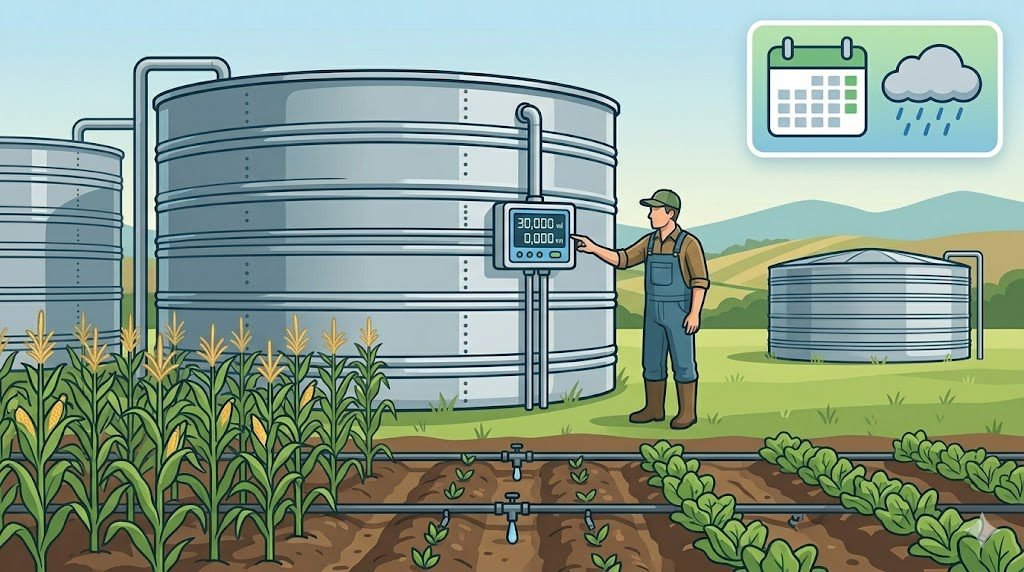
A farm irrigation tank needs to hold enough water to bridge the gap between your source (bore, river, rain, mains) and your peak daily crop demand — typically across the hottest, driest stretch of the season when source flow drops and crop stress peaks simultaneously. The minimum tank size equals peak daily demand × buffer days, where buffer days is determined by your source reliability, not personal preference. This article covers the FAO-based calculation method, crop-specific benchmarks, and the sizing errors that cause tanks to run dry during critical growth windows. If your farm also carries livestock, see our guide on agricultural water storage sizing for irrigation for how the two demands combine in practice.
The Quick Answer
The core formula is:
Tank size (L or m³) = irrigated area (ha) × crop water need (mm/day) × 10,000 × buffer days × 1.15
Where 10,000 converts mm/ha to litres/ha (1 mm of water over 1 hectare = 10,000 L), and 1.15 adds a 15% safety margin for distribution losses and pump inefficiency.
| Crop type | Peak water need (mm/day) | 1 ha, 3-day buffer (L) | 5 ha, 3-day buffer |
| Maize (corn) | 6–8 | 207,000–276,000 L | ~1.0–1.4 ML |
| Wheat | 4–6 | 138,000–207,000 L | ~0.7–1.0 ML |
| Tomato (field) | 5–7 | 172,500–241,500 L | ~0.9–1.2 ML |
| Pasture / fodder grass | 5–9 | 172,500–310,500 L | ~0.9–1.5 ML |
| Tree fruits (orchard) | 3–5 | 103,500–172,500 L | ~0.5–0.9 ML |
Use the farm water storage calculator to enter your crop type, irrigated area, and source reliability for a precise tank size recommendation.
How the calculation works
Crop water need (also called ETc — crop evapotranspiration) is derived from the FAO Penman-Monteith method (FAO Irrigation and Drainage Paper No. 56). It accounts for reference evapotranspiration (ETo) — a climate-driven baseline — multiplied by a crop coefficient (Kc) that varies by growth stage.
ETc (mm/day) = ETo × Kc
During peak growing season in a semi-arid climate, ETo runs 6–10 mm/day. Kc for maize at mid-season is 1.20 (FAO), giving a peak ETc of 7.2–12 mm/day. For wheat at mid-season, Kc is 1.15.
Worked example: 3 ha of tomatoes, 3-day buffer, semi-arid region
Peak ETc for tomatoes: 6 mm/day (conservative estimate).
Daily demand: 3 ha × 6 mm × 10,000 = 180,000 L/day
3-day buffer: 180,000 × 3 = 540,000 L
15% safety margin: 540,000 × 1.15 = 621,000 L (621 m³). This requires either one large above-ground bladder tank or a concrete/earthen storage pond of that capacity.
Key variables that change the answer
Source refill rate vs demand rate. If your bore pumps 5 L/second and your peak demand is 4 L/second, you may not need buffer storage at all — the bore keeps pace. If your bore pumps 2 L/second but demand peaks at 5 L/second, you need buffer storage equal to the deficit × peak hours. A bore pumping 10 hours per day at 2 L/s delivers 72,000 L/day — if your crop demands 120,000 L/day, you need to buffer 48,000 L minimum, plus supply gap coverage.
Irrigation method efficiency. Drip irrigation delivers water directly to the root zone with 85–95% application efficiency. Sprinklers run 70–80%. Surface flooding runs 40–60%. A switch from flood to drip on the same crop area reduces water demand — and therefore tank size — by 35–55%. The buffer days required also drop because less water is lost to evaporation between the tank and the root zone.
Soil water holding capacity. Clay-heavy soils hold 150–200 mm of plant-available water per metre of depth. Sandy soils hold 50–80 mm/m. A deep clay soil acts as a natural buffer — crops can draw from stored soil moisture for 3–5 days without irrigation before stress onset. Sandy soils have almost no buffer — daily irrigation is required. Soil type directly affects how many buffer days your tank must cover.
Seasonal rainfall during irrigation season. If your irrigation season overlaps with partial rainfall — common in Mediterranean or monsoon-adjacent climates — effective rainfall reduces net irrigation requirement. FAO’s CROPWAT method accounts for effective rainfall (typically 70–80% of actual rainfall is plant-available). A 20 mm rainfall event on 3 ha = 600,000 L, replacing approximately 3 days of irrigation demand in a moderate-use crop.
Irrigation system and tank sizing scenarios
| Farm type | Area | Method | Buffer days | Min tank |
| Market garden | 0.5 ha | Drip | 3 days | 90–130 KL |
| Arable crop farm | 10 ha | Sprinkler | 3 days | 1.5–2.5 ML |
| Orchard (tree fruit) | 5 ha | Drip | 5 days | 750 KL–1.2 ML |
| Dairy farm (pasture) | 20 ha | Flood/spray | 3 days | 3–6 ML |
Common mistakes
Sizing to average ETc rather than peak ETc. Average crop water need across a full growing season is 20–40% lower than peak mid-season demand. A tank sized for average demand runs dry during the 4–6 weeks of peak demand when crop stress causes the most economic damage. Always size to peak ETc — typically mid-season for most crops — not the season average.
Not accounting for pump flow rate vs tank draw rate. A common error: the farmer calculates daily crop demand correctly but chooses a pump sized for average flow rather than peak demand. If the irrigation system draws 8 L/s for 6 hours per day but the bore pump delivers 3 L/s continuously, the tank must absorb the deficit (5 L/s × 6 hours = 108,000 L buffer minimum). Undersizing here means the tank empties before the irrigation run completes. The irrigation pump size calculator helps confirm your pump is matched to peak demand before this becomes a problem.
Treating the tank as a season-long reserve rather than a daily buffer. Farm irrigation tanks are not intended to store an entire season’s water requirement — that volume is impractical to store. The tank’s job is to smooth out the mismatch between source availability (often time-of-use restricted or flow-rate limited) and daily crop demand peaks. Size for 3–7 days of peak daily demand, not the full irrigation season.
Ignoring evaporation losses from open storage. Open concrete ponds and earthen dams lose 5–15 mm/day to evaporation in hot, dry conditions (equivalent to 50–150 m³/ha/day). A 500,000 L earth tank in a hot semi-arid climate can lose 30,000–60,000 L per day to evaporation alone. Covered poly tanks or sealed concrete eliminates this loss. When comparing tank types, factor evaporation into the effective storage capacity.
Related calculators you might need
The irrigation water requirement calculator takes your crop type, climate zone, and irrigated area to output daily and seasonal water needs without manual ETc calculations. If you’re using drip irrigation, the drip irrigation tank size calculator accounts for the application efficiency of drip systems specifically. For farms also running livestock, the livestock water requirement calculator produces the daily drinking and management water needed per animal type — combine this with your irrigation figure for total farm storage. And if you’re choosing between a bore pump and a gravity-fed tank system, the irrigation pump size calculator tells you the pump specification needed to meet your peak demand.
Frequently asked questions
How do I size a farm water tank for irrigation?
Multiply your irrigated area in hectares by your crop’s peak water need in mm/day by 10,000 to get litres per day. Multiply that by your buffer days (3–7 for most farms) and add 15% for losses. Example: 2 ha of tomatoes at 6 mm/day peak = 120,000 L/day × 3 days × 1.15 = 414,000 L minimum. Use the farm water storage calculator to model your specific crop and source conditions.
What size water tank do I need for 1 hectare of irrigation?
At a mid-range crop water need of 6 mm/day, 1 hectare requires 60,000 litres per day. For a 3-day buffer with 15% losses, that is 60,000 × 3 × 1.15 = 207,000 L (207 m³). High-demand crops like maize in peak summer can push this to 300,000+ L for the same area and buffer period. Low-demand crops like orchards may require only 120,000–150,000 L.
How many days of irrigation water should I store?
Size for your realistic source gap — the longest period your source cannot deliver at full rate. For bore-fed farms with reliable bores: 2–3 days. For surface water systems subject to seasonal low flow: 5–7 days. For farms relying on water deliveries or seasonal rainfall collection: size to span the full expected dry interval. Never size for less than 2 days regardless of source type — equipment failures always occur at peak demand.
What is the difference between crop water need and irrigation water requirement?
Crop water need (ETc) is the water a crop demands from all sources — rain, soil moisture, and irrigation combined. Irrigation water requirement (IWR) is ETc minus effective rainfall and soil moisture contribution. IWR is always less than or equal to ETc. In dry seasons with no rainfall, IWR = ETc. In wet seasons, IWR can be near zero. Tank sizing should use IWR during the irrigation season, not ETc, to avoid oversizing.
Can I use a rainwater harvesting system to fill a farm irrigation tank?
Yes, where catchment area and rainfall are adequate. A farm shed roof of 500 m² with 600 mm annual rainfall captures approximately 270,000 L per year (at 90% efficiency). Whether that meets irrigation demand depends entirely on when rain falls vs when crops need water. In most agricultural regions, peak irrigation demand coincides with the dry season — meaning rainwater harvesting supplements rather than replaces irrigation storage. Size the tank to the irrigation need, not the catchment capacity.

Licensed Professional Engineer (Texas, PE) with 13+ years in residential and light-commercial water storage systems. Reviews and writes the technical guides on this site — sizing, pressure, roof loading, and treatment — based on 180+ completed field projects.