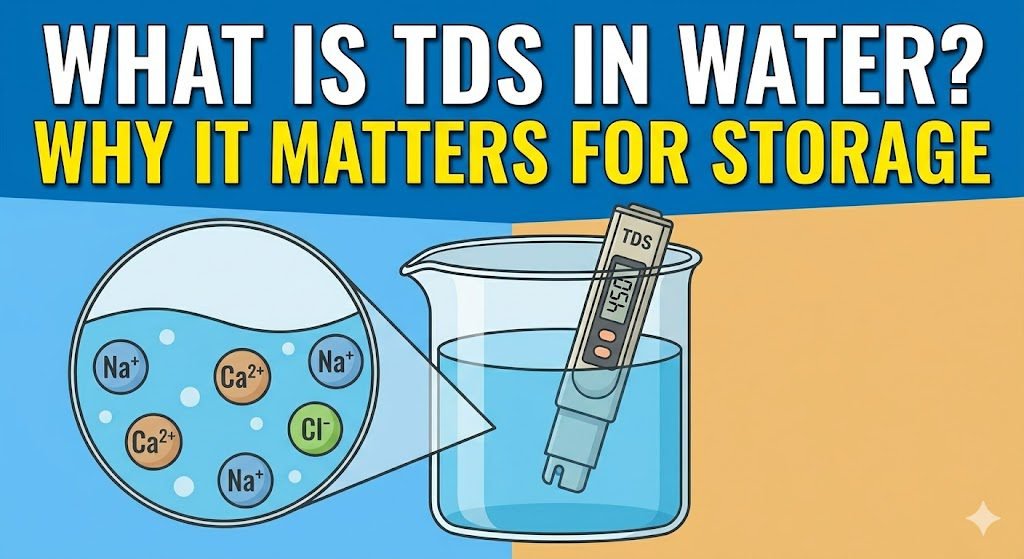
Total Dissolved Solids (TDS) is the combined concentration of all inorganic and organic substances dissolved in water — measured in milligrams per litre (mg/L) or parts per million (ppm), where 1 mg/L = 1 ppm. It includes calcium, magnesium, sodium, potassium, carbonates, chlorides, sulfates, and trace amounts of metals and organics. TDS does not measure bacteria or suspended particles — it specifically captures what is chemically dissolved and invisible to the naked eye.
Use the TDS water calculator to assess your stored water quality against WHO and national drinking standards.
What TDS Levels Mean in Practice
| TDS Level (ppm) | Classification | Taste Profile | Suitable For |
| < 50 | Very low | Flat, bland | Not recommended for prolonged drinking |
| 50–150 | Low | Clean, slightly bland | Drinking, cooking, RO permeate |
| 150–300 | Acceptable | Neutral to pleasant | Ideal for drinking |
| 300–600 | Moderate | Slightly mineral | Acceptable for drinking |
| 600–900 | High | Noticeably mineral | Marginal for drinking; taste complaints common |
| 900–1,200 | Very high | Salty or metallic | Not recommended for drinking |
| > 1,200 | Unsafe | Strongly saline | Unsuitable for human consumption |
WHO does not set a single enforceable TDS limit; instead it classifies palatability, with water rated “good” up to roughly 600 ppm and quality declining noticeably above 300 ppm. Most national standards cap acceptable TDS between 500 and 1,000 ppm. India’s BIS standard sets 500 ppm as desirable and 2,000 ppm as the maximum permissible limit. The US EPA sets a secondary standard of 500 ppm (non-enforceable, taste-based). If stored water is developing an off-taste alongside a rising TDS reading, our guide on why water tastes or smells bad after storage walks through the likely causes.
Why TDS Changes During Tank Storage
Water sitting in a tank does not stay chemically static. Four mechanisms typically drive TDS up over time:
- Evaporation. Open or poorly sealed tanks lose pure water vapour while dissolved solids stay behind, concentrating what remains. As a rough rule, a tank losing 5% of its volume to evaporation will see TDS rise by roughly a similar margin — the relationship isn’t perfectly linear, but it’s close enough to use as a planning estimate.
- Material leaching. Freshly cured concrete tanks add calcium hydroxide and other alkalis, raising both TDS and pH. Corroding iron or galvanised steel tanks contribute iron and zinc ions. Plastic tanks are largely inert but can leach additives if they’re low-grade or UV-degraded.
- Biological activity. In warm, light-exposed, or poorly treated tanks, algae and biofilm growth produce metabolic by-products that add to organic TDS.
- Disinfection by-products. Residual chlorine reacts with organic matter to form by-products that also register as TDS. For the chemistry behind this, see how chlorination of water tanks actually works, and use the chlorine dosage calculator to dose accurately and avoid over-chlorination.
TDS and Storage Safety: What the Number Does Not Tell You
TDS is a proxy measure, not a safety guarantee. Low TDS water is not automatically safe — pathogens, pesticides, and industrial contaminants may be present at dangerous levels while TDS reads below 100 ppm. Conversely, high-TDS water from a mineral-rich aquifer may be microbiologically safe but taste unpleasant and cause scaling in appliances.
TDS testing should always be paired with pH testing and, where there is any doubt about the source, microbiological testing. The water pH adjustment calculator helps correct pH imbalances that often accompany abnormal TDS readings.
For long-term tank storage, TDS alone cannot confirm water is safe to drink after several weeks. Pair TDS readings with a residual chlorine check and a visual inspection — cloudiness, colour change, odour, or a layer of sediment at the bottom of the tank are all signs worth investigating on their own, regardless of what the TDS meter reads.
TDS Thresholds for Specific Uses
| Application | Maximum TDS (ppm) | Notes |
| Drinking water (WHO) | 600 | Taste acceptable up to ~300 ppm |
| Baby formula preparation | < 100 | Low mineral content required |
| Aquarium (freshwater) | < 500 | Species-dependent |
| Hydroponics / irrigation | < 1,500 | Depends on crop type |
| Livestock (cattle) | < 3,000 | Short-term tolerance higher |
| Reverse osmosis membrane | < 2,000 feed | Higher TDS accelerates membrane fouling |
| Boiler/hot water system | < 200 | Scaling risk above this level |
Common Mistakes
Treating TDS as a pass/fail safety test
A TDS reading of 250 ppm tells you the total dissolved load but nothing about what’s dissolved. Arsenic contamination, nitrates, and E. coli are invisible to a TDS meter. Treat TDS as a screening tool and first-line quality indicator — not a definitive safety assessment.
Ignoring TDS rise in sealed tanks during extended storage
Even sealed tanks concentrate dissolved solids slowly over weeks, through minor evaporation at vents and leaching from tank materials. Water stored longer than 30 days should be re-tested. The safe water storage duration calculator estimates how long treated water remains safe under your conditions.
Assuming very low TDS means superior quality
RO-purified or distilled water with near-zero TDS is demineralised. Drinking very low-TDS water over long periods can leach minerals from body tissue and is mildly corrosive to metal plumbing. WHO recommends a minimum of 100 ppm for regular drinking water.
Testing TDS once and assuming it stays constant
TDS shifts with season, supply-source variation, tank condition, and treatment. Test stored water at least quarterly, and again after any change to the supply source or tank.
Related Calculators You Might Need
TDS is one part of a broader water quality picture. If elevated TDS is coming from water hardness, the water hardness calculator will tell you whether scaling is a risk for your appliances and pipes — our guide on how water hardness affects your tank covers the mechanism in more depth. If the storage itself is the source of contamination, the water tank disinfection calculator guides you through a cleaning protocol. For water that requires UV treatment rather than chemical dosing, the UV disinfection tank calculator sizes the system correctly for your flow rate. And if you’re buying a filtration unit to reduce TDS, confirm it can handle your demand with the water filter flow rate calculator.
Frequently Asked Questions
What is a good TDS level for drinking water?
Between 150 and 300 ppm is considered ideal — enough minerals for taste and health, below the threshold where most people notice off-flavours. The 300–600 ppm range is acceptable but may taste noticeably mineral. Above 600 ppm, palatability drops sharply. Below 50 ppm is demineralised and not recommended for regular long-term consumption.
Can high TDS make you sick?
High TDS alone is not acutely toxic for most people — it depends entirely on what’s causing the reading. Elevated TDS from calcium and magnesium is generally harmless. TDS elevated by nitrates, arsenic, heavy metals, or industrial contaminants is a direct health hazard at much lower concentrations. A TDS meter can’t tell these apart; lab analysis is needed to identify specific ions.
How do I reduce TDS in my storage tank?
Treat or replace the water — there’s no shortcut. Reverse osmosis reduces TDS by 90–98%. Distillation removes nearly all dissolved solids. Ion exchange softeners reduce hardness-related TDS. Boiling does not reduce TDS — it concentrates it by driving off pure water as steam. If TDS is rising because the tank itself is leaching, the surface needs cleaning or lining.
Does chlorination affect TDS?
Yes. Chlorine or bleach introduces sodium, chloride ions, and disinfection by-products, all of which raise TDS slightly. A standard shock dose for tank disinfection typically adds 5 to 15 ppm — negligible for most applications, but dosing accuracy still matters. The bleach to water ratio calculator prevents over-dosing that would unnecessarily spike TDS and create off-flavours.
Why does my TDS reading spike after heavy rainfall fills the tank?
Roof runoff carries atmospheric dust, bird droppings, leaf decomposition products, and surface contaminants, all of which dissolve into the collected water and raise TDS. First-flush events — the first few minutes of rainfall — carry the highest contamination load. A first-flush diverter removes the most contaminated initial runoff before it reaches the tank, protecting baseline TDS. After major rain events, re-test TDS before using the stored water for drinking.

Licensed Professional Engineer (Texas, PE) with 13+ years in residential and light-commercial water storage systems. Reviews and writes the technical guides on this site — sizing, pressure, roof loading, and treatment — based on 180+ completed field projects.