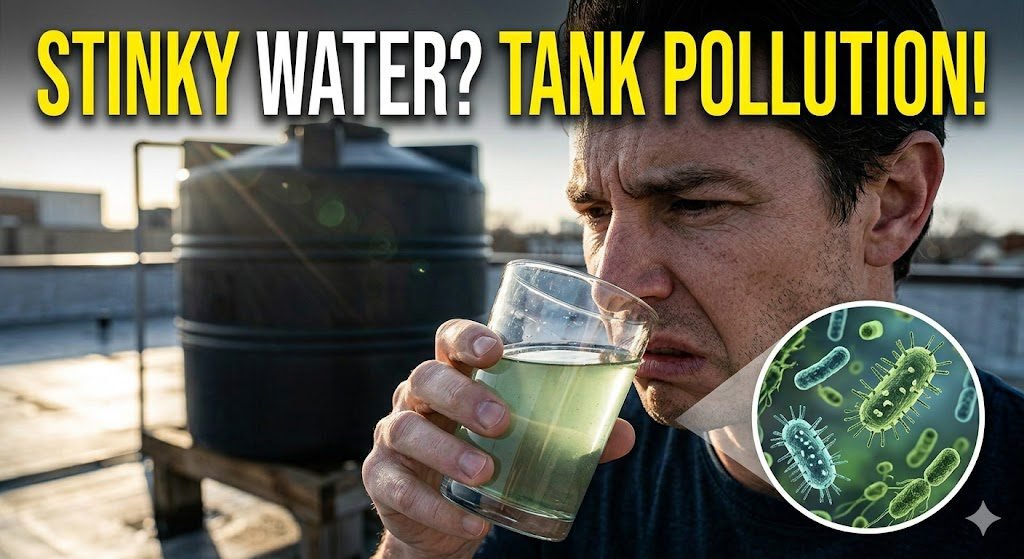
Bad taste or smell in stored water is almost always caused by one of three things: bacterial growth, chlorine dissipation, or contamination from the tank itself. Municipal water typically contains 0.2–0.5 mg/L of residual chlorine at the tap — enough to suppress bacterial growth for 24–48 hours in a clean container. In a large, poorly sealed, or infrequently cleaned rooftop tank, that chlorine is gone within hours, leaving the water unprotected. Use the safe water storage duration calculator to find out how long your tank water is actually safe to use.
The Quick Answer
Water stored in a tank begins to degrade in quality once residual disinfectant is depleted. Under typical conditions — 25–35°C ambient, a partially sealed tank — this takes 12–48 hours for municipal supply. Groundwater with no initial chlorine degrades faster. The key factors are temperature (bacterial doubling time is 20 minutes at 37°C), light exposure, and tank cleanliness.
| Symptom | Most Likely Cause | Test to Confirm |
| Earthy or musty smell | Algae or bacterial biofilm | Inspect tank interior for green/black deposits |
| Rotten egg / sulphur smell | Hydrogen sulphide from anaerobic bacteria | H2S test strip or lab sample |
| Chlorine smell (strong) | Over-dosing during cleaning | Chlorine test strip — above 5 mg/L is excessive |
| Plastic or chemical taste | Tank material leaching | Check tank age, UV damage, food-grade certification |
| Metallic taste | Corroded pipes or steel tank | pH and TDS test; inspect pipe interiors |
| Flat or stale taste | Chlorine dissipated; low dissolved oxygen | Residual chlorine test — target 0.2–0.5 mg/L |
Skip the math: Use the chlorine dosage calculator to determine exactly how much chlorine to add to your tank to restore safe residual levels without over-treating.
How Water Degrades in Storage
When chlorinated municipal water enters a storage tank, residual chlorine begins breaking down through contact with organic matter, UV light, heat, and the tank surface area — the same mechanism explained in more detail in how chlorination of water tanks actually works. The rate is governed by the first-order decay equation: Ct = C0 × e^(-k×t), where C0 is initial chlorine concentration, k is the decay constant (typically 0.01–0.1 per hour depending on temperature and contamination), and t is time in hours.
At 30°C in a moderately contaminated tank (k near the upper end of that range, around 0.1/hour), residual chlorine can drop from 0.5 mg/L to below 0.1 mg/L (the WHO minimum) in roughly 16 hours — and can fall faster still in tanks with heavier organic contamination than this simplified model assumes. Once residual chlorine is gone, any bacteria present double approximately every 20 minutes at body temperature — a colony of 100 bacteria can become 100,000 in just over 3 hours under ideal conditions.
Algae require light. An uncovered or translucent tank exposed to sunlight will develop algal growth within days during warm weather. Algae themselves are not typically harmful at low counts, but they produce earthy, musty compounds (geosmin and 2-methylisoborneol) that are detectable by humans at concentrations as low as 5 nanograms per litre.
Diagnosing Your Specific Problem
Cause 1: Bacterial biofilm (musty, earthy, or faecal smell). Open your tank (safely, with a torch) and inspect the interior walls. A healthy tank has no visible deposits. Visible slime, dark patches, or a slimy film on the inlet pipe or walls confirms biofilm. The fix is a full tank disinfection using the water tank disinfection calculator to determine the right dose. The AWWA C652 standard for storage tank disinfection specifies 50 mg/L of free chlorine held for at least 6 hours (or a higher dose for shorter contact times) as one accepted method.
Cause 2: Hydrogen sulphide (rotten egg smell). This occurs when sulphate-reducing bacteria colonise the tank under anaerobic (oxygen-poor) conditions — typically in large, stagnant tanks where the bottom water is rarely turned over, and often alongside visible sediment at the bottom of the tank. The sulphur smell is unmistakable. H2S is not harmful at trace concentrations but indicates serious bacterial contamination. Resolution requires complete draining, scrubbing with a 200 mg/L chlorine solution, and improved tank turnover — ideally, the tank should be emptied and refilled within 48 hours under normal usage.
Cause 3: Tank material leaching (plastic or chemical taste). Polyethylene tanks certified to NSF/ANSI 61 or equivalent (IS 12701 in India) should not leach chemicals into water at normal temperatures. Tanks that are UV-degraded (surface becomes chalky or brittle) or older than 15–20 years may develop micro-fissures that harbour bacteria and alter taste. High-density polyethylene (HDPE) food-grade tanks are safe; recycled or uncertified plastic tanks are not.
Key Variables That Change the Answer
Temperature. Bacterial growth rate roughly doubles with every 10°C rise in temperature. A tank in a hot climate (35–40°C ambient, 45°C on direct sun) provides ideal conditions for rapid bacterial growth. In temperate climates, the same tank will remain acceptable for significantly longer.
Tank coverage and sealing. An open or poorly sealed tank is continuously exposed to airborne contamination, insects, and bird droppings. Each exposure introduces additional bacteria and organic matter that accelerates chlorine consumption. A properly sealed tank with a tight-fitting lid and inlet mesh reduces contamination load significantly.
Initial water quality. Groundwater from a borehole or well has no residual chlorine and typically carries higher bacterial and mineral loads than treated municipal supply. Stored borehole water without treatment will degrade to unsafe quality within 6–12 hours at 30°C. The TDS water calculator can help assess your source water quality — see also what TDS is and why it matters for storage for what that reading does and doesn’t tell you.
Tank cleaning frequency. WHO recommends cleaning rooftop tanks every 6 months. In practice, most household tanks in South Asia and Africa are cleaned once a year or less — often never. A 2-year-old uncleaned tank will have a substantial biofilm layer that provides both a bacterial reservoir and a chlorine sink.
Pipe material. Old galvanised steel pipes add iron and zinc to stored water, producing a metallic taste and elevated TDS. Copper pipes contribute a slight metallic taste in soft water. PVC and CPVC pipes are neutral for taste if food-grade certified — and if hardness rather than pipe corrosion is the underlying cause of a mineral taste, see how water hardness affects your tank.
Common Mistakes
Adding too much chlorine when cleaning is a common overcorrection. A common belief is that more chlorine means safer water. Above 5 mg/L of free residual chlorine, water tastes strongly chemical and may produce disinfection byproducts (trihalomethanes) at elevated levels. The bleach to water ratio calculator helps determine the correct dilution from household bleach. After tank disinfection, the tank must be flushed thoroughly before returning to use.
Cleaning the tank without addressing the root cause solves the symptom, not the problem. Cleaning removes biofilm but does not prevent it returning. If the tank inlet is not screened, the lid is not sealed, or turnover time is over 72 hours, biofilm will re-establish within weeks. Fix the conditions, not just the symptom.
Assuming cold water is always safe overlooks one specific risk. Water from an underground cistern may remain below 15°C — too cold for rapid bacterial growth. However, it can still harbour Legionella species, which thrive at 25–45°C when the water warms during distribution through hot pipes. Legionella risk is primarily a concern in institutional, commercial, or large residential systems with long pipe runs.
Not testing before assuming the problem is bacterial leads to treating the wrong issue. A metallic taste is not bacteria. A chemical smell from new pipes is not bacteria. Treating with chlorine for a problem caused by pipe corrosion or material off-gassing will not resolve it. Use a basic water test kit (available for $5–15) to check TDS, pH, hardness, and chlorine residual before treating. The water hardness calculator and water pH adjustment calculator can help diagnose mineral-based taste issues.
Related Calculators You Might Need
If you’ve confirmed bacterial contamination, the chlorine dosage calculator is the fastest route to a treatment dose based on your tank volume. For large tanks where you need to establish an ongoing maintenance schedule, the safe water storage duration calculator will tell you how frequently your tank should be cycled or retreated under your local temperature conditions. If you’re considering UV disinfection as a longer-term solution, the UV disinfection tank calculator helps size the right system — see also how UV disinfection works for stored water for how it compares to chlorination. And if your taste problem turns out to be hardness or mineral-based rather than bacterial, start with the water hardness calculator.
Frequently Asked Questions
How often should I clean my water storage tank?
WHO recommends every 6 months for household tanks. In climates above 30°C with hard water or significant sediment, quarterly cleaning is better practice. Commercial and institutional tanks should be cleaned and tested every 3 months. The 6-month cycle is a minimum, not an optimal schedule.
Is it safe to drink water that smells slightly of chlorine?
Yes, if the chlorine smell is faint (0.2–0.5 mg/L range). WHO’s guideline value for residual chlorine is 5 mg/L as a health limit, though taste becomes objectionable at 0.6–0.8 mg/L for most people. If the smell is very strong, the concentration is likely above 2 mg/L — allow the water to stand uncovered for 30 minutes or use a carbon filter.
Why does my water smell fine from the tap but bad from the tank?
The tank environment — heat, low turnover, biofilm surface area — accelerates chlorine decay and bacterial growth that doesn’t occur in pressurised mains pipes. The water is the same at both points, but the tank changes it. This almost always means the tank needs cleaning and the chlorine residual needs restoration.
Can algae in a water tank make you sick?
Common green algae at low concentrations are not directly harmful, but they create an earthy taste and indicate an unsealed or light-exposed tank. More concerning are cyanobacteria (blue-green algae), which produce toxins at higher concentrations. If the water turns green or blue-green, do not use it for drinking and disinfect the tank immediately.
What does a sulphur smell in tank water mean?
Hydrogen sulphide gas, produced by anaerobic sulphate-reducing bacteria colonising sediment at the bottom of the tank. It means the tank is severely contaminated and the water is not safe for drinking. The tank needs to be drained, scrubbed, and disinfected with a 200 mg/L chlorine solution before returning to service.

Licensed Professional Engineer (Texas, PE) with 13+ years in residential and light-commercial water storage systems. Reviews and writes the technical guides on this site — sizing, pressure, roof loading, and treatment — based on 180+ completed field projects.