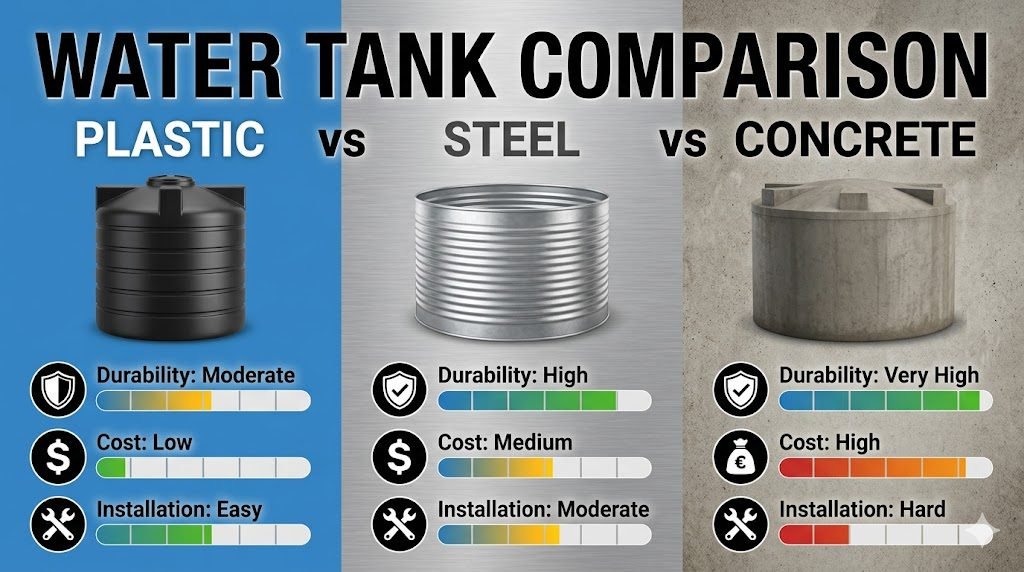
For most households and small commercial sites, HDPE plastic tanks deliver the best value: lowest upfront cost, easiest installation, and adequate lifespan for most use cases. Steel wins on fire resistance and aesthetics in commercial settings. Concrete is the right call only when permanence and very high capacity are the primary requirements. This article breaks down all three across cost, durability, maintenance, safety, and climate suitability so you can make a call that holds up over decades. If you’re specifically deciding between plastic sub-types, our guide on polyethylene vs fibreglass water tanks goes deeper on that comparison.
The quick answer
Plastic tanks dominate residential markets globally because they are cheap, light, and food-safe. Galvanised steel tanks serve farms and light industry where structural durability matters. Reinforced concrete tanks are built when nothing else will survive the environment — underground cisterns, bushfire zones, high-load commercial sites. Use the Plastic vs Steel Tank Cost Calculator to run a side-by-side cost comparison for your specific capacity and region.
| Factor | Plastic (HDPE/PP) | Steel (GI/SS) | Concrete (RCC) |
| Cost (1,000L) | $50–$150 | $120–$400 | $180–$600+ |
| Lifespan | 10–25 years | 15–30 years | 30–50+ years |
| Weight (empty, 1,000L) | 8–25 kg | 60–120 kg | 500–1,000 kg |
| Installation | DIY-possible | Skilled labour needed | Civil work required |
| Maintenance | Low | Moderate (rust risk) | Low (seal/crack checks) |
| Algae risk | High (translucent) | Low | Low |
| Taste/odour risk | Low (food-grade) | Moderate (galvanised) | Low (lined) |
| BPA risk | None (HDPE/PP) | None | None |
| Seismic risk | Low (flexible) | Moderate | High (brittle) |
| Recyclable | Yes (partially) | Yes (fully) | No |
All cost ranges are indicative for a 1,000-litre tank installed in a residential setting. Regional prices vary by up to 40%.
How the calculation works
Tank material selection is not purely a cost decision — it is a total cost of ownership calculation. The variables are: upfront purchase price, installation labour, maintenance over the expected lifespan, likelihood of early failure, and replacement cost.
A simple total cost of ownership (TCO) formula: TCO = Purchase price + Installation cost + (Annual maintenance cost × lifespan in years) + (Replacement cost if lifespan exceeded).
Worked example for a 5,000-litre tank, 20-year horizon, warm-climate residential site:
Plastic (HDPE): $400 purchase + $100 installation + ($20/year × 20 years) = $900 total. Expected lifespan: 15–20 years. One replacement likely over 40 years.
Steel (galvanised): $900 purchase + $350 installation + ($80/year × 20 years) = $2,850 total. Includes annual rust inspection and repainting every 7–10 years.
Concrete: $2,000 construction + $1,000 civil labour + ($30/year × 20 years) = $3,600 total. Lifespan 40–50 years means no replacement on that horizon — TCO per year is competitive over longer timescales.
Key variables that change the answer
Climate and UV exposure. UV radiation degrades standard polyethylene over 10–15 years. UV-stabilised HDPE tanks extend this to 20–25 years. In tropical zones above 25°C mean annual temperature, plastic tank walls can soften and deform if water is stored above ground without shade. Steel and concrete are immune to UV degradation but concrete cracks under thermal cycling — a 30°C daily temperature swing increases crack propagation compared to stable-temperature environments (ACI 350 guidance).
Seismic zone. In high seismic zones (IS 1893 / ASCE 7), unreinforced concrete tanks above ground fail catastrophically under lateral loading. HDPE flexes and survives. Steel tanks anchored to a pad survive if the anchor bolts are rated correctly. If you are in a high-seismic zone, plastic or properly anchored steel is the default recommendation.
Firefighting requirements. Australian bushfire-prone areas (BAL-40 and above) typically require steel or concrete tanks. AS 3959 fire exposure testing shows standard HDPE tanks can deform and fail under sustained radiant heat exposure well below the temperatures a bushfire front can generate. Steel tanks survive direct flame impingement for extended periods without structural failure.
Water quality — hardness and pH. Hard water (above 200 mg/L CaCO3) accelerates scale buildup in galvanised steel tanks and can corrode the zinc coating, releasing zinc at levels above WHO’s aesthetic guideline of 3 mg/L. Concrete tanks leach lime into stored water initially, raising pH to 10–12 for the first 2–3 filling cycles. Plastic is pH-neutral and scale-resistant across the full potable water range. See our guide on how water hardness affects storage for more on how this interacts with tank material.
Roof loading. A 1,000-litre concrete tank fully loaded weighs approximately 2,500 kg including structure. A comparable HDPE tank weighs approximately 1,020 kg. Most residential roof slabs in South Asia are designed for 150–200 kg/m² live load. No 1,000-litre concrete tank should be placed on a residential rooftop without a structural engineer’s sign-off — see will my roof hold a full water tank for what to check first. Use the Rooftop Load Bearing Calculator before specifying any overhead storage tank.
Common mistakes
Buying a translucent plastic tank. Light penetration drives algae growth. Blue or black HDPE tanks block the great majority of light; translucent white or yellow tanks let significantly more light through. Algae blooms are not just aesthetic — they consume dissolved oxygen and can produce toxins. Always specify opaque tanks. If you already have a translucent tank, paint the exterior with food-safe reflective paint.
Installing a galvanised tank without pH testing the water. Galvanised steel corrodes rapidly below pH 6.5. Water in granite-geology catchments frequently sits at pH 5.5–6.0. At that level, a galvanised tank can shed zinc at several times the WHO aesthetic guideline within 12 months. Check water pH with the Water pH Adjustment Calculator and treat if needed, or switch to stainless steel or HDPE.
Skipping curing on new concrete tanks. Uncured concrete leaches calcium hydroxide, pushing stored water above pH 11. At that pH, chlorine disinfection is significantly less effective and water tastes strongly alkaline. Cure new concrete tanks by filling and draining three times, or applying a food-grade epoxy liner before commissioning — our guide on how chlorination of water tanks actually works explains why pH matters so much for disinfection.
Using tank volume as the only sizing criterion. Material choice affects how you should size the tank. Concrete tanks are typically oversized at construction because adding capacity later is nearly impossible. HDPE tanks can be added in series cheaply. If your requirements might grow — more occupants, irrigation expansion — size for future demand now if choosing concrete, or buy modular plastic and expand later. Our guide on single large tank vs multiple small tanks covers this trade-off in more detail.
Related calculators you might need
Before purchasing, confirm the numbers hold up. The Water Tank Cost Calculator gives a full purchase and installation estimate by material type and capacity. If the tank is going on a roof, the Safe Rooftop Tank Load Calculator will tell you whether your slab can handle the filled weight before you commit. For treatment planning — particularly relevant for steel and new concrete tanks — the Water Hardness Calculator and TDS Water Calculator will flag whether your source water is corrosive or scaling.
Frequently asked questions
How long does a plastic water tank last? Food-grade HDPE tanks last 10–25 years depending on UV exposure, water chemistry, and whether the tank was manufactured with UV stabilisers. Cheap tanks without UV inhibitors in tropical climates can fail in 7–10 years. Premium brands with UV-stabilised HDPE and 10-year warranties are widely available and worth the 20–30% price premium.
Are plastic water tanks safe for drinking water? Yes, provided the tank is manufactured from food-grade polyethylene (HDPE or PP) and marked as such. The material itself does not leach harmful chemicals into water under normal storage conditions. BPA is not present in HDPE or PP — it is associated with polycarbonate (PC), which is not used in water storage tanks.
Which is better for a rooftop water tank — plastic or steel? Plastic (HDPE) is the correct default for rooftop installation. A 2,000-litre HDPE tank weighs approximately 30–40 kg empty vs 150–200 kg for a comparable steel tank. Lighter structure means lower structural load on the slab, lower installation cost, and no risk of rust staining. Confirm the filled weight is within your roof’s rated capacity using the Water Tank Weight Calculator.
Do concrete tanks need to be lined? Not always, but lining is recommended for potable water storage. Bare concrete leaches lime during the first several months of use. A food-grade epoxy or polyurea coating applied to the interior eliminates this and adds 10–15 years to the effective life of the tank. Cost is typically $8–$25 per square metre of internal surface, depending on tank size and coating type.
What is the most durable water tank material? For structural longevity: reinforced concrete tanks correctly built and lined last 50+ years with minimal maintenance. For practical durability in residential settings accounting for cost, repairability, and ease of installation: UV-stabilised HDPE with a 20+ year warranty from a reputable manufacturer is the most pragmatic choice for the vast majority of homeowners.

Licensed Professional Engineer (Texas, PE) with 13+ years in residential and light-commercial water storage systems. Reviews and writes the technical guides on this site — sizing, pressure, roof loading, and treatment — based on 180+ completed field projects.