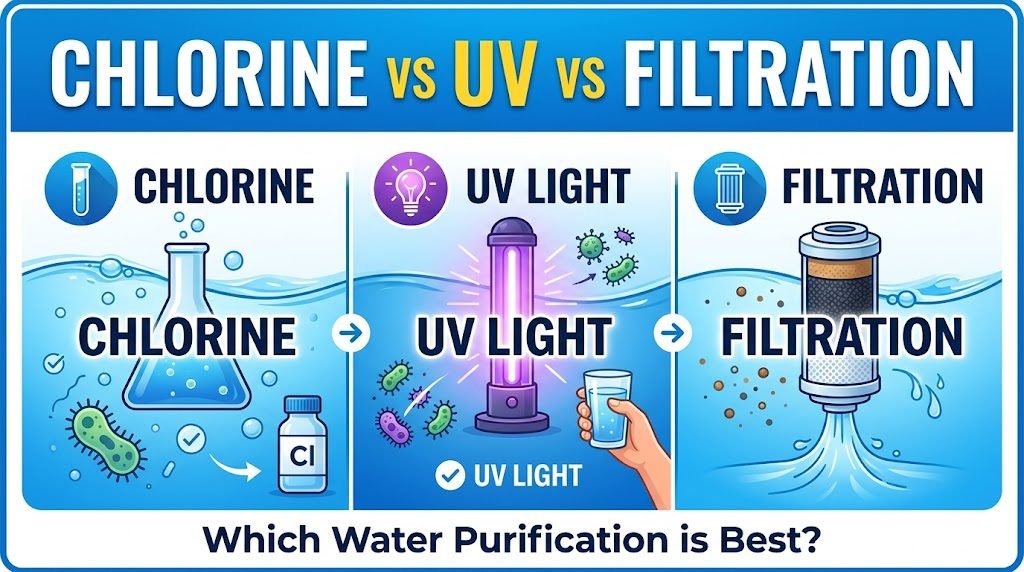
No single method is best in all situations. Chlorination is the most cost-effective choice for large-volume tank disinfection and provides residual protection during storage. UV disinfection kills pathogens without chemicals and adds no taste or by-products, but leaves no residual protection once water leaves the UV unit. Filtration removes physical particulates and some chemical contaminants that neither chlorine nor UV can address, but is not a standalone disinfectant. Most robust water treatment systems combine at least two of these methods. For background on each method individually, see our guides on how chlorination of water tanks actually works and how UV disinfection works for stored water.
If you are dealing with stored tank water, start by calculating your disinfection requirements with the water tank disinfection calculator, which gives you the correct treatment volume and contact time for your specific tank size and contamination level.
How Each Method Works
Chlorination introduces chlorine (as liquid sodium hypochlorite, granular calcium hypochlorite, or chlorine gas in municipal applications) into the water. Chlorine reacts with microbial cell walls and enzymes, killing bacteria, most viruses, and some protozoa within minutes at the correct dosage. A residual concentration of 0.2–0.5 mg/L free chlorine in stored water prevents regrowth during the storage period — the key advantage over other methods. At concentrations above 1 mg/L, taste and odour become noticeable to most people. An alternative oxidant used for some of the same purposes, particularly iron and manganese removal, is potassium permanganate — see our guide on potassium permanganate water treatment for how it compares.
UV disinfection exposes water to ultraviolet light at 254 nm wavelength, which damages the DNA and RNA of microorganisms, rendering them unable to reproduce. It is highly effective against Giardia and Cryptosporidium, which are chlorine-resistant protozoan cysts that resist standard chlorination doses. UV adds no chemicals and alters no taste. Its critical limitation: it provides no residual protection — water treated by UV can be immediately recontaminated if the pipe, tank, or fitting downstream is contaminated.
Filtration is a physical or chemical separation process. Sediment filters (5–50 micron) remove suspended particles. Activated carbon filters adsorb chlorine, organic compounds, and some heavy metals. Ceramic filters (0.2–0.5 micron) can physically block bacteria. Reverse osmosis (RO) removes dissolved salts, nitrates, heavy metals, and most organic compounds. Filtration does not reliably kill pathogens unless the filter pore size is below 0.1 micron (ultrafiltration or nanofiltration territory). Most domestic filters are not rated for viral removal.
Comparison: Chlorine vs UV vs Filtration
| Property | Chlorination | UV Disinfection | Filtration |
| Kills bacteria | Yes | Yes | Partially (ceramic <0.5 µm) |
| Kills viruses | Yes (most) | Yes, at sufficient dose | No (except UF/NF membranes) |
| Kills protozoa (Giardia, Crypto) | Partial (high dose) | Yes | Partially (ceramic) |
| Removes sediment/turbidity | No | No | Yes (sediment filter) |
| Removes chemicals/heavy metals | No | No | Partially (activated carbon, RO) |
| Residual protection in storage | Yes (0.2–0.5 mg/L) | No | No |
| Adds taste/odour | Yes (at high doses) | No | No (removes chlorine taste) |
| Works on turbid water | Reduced efficacy | Reduced efficacy | Yes (sediment filter first) |
| Ongoing cost | Low ($5–30/year for small tank) | Medium (lamp replacement: $50–150/year) | Medium–High (filter replacement) |
| Power required | No | Yes (continuous) | No (except RO pumps) |
| Setup cost | Very low | $200–1,500 | $50–2,000+ |
When to Use Chlorination
Chlorination is the standard treatment for stored tank water — rainwater tanks, emergency reserves, agricultural storage, and any tank that holds water for more than 24–48 hours before use. The residual chlorine prevents regrowth of bacteria during the storage period, which no other single treatment method offers.
Use the chlorine dosage calculator to determine the correct dose for your tank volume and target residual. Overdosing produces disinfection by-products (trihalomethanes) at concentrations that may exceed WHO guidelines. Underdosing leaves the water vulnerable to regrowth. The target residual for potable water storage is 0.2–0.5 mg/L free chlorine after a minimum 30-minute contact time.
Chlorination is less effective in turbid water. Suspended particles shield pathogens from chlorine contact. If your source water is turbid, filter to remove sediment before chlorinating — a 5-micron sediment pre-filter is sufficient for most cases.
When to Use UV Disinfection
UV is the right choice for point-of-use treatment in systems where water quality is already reasonably good and the primary concern is bacterial and protozoan contamination at the final delivery point — a tap, a bottling point, or a cooking water supply. It is the preferred method where no chemical residuals are acceptable (food production, brewing, some healthcare applications).
UV is also the treatment of choice for Cryptosporidium and Giardia, which are resistant to standard chlorination doses and are a significant risk in surface water and poorly protected rainwater supplies. A UV dose of 40 mJ/cm² (the NSF/ANSI 55 Class A benchmark used in most point-of-use systems) comfortably exceeds the roughly 12 mJ/cm² that EPA guidance identifies as sufficient for 4-log (99.99%) inactivation of Cryptosporidium and Giardia. Viruses are considerably more UV-resistant, however — EPA guidance places 4-log virus inactivation at around 186 mJ/cm², so a standard 40 mJ/cm² point-of-use system should not be relied on for high-level virus reduction on its own.
Critical constraint: UV efficacy drops sharply as turbidity or colour (UV absorbance) increases. Water must have a UV transmittance above 75% for standard UV systems to meet their rated dose. Pre-filter turbid water before UV treatment. Check lamp condition and sleeve fouling at least every 6 months — a fouled quartz sleeve can reduce UV output by 50–80%.
When Filtration Alone Is and Is Not Sufficient
Filtration alone is sufficient for removing physical and chemical contaminants — sediment, chlorine taste, certain heavy metals, nitrates (with RO). It is not sufficient as a standalone disinfection method for water at risk of pathogen contamination. The common mistake is using an activated carbon filter and assuming the water is safe to drink without a disinfection step — carbon filters actively create favourable conditions for bacterial growth if not maintained, as the carbon surface provides attachment points and the filter captures organic nutrients.
Common Mistakes
Using UV on turbid water without pre-filtration. UV light is scattered by suspended particles, reducing the dose reaching pathogens. Water with turbidity above 1 NTU (nephelometric turbidity units) significantly compromises UV efficacy. Always install a sediment pre-filter (5 micron or finer) upstream of any UV unit.
Chlorinating without checking pH. Chlorine’s disinfecting form — hypochlorous acid (HOCl) — is pH-dependent. At pH 7.5, roughly 50% of free chlorine is in the effective HOCl form. At pH 8.5, the effective fraction drops to well under 20%. Stored rainwater and some borehole sources have pH above 8. Check pH before chlorinating and adjust if above 7.8 for effective treatment. Use the water pH adjustment calculator to determine the acid dose needed.
Forgetting UV lamp replacement schedules. UV lamps degrade gradually — most have a rated output life of 9,000–12,000 hours (approximately 12–16 months of continuous operation). A lamp near end-of-life may still illuminate but deliver only 60–70% of its rated UV dose, which may fall below the minimum required for reliable pathogen inactivation. Replace lamps on schedule, not when they visibly fail.
Treating water once and assuming ongoing safety. Chlorine dissipates over time. A tank chlorinated to 0.5 mg/L will drop below 0.2 mg/L within 3–7 days under typical conditions, depending on temperature, light exposure, and organic loading. Check residual chlorine with a test kit and re-dose if it falls below 0.2 mg/L. Use the safe water storage duration calculator to estimate how long your treated water remains safe before re-treatment is needed — and see our guide on why water tastes or smells bad after storage for the signs that residual has already dropped too low.
Related Calculators You Might Need
For tank chlorination, the bleach to water ratio calculator converts household bleach concentration to the correct volume for your tank. If your water source has elevated TDS (dissolved solids), the TDS water calculator helps you understand whether filtration or a different source is needed before disinfection — our guide on what TDS is and why it matters for storage explains what the number actually means. For UV sizing, the UV disinfection tank calculator determines the correct UV unit specification for your flow rate. And where hard water scaling is a concern — particularly for UV quartz sleeves and filter membranes — the water hardness calculator quantifies scale risk and helps plan softening requirements, with more detail in our guide on water hardness and how it affects your system.
Frequently Asked Questions
Which is better, UV or chlorine for drinking water? For point-of-use treatment in a reliable piped supply, UV is preferred — no chemical taste, no by-products, effective against Giardia and Cryptosporidium. For stored tank water that sits for days before use, chlorine is better because it provides residual protection against regrowth. In practice, the most robust home systems use both: chlorinate the tank for storage protection and install a UV unit at the final tap for point-of-use assurance.
Is filtered water the same as purified water? No. Filtered water has had physical and some chemical contaminants removed, but may still contain viruses and bacteria unless the filter is rated for biological removal (ultrafiltration at 0.01 micron or below). Purified water — in the regulatory sense — has been treated to meet or exceed drinking water standards for microbial, chemical, and physical parameters. Standard domestic filters do not produce purified water without an additional disinfection step.
How much chlorine do I put in a 1,000-litre water tank? For routine disinfection of a clean tank, you need approximately 5 mg of free chlorine per litre to achieve a contact-time dose sufficient for pathogen inactivation, then allow the residual to drop to 0.2–0.5 mg/L for storage. Using standard 5% sodium hypochlorite bleach (roughly 50,000 mg/L available chlorine), this works out to approximately 100 mL per 1,000 litres for the initial shock dose, targeting a residual of 0.5 mg/L after 30 minutes. Use the chlorine dosage calculator for a precise dose based on your bleach concentration and target residual.
Do I need a sediment filter before UV? Almost always. UV efficacy depends on water clarity — particles scatter and absorb UV light, shielding pathogens. Most UV manufacturers specify a maximum turbidity of 1 NTU and UV transmittance above 75% for the unit to deliver its rated dose. A 5-micron sediment pre-filter upstream of the UV unit is standard practice and costs $20–60 to install.
How long does chlorine last in a water tank? At 0.5 mg/L initial dosage, free chlorine typically falls below 0.2 mg/L within 3–7 days in an outdoor tank at 20–30°C. Warmer temperatures, sunlight, and higher organic loads accelerate dissipation. Indoor tanks or insulated underground tanks retain chlorine residual longer — up to 14 days in cool, dark conditions. Test with a pool test kit and re-dose when the residual drops below 0.2 mg/L.