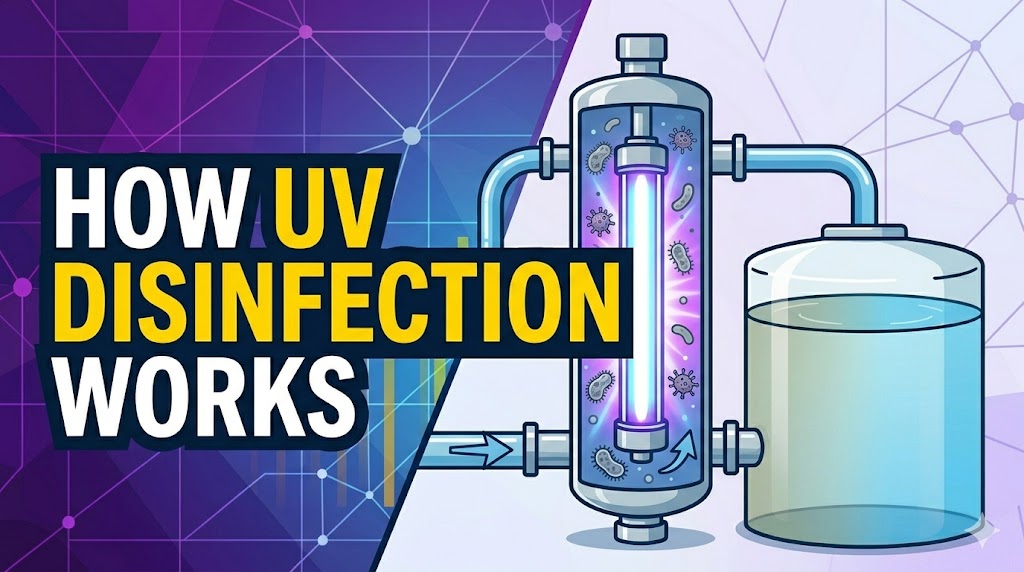
UV disinfection inactivates bacteria, viruses, and protozoa by exposing them to ultraviolet light at 254 nanometres — the wavelength at which UV energy most efficiently damages microbial DNA, preventing reproduction. It does not add chemicals, does not alter taste or pH, and leaves no residual in the water. For stored water that is then distributed through a pipe system, UV must be used as a point-of-entry treatment — at the outlet from the tank, not inside the tank itself. Understanding this distinction, plus the UV dose required for effective disinfection, is critical to sizing and operating a system correctly.
The quick answer
UV dose is measured in millijoules per square centimetre (mJ/cm²). The dose required depends on the target organism. EPA and NSF/ANSI Standard 55 require a minimum of 40 mJ/cm² for UV systems certified for drinking water treatment. This achieves a 4-log (99.99%) reduction in bacteria and viruses. Cryptosporidium and Giardia — protozoa resistant to chlorine — are inactivated at doses as low as 10–12 mJ/cm², making UV one of the few practical treatments for these pathogens in point-of-use systems (NSF/ANSI 55, Class A).
| Organism | Log reduction target | UV dose required (mJ/cm²) | Notes |
| E. coli / bacteria | 4-log (99.99%) | 6–16 | Low dose required |
| Viruses | 4-log (99.99%) | 40–100 | NSF 55 Class A minimum: 40 |
| Cryptosporidium | 2-log (99%) | 5–10 | Chlorine-resistant; UV effective |
| Giardia | 3-log (99.9%) | 11–22 | Chlorine-resistant at normal doses |
Use the UV disinfection tank calculator to determine the correct UV system flow rate for your tank’s output and verify whether your existing unit is appropriately sized.
How the UV disinfection mechanism works
UV-C light at 254 nm is absorbed by the nucleic acids in microbial DNA and RNA. This energy causes adjacent thymine bases to bond to each other (thymine dimers), creating physical damage that prevents the DNA strand from being replicated during cell division. The organism is effectively sterilised — it cannot reproduce even if it remains present in the water. Unlike chlorine, which chemically destroys the cell, UV does not physically destroy the microorganism’s body, which is why turbidity is the critical limiting factor for UV systems.
If suspended particles are present — sediment, algae, organic matter — microorganisms can shelter inside or behind particles and receive insufficient UV dose. This is called shadowing. For this reason, UV systems are always installed after filtration. Most manufacturers require water turbidity below 1 NTU (Nephelometric Turbidity Unit) and UVT (UV transmittance) above 75% for reliable performance at rated dose.
Key variables that change UV system performance
Flow rate. UV dose = lamp output (mW/cm²) × exposure time (seconds). Exposure time depends on how long the water spends in the UV chamber, which is determined by flow rate and chamber volume. If flow rate doubles, exposure time halves, and UV dose halves. This is why UV systems are rated to a maximum flow rate — never exceed it. Undersized UV units used above their rated flow deliver insufficient dose regardless of lamp wattage. Use the water flow rate calculator to determine peak demand flow before selecting a UV system.
Lamp intensity and age. UV lamps degrade over time. Most manufacturers specify lamp replacement at 9,000–12,000 hours of operation (~1 year of continuous use). At end of life, lamp output can drop to 60–70% of initial intensity — below the threshold for reliable 40 mJ/cm² delivery. UV intensity sensors and lamp-hour counters are standard on quality systems; never operate a UV system beyond its rated lamp life without replacing the lamp.
Water UV transmittance (UVT). Different water sources have very different UV transmittance. High iron (above 0.3 mg/L), natural organic matter, tannins from surface water, and turbidity all reduce UVT. Manufacturers rate UV systems at a specified UVT — typically 75–95%. If your water has lower UVT, the effective dose is reduced proportionally. Pre-treatment with activated carbon filtration typically improves UVT significantly for surface-water-derived supply.
Temperature. Low-pressure mercury UV lamps produce optimal output at a lamp temperature of around 40°C. In cold-water installations (below 10°C), lamp output can drop 20–30% unless the unit has a temperature-compensated sleeve. High-output amalgam lamps are more temperature-stable and preferred for cold climates or high-flow installations.
UV disinfection versus chlorination: when to use each
| Factor | UV disinfection | Chlorination |
| Residual protection | None — must be point-of-entry | Residual persists in tank and pipes |
| Cryptosporidium / Giardia | Effective at low dose | Ineffective at normal doses |
| Turbid water | Not suitable without pre-filtration | Reduced but still some effect |
| Taste / odour change | None | Detectable above 0.6 mg/L |
| Ongoing chemical cost | None (electricity only) | Chlorine cost ongoing |
| Suitable for long storage | No — treats at point of use only | Yes — maintains residual |
For stored water in a tank that is refilled periodically and distributed over hours or days, chlorination with a maintained residual is the appropriate primary treatment. UV is best suited as a point-of-entry final polishing step before consumption, installed on the outlet pipe from the tank. In areas with Cryptosporidium risk — particularly surface water sources — combining both chlorination (for residual) and UV (for protozoa) is the recommended approach (WHO Guidelines for Drinking-water Quality, 2022).
Common mistakes
Installing UV inside or on the tank instead of on the outlet pipe. UV treats water that passes through the lamp chamber at the time of treatment. It does not create a disinfected environment in the tank — any water that bypasses the lamp (re-contamination, settling, biofilm growth) is untreated. The unit must be installed on the pipe delivering water to points of consumption, not inside the storage vessel.
Not replacing lamps on schedule. Running a UV lamp beyond 12,000 hours — or one year of continuous operation — does not simply reduce effectiveness gradually. Output can collapse rapidly as the quartz sleeve ages and the mercury distribution changes. Many users operate on the assumption that a functioning lamp is an effective lamp. Install a lamp-hour counter and treat replacement as non-optional maintenance.
Installing UV before filtration. UV must be the final treatment step, after sediment filtration and activated carbon (if required for UVT improvement). Installing UV upstream of a filter exposes the treated water to re-contamination from the filter. The correct order is: pre-filtration (sediment) → activated carbon (if needed) → UV lamp → point of use.
Ignoring quartz sleeve fouling. The quartz sleeve surrounds the UV lamp and must be transparent to UV-C. Iron deposits, calcium carbonate scaling, and biofilm on the sleeve block UV transmission and reduce dose delivered to the water. Clean the sleeve with citric acid solution every 3–6 months depending on water quality. A fouled sleeve can reduce effective dose by 50% or more while the lamp appears to be functioning normally.
Related calculators you might need
Before installing a UV system, verify that your water’s turbidity and quality are suitable using the TDS water calculator as a starting point for water quality assessment. If you are using UV in combination with chlorination — which is recommended for surface water sources — calculate the chemical dose with the chlorine dosage calculator. For systems where the UV unit is installed in a filter housing or after a pressure filter, the water filter flow rate calculator ensures the pre-filter does not restrict flow below the UV system’s minimum operating threshold. And if your tank is sized for emergency storage rather than daily use, the safe water storage duration calculator helps determine when to re-treat or rotate stock.
Frequently asked questions
Does UV light disinfect the water tank itself? No. UV disinfection treats water as it flows through a lamp chamber at the point of delivery — it does not affect water sitting in the tank, biofilm on tank walls, or sediment at the bottom. For tank disinfection, use chemical treatment (chlorination) followed by physical scrubbing and rinsing. UV is a point-of-use or point-of-entry technology, not a tank treatment technology.
How long does UV disinfection take? The treatment is instantaneous — as water passes through the UV chamber, it is exposed to the UV dose. There is no contact time requirement as with chlorination. The critical variable is ensuring that all water passes through the chamber without bypassing, and that flow rate does not exceed the system’s rated maximum. Use the UV disinfection tank calculator to confirm your system handles your peak flow rate.
Can UV kill Cryptosporidium in water? Yes. Cryptosporidium oocysts are highly resistant to chlorination but are effectively inactivated by UV at doses as low as 5–10 mJ/cm² for 2-log (99%) reduction. This is well below the 40 mJ/cm² minimum for NSF 55 Class A certification, meaning any certified residential UV system will achieve adequate Cryptosporidium inactivation. This is the primary reason UV is the preferred treatment for surface water and rainwater sources in areas with known protozoan contamination.
What maintenance does a UV water purifier need? Three maintenance tasks: (1) replace the UV lamp every 9,000–12,000 hours (approximately annually for continuous operation); (2) clean the quartz sleeve every 3–6 months with citric acid solution or as indicated by the manufacturer; (3) inspect and replace pre-filters as recommended. Systems with UV intensity monitors should be checked monthly — a drop in output below threshold triggers immediate lamp replacement regardless of hours elapsed.
Is UV treatment enough on its own for drinking water? UV effectively inactivates biological contaminants but does not remove chemicals, heavy metals, nitrates, or dissolved solids. In areas with agricultural runoff, industrial contamination, or naturally high arsenic or fluoride, UV alone is not sufficient for drinking water safety. A complete treatment train for surface water or rainwater typically includes: coarse filtration → sediment filter → activated carbon → UV. For chemical contamination, reverse osmosis before UV may be required.