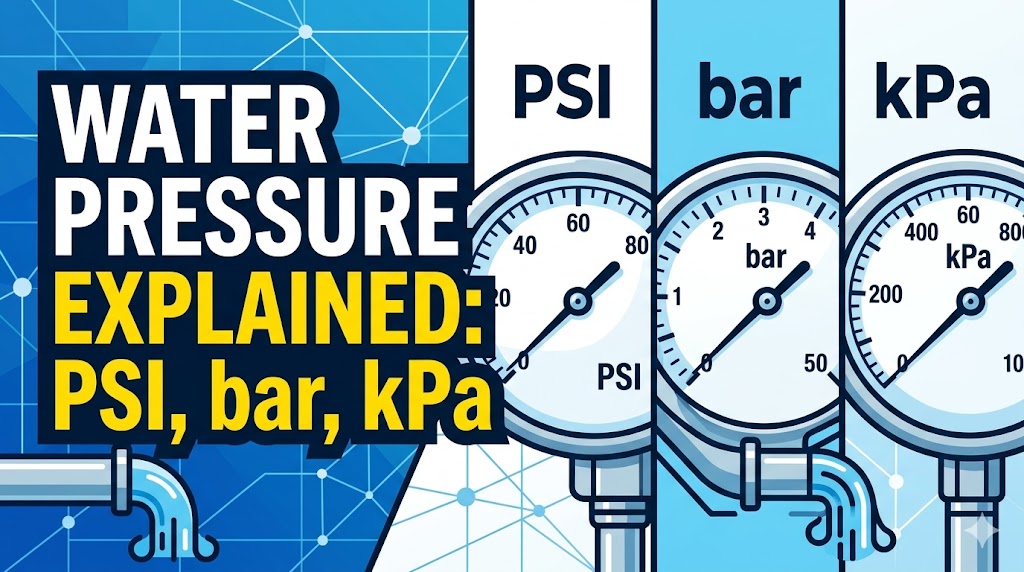
Water pressure is measured in three units depending on where you are: PSI (pounds per square inch) in the US, bar in Europe and Australia, and kPa (kilopascals) in countries using strict SI units. They all measure the same thing — the force that water exerts per unit area — but with different numeric scales. Knowing how to convert between them and what values mean in practice determines whether your gravity-fed tank will run a shower, whether your pump is sized correctly, and whether your pipe fittings are rated for the load.
The quick answer
The three units relate to each other as follows: 1 bar = 100 kPa = 14.5 PSI. Domestic water systems typically run at 2–4 bar (200–400 kPa / 29–58 PSI). A gravity-fed rooftop tank at 3 metres of head delivers roughly 0.3 bar (30 kPa / 4.3 PSI) — enough for a shower only if flow rate requirements are modest.
| Unit | Full name | 1 bar = | Typical mains pressure |
| PSI | Pounds per square inch | 14.5 PSI | 30–60 PSI |
| bar | Bar (metric) | 1 bar | 2–4 bar |
| kPa | Kilopascal | 100 kPa | 200–400 kPa |
| MPa | Megapascal | 0.1 MPa | 0.2–0.4 MPa |
Use the water pressure calculator to convert between units and check whether your system pressure falls within safe operating ranges.
How the calculation works
Pressure from a static water column — which is what a gravity-fed tank produces — follows the hydrostatic formula: P = ρ × g × h, where P is pressure in pascals, ρ is water density (1,000 kg/m³ at 20°C), g is gravitational acceleration (9.81 m/s²), and h is the vertical height of the water column in metres.
Worked example: A rooftop tank with its base 5 metres above the shower head.
P = 1,000 × 9.81 × 5 = 49,050 Pa = 49.05 kPa = 0.49 bar = 7.1 PSI
Most showers require at least 1.0 bar (100 kPa / 14.5 PSI) for comfortable flow. At 0.49 bar, that installation will run a low-flow shower head only. Adding a booster pump or raising the tank to 10 metres would double the pressure to 0.98 bar — just below the 1.0 bar threshold. At 11 metres: 1.08 bar, which clears it. Use the minimum tank height for shower pressure calculator to find the exact height required for your fixture.
What these numbers mean in real systems
Municipal mains supply in the UK is typically 1.0–3.0 bar at the meter. Australia’s water utilities target 500 kPa (5 bar) at the boundary — well above what residential fixtures need. US systems run at 40–80 PSI (2.8–5.5 bar), with 60 PSI considered optimal. India’s urban mains often deliver below 1 bar for much of the day, which is why overhead tanks are standard.
Pressure reducers are required when mains pressure exceeds 5 bar (500 kPa / 72.5 PSI) — above this, standard fittings risk failure, and appliances like washing machines void their warranties. Pressure below 0.7 bar (70 kPa / 10 PSI) at the fixture is insufficient for most combi boilers and tankless water heaters, which will shut off on under-pressure protection.
For tank-fed systems, pressure at the outlet depends on both the height of the tank and the friction losses in the pipe run. Longer or narrower pipes reduce effective pressure. Use the gravity feed flow rate calculator to account for pipe friction and get the actual delivered flow rather than theoretical head pressure.
Converting between PSI, bar and kPa
The conversion factors are exact or near-exact:
| From | To | Multiply by |
| PSI | bar | 0.0689 |
| PSI | kPa | 6.895 |
| bar | PSI | 14.504 |
| bar | kPa | 100 |
| kPa | bar | 0.01 |
| kPa | PSI | 0.145 |
The water column pressure calculator handles all unit conversions automatically and shows pressure at any depth or height in a water column.
Common mistakes
Confusing gauge pressure with absolute pressure. Pressure gauges in plumbing read gauge pressure — the pressure above atmospheric (101.3 kPa). If a fitting is rated to 600 kPa, that is gauge pressure. Absolute pressure is gauge + atmospheric. When specifying tank equipment, always confirm whether a rating is gauge (g) or absolute (a). Mixing them up can lead to choosing fittings that fail at operational pressure.
Treating head height as the full story. A tank 8 metres above a tap theoretically delivers 0.78 bar. But a 20-metre run of 15mm pipe with two elbows can cut that to 0.45 bar at full flow. Engineers account for friction losses using the Darcy-Weisbach equation or simplified tables. For most residential installations, pipe runs over 15 metres should be upsized to 25mm to preserve pressure.
Using PSI specifications on a bar-rated system. A pump rated to “60 PSI” is not a 60-bar pump — it is a 4.1 bar pump. Misreading this when selecting a booster pump for a high-pressure system is a common and expensive error. Double-check the unit on every specification sheet, especially on imported equipment where labels may be inconsistent.
Ignoring pressure variation through the day. Municipal pressure is not constant. It peaks during low-demand hours (early morning) and drops during peak usage. In parts of South Asia and Sub-Saharan Africa, daytime pressure can drop to zero even when supply is nominally present. Size storage tanks based on nighttime refill assumptions and verify with a pressure logger rather than a single reading.
Related calculators you might need
If your pressure analysis points to a pump-fed system, the pump head pressure calculator will tell you the total dynamic head your pump needs to overcome — accounting for static lift, pipe friction, and required outlet pressure. For installations where the tank is on a rooftop, check structural implications with the rooftop load bearing calculator before adding water weight. If you are retrofitting an existing system and need to size replacement pipework, the pipe size and flow rate calculator matches pipe diameter to required flow at a given pressure. For emergency or off-grid contexts where you are relying solely on stored water with no boost pump, the hydrostatic pressure calculator confirms what pressure you can realistically expect from a fixed tank height.
Frequently asked questions
What is a good water pressure for a house? Most residential plumbing is designed for 2–3 bar (200–300 kPa / 29–43 PSI) at the highest fixture. Below 1.5 bar, some appliances will not function correctly. Above 5 bar, you should install a pressure reducer to protect fittings and appliances. The ideal range for most households is 2.5–3.5 bar — enough for good shower pressure without stressing the pipework.
How much pressure does a rooftop tank produce? Every 1 metre of water height above the outlet produces approximately 9.81 kPa (0.098 bar / 1.42 PSI). A tank base at 5 metres above the lowest fixture delivers about 49 kPa (0.49 bar / 7.1 PSI). This is marginal for a conventional shower and insufficient for a power shower or combi boiler. Use the minimum tank height for shower pressure calculator to find the exact height you need for your specific fixtures.
Is 40 PSI enough water pressure? 40 PSI (2.76 bar / 276 kPa) is within the acceptable range for residential use. Most fixtures are rated to work from 25–80 PSI. At 40 PSI you will get adequate flow from taps, showers, and most appliances. If pressure drops below 40 PSI during peak use — indicating insufficient supply or pipe losses — you may need a booster pump or larger pipework.
Why does my water pressure drop when multiple taps are open? Simultaneous demand draws more flow through a fixed pipe diameter, which increases friction losses and reduces pressure at each outlet. This is a pipe sizing and pump capacity problem, not a pressure unit issue. Upsizing the supply main from 15mm to 22mm or 28mm, or adding a pressure-boosting pump with a buffer tank, typically resolves the problem. The water flow rate calculator can help quantify the flow demand.
What is the difference between static and dynamic pressure? Static pressure is measured when no water is flowing — it represents the maximum available head from the tank or main. Dynamic pressure (residual pressure) is what remains at the outlet when flow is occurring. For system design, dynamic pressure is what matters. A tank at 8 metres static head might deliver only 5 metres of dynamic head at full flow once pipe friction is subtracted. Always design for dynamic conditions, not static.