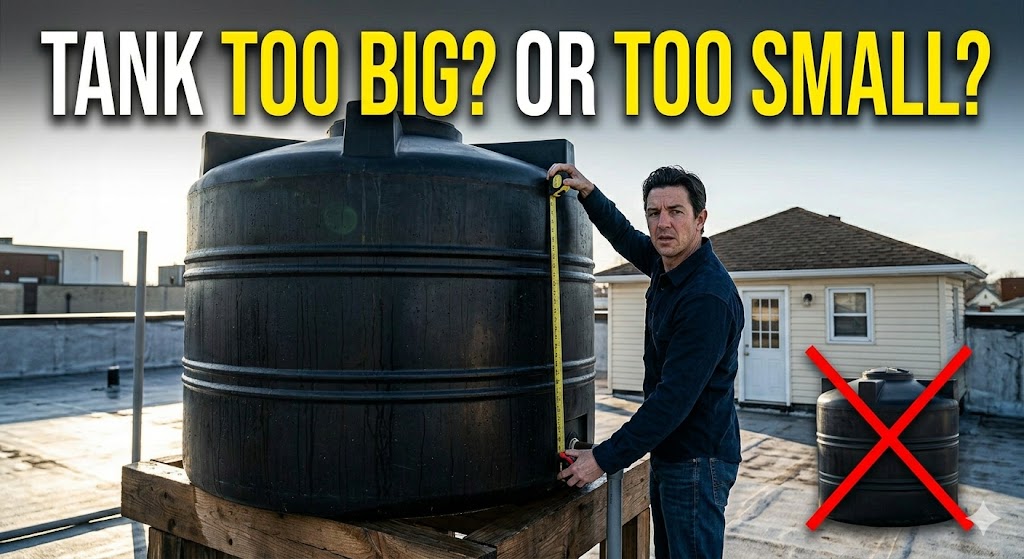
The clearest sign of an undersized tank is running out of water before supply resumes — but by then, the problem is obvious. Subtler signs include low pressure during peak morning usage, frequent pump cycling, and always having less than 20% capacity remaining before refill. An oversized tank is less obvious but equally problematic: water sitting unused for more than 48–72 hours degrades in quality and becomes a bacterial risk. Use the water tank size for home calculator to find the right size based on your household’s actual daily demand and supply schedule.
The Quick Answer
A correctly sized residential water tank should provide 1.5–2 days of household demand as a buffer, assuming daily or every-other-day supply. For households with unreliable supply — 2–3 days per week — the tank should cover 4–5 days of demand. WHO’s basic water requirement is 50 litres per person per day; comfortable urban usage in South Asia typically runs 100–150 L/person/day.
| Household Size | Daily Usage (100 L/p/d) | 2-Day Buffer | 5-Day Buffer (Unreliable Supply) |
| 2 people | 200 L | 400 L | 1,000 L |
| 4 people | 400 L | 800 L | 2,000 L |
| 6 people | 600 L | 1,200 L | 3,000 L |
| 8 people | 800 L | 1,600 L | 4,000 L |
Skip the math: Use the water tank size for home calculator to get a recommended size based on your household, supply frequency, and climate.
How to Calculate the Right Tank Size
The formula is: Tank capacity = Daily demand (litres) × Buffer days × Safety factor (1.1–1.2)
Worked example: A family of 5 in Lahore uses approximately 120 litres per person per day (bathing, cooking, toilet flushing, cleaning). Daily demand = 600 L. Municipal supply arrives every 2 days. Buffer required = 2 days. Tank size = 600 × 2 × 1.15 = 1,380 litres. A 1,500-litre tank is the appropriate choice — the next standard size up from 1,380 L.
The 1.1–1.2 safety factor accounts for seasonal demand spikes (summer usage is typically 20–30% higher), tank dead volume (the last 5–10% of water is often unusable due to sediment or outlet position), and delivery variability.
Signs Your Tank Is the Wrong Size
Undersized tank — what to look for:
The pump runs more than 4–5 times per day in a household that refills from a borehole or sump. The tank drops below 20% capacity before the next supply arrives more than once a week. There is noticeable pressure drop during morning peak usage (6–9 AM). Family members regularly report running out of hot water or water pressure mid-shower.
Oversized tank — what to look for:
Water sits in the tank for more than 72 hours before being used. The tank never drops below 60–70% capacity even during peak periods. There is a recurring musty or stale smell from stored water despite regular cleaning. The tank occupies significant roof space and structural load capacity that could be used more efficiently.
An oversized tank is not just wasteful — it is a water quality risk. The how long will my tank last calculator shows daily usage against tank volume, making it easy to spot whether your turnover rate is healthy.
Key Variables That Change the Correct Size
Supply reliability. This is the dominant factor. A household on continuous mains supply needs only a small header tank or pressure vessel. A household receiving supply every 3 days needs a tank sized for 3+ days of demand. Track your actual supply pattern over one month to get a reliable figure — supply schedules are often less reliable than utilities advertise.
Climate and season. Households in hot climates use 20–40% more water in summer than winter, primarily through increased bathing frequency and evaporative cooling. Size your tank for peak-season demand, not average.
Household type. A family that includes a clothes-washing machine uses 40–80 litres per wash cycle. A garden or livestock adds further irregular demand. The daily water requirement calculator accounts for these use patterns individually.
Backup supply. If you have a borehole, rainwater harvesting, or tanker delivery as a backup, your storage tank can be sized more conservatively — perhaps 2–3 days of demand rather than 5. If the tank is the only source, err toward the upper end of the range.
Common Mistakes
Sizing based on the number of bedrooms, not actual occupancy. Tank sizing guides in South Asia often use bedroom count as a proxy — 1,000 litres per bedroom is a common rule of thumb. This fails for properties with large families in few rooms, or small families in large homes. Always size on actual number of occupants and their usage patterns.
Not accounting for water lost to overflow. A tank without a working float valve or an improperly set one fills to overflow whenever supply arrives. This wastes water and masks the fact that the tank might actually be adequate — it’s just losing water before it can be used. Check the float valve annually.
Buying the largest tank that fits the space. Bigger is not safer if it compromises water quality through slow turnover, or overloads the roof structure. Use the rooftop load bearing calculator to check structural limits before choosing tank volume.
Ignoring the dead volume. Most cylindrical or round-base tanks have an outlet pipe positioned 5–10 cm above the tank floor. This means the last 50–150 litres are unreachable without tilting the tank. Factor this into effective usable capacity when comparing tank sizes.
Related Calculators You Might Need
Once you’ve confirmed the right tank size, check whether your roof can actually support it with the rooftop load bearing calculator. If you’re also managing water quality in relation to storage duration, the safe water storage duration calculator will confirm whether your tank’s turnover rate is within safe limits. For apartment-dwellers or multi-unit buildings where tank sizing is more complex, the apartment water tank size calculator handles shared-supply scenarios. And if you’re trying to understand how long your current tank will last under your actual daily demand, the how long will my tank last calculator gives a direct answer.
Frequently Asked Questions
How do I know if my water tank is big enough for my family?
Calculate your daily usage (typically 80–150 litres per person per day in urban South Asia), multiply by the number of days between supply deliveries, and add a 15% buffer. If your current tank is smaller than this figure, it’s undersized. If it’s more than double this figure, it may be creating a water quality risk from slow turnover.
What happens if my water tank is too small?
You run out of stored water before the next supply arrives, leading to disrupted daily routines. In households dependent on gravity feed, low water levels also mean declining pressure toward the end of the tank’s cycle — showers weaken noticeably when the tank drops below 30% full.
Is it bad to have a water tank that is too large?
Yes. Water sitting in a tank for more than 48–72 hours in warm conditions loses its residual chlorine and becomes susceptible to bacterial growth. An oversized tank that is never fully depleted has a constantly ageing water inventory in the lower section. This is a genuine health concern, not just an efficiency issue.
How many litres per person per day should I plan for?
WHO’s basic requirement for survival is 15–20 L/person/day. Comfortable domestic use with flushing toilets, washing machine, and daily bathing is 100–150 L/person/day in urban South Asia, the Middle East, and Africa. Higher-income households with gardens can reach 200–300 L/person/day.
Should I get one large tank or two smaller tanks?
Two tanks offer redundancy — one can be cleaned while the other remains in service — and better roof load distribution. The downside is added installation cost and two sets of fittings to maintain. For most homes, a single correctly sized tank is simpler and adequate. Two tanks are worth the cost for households with no alternative water source.
Most people buy a water tank once. We’ve spent thousands of hours thinking about nothing else.
Every calculator on this platform was built from scratch — from the physics up. Every guide is researched against the actual building codes, rainfall records, utility tariffs, and supply conditions of the country it covers. Not summarized from another blog. Not generic. The Australia guide uses BOM climate data. The UK guide references CIRIA C539. The Jordan guide accounts for Amman’s 12-48 hour rotational supply schedule specifically.
Water storage is one of those topics where bad information has real consequences — undersized tanks in drought zones, wrong materials in extreme heat, installations that fail structural load. We take that seriously.
This is the resource we wanted when we started asking these questions. We built it because it didn’t exist.