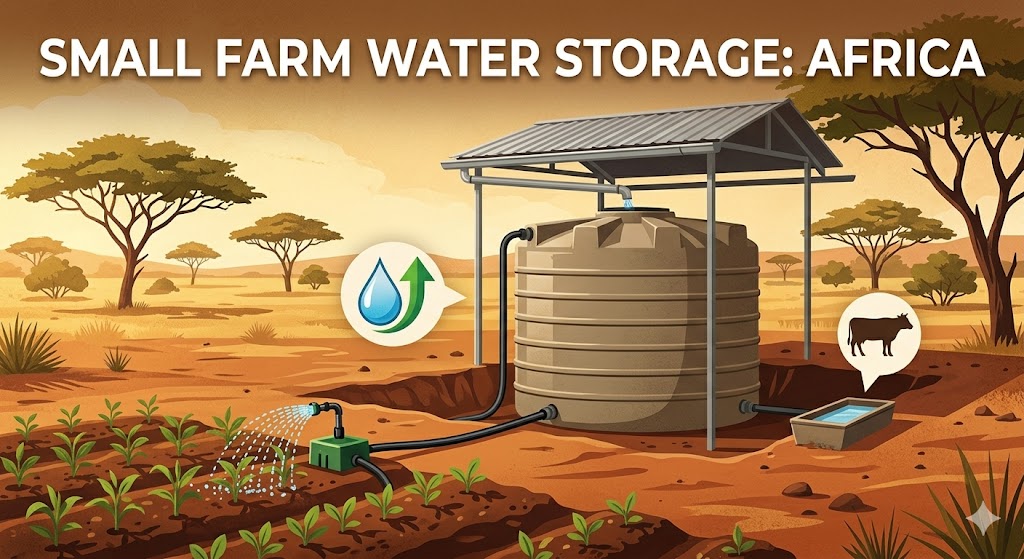
Smallholder farms across Sub-Saharan Africa lose an estimated 40–60% of potential yield annually due to water stress during dry spells — not drought, but irregular gaps within the growing season that a modest storage buffer would bridge. For a 1–5 hectare farm in western Kenya or southern Ethiopia, the difference between crop failure and a viable harvest is often 20,000–50,000 litres of accessible water storage positioned at the right point in the irrigation chain.
Before calculating tank size, use the farm water storage calculator to model your crop type, irrigated area, and dry spell length. The sections below give you the regional and agronomic context to use those figures correctly.
How Water Storage Requirements Vary Across Sub-Saharan Africa’s Climate Zones
Sub-Saharan Africa is not climatically uniform. Storage requirements for a farm in Rwanda’s bimodal rainfall zone differ fundamentally from those in Mali’s Sahel or Zimbabwe’s semi-arid highveld. The core calculation driver is the length of the longest consecutive dry period within the growing season — not annual rainfall.
| Region/Country | Rainfall Pattern | Dry Spell Risk | Recommended Storage Approach |
| East Africa highlands (Kenya, Uganda, Rwanda, Ethiopia) | Bimodal: March–May, Oct–Nov rains | 2–6 week dry spells within seasons | 20,000–50,000L ferro-cement or polyethylene tanks; rainwater + stream abstraction |
| West Africa savanna (Ghana, Nigeria, Burkina Faso, Mali) | Single season May–Oct; 5–7 dry months | Entire dry season; storage must bridge Nov–April | 50,000–200,000L+ earth dams or large ferro-cement; inadequate for season-bridging with tanks alone |
| Southern Africa (Zimbabwe, Zambia, Malawi) | Single season Nov–March; pronounced dry season | April–October dry (7 months) | Large farm dams or multiple 10,000L+ tanks; drip irrigation essential to extend storage |
| Great Lakes (Tanzania, DRC) | Bimodal; generally reliable | Localised 3–4 week gaps | 10,000–30,000L; risk mitigation rather than season-bridging |
| Sahel fringe (Niger, N. Nigeria, N. Mali) | 250–600mm; 1–2 month window | Near year-round water stress | Tank storage insufficient alone; underground cisterns + small dam combination required |
| Horn of Africa (Ethiopia lowlands, Somalia, Djibouti) | Highly erratic; pastoralist-dominated | Multi-year drought risk | Community-scale storage 100,000L+; individual farm tanks supplementary only |
How to Calculate How Much Water Storage Your Small Farm Needs
The starting point is crop water demand, not tank availability. Maize (the most widely grown staple crop in Sub-Saharan Africa) requires approximately 500–800 mm of water over a 90–120 day growing season — or about 5,000–8,000 litres per 0.1 hectare per month at peak demand. Tomatoes require 600–800 mm and are more sensitive to dry spells, making storage critical during fruit set. Sorghum and millet are more drought-tolerant but still benefit from 200–400 mm supplemental irrigation in deficit years.
Use the crop water need calculator to get evapotranspiration-based demand figures for your specific crop, planting date, and location. Then apply this formula for required storage: Storage (L) = Daily crop water requirement (L/hectare/day) × irrigated area (hectares) × dry spell length (days) × 1.2 (safety factor).
| Crop | Growing Season | Peak Water Need (L/hectare/day) | Storage for 0.5 ha over 21-day dry spell |
| Maize | 90–120 days | 50,000–65,000 | ~700,000L (tank approach impractical; dam or stream needed) |
| Tomatoes (drip) | 90–120 days | 35,000–45,000 | ~500,000L full hectare; 25,000L for 0.05 ha plot |
| Beans | 80–100 days | 30,000–40,000 | ~420,000L full hectare; scale down proportionally |
| Kale / sukuma wiki | 60–90 days | 20,000–30,000 | ~270,000L full hectare; 14,000L for 0.05 ha plot |
| Onions | 100–120 days | 25,000–35,000 | ~375,000L full hectare |
The numbers above make clear that field-scale irrigation from tank storage alone is not viable for large plots in prolonged dry spells. The practical model for Sub-Saharan smallholders is to use polyethylene or ferro-cement tanks for kitchen gardens and high-value vegetable plots (0.01–0.1 hectare), while relying on farm dams, seasonal ponds, and river abstraction for staple crop fields.
Which Tank Technology Is Right for Sub-Saharan African Small Farms?
Tank choice is constrained by transport access, local construction capacity, and capital availability. Polyethylene tanks (5,000–10,000L) are available in Kenya, South Africa, Ethiopia, and Nigeria from local manufacturers and cost $150–$400 (USD) per unit. They are the fastest to deploy and require no construction skill, but they are expensive per litre of storage capacity and vulnerable to UV degradation and physical damage at remote sites.
Ferro-cement tanks (10,000–100,000L) are the workhorse of rural water storage across East Africa. A 10,000L ferro-cement ring tank can be constructed by two trained masons in 5–7 days using local materials for $300–$600 total — roughly one-third the cost per litre of a polyethylene equivalent. UNICEF and FAO technical manuals for ferro-cement construction are available through national water ministries in Kenya, Tanzania, and Ethiopia. They require a flat site, skilled masons, and 28 days of curing time — but once built, they last 20–30 years with minimal maintenance.
Rainwater harvesting from roof catchments supplements all tank types at the farm homestead. A standard iron-sheet roof of 60 m² in western Kenya (annual rainfall ~1,200 mm) can yield 57,600 litres per year — enough to fill a 10,000L tank six times. Use the rainwater harvesting calculator to quantify what your roof area can realistically capture under local rainfall patterns.
Common Mistakes in Farm Water Storage Across Sub-Saharan Africa
Building one large tank instead of distributed smaller storage. A single 20,000L tank positioned at the farm homestead requires pumping or manual carrying to reach plots 200–500 metres away. Distributed storage — multiple 5,000L tanks at field edges — reduces labour burden and enables gravity-fed drip systems. Gravity feed from a field-edge elevated tank eliminates pump costs entirely for low-volume drip irrigation. Verify feasibility using the gravity feed flow rate calculator.
Sizing storage for average rainfall, not for the worst 1-in-5 years. In the East African highlands, a bad season with 40% below-average rainfall occurs roughly once every 4–5 years. A storage system sized only for average conditions fails precisely when it is most needed. Size for the 80th percentile dry year — typically 20–30% less rainfall than the long-term average — using at least a 10-year rainfall dataset from the nearest meteorological station.
Installing tanks without overflow management. In high-intensity tropical rainfall events, a 10,000L tank can fill in under 2 hours from a 100 m² catchment. Without a proper overflow outlet directed away from foundations and tank bases, overflow water erodes tank supports and destabilises installations. Always design an overflow outlet sized to handle peak rainfall intensity — typically 100–150 mm/hour for tropical convective storms in East and West Africa.
Ignoring water quality at the point of irrigation. River and dam abstraction in Sub-Saharan Africa frequently carries sediment, agricultural chemical residues, and microbial contamination that clog drip emitters and damage crops if applied directly. A simple settling tank upstream of the storage tank — holding water for 24–48 hours before transfer — removes the bulk of suspended solids. For drip irrigation systems, a minimum 120-mesh screen filter is required at the pump outlet to prevent emitter blockage.
Related Calculators You Might Need
If you’re moving from storage sizing to irrigation design, the drip irrigation tank size calculator tells you exactly how much storage a specific drip layout requires per irrigation cycle. For larger plots using sprinklers, the sprinkler water usage calculator calculates per-session water use. If your farm includes livestock alongside crops — common for smallholders in Ethiopia and Tanzania — add livestock water demand using the livestock water requirement calculator. And for farms where the water source is a borewell with a pump, sizing the pump correctly is critical: use the irrigation pump size calculator to match motor output to your tank refill rate and field distribution requirements.
Frequently Asked Questions
How much water does a small farm need per day in Africa? This depends entirely on crop type, irrigated area, and evapotranspiration rate. A rough working figure for vegetable production under East African highland conditions: 3,000–5,000 litres per 0.1 hectare per day at peak crop demand in the dry season. For a 0.5 ha vegetable plot, that’s 15,000–25,000 litres per day — meaning tank storage alone covers only 1–2 days of irrigation without replenishment.
What is the cheapest way to store water on a farm in Africa? Ferro-cement ring tanks are consistently the lowest cost per litre for volumes of 10,000–100,000L, typically $0.03–$0.06/litre installed versus $0.15–$0.30/litre for polyethylene tanks. For volumes above 100,000L, compacted earth farm dams with clay or geomembrane lining drop costs further — to $0.005–$0.01/litre — but require heavier earthmoving equipment and site assessment for seepage management.
Can rainwater harvesting alone supply a small farm in Kenya? For homestead kitchen gardens of 0.05–0.1 hectare, yes — particularly in high-rainfall zones like Kisii, Nyeri, or Kakamega, where 800–1,400 mm of annual rainfall is the norm. For larger commercial plots, harvested rainwater supplements but cannot replace stream abstraction, borewell supply, or seasonal river pumping. Most viable farm systems combine multiple sources with storage acting as the buffer between them.
What size tank do I need to irrigate 1 acre of vegetables in Uganda? One acre (0.4 hectare) of mixed vegetables under Ugandan highland conditions requires approximately 8,000–12,000 litres per day during peak dry spell irrigation. A 21-day dry spell buffer requires 168,000–252,000 litres — well beyond tank range. A practical approach: 20,000L ferro-cement tank for spot irrigation of highest-value crops, supplemented by direct stream or borehole pumping for the remaining area.

Most people buy a water tank once. We’ve spent thousands of hours thinking about nothing else.
Every calculator on this platform was built from scratch — from the physics up. Every guide is researched against the actual building codes, rainfall records, utility tariffs, and supply conditions of the country it covers. Not summarized from another blog. Not generic. The Australia guide uses BOM climate data. The UK guide references CIRIA C539. The Jordan guide accounts for Amman’s 12-48 hour rotational supply schedule specifically.
Water storage is one of those topics where bad information has real consequences — undersized tanks in drought zones, wrong materials in extreme heat, installations that fail structural load. We take that seriously.
This is the resource we wanted when we started asking these questions. We built it because it didn’t exist.