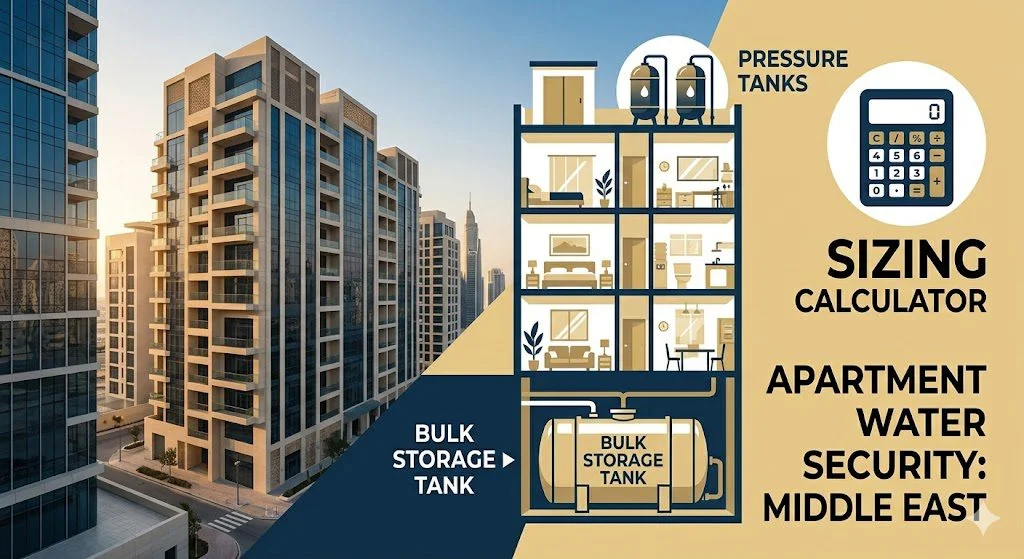
Apartment water tank sizing in the Middle East is governed primarily by two factors that don’t apply in most other regions: extreme per-capita water consumption driven by climate and lifestyle, and the fundamental reality that every litre consumed in the Gulf is either desalinated or imported. Saudi Arabia, UAE, Qatar, Kuwait, and Bahrain have zero or near-zero renewable freshwater resources. Jordan and Iraq have critically stressed river systems. This makes water storage a functional necessity rather than a backup precaution.
Use the apartment water tank size calculator to determine your building’s specific requirements. The context below covers the regulatory, climatic, and consumption realities that should feed into those figures.
Why Middle East Apartments Consume More Water Than Global Averages
Per capita water consumption in the Gulf is among the highest globally. Saudi Arabia averages 265 litres per person per day; UAE averages approximately 550 litres per person per day — roughly 3x the global average of 185 L/person/day. Drivers include widespread use of bidets and shower culture, evaporative cooling systems common in older buildings, inefficient irrigation of building landscaping, and historically subsidised water pricing that removed conservation incentives.
The UAE government eliminated water subsidies progressively from 2015 onward; DEWA’s current residential water tariff reaches AED 11.28/m³ ($3.07) for consumption above 100 m³ per month — making large-building storage and distribution efficiency economically significant. Saudi Arabia’s SWCC water pricing remains subsidised but has increased substantially since 2016.
| Country | Avg Per Capita Consumption (L/day) | Primary Supply Source | Typical Residential Tariff |
| UAE (DEWA) | ~550 | Desalination (Jebel Ali and others) | AED 3.05–11.28/m³ (tiered) |
| Saudi Arabia | ~265 | Desalination (SWCC) + groundwater | SAR 0.50–4.00/m³ (tiered) |
| Qatar (Kahramaa) | ~400 | Desalination (Ras Laffan) | Free up to 500 m³/month for Qataris; metered for others |
| Kuwait (MEW) | ~500 | Desalination | Free for Kuwaiti nationals; KWD 0.25/m³ for expats |
| Jordan (WAJ) | ~90 | Surface + groundwater (critically stressed) | JOD 0.10–0.50/m³ (heavily tiered, supply limited) |
| Bahrain (NOGA) | ~400 | Desalination | Subsidised; ~BHD 0.08/m³ |
| Oman (PAEW) | ~230 | Desalination + groundwater | OMR 0.10–0.45/m³ |
How Apartment Building Water Systems Are Designed in the Middle East
The standard configuration in Gulf apartment buildings is a basement storage tank (ground-level or below-grade cistern) that receives supply from the utility, combined with rooftop distribution tanks that are pumped from the basement and feed individual floors by gravity or boosted pressure. This is structurally similar to the two-stage sump-and-overhead systems used in Indian residential water tank sizing, but operates at much larger scale — a 20-storey residential building in Dubai typically has 50,000–150,000 litres of total storage capacity across basement and rooftop tanks. Getting the transfer pump right matters as much as the tank sizes themselves; how pump head works covers what a basement-to-rooftop pump actually needs to overcome across a tall building.
In Jordan, where piped supply operates on a rotational schedule of 12–48 hours per week in many Amman districts (among the worst urban water supply situations in the world), storage must bridge the entire inter-supply interval at full household consumption. A 4-person Jordanian apartment household consuming 360 litres/day (below national average due to scarcity) needs 4,320–7,560 litres of storage to bridge a 12–21 day supply gap — the typical worst-case interval in East Amman during summer.
Tank Sizing by Country and Building Type
The table below gives reference sizing for common apartment configurations across the region. These are practical baselines — your actual requirement depends on building height, pump capacity, supply reliability, and occupancy.
| Location | Apartment Type | Recommended Per-Unit Storage | Recommended Building Tank (50 units) |
| Dubai / Abu Dhabi (UAE) | 2BR, 4 residents | 500–750L rooftop allocation | 30,000–50,000L basement + 10,000–15,000L rooftop |
| Riyadh / Jeddah (KSA) | 3BR, 5 residents | 750–1,000L allocation | 40,000–60,000L basement + 15,000–20,000L rooftop |
| Amman, Jordan | 2BR, 4 residents — weekly supply | 2,000–4,000L per unit minimum | 100,000–200,000L cistern (supply bridging dominant) |
| Muscat, Oman | 2BR, 3–4 residents | 500–750L allocation | 25,000–40,000L combined |
| Doha, Qatar | 2BR, 3 residents | 400–600L allocation | 20,000–30,000L combined |
| Kuwait City | 3BR, 5 residents | 750–1,000L allocation | 40,000–60,000L combined |
Rooftop Tank Structural Constraints in Middle East High-Rise Buildings
In buildings above 10 storeys, rooftop water tanks create concentrated structural loads that require verification against the original building design. A 25,000L rooftop tank full of water weighs approximately 25 tonnes — a load that most high-rise roof slabs can accommodate if distributed correctly, but which will cause damage if placed on a single point without a proper load-spreading frame or concrete plinth. The underlying question is the same one covered in whether a roof will hold a full water tank, just at a scale where the answer is decided by a structural engineer rather than a rule of thumb.
UAE buildings must comply with DEWA Technical Standards for water systems, which specify tank construction materials, roof penetration requirements, and ventilation. Tank materials in the Gulf must be rated for extreme heat: rooftop temperatures in Dubai and Riyadh regularly exceed 80°C at the tank surface in summer. Standard polyethylene tanks without UV stabilisation fail within 3–5 years in these conditions. Food-grade HDPE or GRP (glass-reinforced plastic) tanks with external insulation are the standard specification for Gulf rooftops.
Check rooftop load implications using the rooftop load bearing calculator, and confirm your tank weight using the water tank weight calculator. Both inputs are required for any structural engineer’s verification in Gulf building submissions.
Common Mistakes in Middle East Apartment Water Tank Sizing
| Mistake | Why it happens | Fix |
| Applying global consumption averages to Gulf apartments | Using the WHO domestic benchmark of 150L/person/day produces a tank 3–4x too small for a UAE or Saudi household | Use 400–550L/person/day for the Gulf; 90–130L/person/day for Jordan, sized up for supply unreliability |
| Ignoring water temperature in tank sizing for hot climates | Rooftop water in Dubai or Riyadh reaches 40–55°C within hours, accelerating Legionella growth in stagnant, oversized tanks | Insulate rooftop tanks (R-value ≥ 3.0) or size for 24–48 hour turnover rather than extended storage — the safe water storage duration calculator indicates safe holding time at elevated temperatures |
| Undersizing for Jordanian supply intervals | Planning around a “weekly” schedule that in practice slipped to 3–4 week gaps in parts of East Amman in summer 2023 | Design for at least 3 weeks of storage at full occupancy; tanker delivery in Amman runs JOD 25–45 per 5,000L, a recurring cost adequate storage avoids |
| Not accounting for building pressure across floors | In a 15-storey Gulf building with rooftop tanks at 45 metres, ground-floor apartments see roughly 4.5 bar of static pressure — above the 3.5 bar most fixtures are rated for | Install pressure-reducing valves (PRVs) on lower floors; use the hydrostatic pressure calculator to verify floor-by-floor pressure, and see how hydrostatic pressure affects tank design for the underlying mechanics |
Related Calculators You Might Need
For shared building water systems, the commercial tank size calculator scales beyond individual apartments to full building requirements. If you’re specifying pump systems for basement-to-rooftop transfer, the pump head pressure calculator gives you the required head for a given building height and flow rate. For assessing whether a specific rooftop can safely carry your intended tank, the safe rooftop tank load calculator converts tank dimensions and water weight to floor loading in kg/m². And for tank chlorination compliance — required under DEWA and SWCC regulations — use the chlorine dosage calculator to determine correct disinfection quantities for your tank volume.
Frequently Asked Questions
What size water tank does an apartment need in Dubai? A 2-bedroom Dubai apartment with 3–4 residents requires approximately 1,500–2,200 litres of allocated rooftop tank capacity, based on UAE per-capita consumption of 400–550L/person/day and a 24-hour storage buffer. At building scale, a 50-unit residential tower typically installs 30,000–60,000L of combined basement and rooftop storage. DEWA does not specify a minimum domestic storage requirement but building codes require uninterrupted supply under scheduled maintenance conditions.
How much water storage does a building in Jordan need? In Amman, the standard engineering specification is 3 weeks of storage at full occupancy consumption — reflecting the realistic worst-case supply gap during summer. For a 50-apartment building with 200 residents consuming 100L/person/day, that’s 420,000 litres minimum. Most established Jordanian apartment buildings have large underground cisterns of 200,000–500,000L precisely for this reason.
Is GRP or stainless steel better for rooftop tanks in the Gulf? GRP (fibreglass) is the dominant choice in the Gulf — it handles extreme rooftop heat better than polyethylene, doesn’t rust like steel, and can be manufactured in large single-piece configurations. Stainless steel (SS316) is superior for water quality but costs 3–5x more and requires professional installation. For most Gulf residential applications, a properly insulated GRP tank is the technically and economically optimal choice.
What are the water tank regulations in the UAE? DEWA Technical Regulations for Building Water Systems (part of the Dubai Municipality Green Building Standards) specify that tanks must be food-grade, UV-resistant, and watertight. They must include accessible manholes for inspection and cleaning, overflow outlets, and ventilation with insect screens. Annual cleaning and bacteriological testing is required. All water system work must be carried out by a DEWA-approved contractor.
Why is my apartment water pressure low in Riyadh? Low pressure in upper-floor Saudi apartments is almost always caused by an undersized or poorly maintained rooftop tank, or a pump that cannot maintain adequate flow rate against the building’s static head. At 3 metres of height — typical of a top-floor apartment sitting close to the rooftop tank — static pressure is only around 0.3 bar, below the 0.5 bar minimum required for most shower systems. This is the same underlying issue covered in why shower pressure stays low even with a full rooftop tank. Verify pump capacity against required flow and head using the pump head pressure calculator.

Licensed Professional Engineer (Texas, PE) with 13+ years in residential and light-commercial water storage systems. Reviews and writes the technical guides on this site — sizing, pressure, roof loading, and treatment — based on 180+ completed field projects.