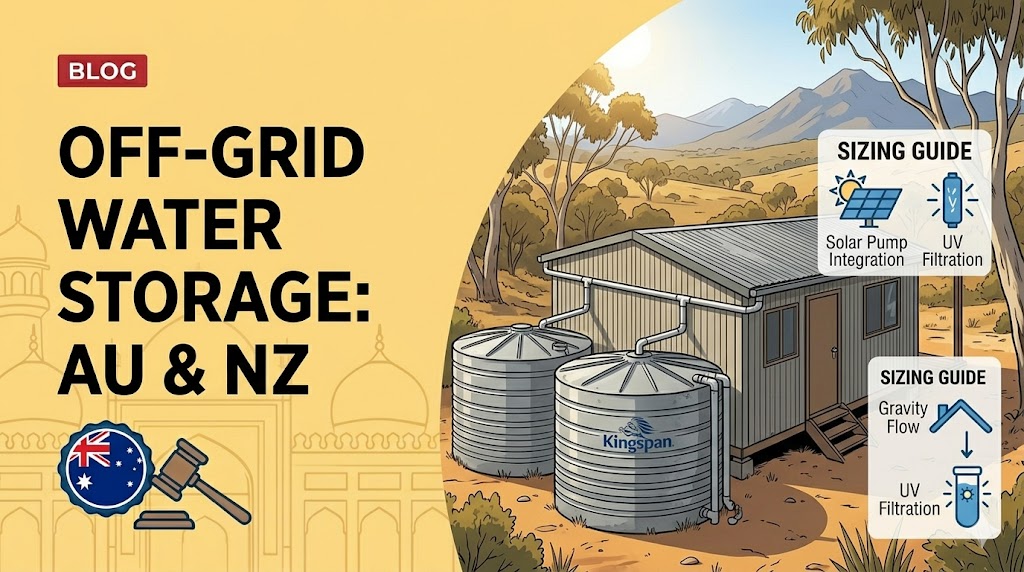
Rural properties in Australia and New Zealand rely almost entirely on rainwater tanks, bores, or creeks — mains supply does not reach most land beyond a few kilometres from town. A correctly sized off-grid water storage system is therefore not a supplement to mains water; it is the entire supply. Undersizing it by even 20% means running out during drought, which in parts of inland Queensland or the South Island high country can mean waiting weeks for a trucked delivery at high cost. A household of 4 in a 600 mm/year rainfall zone needs a minimum of 90,000–120,000 litres of total tank storage — far beyond what most newcomers to rural living anticipate.
The quick answer: how much storage do rural Australian and NZ properties need?
The Australian government’s Your Home guide recommends a minimum of 22,500 litres per person per year for rainwater-only rural properties (at 150 L/person/day). For New Zealand, the Building Research Association of New Zealand (BRANZ) guidance for rainwater-supplied rural properties assumes 120–200 L/person/day depending on lifestyle and stock requirements. These figures do not include firefighting reserve, irrigation, or livestock water.
| Location / rainfall zone | Household size | Min tank storage | Recommended storage |
| High rainfall >800mm/yr (Tas, NZ West Coast) | 4 people | 45,000 L | 90,000 L |
| Medium rainfall 600–800mm/yr (VIC, SA, NZ North Island) | 4 people | 90,000 L | 135,000 L |
| Low rainfall 400–600mm/yr (inland NSW, Qld) | 4 people | 135,000 L | 180,000 L |
| Arid <400mm/yr (outback, central Australia) | 4 people | 180,000 L+ | 200,000–300,000 L |
These figures account for seasonal variation, extended dry periods, and a 20% safety margin above average annual requirement. They do not include additional storage for livestock, irrigation, or bushfire reserves. Use the off-grid water storage calculator to model your specific rainfall zone, household size, and intended uses.
How the calculation works
For an off-grid property, the calculation must account for seasonal variability — not just annual average rainfall. The worst-case dry period in your region determines how much storage you need to bridge without running out.
Storage required = (daily consumption × dry period days) + firefighting reserve + livestock allocation
Worked example — a retired couple (2 people) on a 40-acre property near Armidale, NSW, in a 650 mm/year rainfall zone. Longest historical dry period: 90 days (Bureau of Meteorology climate data for Armidale 1910–2020).
Daily household use: 2 × 150 L = 300 L/day. Dry period storage: 300 × 90 = 27,000 L. Firefighting reserve (NSW RFS recommendation for rural properties): 10,000 L. Total minimum storage: 37,000 L. Recommended size accounting for tank cleaning downtime and year-to-year variation: 45,000 L. Standard configuration: one 22,500 L corrugated steel tank plus one 22,500 L poly tank, positioned at separate locations on the property as fire resilience.
To calculate the annual collection potential from your roof before finalising storage needs, the annual rainwater collection calculator lets you model your catchment area against local rainfall records.
Key variables that change the answer
Longest historical dry period in your region. This is the single most important variable and the one most commonly ignored. Bureau of Meteorology (BOM) data for Australia and NIWA data for New Zealand both provide historical consecutive dry-day records by region. Inland Queensland has recorded dry periods exceeding 200 consecutive days in drought years. If you size for average conditions and a drought year hits, you will run dry. Size for the 1-in-20-year dry period, not the median.
Roof catchment area and material. Rural Australian properties typically have large roof areas — a standard 4-bedroom farmhouse with verandahs may have 250–350 m² of effective catchment. This dramatically increases collection potential: a 300 m² roof in a 700 mm/year zone collects approximately 168,000 litres per year (at 0.8 runoff coefficient). However, Zincalume and colorbond roofs — the dominant material in rural Australia — have runoff coefficients of 0.85–0.95 and are safe for drinking water collection. Old galvanised iron roofing may leach lead and should not feed drinking water tanks.
Livestock and irrigation demands. A single dairy cow requires 50–100 litres per day; a beef cattle herd of 50 animals needs 2,500–5,000 litres per day. Sheep require 4–10 litres per day. If you are running stock off the same water system as the house, livestock demand will dwarf household consumption and must be calculated and stored separately. Purpose-built farm dam or stock dam infrastructure is separate from the domestic rainwater system in most rural Australian configurations.
Fire season storage requirements. NSW RFS, CFA Victoria, and FENZ New Zealand all recommend rural properties maintain a minimum firefighting water reserve, ideally in a dedicated tank accessible to tankers. NSW RFS specifies 10,000 L minimum for residential rural properties, held separate from domestic supply and fitted with a 65 mm Storz coupling at ground level. This reserve must not be drawn down for household use during fire season (November–April in most of Australia).
Tank types used in rural Australia and New Zealand
| Tank type | Common sizes | Typical lifespan | Considerations |
| Corrugated steel (Aquaplate lined) | 22,500–363,000 L | 20–30 years | Most cost-effective at large volumes; standard in rural Aus |
| Polyethylene (poly) | 5,000–30,000 L | 15–25 years | Portable, no liner required, UV-rated; standard in rural NZ |
| Concrete (precast or poured) | 10,000–200,000 L | 40–60 years | Excellent insulation; requires lime neutralisation when new |
| Fibreglass | 5,000–50,000 L | 25–40 years | Good for underground; no liner needed; expensive |
| Farm dam (earthen) | 500,000+ L | Indefinite | Not for drinking water without significant treatment |
The dominant choice for rural Australia is corrugated Aquaplate-lined steel from manufacturers like Kingspan (formerly Rhino Tanks), Tankmasta, or Ozzi Tanks. For rural NZ, polyethylene tanks from Polymaster or Permathene are most common, as they are lighter to transport to remote sites. Both countries’ configurations typically use gravity-feed from elevated tanks wherever site topography allows, eliminating pump energy costs.
Common mistakes
Sizing for annual average rainfall instead of worst-case dry period. This is the most common and most costly mistake in rural water planning. A property in the Western Slopes of NSW might average 650 mm/year historically, but experience 40 mm in a drought year. Annual average provides no useful guidance for sizing storage that must see you through a multi-month dry period. Use BOM 90th percentile dry period data for your location, not the mean.
Connecting old galvanised iron or lead-flashed roofing to drinking water tanks without testing. Pre-1970 rural Australian roofing frequently used lead flashing at ridges and around chimneys, and older galvanised iron may contain lead-tin solder. NSW Health and SA Health both recommend testing tank water from properties with pre-1970 roofing for lead annually. Do not assume age-old roofing is safe without verification.
Not installing first-flush diverters because the property ‘doesn’t have pollution’. Rural and remote roofs accumulate possum and bird droppings, insect nests, leaf debris, and dust from unsealed roads during dry periods. First-flush contamination in rural Australia is often worse than in urban areas. A correctly sized first-flush diverter — 1 litre per 25 m² of roof area — is mandatory for safe drinking water collection even on remote properties.
Inadequate pressure for multi-storey homes without a pressure pump. Many rural Australian farmhouses are single-storey and gravity-feed from an elevated stand works well. For two-storey homes or properties where the tank cannot be elevated sufficiently, a pressure pump and pressure tank are required to maintain consistent flow at all outlets. A tank sitting 3 metres above the highest tap delivers only 29 kPa — below the 50–150 kPa required by most Australian standard showers (AS/NZS 3500.1). Use the gravity feed flow rate calculator to check your system before installation.
Related calculators you might need
Once you have your storage volume, verify that your roof delivers enough collection to refill it reliably using the roof catchment area calculator. For properties also running livestock, the livestock water requirement calculator calculates the daily water demand by animal type and herd size — a critical input before deciding whether the rainwater system can serve both house and stock. If you are evaluating a pump versus gravity-feed setup, the pump horsepower and flow rate calculator will size your pump correctly for the flow rate and head your property requires.
Frequently asked questions
How big a water tank do I need for a rural property in Australia? A household of 4 in a 600–800 mm/year rainfall zone needs a minimum of 90,000–135,000 litres of total tank storage for domestic use alone. Arid zone properties need 180,000–300,000 litres. Add 10,000 L separately for firefighting reserve (NSW RFS standard). These figures are based on a 90-day design dry period and 150 L/person/day consumption. Use the off-grid water storage calculator for your specific location.
Is rainwater safe to drink in Australia without treatment? In most rural settings where the roof is clean (Zincalume, Colorbond, or concrete tile post-1970, with first-flush diversion), tank water is generally safe for healthy adults. However, the Australian Drinking Water Guidelines (ADWG 2022) recommend UV disinfection or chlorination for immunocompromised individuals, infants, elderly people, and pregnant women. SA Health, NSW Health, and Queensland Health all recommend testing annually for E. coli and at least every 5 years for heavy metals.
How long can you go without rain before a rural property runs out of water? At 150 L/day for a family of 4 (600 L/day total), a 45,000 L tank lasts 75 days with no refill. A 90,000 L tank lasts 150 days. In drought conditions, inland NSW and Queensland have seen consecutive rainless periods exceeding 200 days — undersized storage runs out well before the drought breaks. The how long will my tank last calculator gives you the exact duration from your current volume and consumption rate.
What is the largest rainwater tank I can buy in Australia? Corrugated steel tanks from manufacturers like Kingspan and Tankmasta are available up to 363,000 litres (363 kL) as a single tank. Larger volumes are achieved by linking multiple tanks or constructing a concrete reservoir. For most rural Australian households, the upper practical limit for a single-tank installation is around 100,000 litres before the cost per litre shifts in favour of multiple smaller tanks or a dam.
Do I need council approval for a rainwater tank in rural Australia? In most rural zones (zoned RU1, RU2, or equivalent in each state), rainwater tanks are permitted development exempt from approval up to certain thresholds — typically 10,000 L above ground or 72,000 L below ground. In NSW, the State Environmental Planning Policy (Infrastructure) 2007 permits rainwater tanks as exempt development in most zones. Check your state’s equivalent before installation, especially if the tank exceeds 10,000 L or requires structural footing.