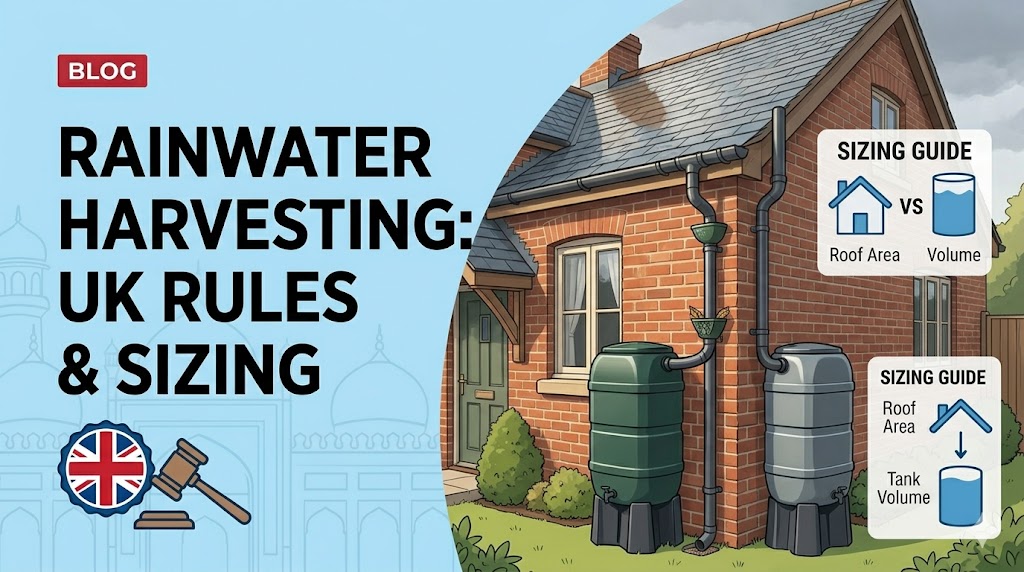
Rainwater harvesting is fully legal in the UK with no permit required for standard domestic systems, but the use of harvested rainwater is restricted by law. In England and Wales, harvested rainwater cannot legally be connected to potable water systems without approval from Water Regulations Advisory Scheme (WRAS) under the Water Supply (Water Fittings) Regulations 1999. This guide covers the legal framework, realistic collection volumes by region, and how to size a storage tank for UK rainfall patterns.
The quick answer
A UK home with a 50 m² roof catchment area in an average rainfall area (England average: 885 mm/year, Met Office 1991–2020 climatology) collects approximately 35,000–40,000 litres per year after accounting for evaporation losses, first-flush discard, and roof efficiency factors (CIRIA C539 Rainwater and Greywater Use in Buildings). For garden irrigation alone, this is more than sufficient for most UK households. For toilet flushing, UK homes use approximately 30–40 litres per person per day for that purpose alone — a household of 4 would use 44,000–58,000 litres per year just on flushing.
| Region | Avg rainfall (mm/yr) | 50 m² yield (L/yr) | Recommended tank size |
| South East England | 610–700 | 22,000–25,000 | 1,500–2,500 L |
| Midlands / East Anglia | 600–700 | 21,000–25,000 | 1,500–2,500 L |
| North West England | 1,000–1,500 | 36,000–54,000 | 2,500–5,000 L |
| Scotland (West) | 1,500–3,000 | 54,000–108,000 | 3,000–7,500 L |
| Wales | 1,200–3,000 | 43,000–108,000 | 2,500–7,500 L |
Tank sizing is not simply a fraction of annual yield — it must account for the longest expected dry spell in your region, which determines how many days of storage you need to bridge. In the South East, summer dry spells of 3–6 weeks are common; in Scotland, the longest dry period rarely exceeds 2–3 weeks. Skip the math: Use the rainwater harvesting calculator to enter your postcode rainfall data, roof area, and intended use.
How the calculation works
The standard UK sizing method follows CIRIA C539 guidance. The formula for estimating annual rainwater yield:
Annual yield (L) = Roof area (m²) × Annual rainfall (mm) × Runoff coefficient × Filter efficiency
For a standard pitched clay tile roof: runoff coefficient = 0.75–0.85. For flat EPDM membrane roof: 0.90–0.95. For green roof: 0.35–0.60 (significantly lower). Filter efficiency for a standard first-flush diverter and leaf filter: 0.90.
Worked example — a semi-detached in Manchester with a 45 m² catchment area, annual rainfall 900 mm, clay tile roof:
45 × 900 × 0.80 × 0.90 = 29,160 litres per year. Monthly average: 2,430 litres. If the intended use is garden irrigation only (typical UK demand: 500–1,000 litres/month in summer), the system will run a surplus for most of the year. A 1,500 L tank is adequate for this use case; a 2,500 L tank is overkill unless a dry summer is the planning scenario.
To verify your roof’s effective catchment dimensions, the roof catchment area calculator accounts for pitch and plan area correctly.
Key variables that change the answer
Rainfall seasonality. UK rainfall is not evenly distributed across the year. The South East receives its lowest rainfall in July and August — exactly when garden demand peaks. A rainwater system sized only for average rainfall conditions will routinely run dry in the South East summer unless the tank is large enough to carry a winter surplus through the dry season. This seasonal mismatch is the primary sizing challenge in England and Wales.
Intended use and legal restriction. Under the Water Supply (Water Fittings) Regulations 1999, harvested rainwater used for toilet flushing, laundry (with appropriate treatment), or any point where cross-connection with the mains supply is possible must use a Type AA or AB air gap or other approved backflow prevention device. Systems not complying with this are illegal and void home insurance. Garden irrigation via a dedicated outdoor tap with no mains connection is legal without any additional approval.
Roof material and contamination risk. Bituminous felt roofing leaches compounds including polycyclic aromatic hydrocarbons (PAHs) into collected rainwater. These are not removed by standard first-flush diverters. CIRIA C539 recommends harvested water from bituminous felt roofs not be used for vegetable garden irrigation or any potable application. Clay, concrete tile, and most metal roofs are acceptable for all non-potable harvesting uses.
First-flush volume. The first 0.5–1 mm of rainfall over a roof washes off accumulated bird droppings, dust, and pollutants. For a 50 m² roof, that represents 25–50 litres per rainfall event. A correctly sized first-flush diverter discards this before allowing water into storage. A diverter that is too small passes contaminated first-flush water into the tank; too large wastes too much clean water. The first flush diverter size calculator gives the correct diverter volume for any roof area.
UK legal framework: what you can and cannot do
Permitted without approval: Garden irrigation, car washing, and outdoor cleaning using harvested rainwater stored in a butt or tank with no connection to the mains supply. No notification to Ofwat, Water Authority, or local council required.
Permitted with compliance: Toilet flushing, laundry, and any indoor use where harvested rainwater is distributed through the building plumbing. Requires a WRAS-compliant backflow prevention device (typically a Type AA air gap cistern). The plumbing must be visibly labelled with “Non-potable water — do not drink” signage under BS EN 806-1. Building Regulations Part G applies; consult your local authority building control before installation.
Not permitted without additional treatment: Use as drinking water, cooking water, or any potable application without treatment to drinking water standards. This would require compliance with the Private Water Supplies Regulations 2016 and periodic testing — not a standard domestic harvesting scenario.
Common mistakes
Installing a system where the mains backup cross-connects without an air gap. Virtually every commercial rainwater harvesting kit sold in the UK includes a mains backup fill to top up the tank during dry periods. If this backup is connected via a float valve below the waterline rather than via an air gap, it creates an illegal cross-connection under the 1999 Water Fittings Regulations. WRAS inspections post-installation have found this fault in a significant proportion of DIY installations. Always use a Type AA air gap for mains backup.
Undersizing the tank for the intended use. A 200-litre water butt — the most common UK purchase — holds roughly 2–3 days of garden irrigation demand in peak summer. It will fill in a single moderate rainfall event and overflow the rest of the year. For any meaningful water savings, a minimum tank size of 1,500 litres is recommended for garden use; 2,500–5,000 litres for toilet flushing applications.
Assuming financial payback is rapid. UK water and sewerage bills average approximately £430/year (Ofwat 2023–24 average). Harvested rainwater for toilet flushing saves roughly 30% of indoor water use — around £130/year at best. A properly installed underground tank system costs £3,000–£6,000 installed. Payback periods are typically 20–40 years, which exceeds most system lifespans. The environmental and resilience case is strong; the financial case is weak without grants.
Neglecting mosquito and algae control. Above-ground tanks with inadequate sealing become mosquito breeding grounds during UK summers. All inlets and overflow pipes must be screened to ≤1 mm mesh. Tanks exposed to light develop algae that degrades water quality and clogs filters. Any above-ground storage tank should be opaque or UV-protected, with all openings sealed.
Related calculators you might need
To evaluate whether your system will pay back over time, the rainwater harvesting ROI calculator models your expected savings against installation cost using UK water tariff rates. Once you have your annual yield, the annual rainwater collection calculator breaks it down by month so you can see exactly how the system performs across seasons. If you are evaluating the system primarily for water bill reduction, the rainwater savings calculator converts your collection volume into annual cost savings by end-use category.
Frequently asked questions
Is rainwater harvesting legal in the UK? Yes, rainwater harvesting is legal in the UK for most non-potable uses without any permit or notification. The legal requirements apply when harvested water is connected to the building’s internal plumbing: specifically, the Water Supply (Water Fittings) Regulations 1999 require a WRAS-approved air gap to prevent cross-contamination with the mains supply. Garden-only use from a standalone butt or tank requires no approval whatsoever.
How much rainwater can I collect from my roof in the UK? A typical UK semi-detached with a 50 m² catchment area collects 20,000–45,000 litres annually depending on location. South East homes collect towards the lower end; Welsh and Scottish homes towards the upper end. These figures are post-first-flush discard. Use the rainwater harvesting calculator with your postcode rainfall data for a precise estimate.
Do I need planning permission for a rainwater harvesting tank? For underground or buried tanks, you may require planning permission depending on your local authority and whether you are in a conservation area. Above-ground tanks in gardens are generally permitted development. In Scotland, the rules are slightly different under the Town and Country Planning (Scotland) Act. Always confirm with your local planning authority before installing underground infrastructure.
What size water butt do I need for a UK garden? A standard 200 L butt is adequate only for very small gardens with limited seasonal irrigation. For a typical UK garden of 50–100 m², a 1,000–1,500 L tank is more appropriate for consistent summer supply. The butt will fill quickly in autumn and winter; the key design challenge is storing enough winter rain to bridge the summer dry period.
Can I drink rainwater collected from my roof in the UK? No, not safely without treatment to drinking water standards. UK roofs accumulate bird droppings, particulates, traffic pollution, and biological contaminants. Standard harvesting systems do not treat water to potable standards. Drinking untreated harvested roof water carries a risk of Cryptosporidium, E. coli, and other pathogens.