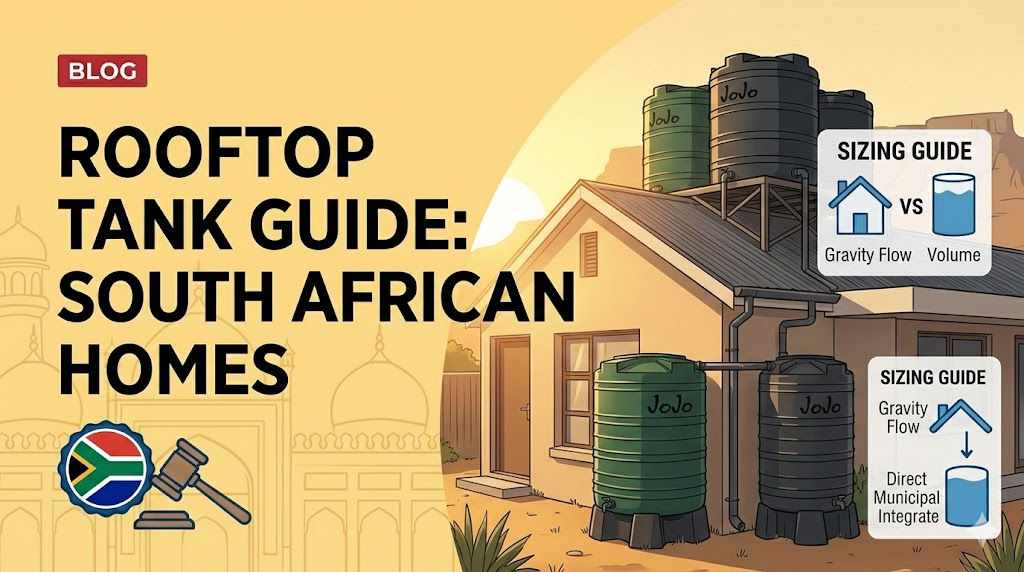
A rooftop tank in South Africa serves a different function than in most other countries — it is not a convenience, it is load-shedding and water shedding insurance. Municipal supply in metros including Johannesburg, Tshwane, and Buffalo City has deteriorated to the point where scheduled and unscheduled outages of 24–72 hours are routine. The standard South African rooftop installation is a 2,000–5,000 L polyethylene tank on a steel or concrete elevated platform, fed by a submersible pump from a ground-level sump. This guide covers sizing, structural requirements, municipal by-laws, and installation considerations specific to SA conditions.
The quick answer: recommended tank sizes for SA homes
South African municipal guidelines and the South African National Standards (SANS 10400-P) specify a basic minimum supply of 25 litres per person per day for basic sanitation compliance, but real household use in middle-income South African homes averages 150–200 litres per person per day (DWS Household Water Use Study, 2022). Using 175 L/person/day as the working baseline:
| Household size | 1-day storage | 3-day storage | 5-day storage |
| 2 people | 350 L | 1,050 L | 1,750 L |
| 4 people | 700 L | 2,100 L | 3,500 L |
| 6 people | 1,050 L | 3,150 L | 5,250 L |
| 8 people | 1,400 L | 4,200 L | 7,000 L |
For most Johannesburg, Cape Town, and Durban households experiencing outages of 1–3 days, a 2,000–4,000 L rooftop tank is the practical minimum. For households in areas with documented water shedding schedules of 5+ days (as occurred in parts of Hammanskraal and Buffalo City in 2022–2024), 5,000 L or a combination of rooftop and underground storage is required.
Use the water tank size for home calculator to get a figure calibrated to your actual household usage and your municipality’s supply pattern.
How the calculation works
The formula for sizing a South African rooftop tank for water security:
Tank size (L) = Daily household consumption (L) × Backup days required
Worked example — a Pretoria family of 5 with Tshwane supply cutting 3 days per week:
Daily consumption: 175 L × 5 people = 875 litres. Backup required: 3 days. Calculated size: 875 × 3 = 2,625 L. Nearest standard tank size: 3,000 L. Add a 15% maintenance buffer: 3,000 L × 1.15 = 3,450 L. Practical recommendation: a 4,000 L tank to allow for cleaning downtime and variable supply.
This family would likely run a 4,000 L rooftop tank plus a 2,500 L underground sump with a 0.75 kW submersible pump — a configuration that has become standard in Gauteng suburbs over the past three years.
Key variables that change the answer
Municipality and water shedding schedule. South Africa’s supply disruption frequency is highly localised. Cape Town after Day Zero planning has significantly upgraded storage in its distribution system; unplanned outages are typically short (4–12 hours). By contrast, eThekwini (Durban) experienced extended supply failures in 2022–2023 affecting some areas for weeks following infrastructure damage. Check your municipality’s current water shedding status — not last year’s — before finalising storage sizing.
Rooftop structure and load capacity. South African home construction is predominantly face-brick with concrete slab roofs in older suburbs, or lightweight steel frame with IBR or fibre cement sheeting in newer developments. A full 2,000 L polyethylene tank weighs approximately 2,060 kg. A concrete slab roof can typically support this if the tank is placed directly over or adjacent to a load-bearing wall. A steel-frame IBR roof cannot support a tank of this size without a dedicated freestanding steel platform alongside the structure — not on it.
Gravity pressure and floor layout. Every metre of elevation above the highest tap in the house delivers approximately 9.81 kPa (0.1 bar) of static pressure. For adequate shower flow, a minimum of 30 kPa (0.3 bar) is required at the showerhead. With a rooftop tank 3 metres above the shower outlet, pressure is marginal at 29.4 kPa. Many SA installations add a pressure-boosting pump or a header tank elevated an additional 1–2 metres above the main tank. Use the minimum tank height for shower pressure calculator to confirm your setup delivers adequate flow.
Borehole integration. An increasing number of Gauteng and Western Cape homes pair a rooftop or underground tank with a borehole. The borehole feeds the tank continuously, making the effective backup duration far longer than the tank volume alone would suggest. If a borehole is part of your system, size the tank primarily for the borehole pump’s output rate rather than for days-of-backup storage alone.
South African rooftop tank installation: local specifics
The dominant tank brands sold in South Africa — Jojo Tanks, Pioneer Plastics, and Harlequin — manufacture in sizes from 260 L to 10,000 L in black, green, and yellow. Black tanks are standard for South African conditions: they inhibit algae growth and UV degradation. Jojo’s most popular rooftop sizes are 2,500 L and 5,000 L; their structural tank stands are rated for the loaded weight of those sizes.
Municipal by-laws relevant to rooftop tank installation in major metros:
| Metro | Permit required? | Backflow prevention? | Key by-law |
| City of Joburg | No for <10,000 L | Required (check valve) | Water Services By-Law 2004 |
| City of Cape Town | No for residential | Required | Water By-Law 2010 |
| eThekwini (Durban) | No for residential | Required | Water and Sanitation By-Law |
| Tshwane | No for <10,000 L | Required | Water Services By-Law 2011 |
All SA metros require a non-return (check) valve between the municipal supply and any supplementary tank to prevent backflow contamination into the municipal network. This is non-negotiable and failure to install one can result in disconnection from supply.
Common mistakes
Placing a large tank directly on an IBR or corrugated steel roof without a platform. South African lightweight roof sheeting — IBR, corrugated, or fibre cement — cannot bear concentrated loads. A 2,000 L tank sitting on three sheeting ribs will puncture through within weeks. All non-concrete roofs require a freestanding steel frame platform built off the walls or ground structure, independent of the roof sheet itself.
Connecting the tank to mains supply without a backflow preventer. Every SA metro water by-law requires a check valve on the inlet. Without it, if mains pressure drops (which happens routinely during load shedding when pumping stations fail), backflow from your tank into the municipal network can contaminate the street supply. This has caused E. coli events in multiple SA suburbs. It is both illegal and a genuine public health risk.
Not accounting for the pump head when selecting a pump. A submersible pump rated 1,000 L/hour at ground level may only deliver 300–400 L/hour when lifting to a rooftop 5 metres above. Pump performance curves drop sharply with head. Many South African homeowners install an undersized pump that takes 6–8 hours to fill the tank — far too slow for daily refilling. The pump head pressure calculator tells you what performance to demand from your pump specification.
Neglecting tank cleaning. South African municipal water quality varies — Johannesburg mains water sometimes delivers with elevated turbidity and sediment. Sediment accumulates in tank bottoms and can exceed 20 cm depth in tanks that have never been cleaned. DWS guidelines recommend annual inspection and cleaning every 2–3 years for domestic storage tanks. A tank with heavy sediment loses effective capacity and can harbour Legionella if water temperatures exceed 25°C.
Related calculators you might need
Before committing to your tank size, use the rooftop load bearing calculator to verify your roof can bear the loaded weight — this is particularly critical for IBR or steel frame constructions. If you are comparing the cost of a rooftop tank system against underground storage, the underground vs rooftop tank cost calculator models the capital and running cost difference over a 10-year period. To understand how long your tank supply lasts under normal usage, the how long will my tank last calculator gives your days of supply at your household’s consumption rate.
Frequently asked questions
What size water tank do I need for a South African home of 4 people? A family of 4 using 175 L/person/day needs 700 litres per day. For 3 days of backup — appropriate for most Gauteng and KwaZulu-Natal supply conditions — this means a minimum 2,100 L tank, with a practical recommendation of 2,500 L to allow for cleaning and consumption variance. In areas with more severe water shedding, size for 5 days: 3,500 L minimum, with a 4,000 L or 5,000 L tank as the nearest standard size.
Do I need a permit to install a water tank in South Africa? For residential rooftop tanks under 10,000 L, no permit is required in most SA metros. You do need to comply with local water by-laws — specifically, installing a non-return valve on the mains inlet and ensuring the structure meets local building regulations. If the tank requires a new support structure, that structure may require building plan submission depending on your municipality.
Is a Jojo tank safe for drinking water? Jojo Tanks are manufactured from food-grade polyethylene and are SABS 1731 and SANS 1020 compliant for potable water storage. The black UV-resistant outer layer prevents algae growth. Water stored in a Jojo tank from a clean mains supply is safe for domestic use without additional treatment, provided the tank is cleaned periodically and the inlet is covered against insect and debris entry.
How much does a 5,000 L water tank installation cost in South Africa? A complete 5,000 L Jojo rooftop tank installation including tank, stand, pump, pipework, and backflow preventer typically costs R18,000–R35,000 depending on Gauteng vs Western Cape labour rates, stand complexity, and pump specification. DIY installation of the tank and stand alone (with a plumber for connections) can reduce this to R12,000–R20,000.
Can I connect my rooftop tank to my borehole? Yes. The typical configuration is: borehole pump feeds an underground sump, submersible sump pump fills the rooftop tank, gravity feeds the house from the rooftop tank. This completely eliminates municipal supply dependency for as long as the borehole yields. Ensure your borehole water is tested annually — borehole water in SA urban areas increasingly shows nitrate and coliform contamination from failing municipal sewer infrastructure.