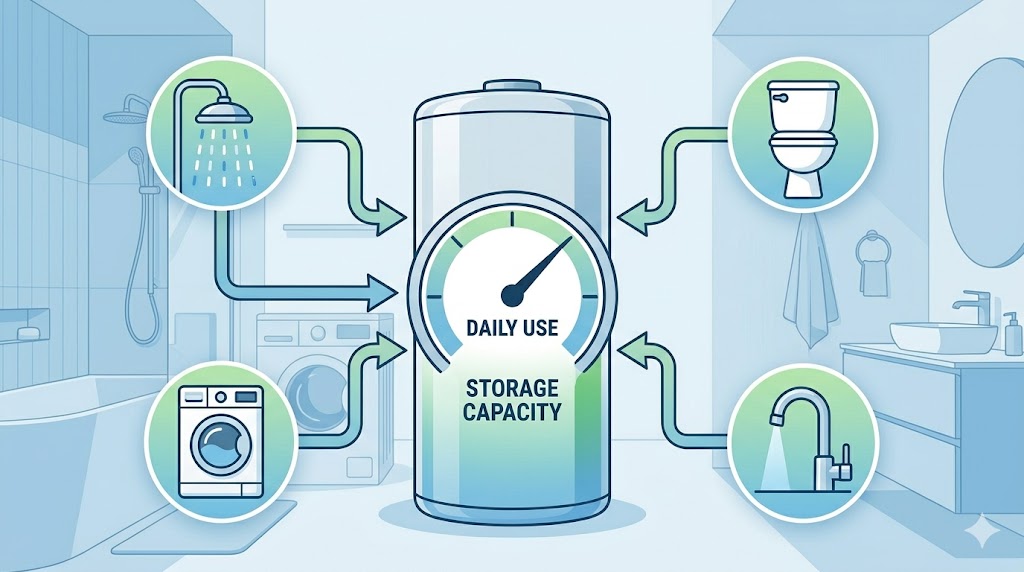
Sizing a household water tank correctly comes down to two numbers: daily consumption and backup days required. Multiply them, add a 10% buffer, and you have your minimum tank size. The difficulty is pinning down accurate consumption figures — most households underestimate by 30–50% compared to actual metered use. This article gives you the formula, the per-activity benchmarks to estimate consumption accurately, and the supply-scenario adjustments that change the answer significantly.
The quick answer
Use this formula:
Tank size (L) = persons × L/person/day × backup days × 1.10
The 1.10 factor adds a 10% safety buffer to account for dead volume, sediment, and gauge inaccuracy.
| Household size | L/person/day | 1-day buffer | 3-day buffer |
| 1 person | 100–150 | 110–165 L | 330–495 L |
| 2 persons | 100–150 | 220–330 L | 660–990 L |
| 4 persons | 100–150 | 440–660 L | 1,320–1,980 L |
| 6 persons | 100–150 | 660–990 L | 1,980–2,970 L |
Skip the math: use the water tank size for home calculator to enter your household details and get a tailored recommendation immediately.
How the calculation works
Daily consumption per person is the key variable. The benchmark figures used in the table above come from IWA (International Water Association) household use studies across urban residential properties. Here is where that 100–150 L/person/day goes:
| Activity | Litres per use | Daily total (per person) |
| Toilet flushing | 6–9 L per flush | 30–45 L |
| Shower (5 min, standard head) | 60–75 L | 60–75 L |
| Shower (5 min, low-flow head) | 35–40 L | 35–40 L |
| Drinking & cooking | — | 5–10 L |
| Laundry (shared, 1 load/day) | 50–80 L per load | 12–20 L |
| Dishwashing (machine) | 15–20 L per cycle | 4–7 L |
| Hand washing, misc. | — | 5–10 L |
A household with standard-efficiency appliances and typical shower habits lands at 120–150 L/person/day. Fitting low-flow showerheads and a water-efficient washing machine drops this to 90–110 L/person/day — a reduction that allows sizing down by 20–25% on the same backup target.
Worked example: 4 people, 3-day backup, standard appliances
Daily use: 4 × 140 L = 560 L/day. Target: 3 days. Raw figure: 560 × 3 = 1,680 L. Add 10% buffer: 1,680 × 1.10 = 1,848 L. Round up to the nearest standard size: 2,000 L tank
Key variables that change the answer
Supply reliability. This is the single biggest factor. In cities with reliable 24-hour mains supply, a tank sized for 1 day’s buffer is a pressure-head buffer, not emergency storage — 500–800 L is adequate for most households. In areas where supply runs for 4–6 hours per day, you need enough to cover the off-supply window plus a margin — typically 2–3 days. Where tanker deliveries are the only source and arrive weekly or fortnightly, size for the full delivery interval: 7–14 days of storage
Rooftop vs underground placement. Rooftop tanks are governed by structural load limits. A full 2,000 L tank weighs roughly 2,100 kg — most residential slabs rated for rooftop loads in developing markets are engineered for 200–300 kg/m². On a 2 m × 1.5 m footprint, that’s 400–600 kg maximum — a 500 L tank ceiling without structural assessment. Underground tanks have no such constraint and are the right choice for larger household storage volumes.
Seasonal demand variation. Hot climates see water use spike 25–40% in summer — more frequent showers, garden irrigation, evaporative coolers. If you’re sizing for a region with hot dry seasons, apply your peak-season consumption figure, not the annual average. A tank sized for average demand runs dry during the months you need it most.
Household type. Young children (under 10) use 30–40% less water than adults. Elderly residents use less shower water but more frequent toilet flushes. Teenagers and young adults are consistently the highest per-person users. Weighting your household composition against these patterns gives a more accurate daily total than simply multiplying people by a fixed per-person average.
Common mistakes
Using the WHO 15 L/person/day survival figure for tank sizing. The WHO’s 15 L/person/day is the humanitarian emergency threshold — drinking and basic sanitation only. It does not include showers, laundry, or dishwashing. Using it to size a residential household tank produces a tank that runs out in days under normal operation. The correct baseline for residential sizing is 100 L minimum; 140–160 L for a typical household.
Ignoring the supply pattern and sizing by household size alone. A 1,000 L tank serves a family of two with reliable mains and a family of two in a water-scarce region very differently. Without factoring in supply frequency, tank size recommendations are meaningless. Define your worst-case supply gap first, then size.
Underestimating garden and outdoor use. Garden irrigation, car washing, and outdoor cleaning add 50–150 L/day to a household’s consumption during active months. This frequently pushes per-person consumption above 200 L/day for households with moderate-sized gardens. Exclude it only if your outdoor area is fully paved or you source outdoor water separately.
Not accounting for tank accessibility for maintenance. Tanks that are never fully drained and cleaned accumulate biofilm and sediment — reducing usable capacity and degrading water quality over 2–5 years. An undersized tank that’s topped up continuously without ever being emptied causes more problems than one correctly sized and periodically cleaned. Factor in a cleaning interval (every 6–12 months) when planning tank size.
Related calculators you might need
If you don’t yet know your daily consumption, the daily water requirement calculator walks through each household activity to build a total. Once you’ve settled on a tank size, the how long will my tank last calculator confirms how many days it covers at your consumption rate. For underground or larger tanks, check the total filled weight with the water tank weight calculator before finalising placement. And if your area has treated water supply, the safe water storage duration calculator tells you how long stored water remains safe before requiring retreatment.
Frequently asked questions
How do I size a water tank for daily household use?
Multiply the number of people in your household by litres per person per day (use 140–160 L for a standard household), then multiply by your backup days, and add 10%. For a family of four needing 3 days’ backup: 4 × 150 × 3 × 1.10 = 1,980 L — round to a 2,000 L tank. Use the water tank size for home calculator to refine this for your specific usage pattern.
What is the minimum water tank size for a household?
The minimum that makes practical sense is 500–1,000 L for a single person or couple with reliable mains supply — enough to buffer daily supply interruptions. Below 500 L, a tank provides almost no meaningful backup. For a family of four with any supply variability, 2,000 L should be considered the floor, not the target.
How much water does a household use per day?
In OECD countries, average residential water use is 100–200 litres per person per day (WHO/OECD data). In urban South Asia and Sub-Saharan Africa, actual delivered supply is often 40–80 L/person/day due to infrastructure limits. Your actual number depends on appliance efficiency, climate, and lifestyle — the per-activity breakdown in the table above will give you a household-specific total.
How many days should a household tank last?
Size for your realistic worst-case supply gap, not the average. If your area loses supply for one day twice a week, size for 2–3 days. If tanker deliveries are the only source and arrive every 7–10 days, size for the full interval. A tank that runs dry before the next refill provides no safety margin — add at least 1.5–2 days beyond your expected gap.
Does a larger tank mean better water pressure?
Not from volume — pressure in a gravity-fed system depends on the height of the water surface above the outlet, not the tank’s capacity. A 500 L tank at 5 m elevation produces the same pressure as a 5,000 L tank at 5 m elevation. To improve gravity-feed pressure, raise the tank or install a pump booster. Volume and pressure are independent variables.

Most people buy a water tank once. We’ve spent thousands of hours thinking about nothing else.
Every calculator on this platform was built from scratch — from the physics up. Every guide is researched against the actual building codes, rainfall records, utility tariffs, and supply conditions of the country it covers. Not summarized from another blog. Not generic. The Australia guide uses BOM climate data. The UK guide references CIRIA C539. The Jordan guide accounts for Amman’s 12-48 hour rotational supply schedule specifically.
Water storage is one of those topics where bad information has real consequences — undersized tanks in drought zones, wrong materials in extreme heat, installations that fail structural load. We take that seriously.
This is the resource we wanted when we started asking these questions. We built it because it didn’t exist.