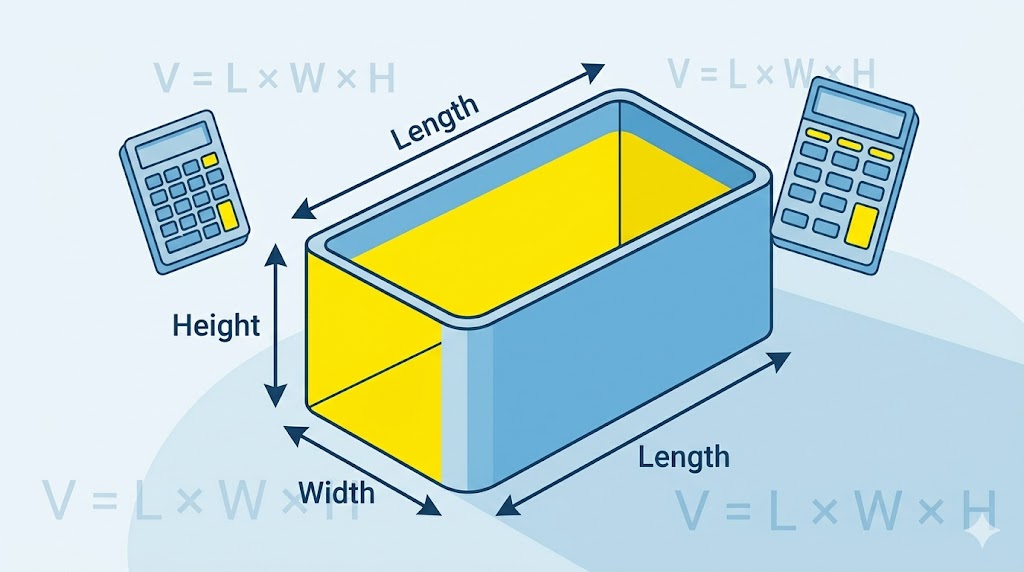
The volume of a rectangular water tank equals length × width × height, measured in the same unit throughout. The result is in cubic units — multiply by 1,000 to convert cubic metres to litres, or multiply cubic feet by 7.48 to get US gallons. This article covers the formula, unit conversions, partial-fill calculations, and the adjustments needed for tanks with wall thickness or irregular proportions.
The quick answer
For a rectangular tank, the calculation has one step:
Volume = Length × Width × Height
All three dimensions must be in the same unit before you multiply. Use metres for litres, feet for cubic feet, or inches for cubic inches (then convert). Here are the most common unit conversions:
| Measurement unit | Volume result | Convert to litres by |
| Metres (m) | Cubic metres (m³) | × 1,000 |
| Centimetres (cm) | Cubic centimetres (cm³) | ÷ 1,000 |
| Feet (ft) | Cubic feet (ft³) | × 28.317 |
| Inches (in) | Cubic inches (in³) | ÷ 61.024 |
Skip the conversion math: the rectangular water tank volume calculator handles all unit conversions and outputs results in litres, gallons, and cubic metres simultaneously.
How the calculation works
The formula treats the interior of the tank as a cuboid. Each dimension — length (L), width (W), height (H) — contributes directly and proportionally to the result. Double the height, you double the volume.
Worked example: residential rooftop tank
A concrete rooftop tank is 2.5 m long, 1.5 m wide, and 1.2 m high.
Volume = 2.5 × 1.5 × 1.2 = 4.5 m³ = 4,500 litres
At 150 litres per person per day, this serves a household of four for 7.5 days without refill.
Worked example: US gallon conversion
A tank measuring 8 ft × 4 ft × 3 ft:
Volume = 8 × 4 × 3 = 96 ft³ × 7.48 = 718 US gallons (2,718 litres)
Key variables that change the answer
Wall thickness. Many concrete and brick tanks have walls 100–200 mm thick. If you measure the external dimensions, you need to subtract wall thickness from each side to get the internal dimensions. For a tank with 150 mm walls: a 2.5 m external length becomes 2.5 − 0.30 = 2.2 m internally. Ignoring this on a brick tank overstates volume by 10–20%.
Fill level. Tanks are almost never filled to capacity. If you’re calculating usable volume or checking how much water is currently stored, use the actual fill height rather than the tank height. Volume at partial fill = L × W × fill depth.
Freeboard. Rooftop and open-top tanks are typically filled to 50–100 mm below the rim to prevent overflow and splashing. This effective height reduction of 5–8% on a standard 1.2 m tank reduces usable volume by 40–60 litres — not trivial if you’re sizing tightly.
Internal fittings. Tanks with inlet baffles, sediment chambers, or structural pillars have obstructions that displace water. Commercial and agricultural tanks sometimes have internal dividers — measure the usable chambers separately and sum them.
Rectangular vs other tank shapes
| Tank shape | Formula | Best use | Volume efficiency |
| Rectangular | L × W × H | Rooftop, underground, concrete | 100% space used |
| Cylindrical | π × r² × H | Polyethylene tanks, silos | ~79% of bounding box |
| Horizontal cylinder | π × r² × L | Underground, transport | ~79% of bounding box |
| Cone-bottom | Cylinder + 1/3 cone | Agriculture, mixing | Varies |
Rectangular tanks are the most space-efficient shape — they fill every cubic centimetre of the space they occupy. A cylindrical tank of the same external dimensions holds only 78.5% as much water.
Common mistakes
Measuring external instead of internal dimensions. For plastic tanks this barely matters — walls are thin. For concrete, brick, or fibreglass tanks with walls 100–200 mm thick, external measurement overstates volume by 15–25%. Always measure from inside face to inside face.
Mixing units mid-calculation. Multiplying 2 metres × 150 centimetres × 1,200 millimetres is a common error — the dimensions aren’t in the same unit. Convert everything to one unit first. The most reliable approach: use metres throughout for litres, or centimetres throughout and divide the cm³ result by 1,000.
Using nominal tank capacity instead of calculating it. Tank manufacturers list nominal capacities that sometimes reflect design intent rather than actual internal volume. A ‘5,000 L’ tank measured physically may hold 4,750 L due to wall thickness, baffles, or manufacturing tolerances. For critical sizing — hospital storage, agricultural irrigation — always calculate from measured dimensions rather than the label.
Ignoring the dead zone at the bottom. Sediment accumulates at the base of rectangular tanks over time, particularly in concrete tanks supplied by surface water. The bottom 50–100 mm is effectively dead volume. A 2.5 × 1.5 m tank loses 188–375 litres to sediment accumulation — deduct this from usable capacity in your planning.
Related calculators you might need
If your tank isn’t a simple rectangle — it has a sloped bottom, a cone section, or it’s cylindrical — the cylindrical tank volume calculator or the cone bottom tank volume calculator will handle the correct geometry. If you’ve calculated litres and need US gallons or imperial gallons for purchasing or regulatory purposes, use the litres to gallons converter. And if you’re installing a rectangular concrete tank on a rooftop, cross-check the filled weight against your slab rating using the water tank weight calculator before pouring or placing.
Frequently asked questions
How do I calculate the volume of a rectangular water tank?
Multiply length × width × height, with all three dimensions in the same unit. If using metres, the result is cubic metres — multiply by 1,000 for litres. Example: a tank 2 m × 1 m × 1.5 m holds 3 m³ or 3,000 litres. Use the rectangular water tank volume calculator for instant results across multiple units simultaneously.
What is the formula for tank volume in litres?
Volume (litres) = Length (m) × Width (m) × Height (m) × 1,000. Alternatively, measure in centimetres: Volume (litres) = L (cm) × W (cm) × H (cm) ÷ 1,000. Both produce the same result. For feet and gallons: L (ft) × W (ft) × H (ft) × 7.48 = US gallons.
How do I calculate how much water is in my rectangular tank?
Measure the current depth of water in the tank (the fill level, not the tank height). Then: Volume = Length × Width × Fill depth. All measurements in the same unit. If your 2.5 × 1.5 m tank currently has water 0.8 m deep: 2.5 × 1.5 × 0.8 = 3 m³ = 3,000 litres currently stored.
Does wall thickness affect the calculation?
Yes, for any tank with walls thicker than 20 mm — concrete, brick, fibreglass, or thick HDPE. Subtract twice the wall thickness from each external dimension to get internal dimensions. A tank with 150 mm walls has 300 mm (0.3 m) deducted from both length and width. Ignoring this on a large concrete tank can overstate volume by hundreds of litres.
How accurate is the rectangular tank volume formula?
Mathematically exact for a perfect cuboid with uniform walls. Real-world accuracy depends on how carefully you measure. A 10 mm error in a 1,000 mm dimension is 1% — acceptable. For a 2,500 mm length, a 25 mm measurement error creates a 1% volume error. Measure each dimension at multiple points and use the smallest reading if walls are uneven.

Most people buy a water tank once. We’ve spent thousands of hours thinking about nothing else.
Every calculator on this platform was built from scratch — from the physics up. Every guide is researched against the actual building codes, rainfall records, utility tariffs, and supply conditions of the country it covers. Not summarized from another blog. Not generic. The Australia guide uses BOM climate data. The UK guide references CIRIA C539. The Jordan guide accounts for Amman’s 12-48 hour rotational supply schedule specifically.
Water storage is one of those topics where bad information has real consequences — undersized tanks in drought zones, wrong materials in extreme heat, installations that fail structural load. We take that seriously.
This is the resource we wanted when we started asking these questions. We built it because it didn’t exist.