
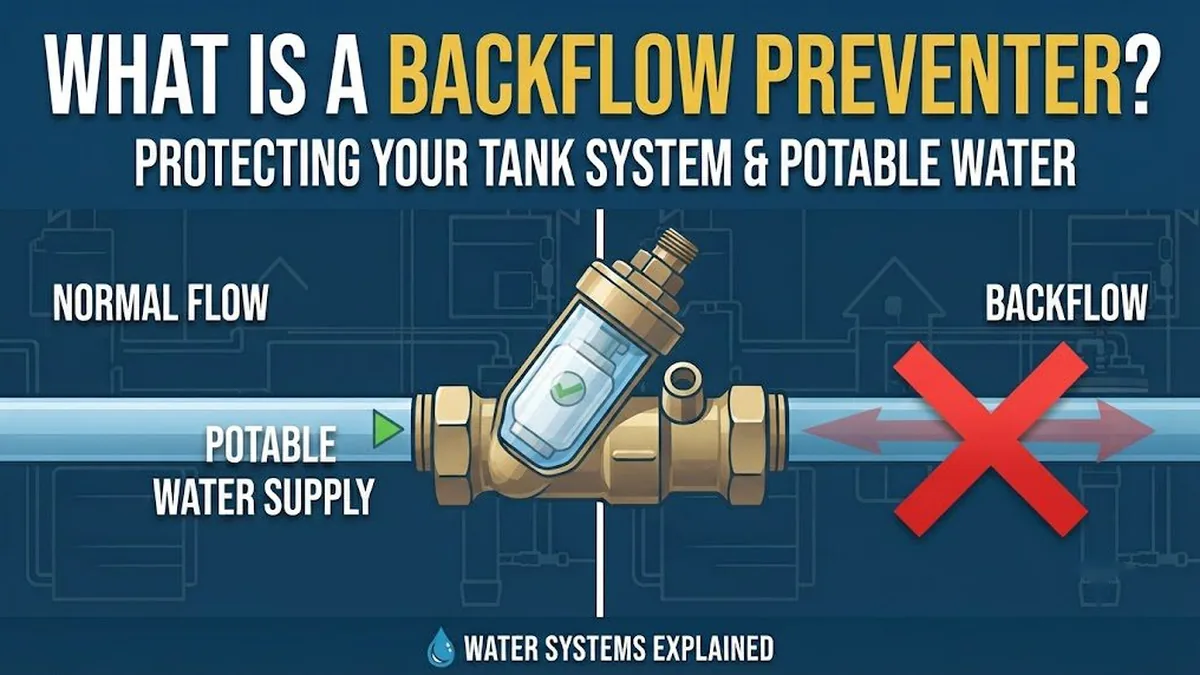
Every time a tank, pump, hose or irrigation line is connected to a drinking-water supply, there's a chance water could flow backwards into it. Backflow preventers and air gaps stop that. This guide explains how backflow happens and which protection suits which system.
How backflow happens
A cross-connection is any link between drinking water and something that isn't: a storage tank, an irrigation system, a boiler, a fertiliser injector, a hose left in a bucket. Normally water flows one way, from the main into your system. Backflow reverses it in two ways:
| Type | Cause | Tank-system example |
|---|---|---|
| Back-siphonage | Supply pressure drops or turns to a vacuum | A main bursts down the street while a hose or inlet pipe is submerged in a tank |
| Backpressure | Pressure on your side exceeds the supply | A booster pump or a raised tank pushes water back towards the main |
The risk matters because stored water, rainwater, irrigation water and anything with fertiliser or chemicals in it should never reach other people's taps.
Types of protection
| Protection | Stops back-siphonage | Stops backpressure | Hazard level | Testing |
|---|---|---|---|---|
| Air gap | Yes | Yes | Health and non-health | Visual check |
| Reduced pressure (RP/RPZ) assembly | Yes | Yes | Health and non-health | Periodic, with gauges |
| Double check valve assembly | Yes | Yes | Non-health only | Periodic, with gauges |
| Residential dual check | Yes | Yes | Non-health; service to single-family homes | Per supplier rules |
| Pressure or atmospheric vacuum breaker | Yes | No | Depends on type | PVB periodic; AVB none |
Air gap. An open, vertical gap between the end of the supply pipe and the highest level water can reach in the tank. With nothing physically connecting them, water can't flow back. It's the standard protection for a mains-fed tank with a float valve: the valve outlet sits above the overflow, and the shut-off level sits below it. See float valves.
Reduced pressure assembly. Two spring-loaded check valves with a relief valve between them, held at lower pressure than the supply. If either check leaks, the relief valve opens and dumps water to drain rather than letting it pass back. It needs a drain or open space below for that discharge.
Double check assembly. Two check valves in series without the relief valve; one backs up the other. Suitable for non-health hazards only.
Vacuum breakers. Let air in to break a siphon. They do nothing against backpressure, so they're unsuitable wherever a pump or raised tank can push water back.
Which protection for which system
| System | Usual protection |
|---|---|
| Mains-fed storage tank with a float valve | Air gap at the inlet, above the overflow level |
| Rainwater tank with mains top-up | Air gap: mains top-up discharges above the tank's overflow level, never piped in below it |
| Booster pump on a mains supply | Assembly or break tank as your supplier requires |
| Irrigation without chemicals | Double check or vacuum breaker, depending on pressure risk and local rules |
| Irrigation with fertiliser injection | Reduced pressure assembly or air gap |
| Hose bibs | Hose vacuum breaker |
Rules differ by country and supplier: the UK has fluid categories and approved air gap types (see rainwater harvesting in the UK), Cape Town requires an RPZ on plumbed alternative water systems (see rooftop tanks in South Africa), and US water suppliers run cross-connection control programmes. Ask your supplier before connecting anything.
Common mistakes
- Piping mains top-up below the tank's water level. This removes the air gap; discharge above the overflow.
- A plain check valve as protection. Use an approved, testable assembly where one is required.
- A vacuum breaker where there's a pump. It can't stop backpressure.
- An RPZ with nowhere to drain. Its relief valve discharges water; give it a drain and don't bury it in a pit that floods.
- Never testing. Mechanical assemblies fail silently; test them as your supplier requires.
For overflow and inlet levels in a tank, see water tank overflowing; for pumped systems, pump system vs gravity feed.
The bottom line
Backflow is water flowing from your system back into the supply, by back-siphonage or backpressure. For a mains-fed tank, an air gap above the overflow is the best protection; for pressurised connections, use a reduced pressure assembly for health hazards like fertiliser or chemicals, a double check for non-health hazards, and vacuum breakers only where back-siphonage is the sole risk. Follow your water supplier's rules and test mechanical assemblies regularly.