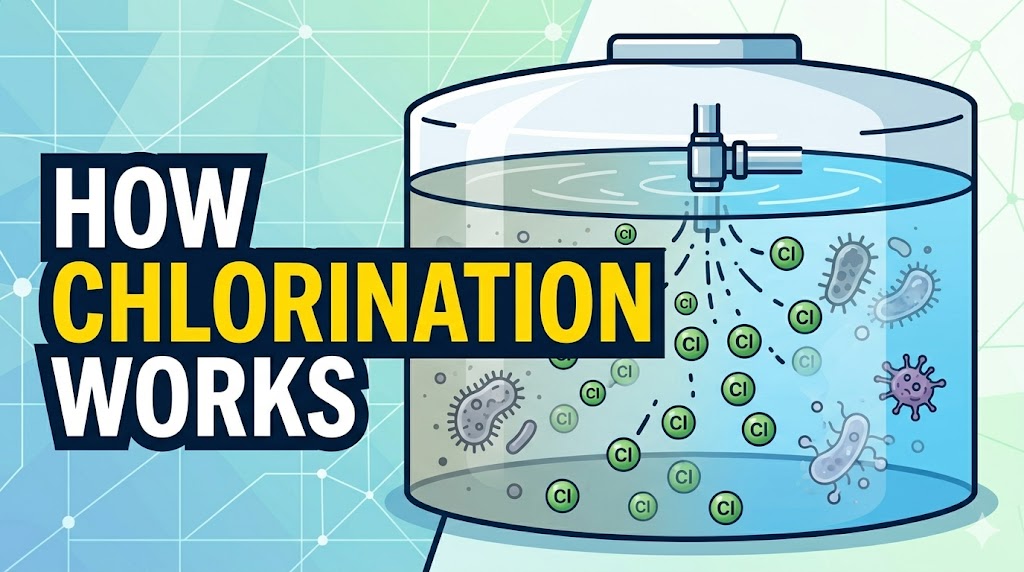
Chlorination kills or inactivates bacteria, viruses, and protozoa by oxidising their cell membranes and disrupting metabolic processes. For stored water, the effective dose is 2–5 mg/L of free chlorine (also expressed as 2–5 ppm), held in contact for a minimum of 30 minutes before the water is used. The key variables — tank volume, initial contamination level, pH, and water temperature — all affect how much chlorine you need and whether a residual remains after treatment. This article explains the chemistry, the dose calculation, and the practical steps for disinfecting a storage tank.
The quick answer
To disinfect a tank, you need to know its volume and whether you are doing routine maintenance or treating a contaminated tank. WHO guidelines recommend 0.5 mg/L free chlorine residual after 30 minutes of contact time for routine disinfection. For a contaminated or newly installed tank, dose to achieve 2 mg/L residual after contact.
| Scenario | Target residual | Sodium hypochlorite (5%) | Contact time |
| Routine maintenance | 0.5 mg/L | 10 mL per 1,000 L | 30 min |
| Post-contamination shock | 2 mg/L | 40 mL per 1,000 L | 30–60 min |
| Algae or heavy turbidity | 5 mg/L | 100 mL per 1,000 L | 60 min minimum |
Use the chlorine dosage calculator to compute the exact amount of chlorine product required for your tank volume and target residual.
How the calculation works
The dose formula is: Chlorine product volume = (Tank volume in litres × Target dose in mg/L) ÷ (Product concentration × 10,000). For a 5,000-litre tank dosed to 2 mg/L using 5% sodium hypochlorite (household bleach):
Volume = (5,000 × 2) ÷ (5 × 10,000) = 10,000 ÷ 50,000 = 0.2 litres = 200 mL
This is the amount of bleach to add, not the amount of active chlorine. Bleach concentration varies by brand — always check the label. Granular calcium hypochlorite (65–70% available chlorine) requires a very different quantity: for the same scenario, approximately 15 grams for a 5,000-litre tank at 2 mg/L. The bleach to water ratio calculator handles both liquid and granular forms.
The chemistry of chlorine disinfection
When sodium hypochlorite (NaOCl) dissolves in water, it produces hypochlorous acid (HOCl) and hypochlorite ion (OCl-). HOCl is the active disinfecting species — it is approximately 80 times more effective than OCl-. The ratio between the two depends on pH. At pH 7.5, roughly 50% of free chlorine is in the HOCl form. At pH 8.5, only about 10% is HOCl — meaning at high pH you need significantly more chlorine to achieve the same kill rate (EPA Guidance Manual for Compliance, 1999).
Temperature also matters. Chlorine reacts faster at higher temperatures but dissipates more quickly. At 25°C, a well-dosed tank may lose half its free chlorine residual within 48–72 hours through oxidation of organic matter, UV degradation (in uncovered tanks), and off-gassing. An enclosed, dark tank at moderate temperature retains residual for considerably longer. The safe water storage duration calculator models this decay based on your storage conditions.
Key variables that change the required dose
Water pH. As described above, high pH (above 8.0) dramatically reduces chlorine effectiveness. If your source water is alkaline — common with borehole or hard water supplies — test pH before chlorinating and consider acidifying to pH 6.5–7.5 with citric acid or CO₂ injection before adding chlorine. Use the water pH adjustment calculator to determine the adjustment dose.
Turbidity and organic load. Chlorine reacts with organic matter — soil particles, algae, biofilm — to form disinfection by-products (DBPs) and is consumed in the process without providing any disinfection. WHO recommends water be clarified to below 1 NTU before chlorination. A visibly turbid tank may consume 5–10 mg/L of chlorine just in DBP formation before any residual remains. Always settle and filter heavily turbid water before chlorinating.
Tank condition and biofilm. A tank that has never been cleaned accumulates biofilm — a bacterial community embedded in a protective polysaccharide matrix. Chlorine at normal doses does not penetrate mature biofilm effectively. Tanks must be drained, physically scrubbed, and rinsed before chemical disinfection. Shock chlorination alone of a fouled tank produces a false sense of safety.
Chlorine product age and storage. Liquid bleach degrades at roughly 20% per month at room temperature. A bottle stored for 6 months at 30°C may have lost 50–60% of its stated concentration. Always check the manufacture date and factor in degradation — or use fresh product. Granular calcium hypochlorite is more stable if kept dry and sealed, retaining potency for 2–5 years.
Common mistakes
Dosing by tank size alone without accounting for concentration. Adding “one capful” of bleach to a 10,000-litre tank based on a rough estimate delivers an unknown dose. Calculate using the exact product concentration and target residual. Under-dosing leaves pathogens alive. Over-dosing (above 5 mg/L free chlorine) creates taste and odour problems and may form excessive trihalomethanes.
Not testing for residual after contact time. The dose calculation gives you the starting concentration, not the end result. Chlorine demand — the amount consumed by organic matter and reactions in the water — reduces the residual. After 30 minutes, test with a DPD test kit or strip to confirm at least 0.2 mg/L free chlorine remains. If residual is zero, re-dose and wait. If it never holds residual, the tank requires physical cleaning first.
Chlorinating without isolating the tank. If the supply line feeds directly into the distribution system, chlorinating the tank without isolation will push high-chlorine water into pipes serving sinks and appliances. Isolate the tank outlet valve before dosing. Only reconnect after testing confirms the residual has dropped to below 0.5 mg/L — or flush the tank before reconnecting.
Ignoring pH when treating borehole water. Borehole water commonly has pH 7.8–8.5 and high hardness. At these pH levels, chlorination is inefficient — you may dose correctly and still leave viable pathogens because HOCl is too low a fraction of the free chlorine. Test and correct pH before dosing. This single step is the most commonly skipped in rural and peri-urban settings.
Related calculators you might need
If you are treating a contaminated tank, start with the water tank disinfection calculator, which walks through the full disinfection sequence including drain-down, rinsing, and re-dosing phases. For tanks where biofilm or iron bacteria are the problem, the potassium permanganate dosage calculator provides an alternative oxidative treatment. If you need to assess your water’s overall quality before deciding on a treatment approach, the TDS water calculator gives a baseline reading of dissolved solids. For long-term water quality monitoring, the water hardness calculator helps assess scaling risk that affects chlorine contact efficiency in pipes and fittings.
Frequently asked questions
How much bleach do I add to a 1,000-litre water tank? For routine disinfection using 5% sodium hypochlorite (household bleach), add approximately 10 mL (two teaspoons) per 1,000 litres. For shock disinfection after contamination, use 40 mL per 1,000 litres. Wait 30 minutes, then test with a chlorine test strip to confirm a residual of at least 0.2 mg/L before use. Adjust if your bleach concentration differs — check the label.
How long does chlorine last in a water tank? In a covered, dark, well-maintained tank with low organic load, a 0.5 mg/L residual typically falls below detectable levels within 3–5 days at 25°C. In an open or algae-affected tank, this may happen within hours. WHO recommends re-testing residual every 24–48 hours for stored drinking water and re-dosing if it drops below 0.2 mg/L. Use the safe water storage duration calculator to estimate based on your conditions.
Is it safe to drink water after chlorinating a tank? Yes, provided the free chlorine residual is between 0.2 and 0.5 mg/L at the point of consumption (WHO Guidelines for Drinking-water Quality, 2022). Above 5 mg/L, the water should not be consumed without dilution or further treatment. Always test with a DPD kit or test strip before resuming use. If residual exceeds 1 mg/L after contact time, flush the tank until it drops to an acceptable level.
Why does my chlorinated tank still smell bad? Persistent odour in a chlorinated tank usually indicates chloramines — compounds formed when chlorine reacts with ammonia or organic nitrogen. Chloramines are a sign of under-treatment (not enough chlorine to complete oxidation) or high organic load in the water. The fix is to shock-dose to breakpoint chlorination — typically 7–10 mg/L — which fully oxidises the nitrogen compounds. After breakpoint, the odour disappears and free chlorine residual is restored.
Can I use swimming pool chlorine for drinking water tank treatment? Only if it is pure calcium hypochlorite without stabilisers. Many pool products contain cyanuric acid (a stabiliser) which is not approved for drinking water use. Look for food-grade or NSF-certified calcium hypochlorite at 65–70% available chlorine. Trichlor and dichlor tablets used in pools are not suitable for potable water treatment.