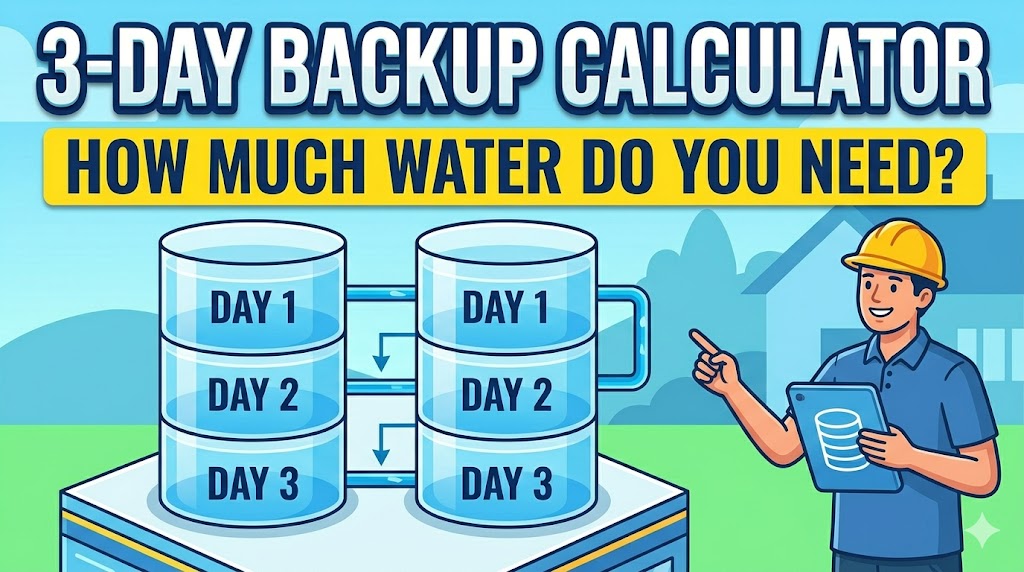
For a 3-day water backup, FEMA recommends 1 US gallon (3.78 litres) per person per day as a survival minimum — but this covers only drinking and basic sanitation with no cooking, bathing, or toilet flushing. For functional 3-day backup that maintains normal household operations, the figure is 50–100 litres per person, meaning a family of four needs 600–1,200 litres in storage. This article explains the range, how to set the right number for your situation, and what infrastructure you need to store it reliably.
The Quick Answer
Three-day water storage targets depend on use level. FEMA’s minimum (1 gallon/person/day, per FEMA Ready.gov guidelines) is a survival threshold — it assumes no bathing, no toilet flushing, and minimal cooking. The WHO minimum for basic needs is 15 litres/person/day. Normal household operation requires 50–150 litres/person/day depending on climate and habits.
| Household size | FEMA minimum (72 hrs) | WHO basic (72 hrs) | Normal household use (72 hrs) |
| 1 person | 11.4 L (3 gal) | 45 L | 150–450 L |
| 2 people | 22.7 L (6 gal) | 90 L | 300–900 L |
| 4 people | 45.4 L (12 gal) | 180 L | 600–1,800 L |
| 6 people | 68.1 L (18 gal) | 270 L | 900–2,700 L |
| 4 people + 1 infant | 45.4 L + 15 L formula | 220 L | 700–2,000 L |
Skip the math: Use the 72-Hour Water Supply Calculator to get a 3-day storage target based on your household size, climate, and intended use level — survival minimum through full household operation.
How the Calculation Works
Step 1 — Establish your daily consumption baseline. The most accurate figure comes from your water meter. Read it at the same time on two days with normal usage. Divide the total by 2 (or the number of days) and by the number of occupants. This is your actual per-capita daily consumption.
Step 2 — Apply an emergency reduction factor. During a supply interruption, toilet flushing (which accounts for 25–30% of normal household use, per US EPA WaterSense data) can be reduced or eliminated. Outdoor water use stops entirely. Showers get shorter or are replaced with sponge bathing. A realistic emergency reduction factor is 50–70% of normal consumption for a household that is conserving actively.
Step 3 — Worked example. Family of 4, normal consumption 180 litres per day per person = 720 litres/day total. Emergency mode consumption (60% reduction) = 720 × 0.4 = 288 litres/day. Over 3 days: 288 × 3 = 864 litres. Round to the next standard tank size: 1,000 litres
Step 4 — Add a safety margin. FEMA recommends building in reserve beyond the 72-hour target because emergencies rarely resolve exactly on schedule. A 20% buffer is standard: 864 × 1.2 = 1,037 litres. A 1,000-litre tank is the minimum; 1,200–1,500 litres provides adequate margin.
Key Variables That Change the 3-Day Storage Requirement
Climate and ambient temperature. In hot climates (above 35°C), per-person drinking water requirements increase from 2 litres/day to 4–6 litres/day (WHO, 2011 Guidelines for Drinking Water Quality). Physical labour outdoors in heat raises this further. A 3-day minimum for active adults in a hot climate must account for this — the FEMA gallon-per-day figure was developed for temperate conditions.
Medical and sanitary requirements. Dialysis patients typically require 120–150 litres of clean water per session, 3 sessions per week. A 3-day backup for a household with a dialysis patient requires this volume on top of household consumption. Similarly, households with infants need water for formula preparation and sterilisation — typically an additional 5–8 litres per day per infant.
Whether you have flush toilets. Standard flush toilets use 6–13 litres per flush (US EPA data). At 5 flushes per person per day, a family of 4 uses 120–260 litres just for toilets. If supply is cut and mains pressure is lost, toilet flushing requires manual tank filling. Many households do not account for this — they calculate drinking and cooking water only, then find their storage depleted in 12–18 hours by toilet use alone.
Whether the storage is pre-treated. Stored water must be treated for it to remain safe across a 72-hour period, particularly in warm climates. Untreated water from a tap stored in a clean container is safe for 6–12 hours at room temperature; treated water with 0.2–0.5 mg/L free chlorine (WHO standard) remains safe for 6–12 months in a sealed container. If your 3-day storage is not chemically treated, it needs to be rotated continuously or used immediately on a supply interruption.
Pets. A medium-sized dog requires 30–50 ml per kg of body weight per day (approximately 1 litre/day for a 25 kg dog). A household with two dogs and a family of four needs to add 2+ litres per day — small in absolute terms but worth including in a precise calculation.
Common Mistakes When Planning 3-Day Water Backup
Calculating drinking water only and ignoring sanitation. The FEMA 1 gallon/day figure is explicitly a survival minimum for drinking only. People planning a ‘3-day emergency supply’ using this number are typically unprepared for toilet flushing, cooking, wound cleaning, and medication preparation. Real 72-hour preparedness for normal function requires 10–20× the FEMA minimum per person.
Storing water in food-grade containers that are not food-grade. HDPE plastic containers rated food-grade (marked with recycling code 2) are suitable for water storage. Containers that previously held bleach or chemicals, or are made from non-food-grade plastics, leach compounds into stored water. Standard garden water barrels are often not food-grade. Containers must also be opaque — clear or translucent containers allow algae growth in any light.
Not accounting for rotation. Water stored without treatment and without rotation becomes unsafe. Even treated water in a non-sealed container should be replaced every 6 months. Many households set up 3-day storage and forget it — inspecting it years later to find sediment, bacterial growth, or degraded container integrity.
Ignoring access during power outages. If your backup storage depends on an electric pump to access it — for example, underground cisterns or pressurised systems — a power outage simultaneously cuts water supply and pump operation. Gravity-fed rooftop tanks or hand-pump accessible containers are the only reliable 3-day backup for power-cut scenarios.
Related Calculators You Might Need
The Emergency Water Storage Calculator lets you customise your target by intended use level and household composition. If you want to plan beyond 72 hours, the Water Stockpile Duration Calculator tells you how long any given stored volume will last at your consumption rate. For households preparing for specific events, the Hurricane and Disaster Water Prep Calculator applies scenario-specific guidance. And if you are evaluating the ongoing cost of maintaining emergency storage versus other supply options, the Water Delivery vs Tank Cost Calculator puts the numbers into context.
Frequently Asked Questions
How much water does a family of 4 need for 3 days?
At FEMA’s survival minimum of 1 US gallon (3.78 L) per person per day: 45.4 litres total — covering drinking only. For normal household operation with emergency conservation: 600–900 litres. The correct figure depends entirely on how you define ‘backup’ — survival hydration only or maintained household function. Use the 72-Hour Water Supply Calculator to calculate for your specific household.
What size water tank do I need for a 72-hour emergency supply?
For most households aiming at functional (not survival) backup, the practical tank size is 200–300 litres per person for 72 hours. A family of four therefore needs an 800–1,200-litre tank dedicated to emergency use. This can be a standalone polyethylene tank with a sealed lid, a gravity-fed overhead unit, or a purpose-built underground cistern — depending on access and structural constraints.
Can I use my existing water tank as a 3-day backup?
Yes, if it meets three criteria: the stored volume is adequate for your 72-hour target, the water is treated and rotated on schedule, and you can access it independently of mains pressure and electric pumps. Many household overhead tanks already hold 500–2,000 litres — check whether the usable volume (subtracting the dead zone below the outlet) meets your 3-day requirement before purchasing additional storage.
How long does stored water last before it goes bad?
Treated tap water in a sealed, food-grade, opaque container remains safe for 6–12 months. Water stored in open or semi-open containers should be replaced every 48–72 hours. Commercially bottled water has a stated shelf life of 12–24 months, though this reflects container integrity, not water chemistry — properly stored water does not expire the way food does; the container degrades.
Is 1 gallon of water per day per person enough for 3 days?
For survival — yes. FEMA’s 1 gallon/person/day is sufficient to prevent dehydration in a temperate climate with minimal activity. It is not sufficient for cooking, hygiene, toilet flushing, or any medical needs. If you are planning for a functional emergency period rather than strict survival, multiply the FEMA figure by 5–15 depending on your specific household requirements.
Most people buy a water tank once. We’ve spent thousands of hours thinking about nothing else.
Every calculator on this platform was built from scratch — from the physics up. Every guide is researched against the actual building codes, rainfall records, utility tariffs, and supply conditions of the country it covers. Not summarized from another blog. Not generic. The Australia guide uses BOM climate data. The UK guide references CIRIA C539. The Jordan guide accounts for Amman’s 12-48 hour rotational supply schedule specifically.
Water storage is one of those topics where bad information has real consequences — undersized tanks in drought zones, wrong materials in extreme heat, installations that fail structural load. We take that seriously.
This is the resource we wanted when we started asking these questions. We built it because it didn’t exist.