Rice paddy irrigation in Southeast Asia accounts for 85–90% of freshwater withdrawal across the region. But the storage challenge is not one of scarcity in wet months — it’s one of temporal mismatch: monsoon rainfall arrives in concentrated 4–6 month windows, while the second crop season runs through the dry period when rivers run low and groundwater tables drop. A farm in the Mekong Delta, the Chao Phraya basin, or Luzon’s Central Plain must store or access water across a 3–5 month gap that river irrigation schemes often cannot reliably fill.
Use the irrigation water requirement calculator to compute your seasonal water demand before sizing storage. What follows gives you the regional and crop-specific context to use those numbers correctly — and for the general sizing logic behind these figures, see our guide on how to size a farm water tank for irrigation season.
How Southeast Asia’s Rainfall Patterns Drive Storage Requirements
Southeast Asia has two distinct hydrological regimes that determine storage strategy: monsoon-dominated mainland systems and equatorial wet regions. The seasonal-storage challenge here mirrors what smallholders face in other single- or bimodal-season regions — see our comparable regional guide on water storage for small farms in Sub-Saharan Africa for a side-by-side reference point.
| Country/Region | Rainfall Pattern | Dry Season Length | Primary Irrigation Stress Period |
| Thailand (Central Plain) | Single monsoon; May–Oct rains | Nov–Apr (6 months) | Feb–April: rice second crop; groundwater low |
| Vietnam (Mekong Delta) | Bimodal south; Oct–Apr floods then dry | Jan–Apr | March–April at peak; canal levels minimal |
| Vietnam (Red River Delta) | May–Sep monsoon | Oct–Apr | Feb–Apr: spring crop requires full irrigation |
| Philippines (Luzon) | June–Oct typhoon/monsoon | Nov–May | Mar–May: dry season rice in Central Luzon |
| Indonesia (Java) | Nov–Apr wet; May–Oct dry | Jun–Oct | Aug–Sep: critical dry; highland veg farms stressed |
| Myanmar (Irrawaddy basin) | May–Oct monsoon | Nov–Apr | Feb–Apr: dry zone crops; river levels low |
| Cambodia (Tonle Sap) | May–Oct; Tonle Sap floods | Nov–Apr | March–April: significant irrigation demand |
The equatorial zone — peninsular Malaysia, Singapore, Sumatra, and Kalimantan — receives year-round rainfall with no pronounced dry season, making irrigation storage less critical for annual crops. The challenge there is flood management, not drought. The seasonal strategies in this article apply primarily to the mainland and island nations above the 5°N latitude line where a pronounced dry season exists.
How Much Water Do Southeast Asian Crops Actually Require?
Rice dominates irrigated agriculture across the region. Lowland wet-season rice requires 800–1,200 mm of water over a 90–120 day cropping period — meaning a full hectare of paddy consumes 8,000,000–12,000,000 litres per season. This scale makes individual farm tank storage impossible for paddy fields; communal irrigation schemes, canals, and river abstraction do the heavy lifting. Tank storage for rice is relevant only as a pump buffer — a holding tank that smooths irregular pumping schedules from rivers or canals, typically 20,000–100,000L at the farm pump station.
High-value vegetables and fruits are where individual farm storage investments pay off. Tomatoes in the Thai highlands or Philippine lowlands require 400–600 mm over 90 days — 4,000,000–6,000,000L per hectare. A 0.1 hectare plot needs 400,000–600,000 litres for a full season. That’s beyond practical tank storage, but a 3–5 day buffer tank of 20,000–30,000L allows pump-off periods for maintenance and provides operational flexibility. Use the crop water need calculator to get evapotranspiration-corrected seasonal requirements for your specific location and crop.
| Crop | Water Req. (mm/season) | Common Storage Strategy | Practical Tank Size for 0.5 ha |
| Wet rice (lowland) | 800–1,200 | Canal + river abstraction; small pump buffer | 20,000–50,000L pump buffer |
| Dry season rice (irrigated) | 700–1,000 | Groundwater pump + storage buffer | 30,000–80,000L |
| Tomatoes | 400–600 | Drip + 5-day buffer tank | 20,000–30,000L |
| Cassava | 500–700 | Rainfed primarily; buffer for establishment phase | 5,000–10,000L |
| Sugarcane (Thailand/Philippines) | 1,200–1,500 | Canal or borewell; large farm dam | Farm dam 500,000L+ |
| Banana (lowland) | 1,200–2,000 | Year-round irrigation; borewell or drip | 20,000–50,000L buffer |
| Durian/Mangosteen | 700–1,000 | Precision drip; tank essential during fruit set | 10,000–30,000L per hectare |
Practical Tank Sizing for Southeast Asian Farm Conditions
For most commercial vegetable and fruit farms in Southeast Asia, storage is designed around a 3–7 day irrigation buffer — enough to absorb pump failures, canal shutdowns, and brief supply interruptions without crop loss. The formula: Tank size (L) = Daily water application (L/hectare/day) × irrigated area (hectares) × buffer days.
For a 0.5 hectare tomato farm in Central Luzon applying 30,000L/hectare/day under drip irrigation: 30,000 × 0.5 × 5 = 75,000 litres. That’s typically two 40,000L polyethylene or ferro-cement tanks positioned at the field edge with gravity-fed drip distribution — the same distributed-storage logic covered in our guide on single large tanks vs. multiple small tanks. This configuration is commonly seen in the Benguet vegetable farms in the Philippine highlands and in Thailand’s Chiang Mai basin.
For highland greenhouse operations in the Philippines (Bukidnon, Benguet) and Thailand (Chiang Rai), where rainfall is more seasonal and supplemental irrigation is applied year-round, storage needs increase to 10–14 day buffers — approximately 150,000–300,000L for a 1-hectare controlled environment facility. (This range implies a lower daily application rate than the open-field tomato figure above — roughly 15,000–21,000 L/ha/day — consistent with the reduced evaporation loss inside a greenhouse, though worth confirming against your specific system’s actual application rate rather than treating it as a fixed formula output.) These installations typically use fiberglass or geomembrane-lined earthen ponds rather than polyethylene tanks, as cost per litre drops sharply above 50,000L.
Irrigation Infrastructure Options Across Southeast Asia
Southeast Asian farm water storage exists on a spectrum from simple polyethylene tanks to large communal farm dams, and choice of system is heavily constrained by terrain, electricity access, and capital — the same material trade-offs covered in our broader plastic vs. steel vs. concrete water tanks comparison.
In the Mekong Delta (Vietnam), land is flat and canal infrastructure is the primary distribution network. Individual farm storage in this setting means pump sumps of 5,000–20,000L that buffer between canal availability and drip system timing — rarely larger, as canal access is consistent in the wet season and farmers rotate irrigation schedules in the dry period. In the Thai highlands (Chiang Mai, Chiang Rai), altitude and terrain mean gravity-fed tank systems are viable — tanks are filled from mountain streams or seasonal springs and distributed downslope via drip without pumping costs. In Luzon’s Central Plain (Philippines), National Irrigation Administration canals supply the bulk of water; individual farm tanks serve primarily as backup for dry season gaps when NIA allocation schedules are cut.
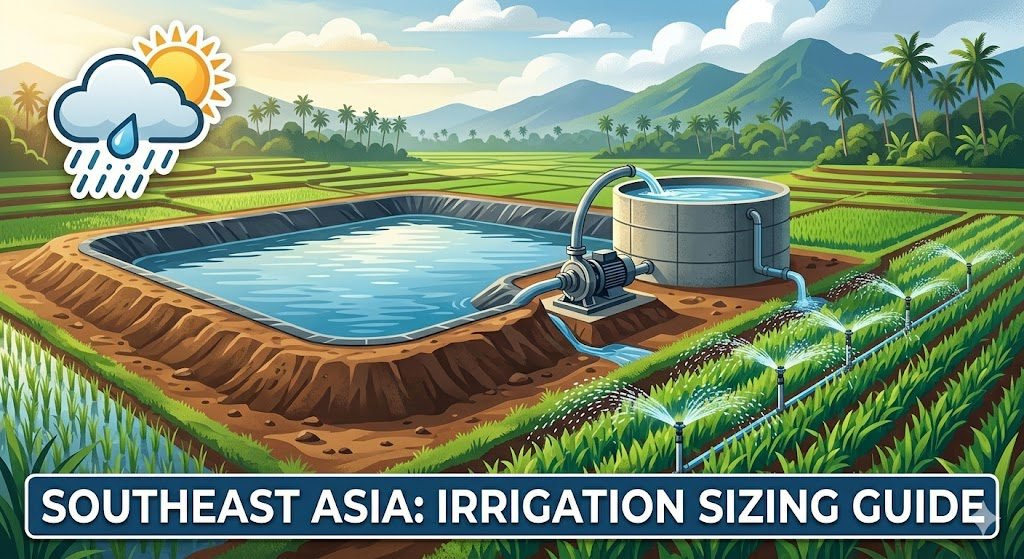
For farms in areas without canal access, groundwater is the primary source. Groundwater in the Chao Phraya basin has been heavily over-extracted — the Bangkok subsidence zone records 1–4 cm of annual ground subsidence linked to aquifer depletion. Borewell depth has increased from 50–100m to 300m+ in parts of central Thailand over the past 30 years, with corresponding yield reduction. This makes surface storage more valuable: collecting and storing monsoon runoff in farm ponds reduces groundwater dependence during the dry season. The field irrigation tank sizing calculator is designed for exactly this application — sizing a surface storage pond or tank against your field water demand and rain-fed inflow.
Common Mistakes in Southeast Asian Agricultural Water Storage
- Using flood irrigation assumptions for drip-converted systems. Many Southeast Asian farmers transitioning from flood irrigation to drip incorrectly carry over their old water demand figures. Drip irrigation delivers 30–50% less water than flood irrigation for equivalent yield — the storage requirement drops correspondingly. Oversizing a tank for a drip system wastes capital; more critically, it creates large volumes of stagnant water that breed mosquitoes and algae during rainy periods when irrigation demand drops. Size the tank for drip demand, not for the old flood figures.
- Placing storage tanks on flat ground in flood-prone delta areas. In the Mekong Delta and many low-lying Philippine agricultural areas, ground-level tanks flood during monsoon. A 10,000L polyethylene tank on a concrete slab will float and shift in floodwater above 30–40 cm depth if not anchored. Either elevate tanks on concrete plinths above the local 1-in-10-year flood level, or bury tanks below ground as cisterns with sealed lids. Check the underground tank volume calculator for buried configurations.
- Not accounting for sedimentation in farm pond storage. Farm ponds in Southeast Asia accumulate sediment rapidly — particularly in areas with deforested upland catchments feeding into irrigation ponds. A 500,000L earth pond can lose 20–30% of its effective capacity within 5–10 years through silt accumulation without annual desilting. Factor in a 25% capacity buffer above calculated requirements to account for sedimentation over the storage system’s design life.
- Sizing pump and tank independently without matching flow rates. A common installation error is buying a tank based on volume requirements and a pump based on price, without verifying that the pump can fill the tank within the available daily pumping window. If canal or groundwater access is available for only 6 hours per day, the pump must deliver your full daily irrigation requirement in that window. Use the water flow rate calculator to confirm pump-to-tank sizing before purchase.
Related Calculators You Might Need
Once your storage volume is determined, the drip irrigation tank size calculator refines the figure against your specific emitter layout and irrigation frequency. For farms with both crops and livestock — common in mixed smallholder operations across Southeast Asia — add livestock water demand via the livestock water requirement calculator. If you’re installing a pump to fill your storage tank, use the irrigation pump size calculator to match motor horsepower to required flow and head. And for gravity-fed distribution from elevated tanks without a pressure pump, the gravity feed flow rate calculator confirms whether your tank height generates sufficient pressure for your drip system’s minimum operating pressure.
Frequently Asked Questions
How much water does rice farming need per hectare in Southeast Asia? Lowland wet rice requires 800–1,200 mm of water over the growing season — equivalent to 8,000,000–12,000,000 litres per hectare. Water use efficiency varies significantly by soil type: heavy clay soils in the Mekong Delta retain water well (paddy water requirement 700–900 mm), while sandy lowlands in parts of the Philippines require 1,100–1,400 mm due to higher percolation losses. These volumes make river/canal abstraction the only practical supply source at full-hectare scale.
What size water tank do I need for a vegetable farm in Thailand? For a 1-hectare drip-irrigated vegetable operation in Chiang Mai or Central Thailand, a 5–7 day buffer tank of 60,000–100,000L is the standard specification. This is typically configured as two 40,000–50,000L GRP or ferro-cement tanks positioned at field elevation to enable gravity-fed drip distribution. Smaller plots (0.1–0.2 ha) can manage with a single 10,000–20,000L polyethylene tank.
Can I use a rainwater tank for irrigation in Southeast Asia? In wet-season months, absolutely — and it’s economically superior to groundwater pumping. Roof catchment systems on farm buildings can collect substantial volumes: a 200 m² iron sheet roof in Manila (annual rainfall ~2,000 mm) yields approximately 280,000 litres per year — the actual figure depends on your roof’s runoff coefficient. This won’t replace river or borewell supply for field-scale irrigation, but it covers greenhouse or nursery operations reliably. Use the annual rainwater collection calculator to size the catchment system.
What is the cheapest way to store large volumes of irrigation water on a farm? For volumes above 100,000L, compacted earth ponds lined with HDPE geomembrane are consistently the most cost-effective option — typically $0.01–$0.03/litre installed versus $0.15–$0.30/litre for polyethylene tanks. The catch: they require flat terrain, a reliable water source to fill them, and annual maintenance to prevent seepage and weed growth. For volumes under 100,000L, ferro-cement ring tanks offer the best cost-per-litre balance for permanently installed structures.
How do I calculate how much water my farm needs per day? Multiply your irrigated area (in hectares) by the crop’s peak evapotranspiration rate (available from local agricultural extension offices or the FAO Penman-Monteith dataset for your region) by the crop coefficient for your specific crop and growth stage. Apply irrigation efficiency factor: 0.90 for drip, 0.75 for sprinkler, 0.55–0.65 for flood. Use the crop water need calculator to run this calculation against your location’s temperature and humidity data.

Licensed Professional Engineer (Texas, PE) with 13+ years in residential and light-commercial water storage systems. Reviews and writes the technical guides on this site — sizing, pressure, roof loading, and treatment — based on 180+ completed field projects.