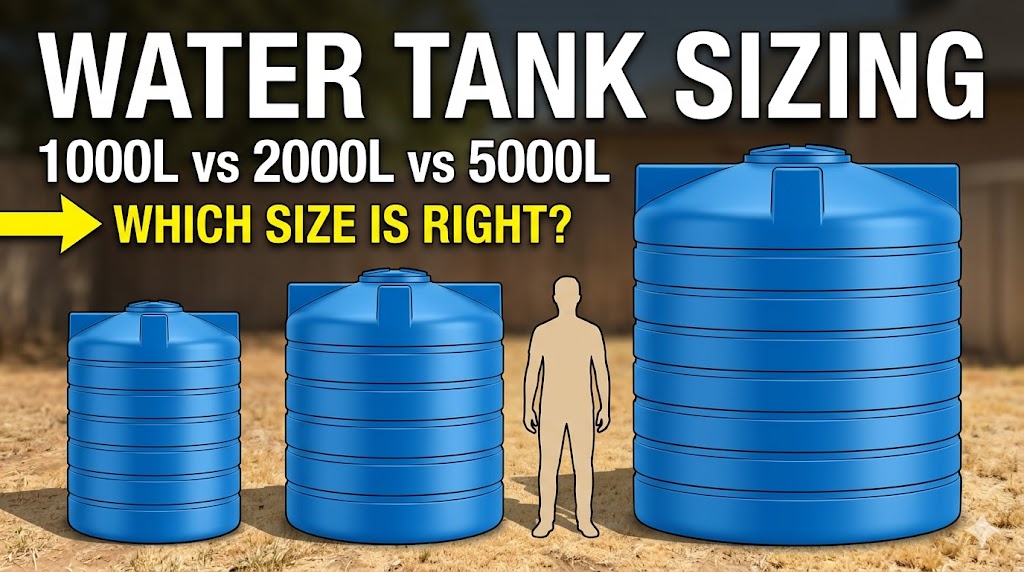
A 2,000-litre tank is the right starting point for a household of 3–4 people with a reasonably reliable municipal supply. A 1,000-litre tank only works for 1–2 people or as a secondary top-up tank. A 5,000-litre tank is correct when supply is intermittent, the household is large, or irrigation is involved. This article gives you the formula to confirm the right size for your actual usage, supply pattern, and site constraints.
The quick answer
Tank sizing comes down to three numbers: daily consumption, how many backup days you need, and what you can physically fit on the site. Use the Water Tank Size for Home Calculator to get a number tailored to your household size, climate, and supply reliability.
| Household / Use Case | Daily use (L) | Backup days | Recommended size |
| 1–2 people, city supply | 100–150 L | 7 days | 1,000 L |
| 3–4 people, city supply | 200–300 L | 7 days | 2,000 L |
| 3–4 people, intermittent supply | 200–300 L | 14 days | 5,000 L |
| 5–6 people, city supply | 300–450 L | 7 days | 3,000–5,000 L |
| 5–6 people, rural/borehole | 300–450 L | 21 days | 5,000–10,000 L |
| Small farm or livestock (<20 head) | 500–1,000 L | 7 days | 5,000 L |
Daily use figures are based on WHO guidelines (50–100 L/person/day for basic use, up to 150 L in high-income households). Backup days assume one supply interruption per week at the stated duration.
How the calculation works
The formula is straightforward: Tank size = Daily household consumption (L) × Backup days required.
Every variable matters. Here is a worked example:
Household: 4 people. Average daily use: 250 L (62.5 L/person, mid-range WHO figure for basic needs). Supply reliability: city mains, 10-day worst-case outage. Tank size = 250 × 10 = 2,500 L. Round up to 3,000 L for a safety margin, or 2,000 L if you are confident outages rarely exceed 7 days.
If you are adding irrigation or livestock, calculate those demands separately and add to the household figure before sizing. A vegetable garden of 50 m² uses 3–5 L/m²/day in hot climates — that adds 150–250 L/day to the calculation. Use the Daily Water Requirement Calculator to model combined household and garden demand.
Key variables that change the answer
Supply reliability. This is the single biggest variable. In cities with 24/7 mains pressure, a 7-day backup (the most common outage scenario in South Asian urban centres) drives the tank size. In rural areas or regions with scheduled outages — parts of sub-Saharan Africa, Pakistan, India — 14–21 day buffers are standard. Doubling the backup period doubles the required tank size.
Household size. Per-person water use does not scale linearly. A single person in a large house uses more water than a per-head average suggests — shared facilities change the maths. Per-capita use typically drops from 120–150 L/person for 1–2 person households to 80–100 L/person for households of 5+.
Climate and season. In arid climates, a household of 4 uses 20–30% more water during summer months due to increased showering, garden watering, and evaporative cooling. Size for peak-season demand, not annual average. A tank sized on annual averages will run dry for 3 months of every year.
Rooftop vs ground installation. A filled 5,000-litre tank weighs 5,025 kg. Most residential reinforced concrete roof slabs in South Asia are rated for 150–200 kg/m². A 5,000-litre tank requires a 25–33 m² load distribution or a purpose-built concrete plinth — it cannot sit on a typical residential roof. The 2,000-litre tank at 2,020 kg filled requires careful load distribution. The 1,000-litre tank at 1,015 kg filled is the only one that routinely clears standard residential roof loading without engineering input.
| Spec | 1,000 L | 2,000 L | 5,000 L |
| Typical footprint (HDPE) | 1.0 m dia. | 1.3–1.4 m dia. | 1.8–2.0 m dia. |
| Height (vertical HDPE) | 1.4 m | 1.7 m | 2.5 m |
| Filled weight | 1,015 kg | 2,020 kg | 5,025 kg |
| Typical rooftop fit? | Yes (most slabs) | Verify load | No — ground only |
| Price range (HDPE) | $50–$150 | $120–$280 | $280–$600 |
| Price range (steel) | $180–$350 | $300–$550 | $700–$1,400 |
Common mistakes
Sizing for average demand instead of peak demand. Average daily use across the year is not the number to use. A family of 4 that uses 250 L/day in winter can hit 380 L/day in summer when children are home, gardens need watering, and temperatures push daily showering up. Tank sized at 250 × 7 = 1,750 L will run out in 4–5 days at peak summer demand. Size for peak-season use or you will constantly supplement with deliveries.
Ignoring the refill rate. A tank only works if it refills before the next demand cycle. If your mains pressure delivers 200 L/hour and your household uses 300 L/day, your 2,000-litre tank refills in 10 hours — fine. If your supply is gravity-fed at 50 L/hour, refill takes 40 hours and you will drain the tank faster than it fills. Check refill time with the Tank Refill Time Calculator. If refill is slower than consumption rate, size up.
Buying the cheapest tank without checking wall thickness. 1,000-litre HDPE tanks range from 3.5 mm wall thickness (entry-level) to 8+ mm (heavy-duty). A thin-walled tank stored at ground level under direct sun in a hot climate will deform and develop stress cracks within 5 years. Wall thickness is not always advertised — ask the manufacturer for the specification sheet or check for a 10-year warranty as a minimum proxy.
Not accounting for dead volume. The outlet fitting on most tanks is positioned 5–15 cm above the base — this is dead volume you cannot use. On a 1,000-litre tank, 50–100 litres (5–10%) may be inaccessible without a pump. Factor this into your usable capacity calculation, especially for tanks near the bottom of your backup requirement.
Related calculators you might need
Once you know the tank size you need, the next check is whether your roof structure can support it. Run the Rooftop Load Bearing Calculator before ordering anything above 1,000 litres for an elevated position. If your situation is an apartment with limited space, the Apartment Water Tank Size Calculator accounts for the space and load constraints typical of multi-storey buildings. To verify your current tank is lasting as expected, use the How Long Will My Tank Last Calculator to model drawdown against your daily usage.
Frequently asked questions
Is a 1000-litre tank enough for a family of 4? Only if your mains supply is continuous and reliable. At 200–300 L/day for 4 people, a 1,000-litre tank provides 3–5 days of backup — not enough for extended outages. If your city experiences outages longer than 3 days, move to 2,000 L minimum. Use the Water Tank Size for Home Calculator with your specific outage data to confirm.
What is the standard water tank size for a house? There is no universal standard, but 2,000–3,000 litres is the most common residential tank size across South Asia, Australia, and sub-Saharan Africa for households of 3–5 people. This covers 7–14 days of typical household use and fits within standard residential roof load limits when properly distributed.
Can a 5000-litre tank go on a rooftop? Rarely. At 5,025 kg filled, a 5,000-litre tank exceeds the load capacity of most residential rooftops. It typically requires a purpose-built ground-level pad or a reinforced concrete structure. Even purpose-built elevated plinths need structural engineering signoff for this weight. A 5,000-litre tank is a ground-level or below-ground installation in most residential contexts.
How do I calculate the right tank size for my home? The basic formula is: daily household water use (litres) × maximum backup days required. If you use 250 L/day and need 10 days of backup, you need 2,500 L minimum. Add 20% margin for peak-season demand variation. If you have irrigation or livestock, add those daily volumes before multiplying by backup days.
Does a bigger tank mean better pressure? No. Water pressure from a gravity-fed tank depends on the height of the water surface above the outlet, not the tank volume. A 1,000-litre tank mounted 5 metres high gives the same pressure as a 5,000-litre tank at the same height. To calculate the pressure you will get from your tank elevation, use the Water Pressure Calculator.