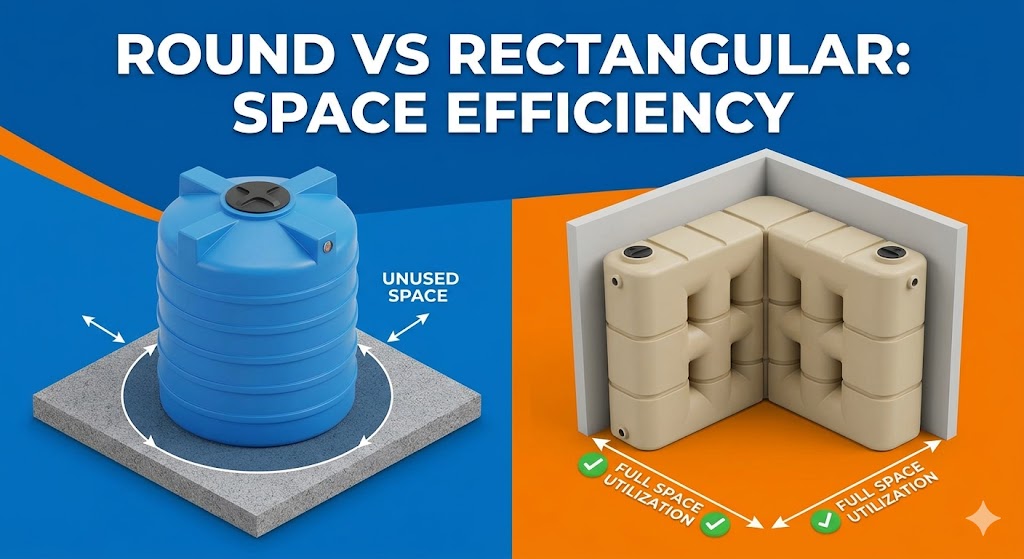
Shape affects more than aesthetics. Round (cylindrical) tanks distribute internal water pressure more evenly across their walls, requiring less material to achieve the same structural strength. Rectangular tanks make better use of corners and straight wall spaces, fitting into building footprints that cylinders waste. Choosing the wrong shape for your installation site costs you either usable floor space or money spent on over-engineered walls.
To see exactly how volume differs between a cylindrical and rectangular tank at your target dimensions, compare results from the cylindrical tank volume calculator and the rectangular tank volume calculator side by side before ordering.
The Physics of Shape: Why It Matters for Storage
Water pressure acts equally in all directions. A cylindrical wall converts that pressure into pure tension along its circumference — the most structurally efficient load path. A flat rectangular wall must resist bending in addition to tension, which requires thicker walls or internal bracing. This is why identical-volume cylindrical tanks typically weigh 15–25% less than rectangular equivalents: less material, same strength.
The trade-off is footprint geometry. A cylinder with a 1-metre diameter takes up 0.785 m² of floor space. A rectangular tank 1 m × 1 m uses exactly 1 m² but holds the same volume at the same height. The cylinder wastes the 0.215 m² of unused space in every corner of the notional square it occupies. In tight plant rooms or rooftops, that dead corner space adds up.
Space Efficiency: Round vs Rectangular by Scenario
| Scenario | Best Shape | Why |
| Rooftop with defined rectangular slab | Rectangular | Fills corners, maximises volume per m² |
| Open ground-level installation | Round (cylindrical) | Easier to position, lower cost per litre |
| Narrow utility corridor or room | Rectangular (slim profile) | Can be sized to fit exact wall-to-wall width |
| Underground cistern | Round (cylindrical) | Handles soil pressure load more uniformly |
| Multiple tanks in a row (manifolded) | Rectangular | Flat sides allow direct adjacency |
| High-volume farm storage (20,000 L+) | Round (cylindrical) | Available in large diameters, lower material cost |
| Indoor apartment / housing complex | Rectangular | Fits corner spaces, stackable in some designs |
Cost Comparison: Where Each Shape Wins
For tanks up to 5,000 litres, cylindrical polyethylene tanks are almost universally cheaper per litre than rectangular alternatives because they are blow-moulded in large quantities. Expect to pay 10–20% less for a cylindrical tank of the same volume from the same manufacturer. Rectangular tanks often command a premium due to added structural reinforcement.
Above 10,000 litres, the cost gap narrows. Custom-fabricated rectangular GRP (glass-reinforced plastic) or stainless steel tanks are quoted by volume and site requirements, not shape. At this scale, the choice becomes about installation constraints rather than unit price.
Cleaning and Maintenance Differences
Cylindrical tanks have no corners where sediment accumulates in hard-to-reach pockets. Cleaning requires a brush against a continuous curved wall. Rectangular tanks have eight interior corners, each of which collects silt and biofilm. A manual clean of a rectangular tank typically takes 30–50% longer than the same volume cylindrical tank, and pressure-washing is less effective in corners without physical scrubbing.
Rectangular tanks also have flat bases, which can bow under sustained water load if not properly supported across the entire base area. A cylindrical tank’s rounded base distributes load more evenly and is less prone to deformation over time.
Common Mistakes
Choosing rectangular to ‘maximise rooftop space’ without checking actual dimensions. A rectangular tank that fills a 2 m × 3 m rooftop alcove sounds efficient — until you realise the tank’s actual footprint is 1.8 m × 2.7 m to allow maintenance access, leaving unused strip space on all four sides anyway. Measure the usable installation zone, not the total slab.
Selecting round tanks for wall-adjacent installations. Cylindrical tanks leave a curved gap against any flat wall. Installing a 1,500-litre cylinder against a straight wall wastes the crescent-shaped void behind it — roughly 20% of the square footprint. Use a rectangular tank flush against walls.
Ignoring the structural difference for underground use. A rectangular underground tank must resist lateral soil pressure on flat walls. This requires concrete encasement or engineered GRP panels. Placing a standard rectangular polyethylene tank underground without proper support leads to wall collapse within months. Cylindrical tanks handle soil pressure structurally and are the standard for underground plastic installations.
Assuming the same capacity from the same external dimensions. A round tank inscribed in a 2 m × 2 m square has a diameter of 2 m and a base area of 3.14 m². A rectangular 2 m × 2 m tank has a base area of 4 m². At 2 m height, the rectangular tank holds 27% more water despite fitting in the same square footprint.
Related Calculators You Might Need
If you have a specific rooftop or room dimension, use the rooftop tank size calculator to determine the maximum volume that fits your available space regardless of shape. Once you have your target volume, the water tank weight calculator tells you the structural load a full tank imposes. For non-standard shapes like tapered or oval-profile tanks, the oval/elliptical tank volume calculator handles the geometry. If you are converting between metric and imperial specs when comparing imported tanks, the litres to gallons converter saves time.
Frequently Asked Questions
Which is better, round or square water tank? Cylindrical (round) tanks are structurally stronger per kilogram of material and cheaper per litre in most residential sizes. Rectangular (square) tanks make more efficient use of wall-adjacent or corner spaces. If you are installing on open ground or underground, choose cylindrical. If you are fitting into a defined rectangular footprint, choose rectangular.
Do round water tanks hold more water than rectangular ones of the same size? Not if ‘same size’ means the same external footprint. A cylindrical tank inscribed in a square footprint holds less volume than a rectangular tank that fills that footprint — because the cylinder’s curved sides leave unused corner space. However, cylindrical tanks are stronger for the same wall thickness, so the comparison is really volume vs structural efficiency.
Why are most large water storage tanks cylindrical? Cylinders distribute internal pressure as tension along the wall circumference, which is the most material-efficient structural response. For very large volumes — 20,000 litres and above — the material savings of a cylindrical shell over a rectangular box are substantial enough to dominate the cost calculation. Most industrial and agricultural tanks above 10,000 litres are cylindrical for this reason.
Can I install a round tank in a corner? You can, but it wastes space. The corner area behind a cylindrical tank is typically inaccessible dead space. If your installation site has one or more flat walls you want to use efficiently, a rectangular slim-profile tank will fit significantly better. Use the rectangular tank volume calculator to find the maximum volume for your exact corner dimensions.
Are rectangular water tanks more expensive than round? At equivalent volumes under 5,000 litres, rectangular polyethylene tanks typically cost 10–20% more than cylindrical tanks due to added structural reinforcement. At larger custom-fabricated sizes, pricing depends on material and site requirements rather than shape.

Most people buy a water tank once. We’ve spent thousands of hours thinking about nothing else.
Every calculator on this platform was built from scratch — from the physics up. Every guide is researched against the actual building codes, rainfall records, utility tariffs, and supply conditions of the country it covers. Not summarized from another blog. Not generic. The Australia guide uses BOM climate data. The UK guide references CIRIA C539. The Jordan guide accounts for Amman’s 12-48 hour rotational supply schedule specifically.
Water storage is one of those topics where bad information has real consequences — undersized tanks in drought zones, wrong materials in extreme heat, installations that fail structural load. We take that seriously.
This is the resource we wanted when we started asking these questions. We built it because it didn’t exist.